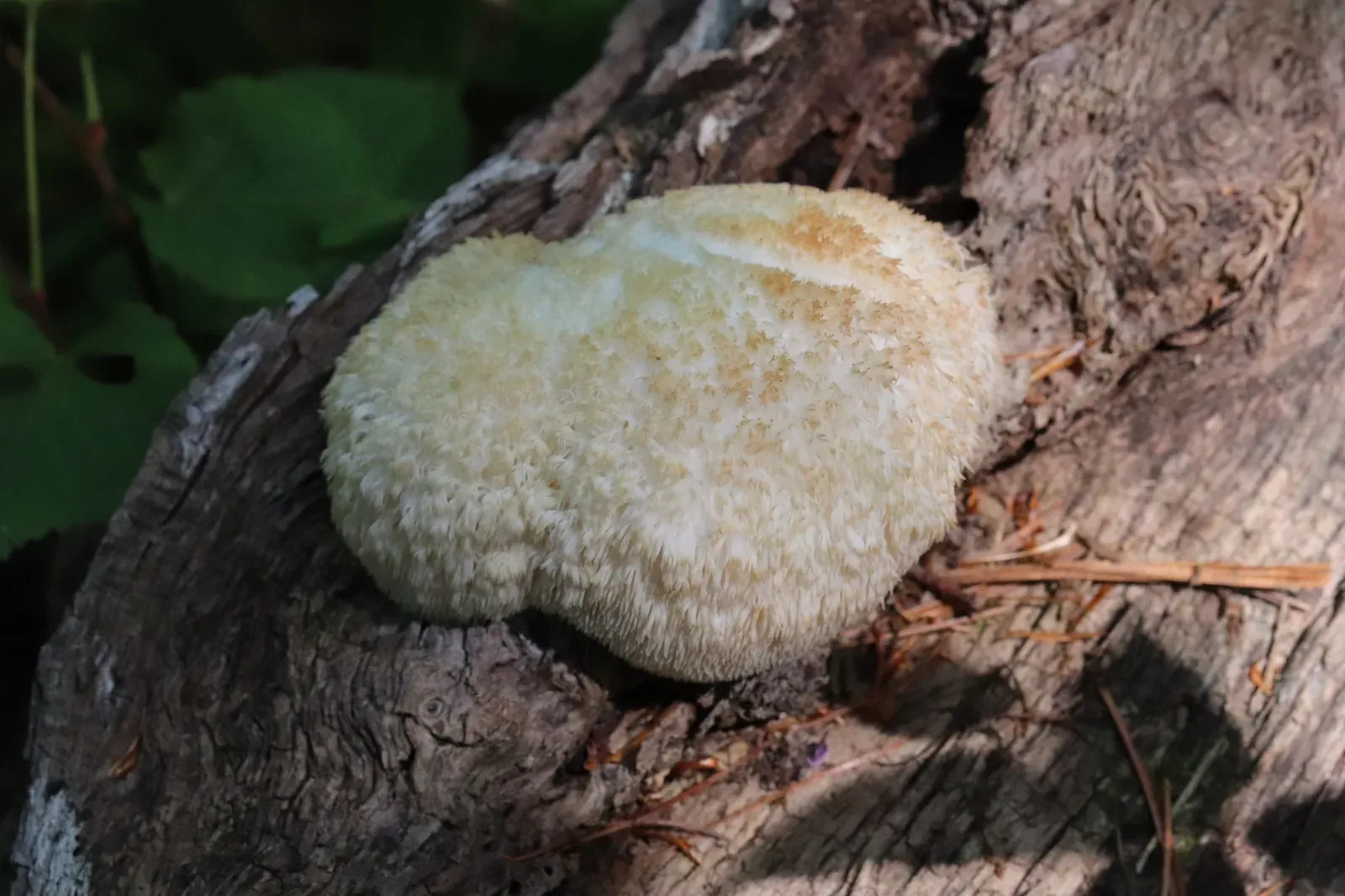
Lion's mane is hard to confuse with anything: it looks like a fluffy white beard or a frozen waterfall hanging from a trunk. Instead of the usual gills or pores, it has long, soft spines. This rare and beautiful mushroom draws more and more foragers' interest, and finding one in the forest is real luck.
Let's look at what lion's mane looks like, where it grows and how to recognize it with confidence.
What lion's mane looks like
- Shape — a rounded or cushion-shaped white body 5–20 cm across, solid, with no stem, attached to the tree.
- Spines — numerous soft, hanging “icicle” spines 1–4 cm long instead of gills; they're what gave it the names “hedgehog mushroom” and “lion's mane.”
- Color — white, turning yellowish or brownish with age.
- Flesh — white, soft, with a pleasant smell.
These features are so distinctive that it's practically impossible to mistake lion's mane for anything else.
Where and when it grows
Lion's mane is a wood-decaying mushroom. It settles on trunks and stumps of broadleaf trees, most often oak and beech, in old, damp forests. It grows singly, appearing on the same tree several years in a row.
The season runs from August to October. In Ukraine the mushroom is uncommon and in some areas is on protected lists, so treasure a find and don't destroy the mycelium.
Is it edible
Lion's mane is edible and tasty: the young white flesh has a delicate texture. Only young, pale specimens are cooked — old, yellowed ones turn tough and bitterish. Since the mushroom is rare, it's picked sparingly, and often simply photographed.
What to keep in mind
- Only white and young. Old, yellowed mushrooms turn bitter.
- Don't destroy the mycelium. The mushroom is rare — cut it carefully without tearing off the bark.
- Easy to recognize. White hanging spines on a tree are a unique feature; there are no look-alikes.
Sources
- “Identification Guide to the Fungi of Ukraine” (Kyiv, Naukova Dumka publishing house).
- Hericium erinaceus in GBIF, the global biodiversity database.
- Hericium erinaceus in MycoBank, the international fungal nomenclature database.
- Hericium erinaceus on Wikipedia.
Frequently asked questions
What does lion's mane look like?
Like a white, cushion-shaped body on a trunk, covered in numerous soft, hanging “icicle” spines instead of gills. It looks like a white beard or a waterfall.
Why is it called lion's mane?
Because of its hanging white spines, which look like a mane. Its Ukrainian name says “hedgehog” for the spines and “comb-like” for how they're arranged.
Where does lion's mane grow?
On trunks and stumps of broadleaf trees, most often oak and beech, in old, damp forests. It appears on the same tree several years in a row.
When does lion's mane appear?
From August to October. In Ukraine it's uncommon, so a find is considered a stroke of luck.
Is lion's mane edible?
Yes, the young white flesh is edible and tasty. Old, yellowed mushrooms turn tough and bitterish, so only young ones are picked.
Can you confuse lion's mane with another mushroom?
Practically not: white hanging spines on a tree are a unique feature, and it has no dangerous look-alikes.
Is this mushroom rare?
Yes, in Ukraine it's uncommon and protected in some areas. So pick it sparingly and don't damage the mycelium.
How do you protect the lion's mane mycelium?
Cut the mushroom carefully without tearing off bark and wood, and don't take every fruiting body — then the mushroom will appear on the tree next year too.
Related articles
 How to identify
Truffles in Ukraine: do they grow here, and where to look
Truffles aren't just a French delicacy. Several species grow in Ukraine too. Here's which ones, where they occ…
August 24, 2026·2 min Recipes & cooking
How to store fresh mushrooms, and for how long
Fresh mushrooms spoil faster than you might think. Here's how long they keep in the fridge, how to store them…
August 21, 2026·4 min Recipes & cooking
How long to boil mushrooms
Boiling time depends on the type of mushroom and on what you're cooking next. Here's a clear cheat sheet: how…
August 22, 2026·4 min