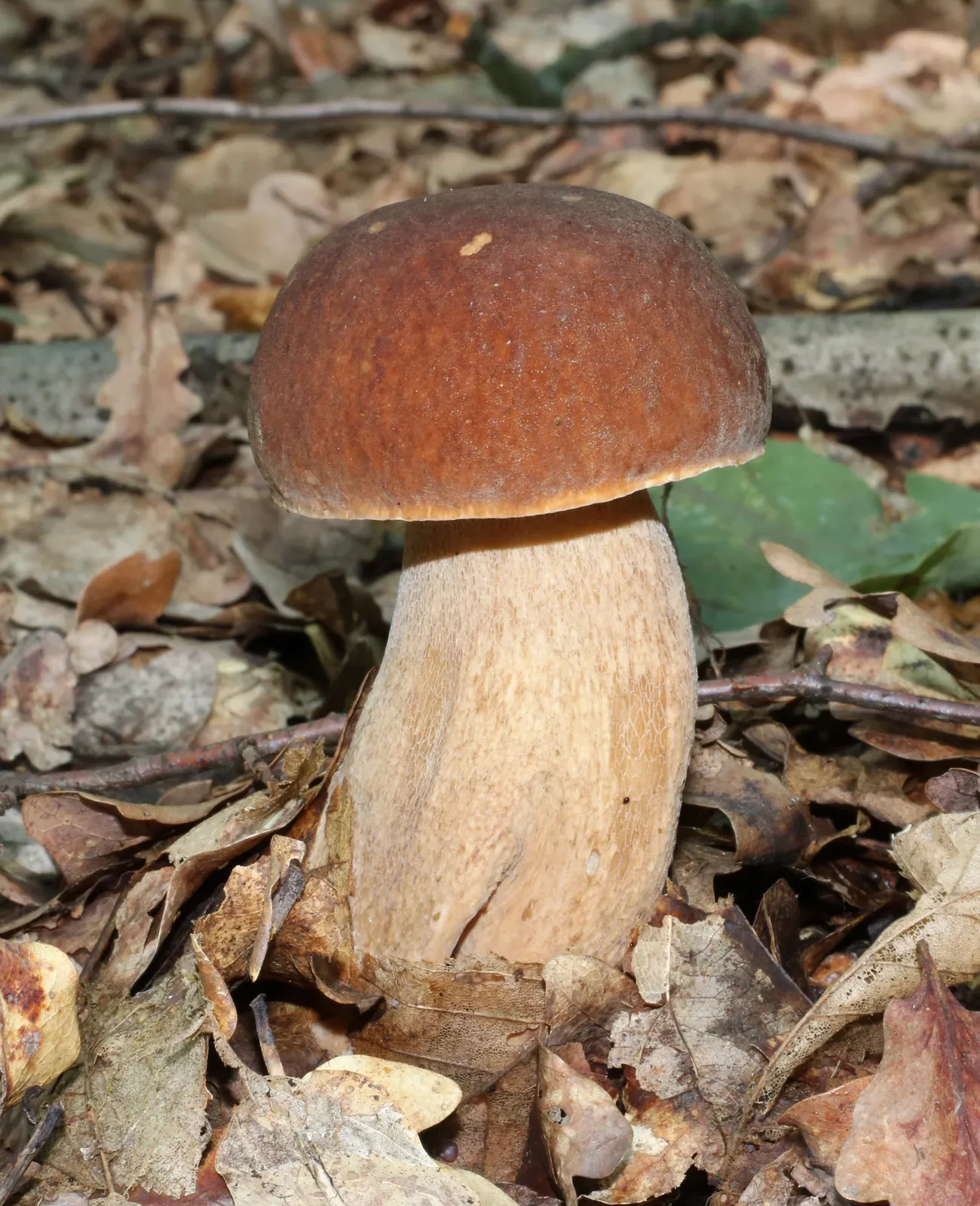
While most foragers are waiting for August, anyone who knows the summer bolete (Boletus reticulatus, in our catalog the summer bolete) is already carrying home full baskets. This bolete opens the season while the other boletes are still gathering strength under the leaf litter.
It's this early appearance that made it a favorite for so many. But “early” doesn't mean “by the calendar”: the exact date drifts every year and depends on the weather. Let's look at what to watch so you don't miss the first flush.
When the first mushrooms appear
The first specimens turn up as early as late May, as soon as the soil has warmed up steadily. In warm years single boletes have been seen even in mid-May; in cool years the start shifts to early June.
The rule of thumb is simple: when daytime temperatures hold at around twenty degrees and the nights are no longer cold, the ground warms up and the mycelium wakes. The calendar matters less here; what counts is soil temperature.
The main flush
Those scattered May mushrooms are just scouts. The real flush comes in June and July, when the warmth is steady and there's enough moisture after the rains.
This is when the bolete fruits most abundantly. With a mild autumn that isn't too dry, the species carries on right into September, so overall the season is a long one, from late spring to the first chilly nights.
Here's a quick timeline:
- late May the first scattered mushrooms in warm years;
- June and July the main, most generous flush;
- August and September a second flush in damp, mild weather.
What decides the start
The start date isn't random; three things set it: warmth, moisture and the type of forest.
First, warmth. While the soil is cold, the mycelium sleeps. Steady daytime warmth and warm nights are the main trigger.
Second, moisture. The bolete likes to come up two or three days after a good warm rain, once the ground has soaked up water and warmed again. A dry May can push the season back by weeks.
Third, region and forest. On warm south-facing forest edges and sun-warmed slopes the mushroom appears earlier than in shady, damp woodland. In open deciduous forests the start usually comes earlier than in mixed ones.
So you're not guessing blindly, keep an eye on conditions with our mushroom radar: it shows when moisture and warmth line up well for boletes to appear. It's more accurate than any calendar.
How not to miss the first flush
The first mushrooms are the most precious: firm, clean and not yet touched by maggots. To get there in time, you need to stay one step ahead.
Watch the weather from mid-May. Once you see a warm rain after a few fine days, plan your outing for two or three days later. Don't wait until “everyone has gone”, because the best young boletes get picked fast.
Go to familiar spots. The bolete is loyal to its trees and comes back to the same places every year, so last year's spots under oak or beech are the most reliable start. And don't rush off after one mushroom: there are often a few more from the same family standing nearby.
A word about autumn. In autumn the summer bolete is joined by its relative, the pine bolete, which grows under conifers. But that's another story and other places; the difference between them deserves a separate conversation.
Sources
- “Identification Guide to the Fungi of Ukraine” (Kyiv, Naukova Dumka publishing house).
- Boletus reticulatus on GBIF, the global biodiversity database.
- Boletus reticulatus on MycoBank, the international fungal nomenclature database.
- Boletus reticulatus on Wikipedia.
Frequently asked questions
When does the summer bolete season begin?
Usually in late May or early June, as soon as the soil has warmed up steadily. In warm years the first mushrooms turn up earlier; in cool years the start shifts to early summer.
Which month is best for picking boletes?
June and July are usually the most generous, when the warmth is steady and there's enough moisture. With a mild autumn a second flush lasts into September.
Why are there plenty of mushrooms one year and almost none the next?
It all comes down to warmth and moisture. A dry May or cold nights delay the season and make it poorer, while warmth with regular rain gives a rich harvest. The calendar matters less here.
How many days after rain should you wait for boletes?
Usually two or three days after a good warm rain, once the ground has soaked up water and warmed again. An easy way to track these windows is our .
Can you find a porcini in May?
Yes, in warm years single boletes appear as early as the second half of May. But these are more like scouts; the main flush arrives in June.
Until what month can you pick the summer bolete?
With a mild autumn that isn't too dry, the species fruits until September. The first chilly nights gradually bring the season to an end.
Where do the first mushrooms appear earlier?
On warm south-facing forest edges, sun-warmed slopes and in open . In shady, damp woodland and mixed forests the start usually comes later.
How do you plan your first outing of the season?
Watch the weather from mid-May. After a warm rain that follows a spell of fine days, plan your outing two or three days later to familiar spots under oak or beech where the mushroom grew last year.
Mushrooms in this article
Related articles
 Recipes & cooking
How to store fresh mushrooms, and for how long
Fresh mushrooms spoil faster than you might think. Here's how long they keep in the fridge, how to store them…
August 21, 2026·4 min How to identify
Truffles in Ukraine: do they grow here, and where to look
Truffles aren't just a French delicacy. Several species grow in Ukraine too. Here's which ones, where they occ…
August 24, 2026·2 min Safety
False morel: why this spring mushroom is dangerous
The false morel looks like a morel, but it contains a poison. Here's how to recognize it, why it's dangerous a…
August 24, 2026·2 min