Most slippery jacks are easy to recognize by their slimy cap, which peels so conveniently. But there's an exception among them: the velvet bolete (Suillus variegatus, listed in our catalog as velvet bolete). Its cap is almost dry and granular, and the skin barely peels at all.
Because of this, beginners sometimes wonder whether it's a slippery jack at all. On top of that, it blues slightly when cut, which is confusing too. Let's go through both traits so you can recognize it with confidence.
A slippery jack that doesn't look like one
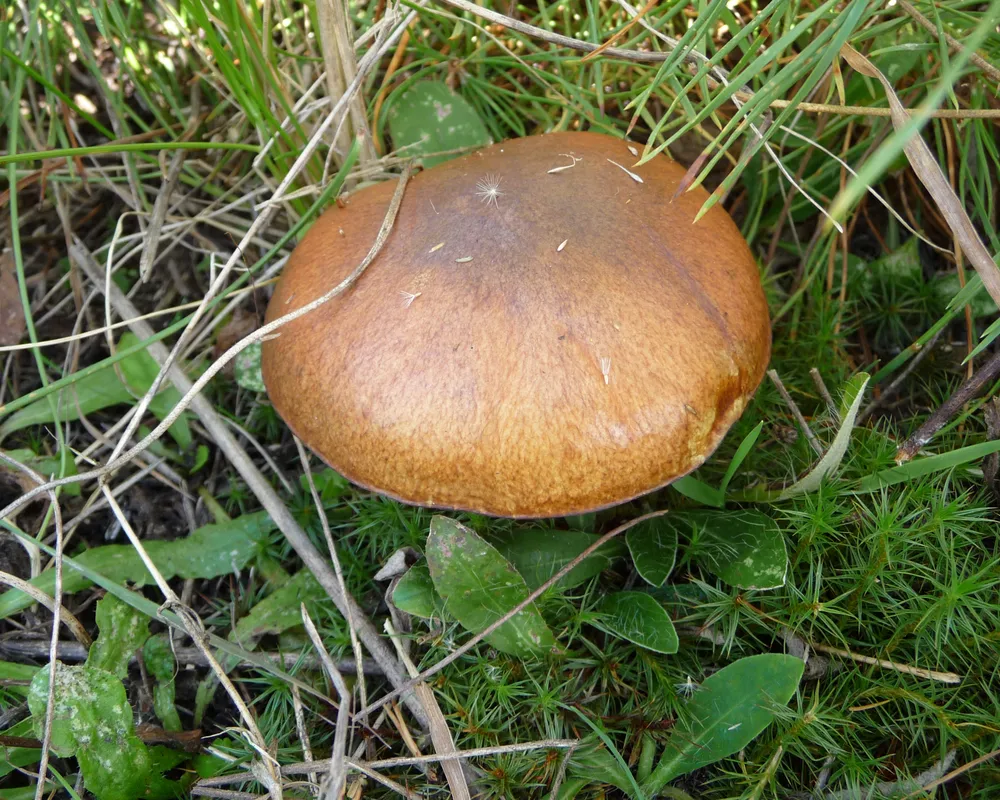
The velvet bolete breaks the usual expectations. Instead of a glossy, slimy cap, it has a dry, finely granular surface that looks dusted with sand, in ocher-yellow or brownish-olive tones. Slime appears only in very wet weather, and even then it's barely noticeable.
That's why the skin hardly comes off the cap at all, unlike the slippery jack. In the kitchen this is actually handy: the mushroom is easier to clean, you just wipe and rinse it.
Like all slippery jacks, it lives in partnership with pine. This bond is called mycorrhiza: the mycelium wraps around the tree's rootlets and trades nutrients with it.
Why it blues when cut
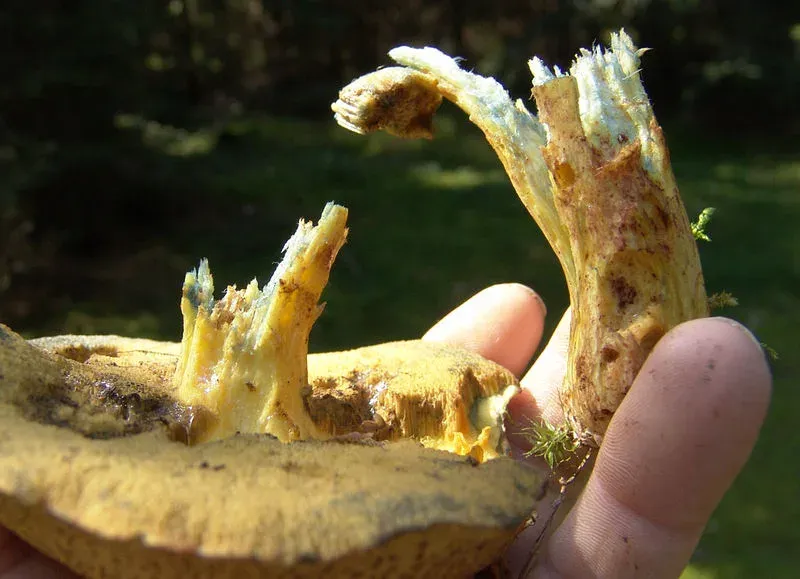
The second quirk of the velvet bolete is a slight bluing of the flesh where it's cut or broken. This alarms people who are used to boletes and slippery jacks not changing color when cut.
You can relax here: for this species, faint bluing is a normal, harmless reaction. It doesn't mean the mushroom is poisonous. The velvet bolete is edible, although its flavor falls a little short of the classic slippery jacks, so it's often picked for preserving rather than as the main prize.
Still, if you're not sure of your identification, bluing is a reason to double-check every feature before you put the mushroom in your basket.
How to recognize the velvet bolete
It's identified by a combination of features, not just one. Look the mushroom over from top to bottom.
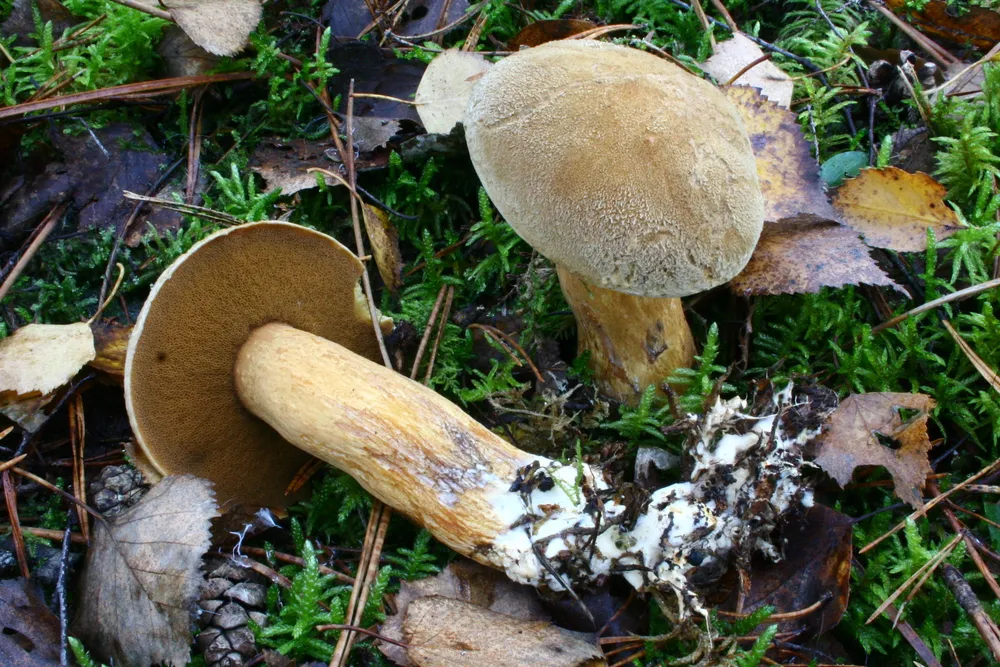
- Cap. Dry, finely granular, ocher-yellow or brownish-olive. Slimy only in very wet weather. The skin barely peels.
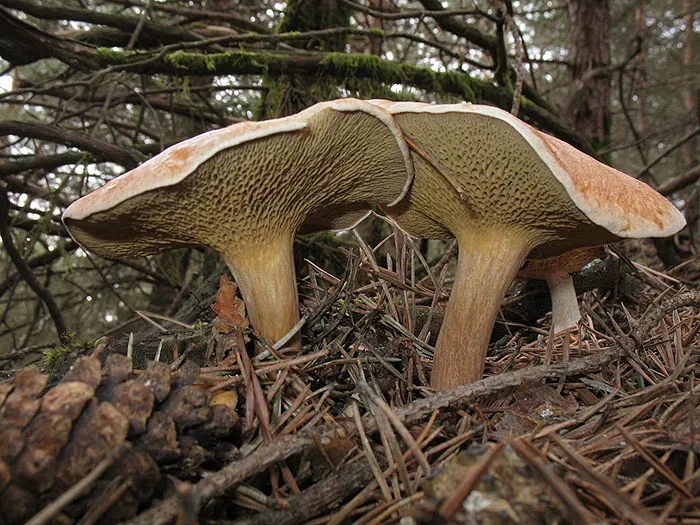
- Pores. The tube layer underneath: olive-brown, with small pores.
- Stem. Firm, yellowish-brown, with no ring.
- Flesh. Yellowish, blues slightly when cut, especially above the tubes.
The main clue: a dry, granular cap plus slight bluing of the cut. That's what sets it apart from its relatives.
How it differs from other slippery jacks
- Compared with the slippery jack, it has a dry cap, no ring, and skin that doesn't peel.
- Compared with the bovine bolete, it has finer pores and blues when cut.
Essentially, it's a dryish, slightly “atypical” slippery jack for those who pick for preserving.
Where and when to look for it
The best spots are:
- pine woods on sandy and dampish soils;
- sunny edges of conifer forest with moss and bilberry;
- patches of mixed forest where pine grows alongside birch.
The season runs from July to October, in flushes after warm rains. The best time to go is a day or two after rain. You can keep track of these windows with our mushroom radar: it shows when moisture and warmth line up well for mushrooms to appear.
A little caution never hurts
The velvet bolete is safe, but its dryish cap and bluing make it easier to mix up with other mushrooms in your head. So check every feature: a spongy underside, no gills, and a pine nearby. And as always: if you're not sure, don't pick it.
Sources
- “Identification Guide to the Fungi of Ukraine” (Kyiv, Naukova Dumka publishing house).
- Suillus variegatus on GBIF, a global biodiversity database.
- Suillus variegatus on MycoBank, an international fungal nomenclature database.
- Suillus variegatus on Wikipedia.
Frequently asked questions
What is the velvet bolete?
It's an edible slippery jack (*Suillus variegatus*) with a dry, granular cap that grows under pines. Unlike typical slippery jacks, its skin barely peels, and the flesh blues slightly when cut.
What does the velvet bolete look like?
A dry, finely granular, ocher-yellow or brownish-olive cap, an olive-brown spongy underside, and a firm stem with no ring. The flesh is yellowish and blues slightly when cut.
Why won't the velvet bolete's skin peel?
Because its cap is almost dry and granular rather than slimy like the classic slippery jacks. Slime appears only in very wet weather, so the skin is hard to remove. That actually makes cleaning easier.
Why does the velvet bolete blue when cut?
For this species, it's a normal, harmless reaction of the flesh to air. Slight bluing doesn't mean the mushroom is poisonous. But if you're not sure of your identification, double-check every feature.
Is the velvet bolete edible?
Yes, it's edible, although its flavor falls a little short of the classic slippery jacks. It's often picked for preserving, pickling and drying.
How does the velvet bolete differ from the slippery jack?
By its dry, granular cap, the lack of a ring on the stem, skin that doesn't peel, and slight bluing of the cut. The has a slimy cap and a ring, and its cut flesh doesn't change color.
Where does the velvet bolete grow?
In pine and on sandy and dampish soils, among moss and bilberry, on sunny forest edges.
When should you pick the velvet bolete?
The season runs from July to October, in flushes after warm rains. The best time to go is a day or two after rain, guided by the .
Mushrooms in this article
Related articles
 Recipes & cooking
How to store fresh mushrooms, and for how long
Fresh mushrooms spoil faster than you might think. Here's how long they keep in the fridge, how to store them…
August 21, 2026·4 min How to identify
Truffles in Ukraine: do they grow here, and where to look
Truffles aren't just a French delicacy. Several species grow in Ukraine too. Here's which ones, where they occ…
August 24, 2026·2 min Recipes & cooking
How long to boil mushrooms
Boiling time depends on the type of mushroom and on what you're cooking next. Here's a clear cheat sheet: how…
August 22, 2026·4 min