.webp)
The red-capped scaber stalk is hard to miss: among the greenery and fallen leaves, its rusty or orange cap glows like a little lantern. It's one of the most prized boletes — firm, meaty, and good for frying, drying and pickling alike.
Let's look at when the red-capped scaber stalk grows in Ukraine, which trees to look under, and how to recognize it without a doubt.
When the red-capped scaber stalk grows
Its season is long: the first mushrooms appear as early as June, and the real peak comes in August–September, when boletes come up together after warm rains. The season lasts until October, until the first hard frosts.
Like all boletes, the red-capped scaber stalk loves moisture after rain combined with warm soil. At the end of summer, when the nights get cooler and fog adds moisture, it grows especially abundantly. Use the mushroom radar to head into the woods at the right moment.
Where to look for the red-capped scaber stalk
Despite its Ukrainian name (“under-the-aspen”), it doesn't grow only under aspens.
- Aspen and poplar woods. The classic spot is young aspen stands, where the mushroom forms mycorrhiza with aspen.
- Birch and mixed forests. The orange birch bolete sticks to birches, so deciduous and mixed forests are promising too.
- Forest edges, clearings, path sides. Warm, damp spots with young tree growth.
Red-capped scaber stalks often grow singly or in small groups. Once you find one, look closely nearby — its neighbors may be hiding under the leaves close by.
How to recognize the red-capped scaber stalk
The mushroom has recognizable features.
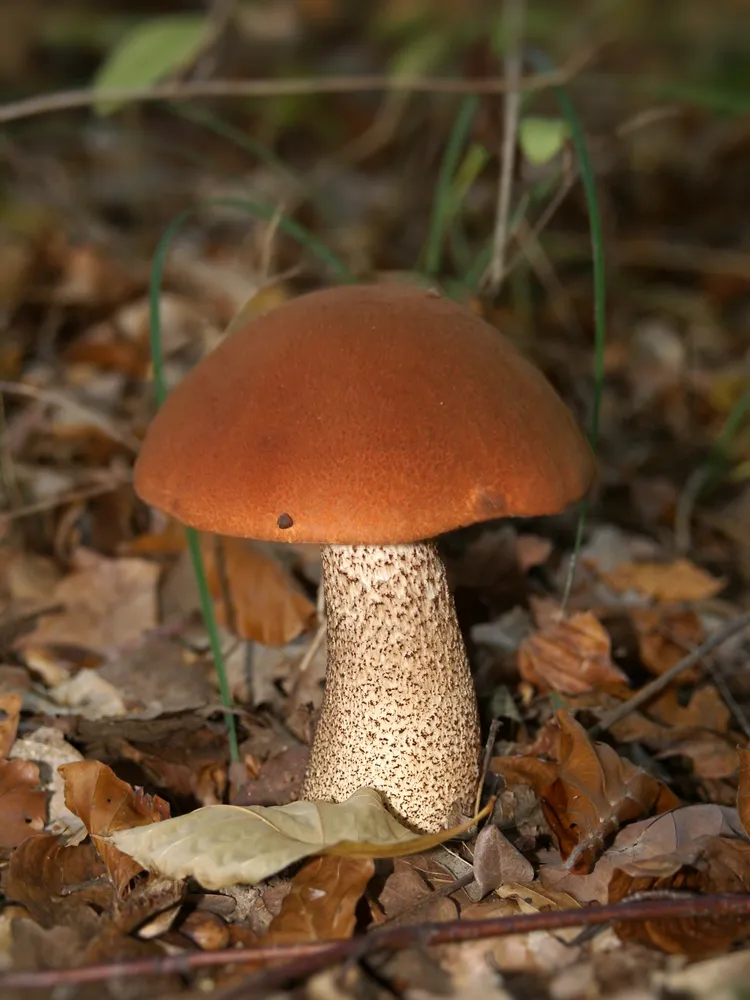
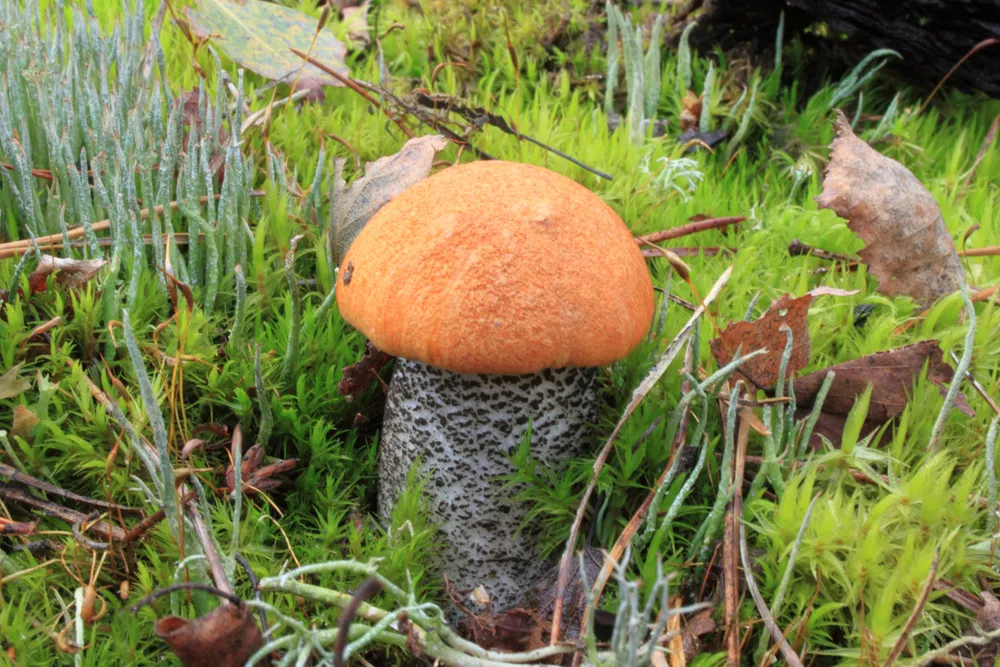
- Cap bright rusty, orange or reddish-brown, hemispherical in young mushrooms, firm and velvety.
- Stem tall, whitish, covered in small dark scales — a hallmark of the red-capped boletes.
- Flesh turns blue when cut, then darkens almost to black. This is a normal reaction, not a sign of toxicity.
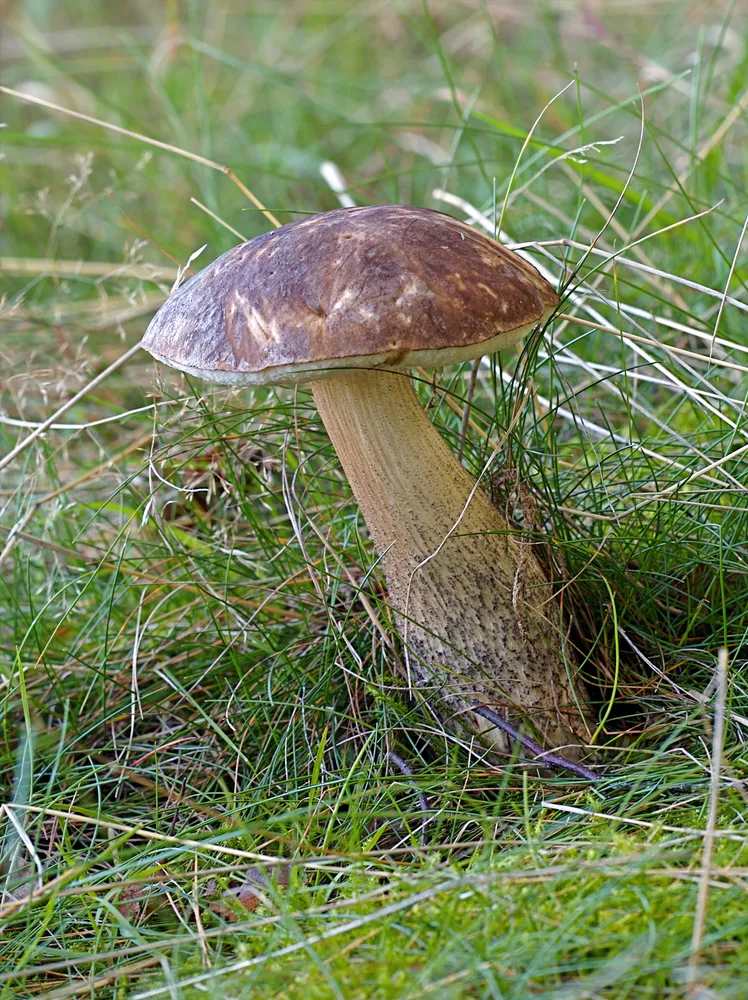
The red-capped scaber stalk is a good edible mushroom with no dangerous deadly lookalikes, but the darkening flesh puts many people off. We've written separately about how to recognize the red-capped scaber stalk. Growing alongside it you'll often find the brown birch bolete — a close relative with a similar stem.
What to keep in mind
- Don't be alarmed by the blue color when cut. For this mushroom, it's the flesh's usual reaction to air.
- Take young, firm mushrooms. Old ones turn soft and watery and quickly get wormy.
- Process them right away. Because the flesh darkens, these mushrooms are best cleaned and cooked fresh, without delay.
Sources
- “Key to the Fungi of Ukraine” (Kyiv, Naukova Dumka publishing house).
- Leccinum aurantiacum in GBIF, the Global Biodiversity Information Facility.
- Leccinum in MycoBank, the international fungal nomenclature database.
- Leccinum on Wikipedia.
Frequently asked questions
When does the red-capped scaber stalk grow?
The first ones appear in June, the peak comes in August–September, and the season lasts until October, when hard frosts set in.
Which trees should you look under for the red-capped scaber stalk?
First of all under aspens and poplars, while the orange birch bolete grows under birches. So aspen stands, birch woods and mixed forests are all promising.
Why is it called krasnoholovets?
Because of its bright rusty or orange cap, which you can see from afar. Krasnoholovets (“redhead”) is a Ukrainian folk name that points straight to the cap color.
Why does the red-capped scaber stalk's flesh turn blue when cut?
It's the flesh's normal reaction to air: first it turns blue, then darkens almost to black. It is not a sign of toxicity.
How to tell the red-capped scaber stalk from the brown birch bolete?
The red-capped scaber stalk has a bright rusty cap and a stockier stem; the brown birch bolete has a brown cap and is slimmer overall. Both have a scaly stem and belong to the genus Leccinum.
Is the red-capped scaber stalk edible?
Yes, it's a prized edible bolete — tasty fried, dried and pickled. It has no dangerous deadly lookalikes.
Where is the best place to look for red-capped scaber stalks?
In young aspen stands, birch woods and on damp forest edges, especially after warm rains in late summer and autumn.
How to preserve red-capped scaber stalks?
Because the flesh darkens, they're best cleaned and cooked fresh. They dry and pickle well if you take young, firm mushrooms.
Mushrooms in this article
Related articles
 Recipes & cooking
How to store fresh mushrooms, and for how long
Fresh mushrooms spoil faster than you might think. Here's how long they keep in the fridge, how to store them…
August 21, 2026·4 min How to identify
Truffles in Ukraine: do they grow here, and where to look
Truffles aren't just a French delicacy. Several species grow in Ukraine too. Here's which ones, where they occ…
August 24, 2026·2 min Recipes & cooking
How long to boil mushrooms
Boiling time depends on the type of mushroom and on what you're cooking next. Here's a clear cheat sheet: how…
August 22, 2026·4 min