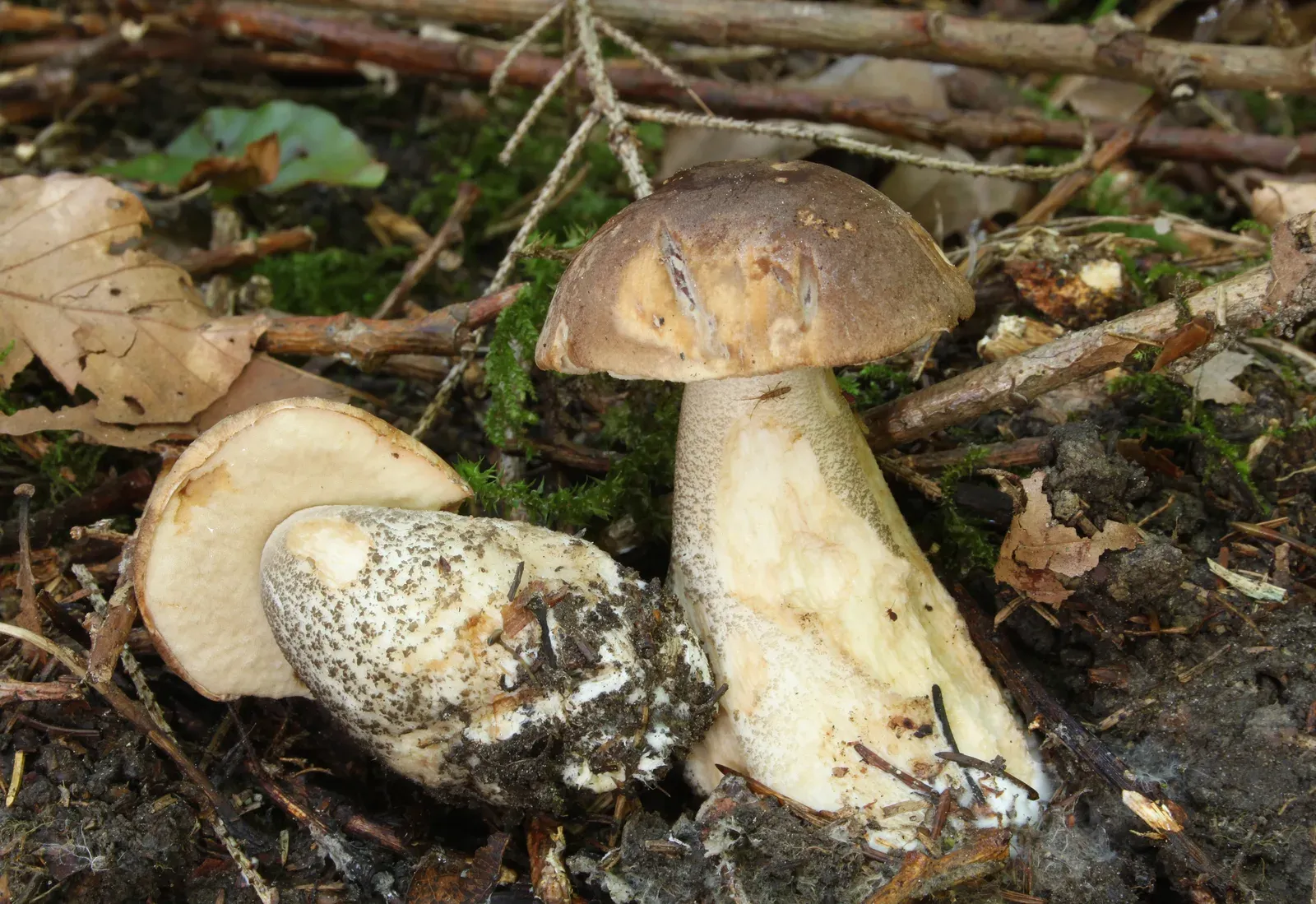
The brown birch bolete (Leccinum scabrum) and porcini share a family connection: both are pored mushrooms and even belong to the same mushroom “clan.” That's why beginners often confuse them, especially when they see a young birch bolete with pale pores.
In fact, they're easy to tell apart once you know a few features. Let's go through them one by one so you'll never doubt whether you're looking at a brown birch bolete or porcini. For a detailed species comparison, see the page brown birch bolete vs porcini.
The stem, the main difference
The quickest way to tell these mushrooms apart is to look at the stem.
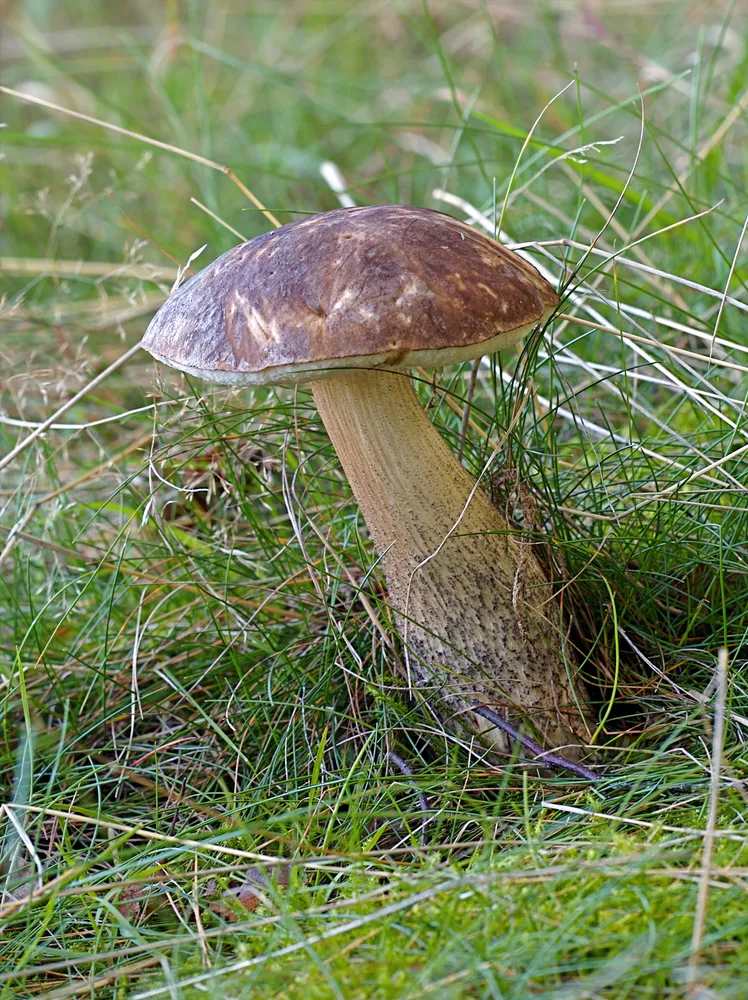
- The brown birch bolete has a long, slender, white stem covered in small dark scales, like pencil strokes.
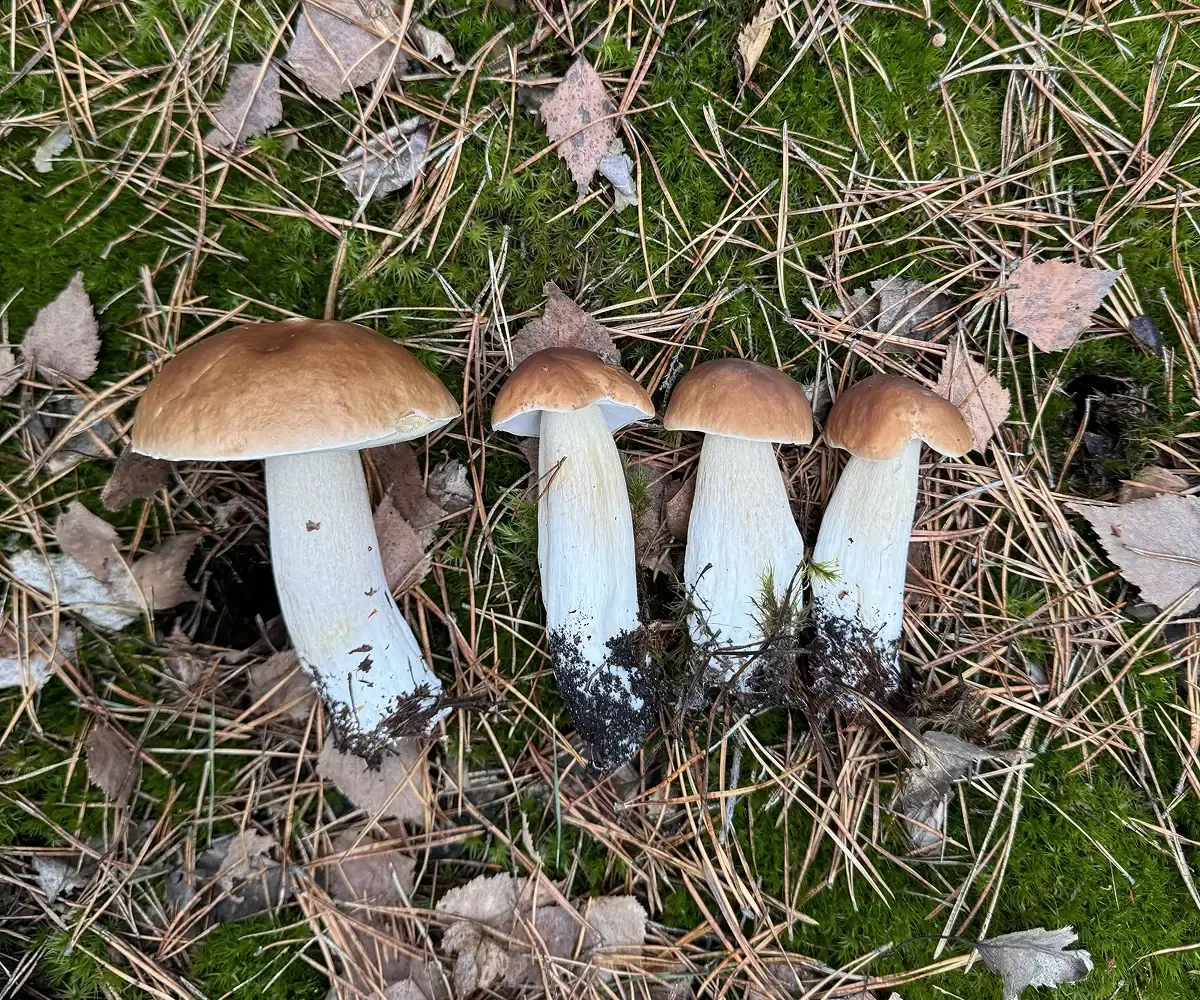
- The porcini has a thick, barrel-shaped, pale stem with a delicate pale network on its upper part.
Dark scales versus a pale network is the most reliable difference. If the stem has dark streaks, you're looking at a brown birch bolete. If it's thick, barrel-shaped, and has a white network, it's porcini.
Cap and build
The mushrooms' silhouettes differ too, if you look closely.
The brown birch bolete is slender and tall, as if perched on a thin stem. Its cap is proportionally small and gray-brown, and the mushroom itself looks light and elongated.
Porcini is stocky and squat. The stem is thick, the cap massive, from light brown to dark brown, and the whole mushroom looks sturdy and heavy. Next to it, the brown birch bolete is like a ballerina next to a wrestler.
Flesh and cut
If you cut both mushrooms, the difference becomes even more obvious.
- The porcini has white, firm, springy flesh that, when cut, does not change color. That's exactly why it's valued so highly.
- The brown birch bolete has softer flesh that, when cut, often turns slightly gray, and it noticeably darkens during cooking.
It's this unchanging white flesh that gave porcini its Ukrainian name, “white mushroom.” The brown birch bolete gives itself away by darkening, so dishes made with it turn out darker.
Where and when they grow
Both mushrooms occur in similar forests but have different preferences.
The brown birch bolete is loyal to birch and grows mainly in deciduous and mixed birch woods. Porcini is less picky: it lives under oak, pine, beech, and spruce, in deciduous, mixed, and coniferous forests.
Their seasons are almost the same, from summer to autumn. So you can often find a brown birch bolete and porcini side by side in the same birch wood. For when exactly to head out, check our mushroom radar: it shows when moisture and warmth line up well for mushrooms to appear.
Which one tastes better
Porcini is considered the king of the forest: it's firm, aromatic, doesn't darken, and is equally good fried, dried, and pickled. The brown birch bolete is more modest: it's tasty when young, but softer, more watery, and it darkens during cooking.
Still, both mushrooms are wonderful, and finding a brown birch bolete is nothing to be disappointed about. The main thing is not to confuse either of them with the bitter-tasting bitter bolete, which mimics both but stands out with its pinkish pore surface and unbearable bitterness.
Sources
- “Identification Guide to the Fungi of Ukraine” (Kyiv, Naukova Dumka publishing house).
- Leccinum scabrum on GBIF, a global biodiversity database.
- Boletus edulis on MycoBank, the international fungal nomenclature database.
- Leccinum scabrum on Wikipedia.
Frequently asked questions
How does the brown birch bolete differ from porcini?
Above all, by the stem: the 's is slender with dark scales, while the 's is thick, barrel-shaped, with a pale network. The brown birch bolete is also slimmer and darkens when cut, while porcini is firm and doesn't change color.
How do you tell a birch bolete from porcini by the stem?
The birch bolete's stem is covered in small dark scales, like pencil strokes. Porcini's stem is thick and has a delicate pale network on its upper part. That's the most reliable feature.
Are porcini and the brown birch bolete related?
Yes, both are pored mushrooms from related genera. But is a true bolete (Boletus), while the is a scaber stalk (Leccinum), so they're different mushrooms.
Why does the brown birch bolete's flesh darken but porcini's doesn't?
It's a trait of each species. The flesh of stays white when cut, while the turns slightly gray and noticeably darkens during cooking. This doesn't affect safety.
Which tastes better, the brown birch bolete or porcini?
Porcini is valued more highly: it's firm, aromatic, and doesn't darken. The brown birch bolete is tasty but softer and more watery. Still, a young brown birch bolete is wonderful fried or in soup.
Can you confuse a brown birch bolete with porcini in the forest?
Beginners sometimes confuse a young brown birch bolete with pale pores with porcini. But just look at the stem: scales instead of a network immediately give away the birch bolete.
Where does the brown birch bolete grow more often, and where does porcini?
sticks to birch in and . is less picky: it grows under oak, pine, beech, and spruce in all three forest types.
Is it dangerous to confuse a brown birch bolete with porcini?
No, both mushrooms are edible and tasty. It's much more important not to confuse them with the bitter-tasting , which stands out with its pink pore surface and unbearable bitterness.
Mushrooms in this article
Related articles
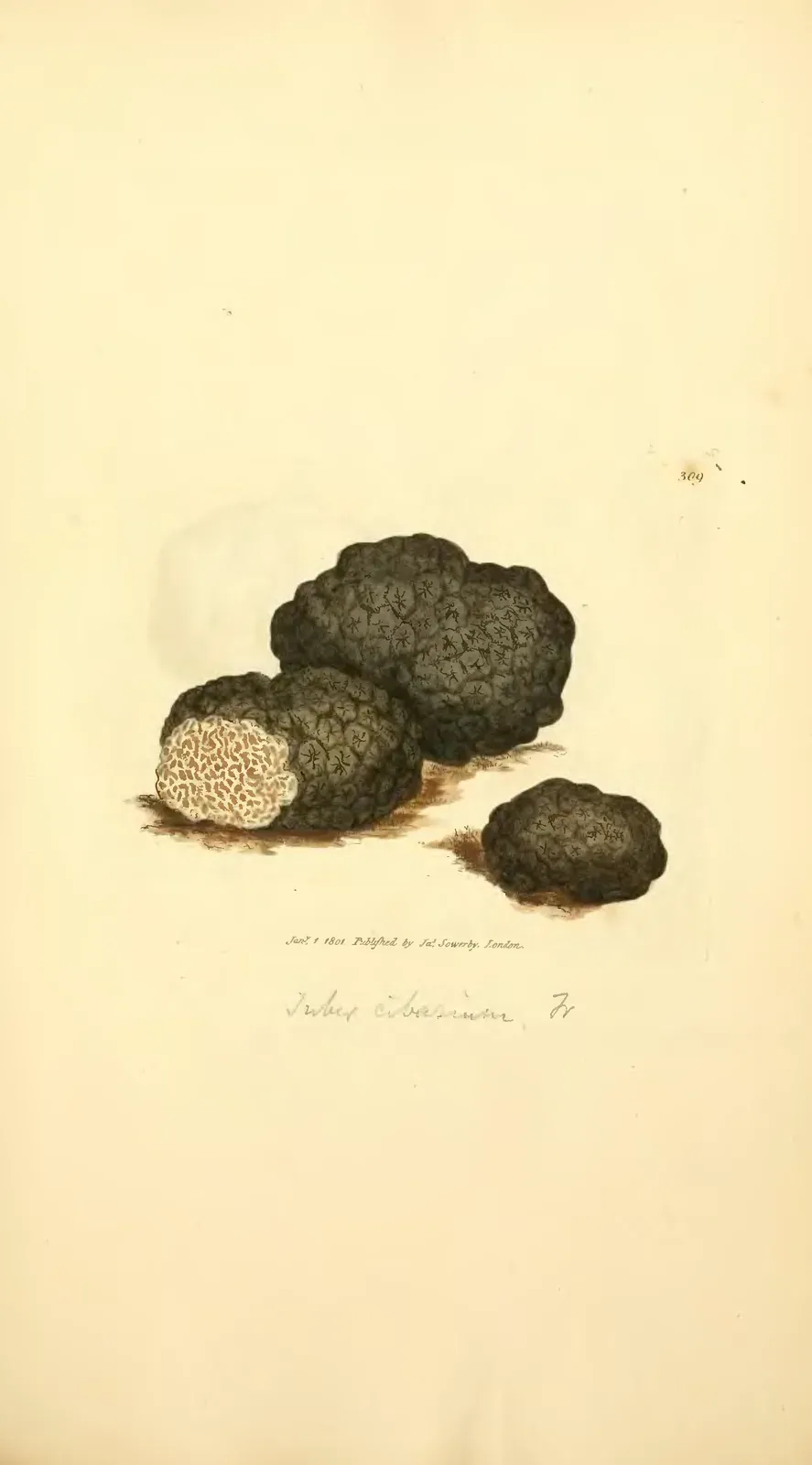 How to identify
Truffles in Ukraine: do they grow here, and where to look
Truffles aren't just a French delicacy. Several species grow in Ukraine too. Here's which ones, where they occ…
August 24, 2026·2 min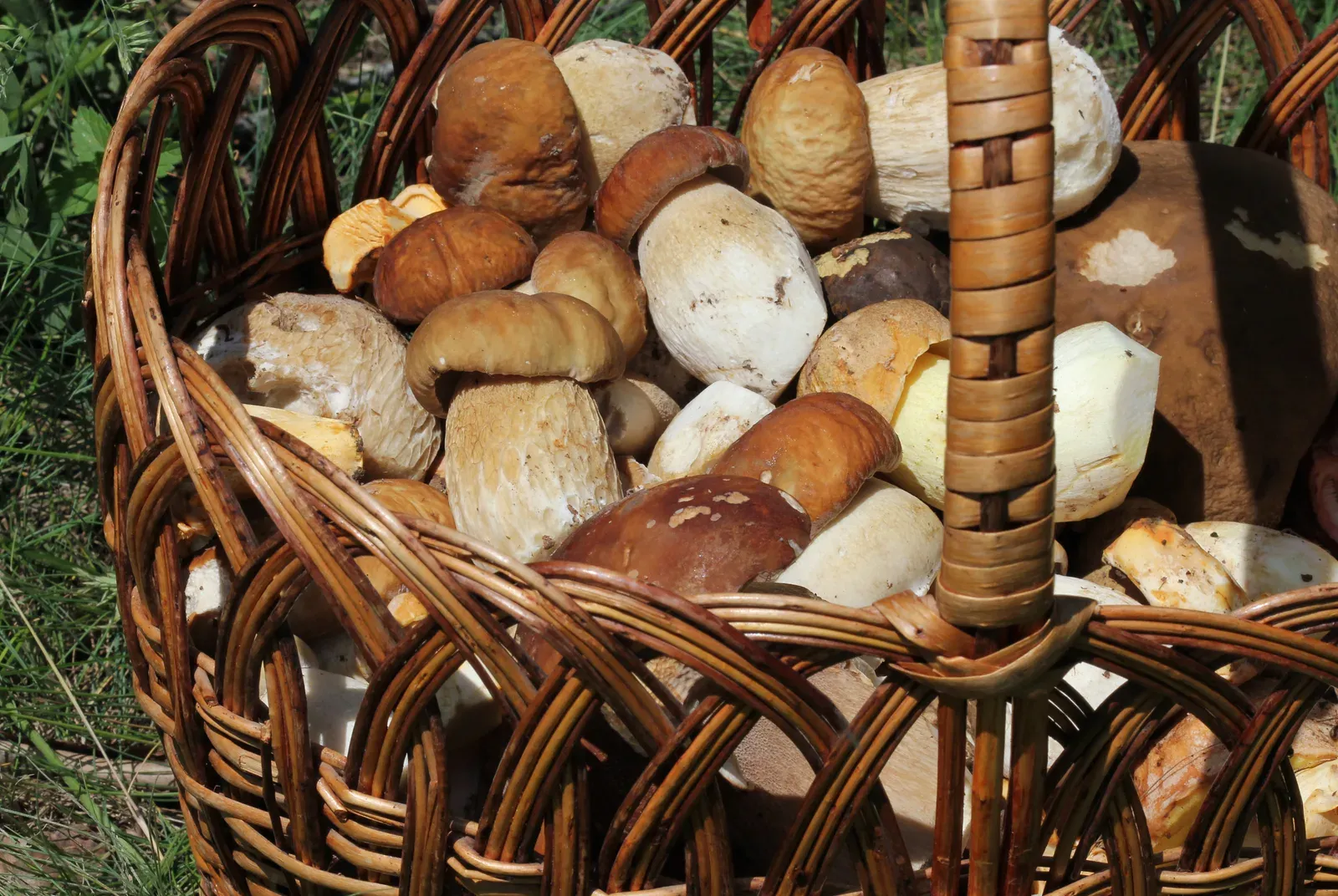 Recipes & cooking
How to store fresh mushrooms, and for how long
Fresh mushrooms spoil faster than you might think. Here's how long they keep in the fridge, how to store them…
August 21, 2026·4 min Recipes & cooking
How long to boil mushrooms
Boiling time depends on the type of mushroom and on what you're cooking next. Here's a clear cheat sheet: how…
August 22, 2026·4 min