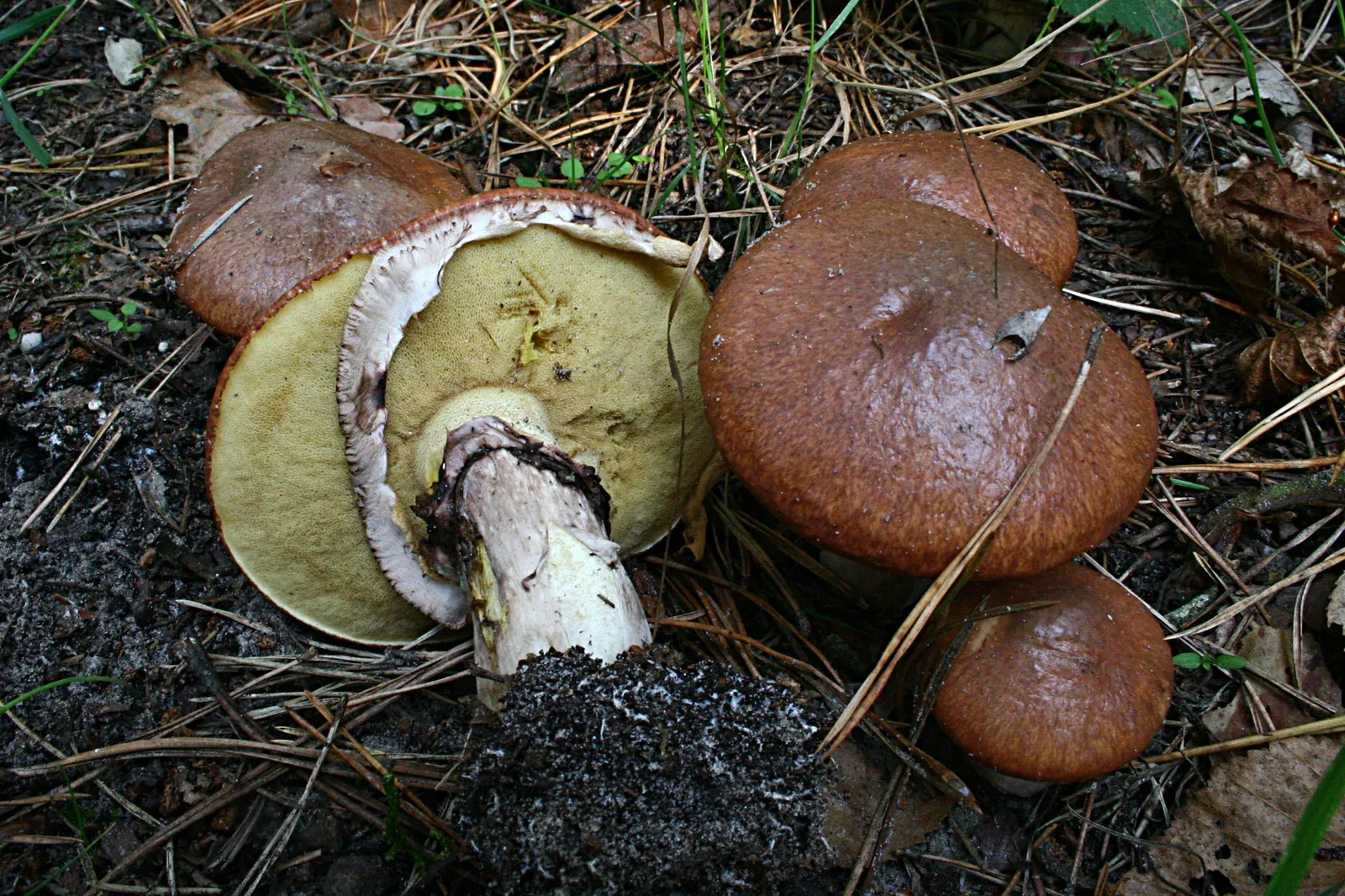
Walk into a young pine stand after a warm rain and you'll almost certainly come across them: glossy brown caps gleaming in the sun as if greased with oil. These are slippery jacks (Suillus luteus, listed in our catalog as slippery jack), one of the most recognizable and beginner-friendly mushrooms of Ukrainian forests.
The name speaks for itself: the cap is coated in a slimy, oily film, which is how it got its name. Slippery jacks grow in large clusters, so once you find one, you rarely walk on with an empty basket.
Why every beginner loves the slippery jack
The slippery jack is the ideal first mushroom. It's easy to spot, grows in groups, has several very clear features and almost no dangerous lookalikes. Remember the slimy cap, the yellow pores and the ring on the stem, and you'll find it hard to confuse with anything poisonous.
What's more, slippery jacks turn up all over Ukraine wherever there are pines, and they crop generously through almost the whole warm half of the year. They grow quickly and often, so the slippery jack season lasts a long time, with only short breaks.
The only “price” for this generosity is a bit of fuss with cleaning: the slimy skin is usually peeled off the cap. More on that later; first, let's work out how to recognize a true slippery jack.
What a true slippery jack looks like
A slippery jack is identified by a combination of features, not just one. Look the mushroom over from top to bottom.
- Cap. Convex, then flat, brown or chocolate-colored, with a characteristic slimy, glossy skin. In wet weather it's especially sticky; in dry weather it dries out and turns dull.
- Pores. The tube layer underneath: small-pored, yellow, darkening to olive with age. In young mushrooms it's covered by a white veil.
- Ring. A ring remains on the stem, the remnant of the veil that joined the cap margin to the stem. This is an important feature of Suillus luteus.
- Stem. Pale, cylindrical, often with tiny dots above the ring.
- Flesh. Soft, pale, yellowish, with a pleasant mushroomy smell.
The simplest check: slimy cap plus spongy yellow underside plus a ring on the stem. If everything matches, you're looking at a slippery jack.
Slippery jacks are a whole family
What we call a slippery jack is actually several closely related species. They all have a slimy cap and a spongy underside, but differ in their host trees and details.
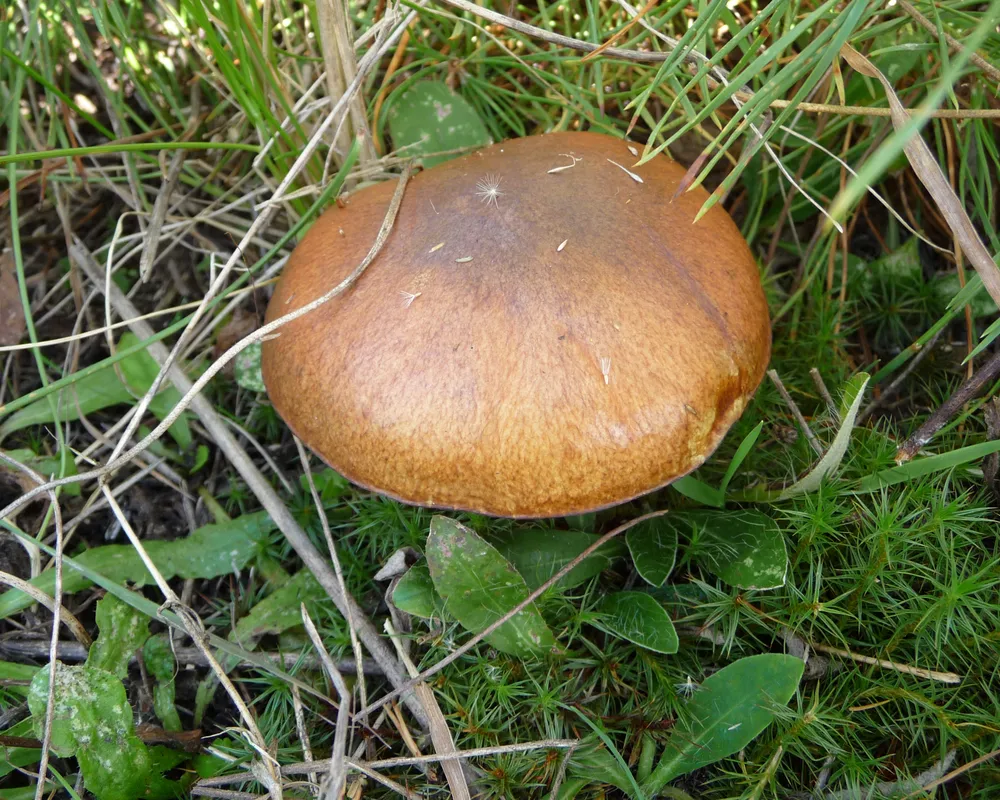
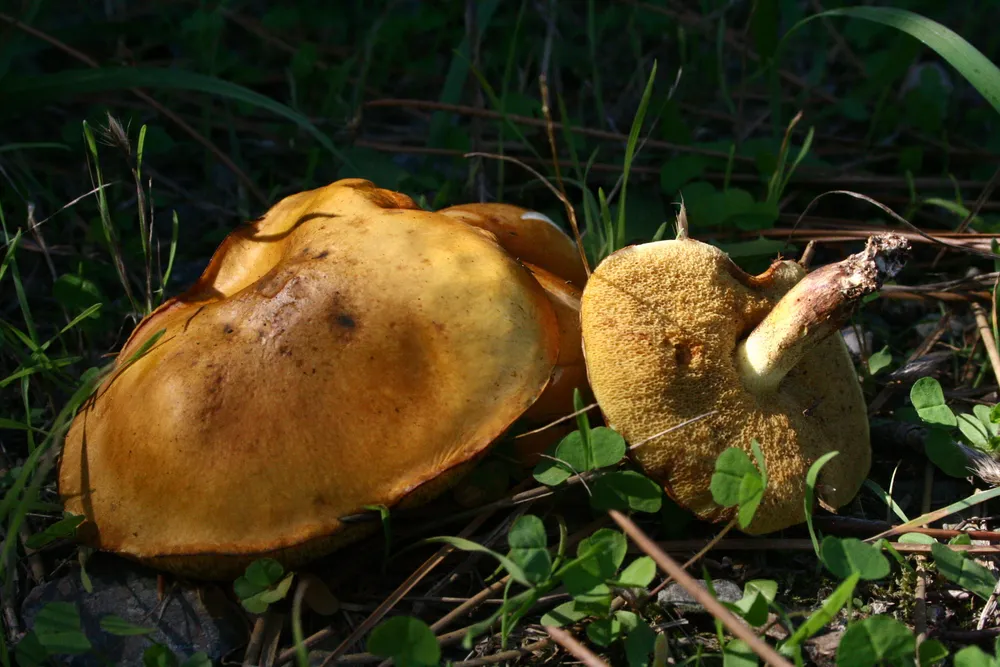
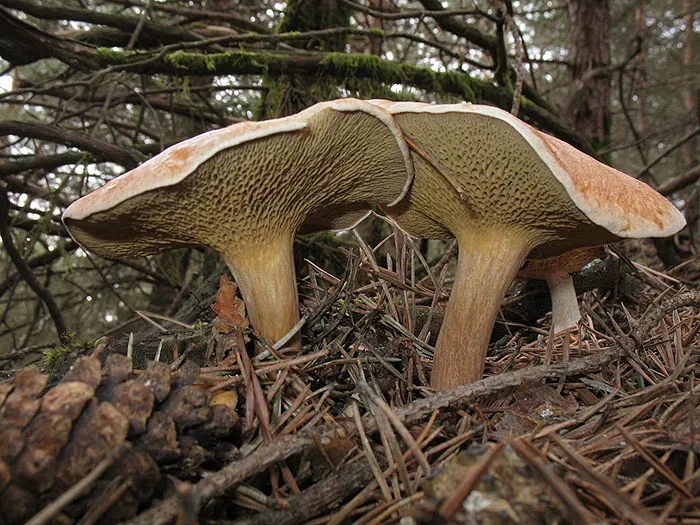
The most common is the late slippery jack, with a ring on its stem. Appearing earlier is the weeping bolete, which has no ring but shows tiny granules and droplets on its stem. Standing a little apart is the bovine bolete, a humbler relative with a reddish-brown, dryish cap. And under larch grows the bright yellow larch bolete. So “slippery jack” is more of a group than a single species.
Where and when to look for it
Slippery jacks are linked to trees through mycorrhiza, meaning they live in a mutually beneficial partnership with their roots. Nearly all slippery jacks favor pine, so look for them in conifer forests.
The best spots are:
- young pine stands and pine plantations;
- sunny edges of conifer forest and warm sandy hillocks;
- roadsides of forest tracks and paths among pines;
- patches of mixed forest where pine grows alongside birch.
Slippery jacks don't like dense, dark thickets; they need light and warm, sandy soil. The season runs from June to October, in flushes after every warm rain. The best time to go is a day or two after rain, since slippery jacks grow fast. You can keep track of these windows with our mushroom radar: it shows when moisture and warmth line up well for mushrooms to appear.
A little caution never hurts
The slippery jack is one of the safest mushrooms, but caution never hurts. The main rule: only pick mushrooms with a spongy layer underneath, not gills. All slippery jacks have tubes, so a gilled mushroom under pines is no longer a slippery jack.
In some people, the slimy skin of slippery jacks causes mild stomach upset, so it's usually peeled off before cooking. And as always, the golden rule: if you're not sure, don't pick it.
Sources
- “Identification Guide to the Fungi of Ukraine” (Kyiv, Naukova Dumka publishing house).
- Suillus luteus on GBIF, a global biodiversity database.
- Suillus luteus on MycoBank, an international fungal nomenclature database.
- Suillus luteus on Wikipedia.
Frequently asked questions
What is a slippery jack?
It's an edible pored mushroom (*Suillus luteus* and close relatives) that grows under pines. It got its name from the slimy, oily film on its cap. Slippery jacks grow in clusters and are very popular with foragers.
What does a true slippery jack look like?
It has a brown, slimy, glossy cap, a yellow spongy underside, a pale stem and a ring on it (in Suillus luteus). The flesh is pale and yellowish, with a pleasant mushroomy smell.
Why is it called a slippery jack?
Because of the slimy, oily film that covers the cap and shines as if greased with oil. That sticky skin is exactly what gave the mushroom its name.
Where does the slippery jack grow?
In pine and , mostly in young pine stands, on sunny forest edges and in warm sandy soils. It loves light and avoids dense, dark thickets.
When should you pick slippery jacks?
The season runs from June to October, in flushes after every warm rain. Slippery jacks grow fast, so the best time to go is a day or two after rain, guided by the .
Are there poisonous slippery jacks?
The slippery jack has practically no dangerous lookalikes. The main thing is to make sure the underside of the cap is spongy, not gilled. All true slippery jacks have tubes and are edible.
Do you need to peel slippery jacks?
Usually, yes. In some people the slimy skin causes mild stomach upset, and it makes the dish too slimy. It's easier to peel from a dry cap, so slippery jacks are often cleaned before washing.
How many kinds of slippery jacks are there?
Several closely related species: the with a ring, the without a ring, the under larch, and the related . All of them are edible and similar in structure.
Mushrooms in this article
Related articles
 Recipes & cooking
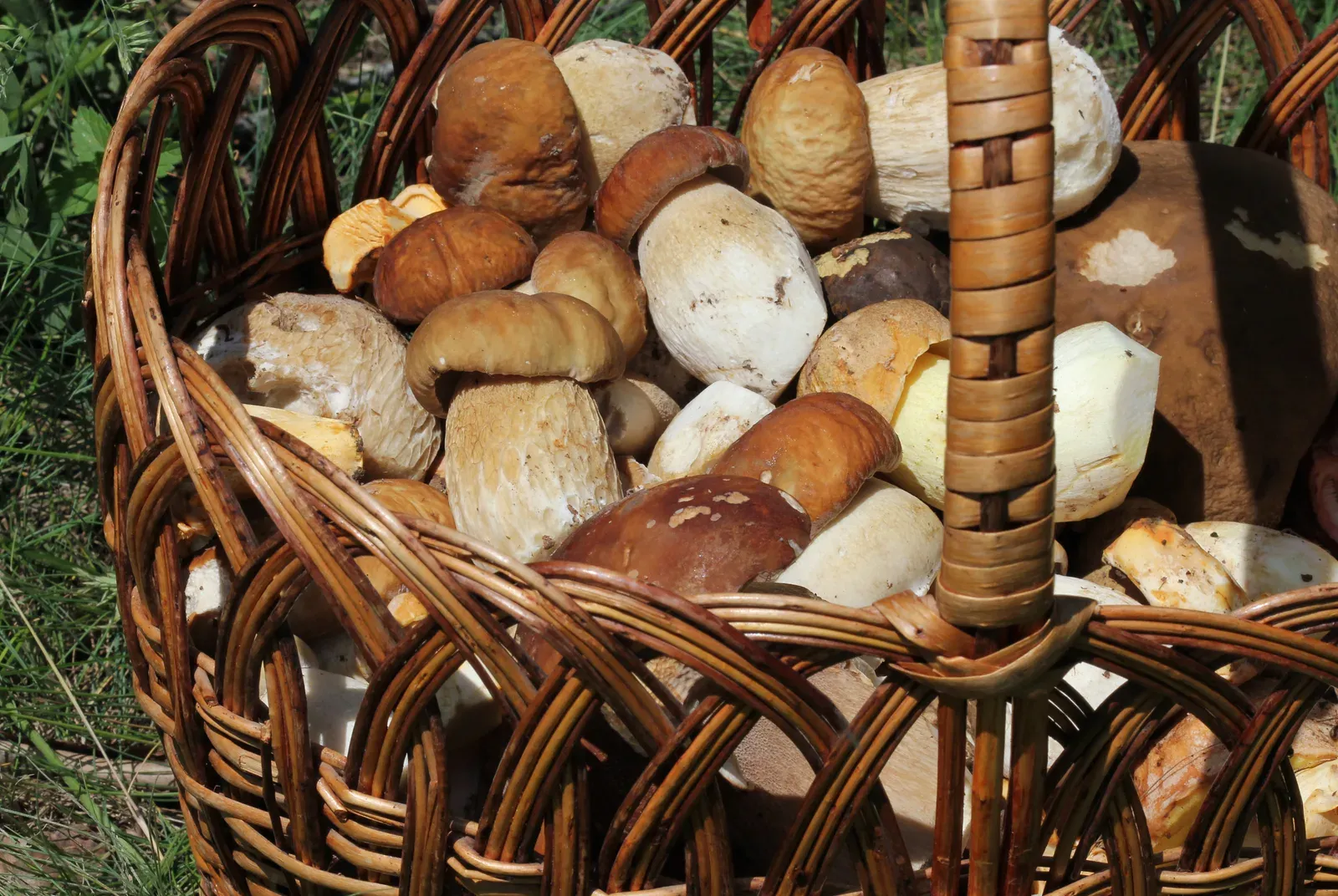
How to store fresh mushrooms, and for how long
Fresh mushrooms spoil faster than you might think. Here's how long they keep in the fridge, how to store them…
August 21, 2026·4 min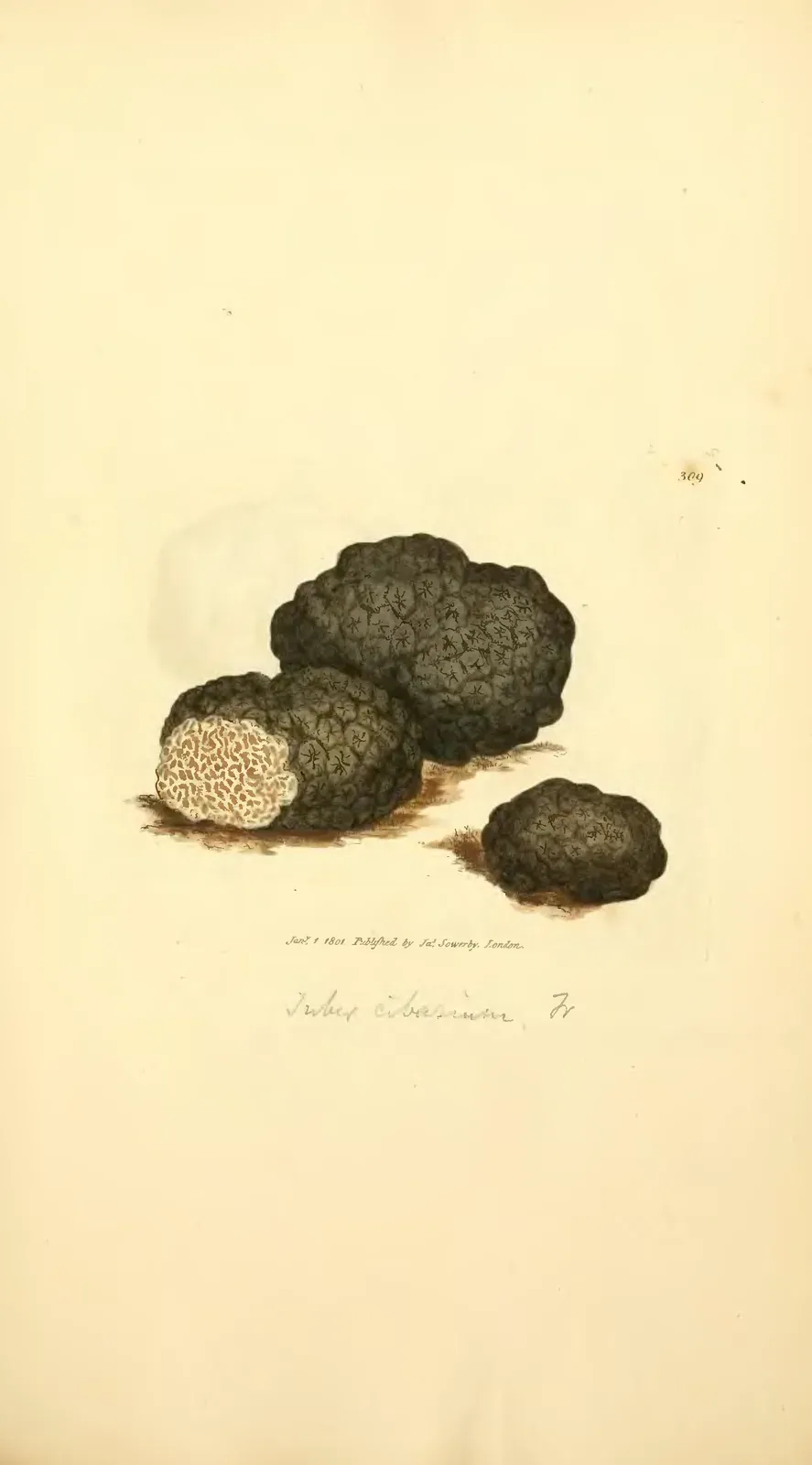 How to identify
Truffles in Ukraine: do they grow here, and where to look
Truffles aren't just a French delicacy. Several species grow in Ukraine too. Here's which ones, where they occ…
August 24, 2026·2 min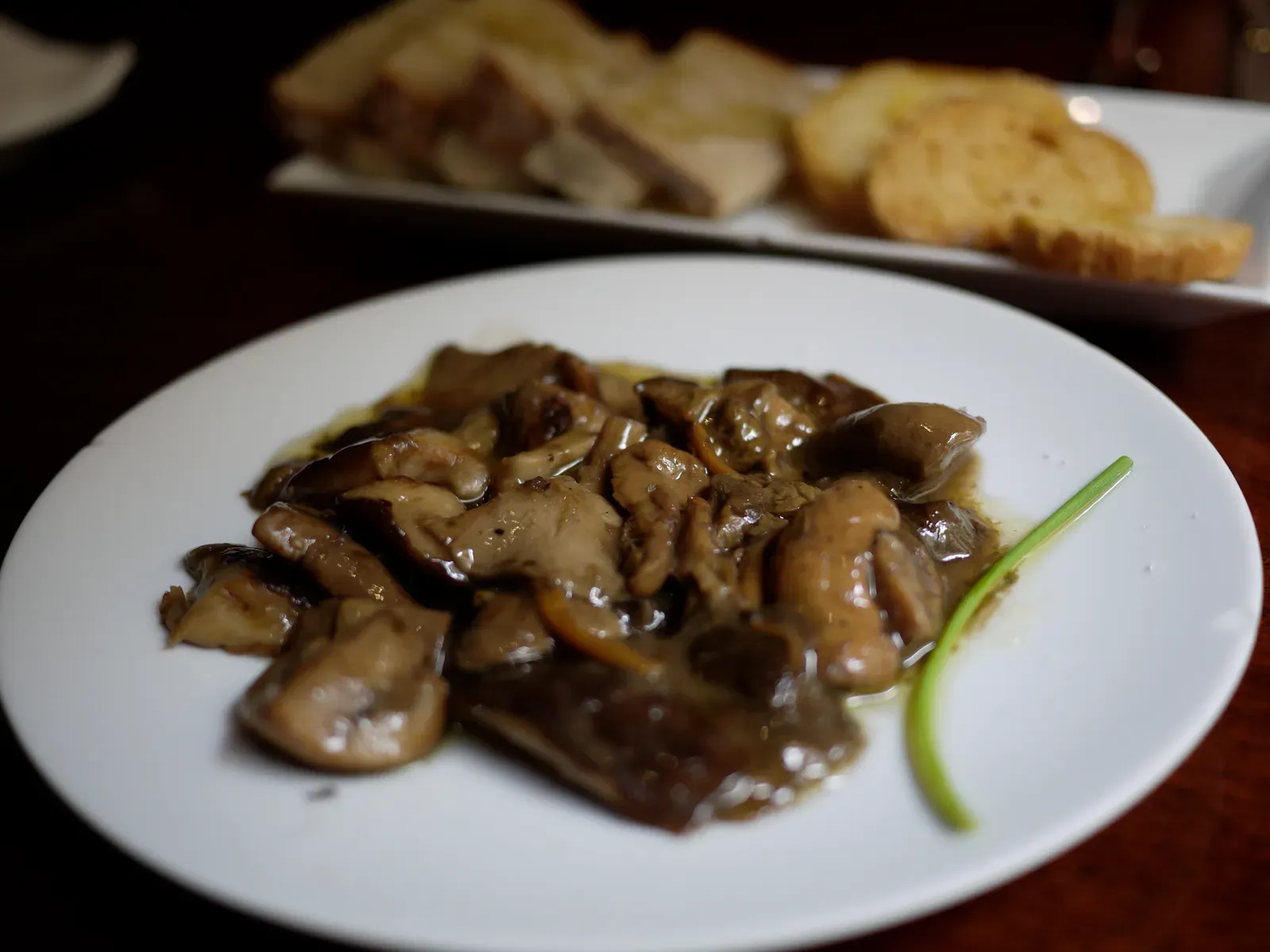 Recipes & cooking
How long to boil mushrooms
Boiling time depends on the type of mushroom and on what you're cooking next. Here's a clear cheat sheet: how…
August 22, 2026·4 min