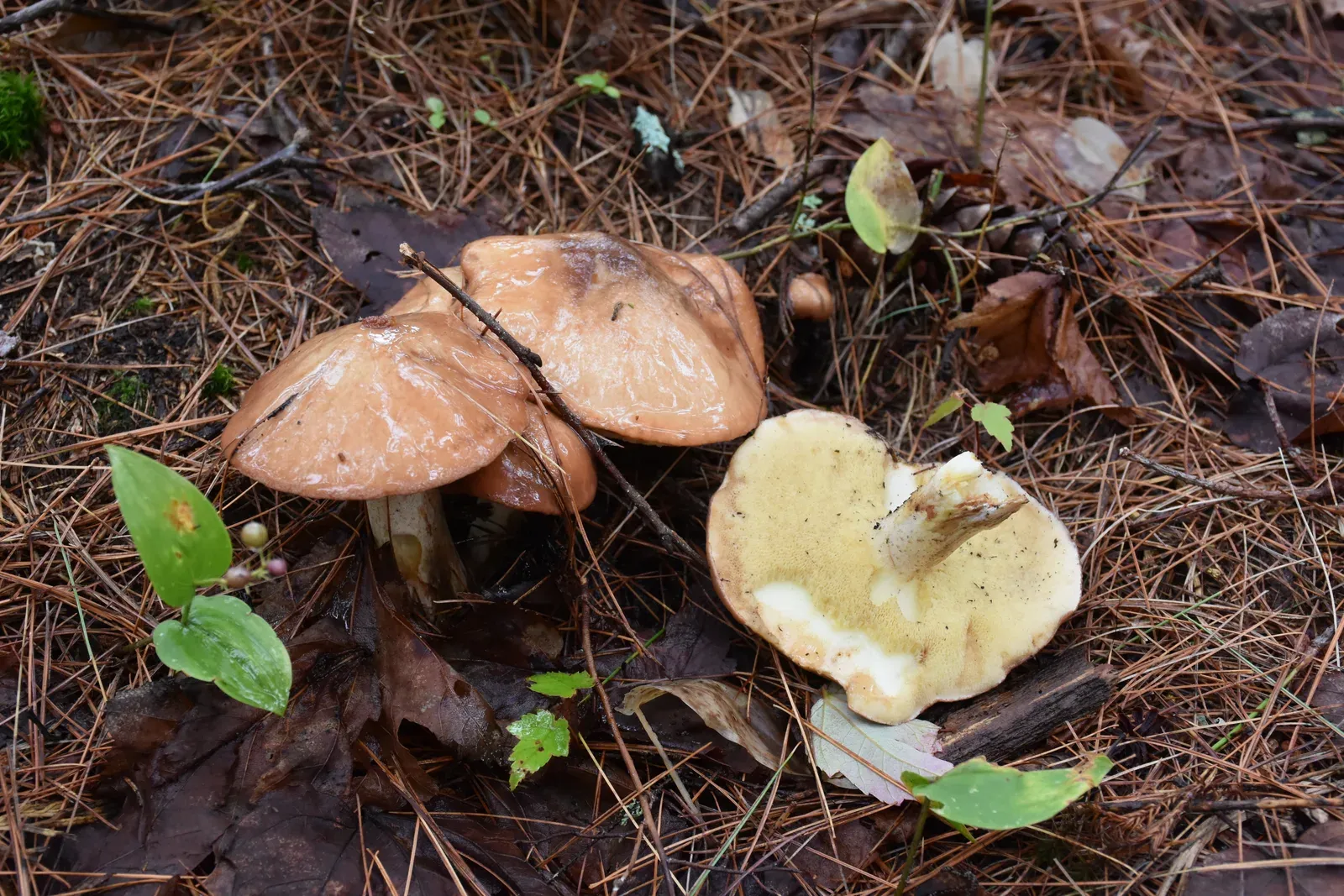
When people simply say “butter mushroom,” they almost always mean this one, the slippery jack (Suillus luteus, listed in our catalog as slippery jack). It's the most common and most recognizable Suillus of our pine woods, with a dark glossy cap and a distinctive ring on its stem.
It's also called the late slippery jack, because it gives its main harvests closer to autumn, when other Suillus species are already fading. Firm, tasty and very generous with its harvests, it has long been a favorite of beginner foragers.
Why “common”
The name (its Ukrainian name means “common butter mushroom”) doesn't belittle the mushroom, it just signals that this is the most typical member of the family. It's the slippery jack that shapes how we picture the whole genus: a slimy chocolate cap, yellow pores, a pale stem with a ring.
It's easy to recognize and hard to confuse with anything dangerous. On top of that, it grows in big families in bright pine areas, so once you find one cluster, you usually gather quite a lot at once.
The only hassle is the ring and the slimy skin when cleaning, but that's a small price for such generosity and flavor.
How to recognize the slippery jack
You recognize it by a combination of features, not just one. Look the mushroom over from top to bottom.
- Cap. Convex, then flat, dark brown or chocolate, with a distinctly slimy, glossy film. Very sticky in wet weather.
- Ring. The stem has a visible membranous ring, the remains of the veil that covered the young pores. This is the key feature of the slippery jack in particular.
- Pores. The tube layer underneath: finely porous, yellow, turning olive with age. In young mushrooms it's covered by a white veil.
- Stem. Pale, cylindrical, often with tiny dots above the ring.
- Flesh. Soft, pale, yellowish, barely changes color when cut.
The simplest check: slimy cap plus a ring on the stem plus yellow pores underneath. All match? It's a slippery jack.
How it differs from the weeping bolete
The slippery jack is most often confused with its early-season relative, the weeping bolete. Two details make it easy to tell them apart.
- Ring. The slippery jack has one; the weeping bolete has none at all.
- Stem. Instead of a ring, the weeping bolete has tiny milky-colored granules and droplets, especially on young mushrooms.
Both are edible and equally tasty, so mixing them up isn't dangerous. But knowing the difference helps you read your finds with confidence.
Where and when to look for it
The slippery jack is linked to pine through mycorrhiza, meaning it lives in a mutually beneficial partnership with its roots. So you need to look for it in coniferous forests.
The best spots are:
- young pine stands and pine plantations;
- bright edges of coniferous forest and sun-warmed sandy hills;
- verges of forest roads among pines;
- patches of mixed forest where pine grows next to birch.
The season runs from June to October, but the slippery jack gives its main, most generous flushes in late summer and autumn, right up to the first frosts. It's best to go out a day or two after a warm rain, because slippery jacks grow fast. An easy way to watch for these windows is our mushroom radar: it shows when moisture and warmth line up well for mushrooms to appear.
Caution never hurts
The slippery jack is one of the safest mushrooms. The main rule never changes: pick only mushrooms with pores underneath, not gills. The slimy skin is usually peeled off the cap, because in some people it causes a mild stomach upset. And, as always: if you're not sure, don't pick it.
Sources
- “Key to the Fungi of Ukraine” (Kyiv, Naukova Dumka publishers).
- Suillus luteus on GBIF, the global biodiversity database.
- Suillus luteus on MycoBank, the international fungal nomenclature database.
- Suillus luteus on Wikipedia.
Frequently asked questions
What is the slippery jack?
It's the most common Suillus (*Suillus luteus*), growing under pines. It has a dark slimy cap, yellow pores underneath and a distinctive ring on the stem. It's also called the late slippery jack.
What does the slippery jack look like?
A dark brown or chocolate, slimy, glossy cap, yellow pores underneath, a pale stem with a membranous ring and tiny dots near the top. The flesh is pale and yellowish.
Why is the slippery jack called “late”?
Because its main, most generous harvests come in late summer and autumn, when the early Suillus species are already fading. It keeps fruiting right up to the first frosts.
How does the slippery jack differ from the weeping bolete?
The slippery jack has a ring on its stem; the has no ring, but shows tiny granules and droplets instead. Both are edible and equally tasty.
Where does the slippery jack grow?
In pine and , mostly in young pine stands, on bright forest edges and warm, sandy soils. It grows in big families.
When should you pick slippery jacks?
The season runs from June to October, with the main flushes in late summer and autumn. It's best to go out a day or two after a warm rain, guided by the .
Should you peel the skin off a slippery jack?
Usually, yes. In some people the slimy skin causes a mild stomach upset, and it makes the dish too slimy. It's easier to peel from a dry cap, before you wash the mushroom.
Does the slippery jack have dangerous lookalikes?
Practically none. The key is to make sure the underside of the cap has pores, not gills. All true Suillus species have tubes and are edible.
Mushrooms in this article
Related articles
 Recipes & cooking
How to store fresh mushrooms, and for how long
Fresh mushrooms spoil faster than you might think. Here's how long they keep in the fridge, how to store them…
August 21, 2026·4 min How to identify
Truffles in Ukraine: do they grow here, and where to look
Truffles aren't just a French delicacy. Several species grow in Ukraine too. Here's which ones, where they occ…
August 24, 2026·2 min Recipes & cooking
How long to boil mushrooms
Boiling time depends on the type of mushroom and on what you're cooking next. Here's a clear cheat sheet: how…
August 22, 2026·4 min