The slippery jack is one of those mushrooms that practically beg to go in your basket: easy to spot, growing in little families, and with a few very clear features. Still, beginners sometimes hesitate over whether it's really a slippery jack. Let's settle once and for all what to look at.
The good news: to confidently recognize a slippery jack (Suillus luteus and close relatives), you only need to check a few simple traits. Look the mushroom over from top to bottom, and your doubts will vanish.
Feature one: a slimy cap
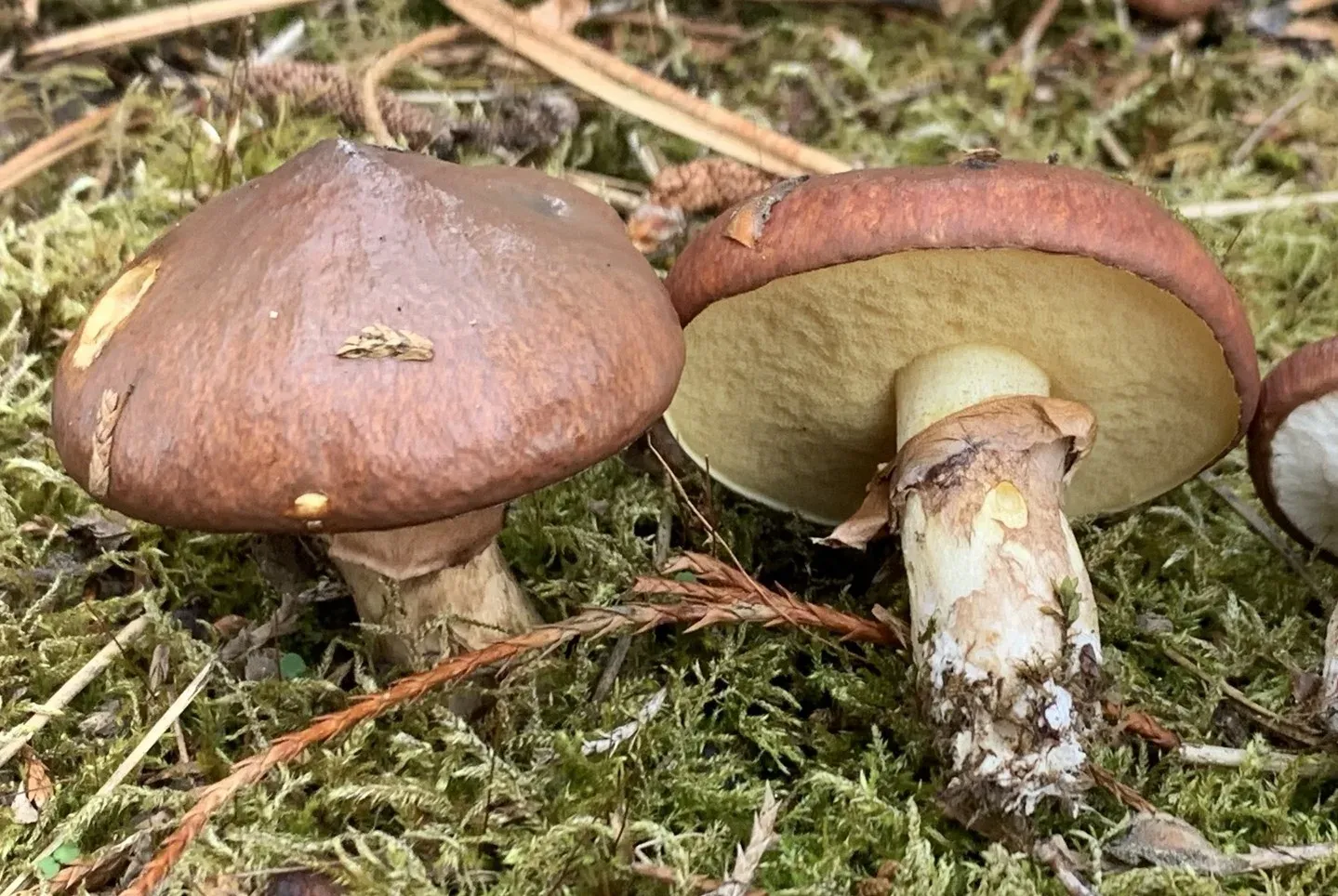
The first thing that catches your eye is the glossy, slimy cap. That's exactly how the slippery jack got its name: the film on the cap looks as if the mushroom had been greased with oil.
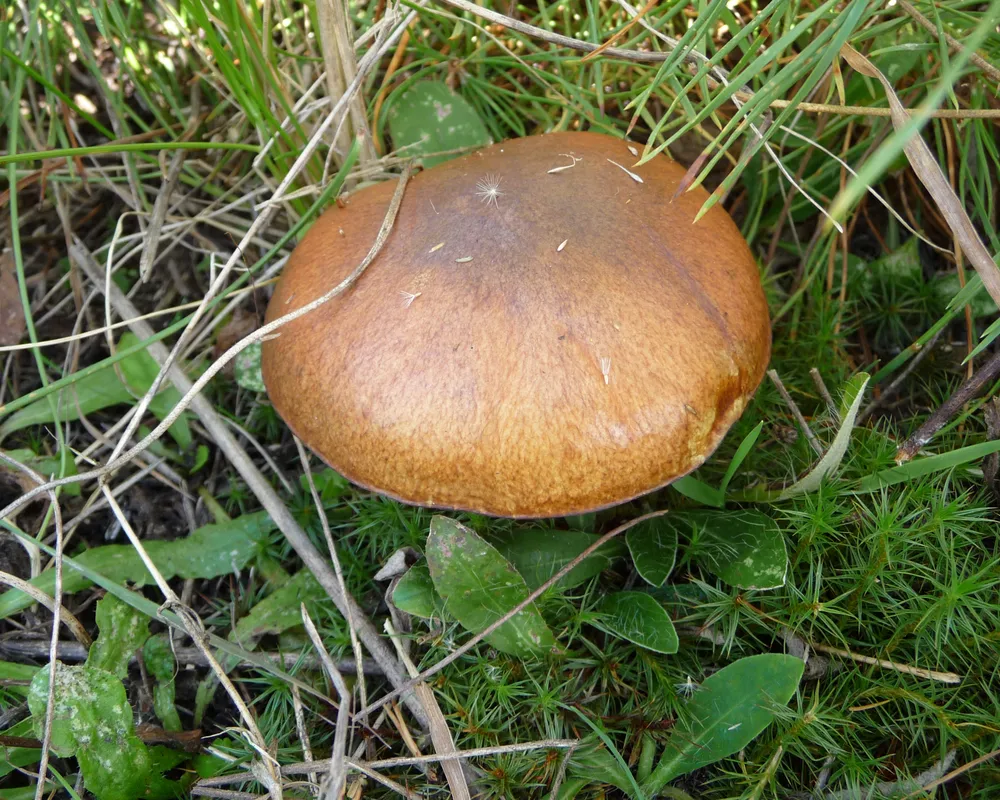
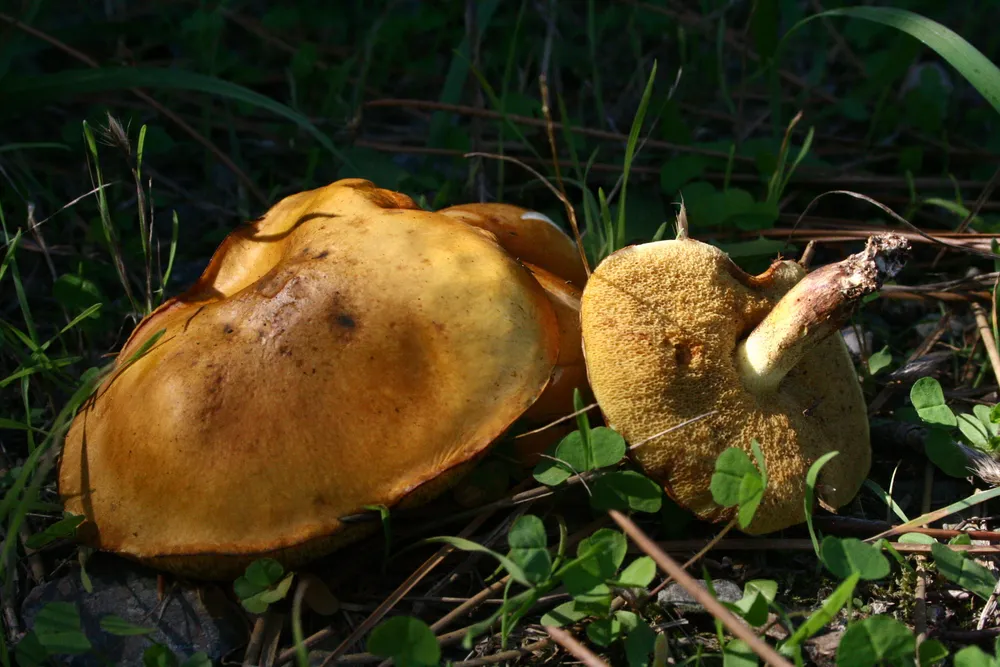
In wet weather the slime is especially noticeable, and the cap positively gleams. In dry weather it dries out, dulls and turns slightly tacky to the touch. The color depends on the species: from chocolate brown in the slippery jack to yellow in the larch bolete.
If the cap is dry and matte, it's either an old mushroom or one of its drier relatives, such as the bovine bolete or the velvet bolete. In that case, check the other features more carefully.
Feature two: a spongy underside
Now turn the mushroom over. Under the cap of a slippery jack there's a spongy layer of tubes that looks like a fine, soft sponge, not gills.
This is the most important safety sign. All slippery jacks have tubes, so if you see gills under the cap, it's definitely not a slippery jack. The color of the sponge changes with age:
- in a young mushroom it's pale yellow, sometimes covered by a white veil;
- in a mature one it's bright yellow;
- in an old one it's dark olive and soft.
Old mushrooms with a darkened sponge are best left in the forest.
Feature three: a ring or granules on the stem
Look at the stem. The slippery jack and larch bolete have a ring on it, what's left of the veil that covered the young sponge.
The weeping bolete has no ring, but its stem shows tiny milky-colored granules, like little droplets. Both the ring and the granules are reliable clues that you're looking at a slippery jack.
Here it all is in one short rule:
- a slimy, glossy cap;
- a spongy, not gilled, underside;
- a ring or granules on the stem.
All three match? There's practically no doubt.
Where this check matters most
Slippery jacks grow under pines and larches, that is, in coniferous and mixed forests. The tree is a clue too: a true slippery jack won't grow in the middle of a deciduous grove with no conifers nearby.
The best time to go is a day or two after a warm rain, when slippery jacks come up en masse. These windows are easy to track with our mushroom radar: it shows when moisture and warmth line up well for mushrooms to appear.
Caution never hurts
The slippery jack is one of the safest mushrooms, because it has practically no dangerous lookalikes. But the habit of checking features is useful for any mushroom. The main thing to remember: a spongy underside means a slippery jack; gills under the cap are a reason to stop. And, as always: if you're not sure, don't pick it.
Sources
- «Key to the Fungi of Ukraine» (Kyiv, Naukova Dumka publishers).
- Suillus luteus on GBIF, a global biodiversity database.
- Suillus on MycoBank, an international fungal nomenclature database.
- Suillus luteus on Wikipedia.
Frequently asked questions
How do you recognize a slippery jack in the forest?
By three features: a slimy, glossy cap, a spongy (not gilled) underside, and a ring or tiny granules on the stem. If all three match and there's a pine or larch nearby, it's a slippery jack.
What is the main feature of a slippery jack?
The slimy, buttery cap that gave the mushroom its name. But the most important feature for safety is the spongy, tubed underside instead of gills.
Why does a slippery jack have a slimy cap?
It's a special film that protects the mushroom from drying out and helps it hold on to moisture. In wet weather it shines especially brightly; in dry weather it dries out and dulls.
How do you tell a slippery jack from a different mushroom?
Look under the cap. A slippery jack has a spongy layer of tubes, not gills. A gilled mushroom under a pine is not a slippery jack, even if the cap looks similar.
What does the ring on a slippery jack's stem mean?
It's what's left of the veil that covered the sponge in the young mushroom. The ring is found on the and . The has no ring, but it has tiny granules instead.
Where do slippery jacks grow most often?
In under pines, and some species under larches. In young pine stands, on light forest edges and on sandy, sun-warmed soils.
Can a slippery jack be confused with a poisonous mushroom?
The slippery jack has practically no dangerous lookalikes. The key is to make sure the underside is spongy, not gilled. That reliably sets the slippery jack apart from gilled mushrooms.
When is the best time to look for slippery jacks?
A day or two after a warm rain, when they come up en masse. To plan around the weather, use the . The season runs from June to October.
Mushrooms in this article
Related articles
 Recipes & cooking
How to store fresh mushrooms, and for how long
Fresh mushrooms spoil faster than you might think. Here's how long they keep in the fridge, how to store them…
August 21, 2026·4 min How to identify
Truffles in Ukraine: do they grow here, and where to look
Truffles aren't just a French delicacy. Several species grow in Ukraine too. Here's which ones, where they occ…
August 24, 2026·2 min Recipes & cooking
How long to boil mushrooms
Boiling time depends on the type of mushroom and on what you're cooking next. Here's a clear cheat sheet: how…
August 22, 2026·4 min