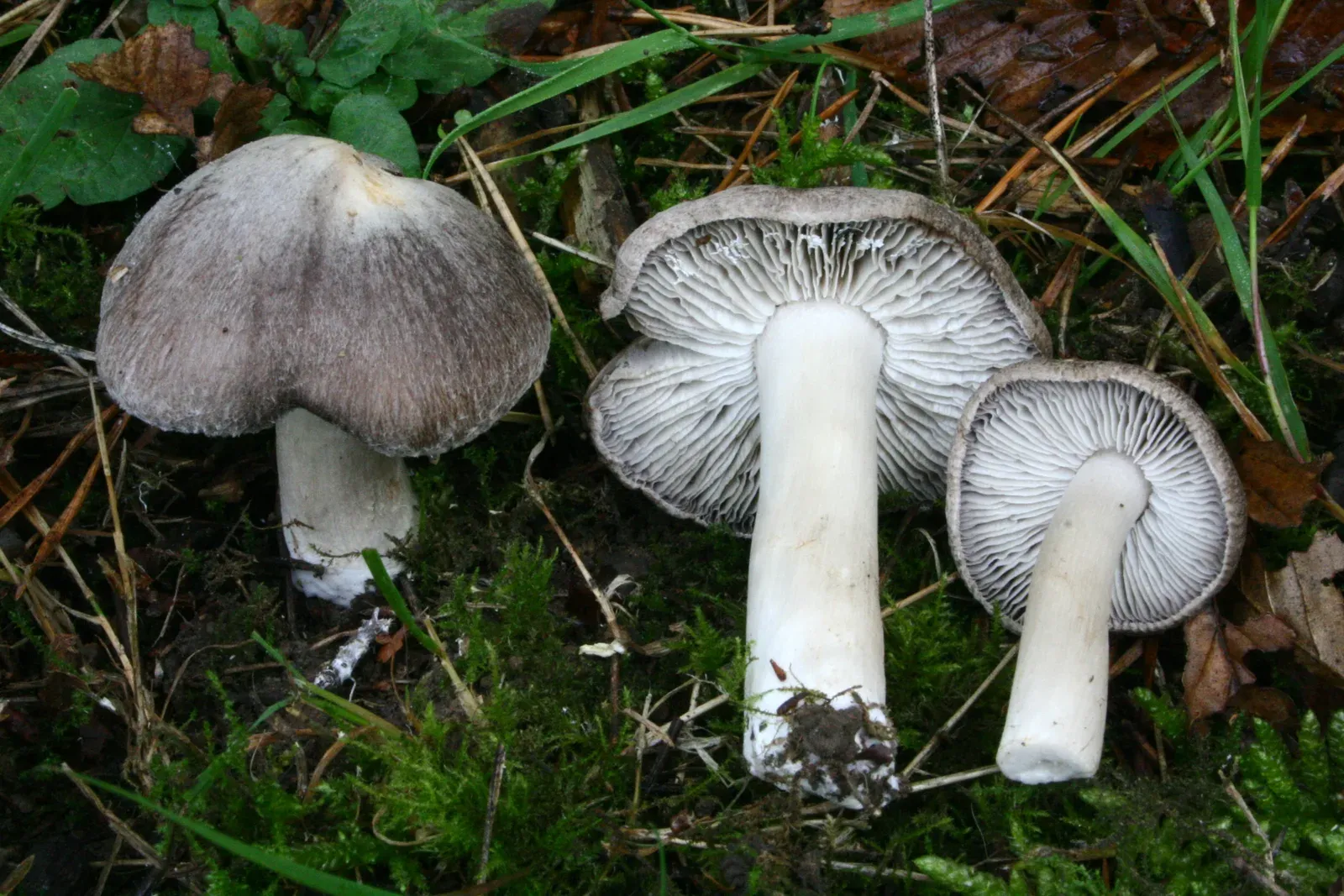
The grey knight, popularly called the “mousey”, is one of the tastiest late-fall mushrooms. It appears when most others are already gone and grows in large groups in pine forests. But its gray color is exactly what makes it resemble a dangerous relative, so you need to identify it with confidence.
Let's go over the key features of the grey knight and how to tell it apart from the poisonous tiger tricholoma.
What the grey knight looks like
- Cap gray or grayish brown, 4–10 cm, with darker radial streak-like fibers (hence the name “streaked”); bell-shaped in young mushrooms, later spreading out flat with a bump.
- Gills whitish or grayish white, broad.
- Stem white or grayish, fibrous, often half-buried in the forest litter.
- Flesh whitish, not bitter, with a faint mealy smell.
Where and when it grows
The grey knight is a mushroom of pine and mixed forests on sandy soils. It grows in large groups and rows from September to November, often after the first light frosts, when there are hardly any other mushrooms. It often hides in fallen needles, with just its gray cap peeking out.
We've written separately about which other mushrooms to pick in October — the grey knight is among the main ones there.
Is it edible?
Yes, the grey knight is a good edible mushroom. It's boiled first and then fried or pickled. Young, firm specimens are prized for their pleasant texture. It isn't cooked fresh, without boiling.
The main danger: the tiger tricholoma
The most important thing is not to confuse the grey knight with the poisonous tiger (leopard) tricholoma. The differences:
- The tiger tricholoma is bigger and more massive, its cap light gray with distinct dark scales (rather than fine streak-like fibers).
- Young tiger tricholomas often have visible droplets on the gills.
- The grey knight is smaller, with an evenly fibrous rather than scaly cap.
More about poisonous knights and their features in a separate article. The rule is simple: don't pick a large gray knight with distinct scales.
Sources
- “Key to the Fungi of Ukraine” (Kyiv, Naukova Dumka publishing house).
- Tricholoma terreum on GBIF, the global biodiversity database.
- Tricholoma terreum on MycoBank, the international fungal nomenclature database.
- Tricholoma terreum on Wikipedia.
Frequently asked questions
How do you recognize the grey knight?
By its gray cap with dark radial streak-like fibers, whitish gills and fibrous stem. It grows in groups in pine forests on sand.
Why is it called the “mousey”?
Because of the cap's characteristic mouse-gray color. “Streaked” is another of its names, after the radial fibers on the cap.
Is the grey knight edible?
Yes, it's a good edible mushroom. It's boiled first and then fried or pickled. It isn't cooked fresh, without boiling.
When should you pick the grey knight?
From September through November, often after the first light frosts, when there are hardly any other mushrooms in the forest.
Where does the grey knight grow?
In pine and mixed forests on sandy soils, in large groups, often half-buried in fallen needles.
How do you tell the grey knight from the poisonous tiger tricholoma?
The tiger tricholoma is bigger, with distinct dark scales on the cap, while the grey knight has only fine streak-like fibers. Don't pick a large gray knight with scales.
Can you be poisoned by the grey knight?
The grey knight itself is edible, but poisonings happen through confusion with the tiger tricholoma. That's why confident identification is critical here.
Does the grey knight need to be boiled?
Yes, it's boiled before frying or pickling, with the water discarded. This is the standard preparation for knights.
Mushrooms in this article
Related articles
 How to identify
Truffles in Ukraine: do they grow here, and where to look
Truffles aren't just a French delicacy. Several species grow in Ukraine too. Here's which ones, where they occ…
August 24, 2026·2 min Recipes & cooking
How to store fresh mushrooms, and for how long
Fresh mushrooms spoil faster than you might think. Here's how long they keep in the fridge, how to store them…
August 21, 2026·4 min Recipes & cooking
How long to boil mushrooms
Boiling time depends on the type of mushroom and on what you're cooking next. Here's a clear cheat sheet: how…
August 22, 2026·4 min