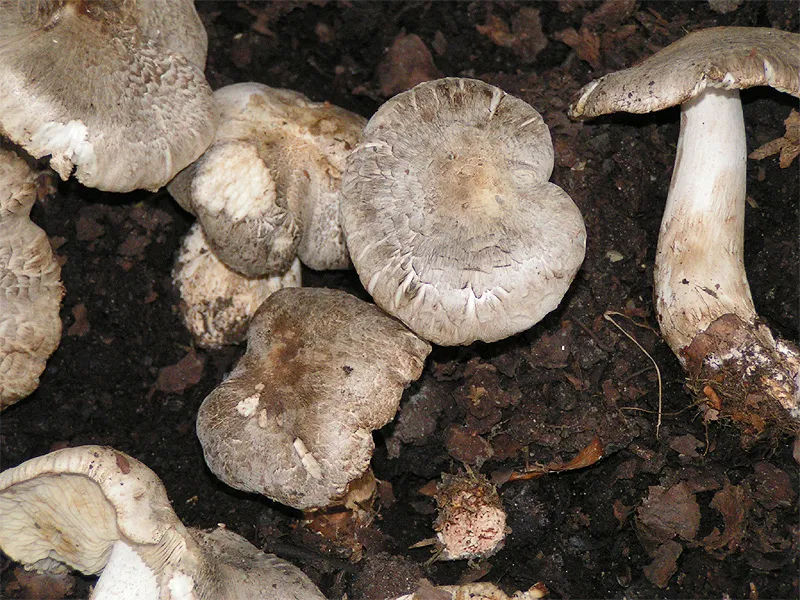
Tiger tricholomaTricholoma pardinum
Expert-verifiedUpdated October 3, 2026
Passport
- Edibility
- Poisonous
- Season
- Aug — Nov
- Hymenophore
- Gilled
- Cap color
- Grey
- Size
- Large (over 15 cm)
- Smell
- Floury
- Reviewed
- Yes ✓
POISONOUS
Eating it causes poisoning. Do not pick it unless you have identified it with certainty.
Severe gastrointestinal poisoning — the most common serious mushroom poisoning in some regions of Europe (France, Italy, Switzerland, and in part Ukraine).
Active toxins: not precisely identified; probably a mixture of heat-labile and heat-stable irritants of the intestinal lining, possibly including the tyrosine-pyridine group and sesquiterpenes. Boiling does not neutralize them completely.
Latency period: 1-3 hours after eating (average 1.5 h).
Symptoms: Sudden severe nausea and repeated vomiting (often every 10-15 min during the first hours) Watery diarrhea, sometimes with traces of blood Severe cramping abdominal pain Profuse sweating, tachycardia, hypotension from dehydration Cold extremities, oliguria (reduced urine output) with severe dehydration In children and the elderly — rapid development of collapse and kidney failure
Duration: 24-72 h in mild cases, up to 4-5 days in severe ones. Full recovery usually takes 7-10 days. Among healthy adults there are practically no deaths, but deaths have been reported in children under 5 and in people over 70 with cardiovascular disease, due to complications of dehydration.
First aid — call an ambulance IMMEDIATELY (112 or your local emergency number): 1. Do NOT induce vomiting (the person is already vomiting profusely). 2. Rehydration — oral rehydration salts (Regidron) if the person can swallow; intravenous rehydration in hospital is the mainstay of treatment. 3. Save a sample of the mushroom (fresh or from vomit) so a toxicologist can identify it. 4. With severe dehydration — hospital treatment with monitoring of electrolytes, kidneys and the cardiovascular system. 5. Antibiotics are not needed (this is not infectious gastroenteritis). 6. Symptomatic treatment: for severe nausea — metoclopramide, for pain — antispasmodics; antidiarrheals (loperamide) are contraindicated in the first 12 h because they slow the elimination of toxins.
The prognosis is good with adequate rehydration; deaths are isolated and have been reported mainly in risk groups (children under 5, people over 70).
ABSOLUTE RULE: do NOT PICK large gray knights with scales. If a suspicious large, scaly gray one turns up in your basket of knights, throw out the WHOLE basket (spore dust may have cross-contaminated the other mushrooms).
If you suspect poisoning, call an ambulance immediately: 112 (the European emergency number) or your local emergency number
Quick answers
Where to look?
Deciduous forest, Mixed forest
When does it appear?
Aug — Nov
Active months: August, September, October, November.
How to recognize it? Three signs
- Cap color: Grey, White
- Cap shape: Convex
- Smell: Floury
Fruiting season
August – November
Description
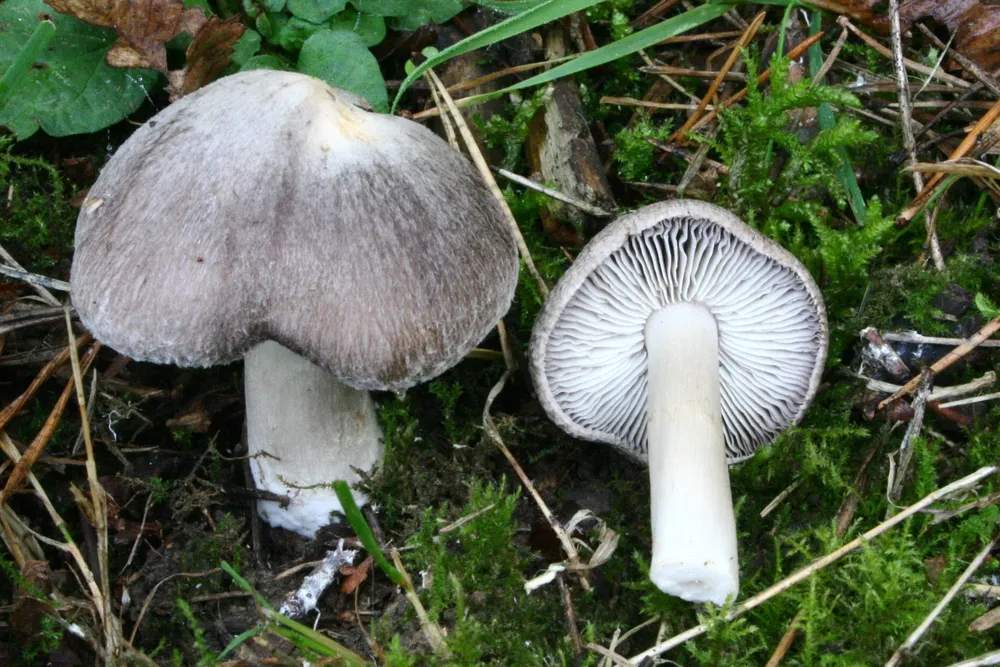
Tiger tricholoma (Tricholoma pardinum, synonyms T. tigrinum, T. pardalotum) is Europe's most dangerous Tricholoma, causing dozens of serious poisonings every year in France, Italy and Switzerland, and gradually more and more often in Ukraine. The Latin epithet pardinum — "leopard-like, spotted" — perfectly describes its characteristic grayish-white cap with distinct dark gray scales arranged in concentric rings, like the pattern of a leopard's coat. The cap is 8-15 cm across (sometimes up to 20 cm!), very fleshy, heavy, with thick, firm flesh — a tempting mushroom to pick, because it looks like the large edible knights.
Seriously poisonous — causes severe gastroenteritis with a risk of dehydration. Symptoms begin 1-3 hours after eating: severe nausea, repeated vomiting, heavy watery diarrhea, cramping abdominal pain; in children and the elderly, rapid dehydration with a risk of collapse. Symptoms last 24-72 hours, in severe cases up to 4-5 days. Deaths usually do not occur with adequate rehydration, but deaths have been reported among elderly people and children due to dehydration and cardiovascular complications.
The main reason for frequent poisonings — its striking resemblance to edible knights: T. portentosum (charbonnier, with a streaked cap), T. terreum (grey knight), T. argyraceum. The key differences of T. pardinum: (1) much larger size (cap 8-15 cm versus 3-8 cm in T. terreum); (2) distinctly scaly, concentric "leopard" spots on the cap (not streaks, not fuzz); (3) a very fleshy build (a single mushroom can weigh up to 200-300 g); (4) it grows in deciduous and mixed forests on limestone soils (T. terreum and T. portentosum grow in pine forests on sandy soils).
In Ukraine its range is expanding to the northeast — it used to be found mainly in the Carpathians (Zakarpattia, Lviv region), and today it turns up more and more often in Prykarpattia, western Podillia, and in part Polissia. Beech and oak forests on limestone or carbonate soils are its typical habitat. The season is August — November. It often grows in groups of 3-10 fruiting bodies.
If you have the slightest doubt about a large gray knight — do NOT take it. This is one of those cases where it is better to walk past a beautiful mushroom than to be treated for severe poisoning.
Cap
The cap is 8-15 cm across (sometimes up to 20 cm), very fleshy, heavy; when young it is hemispherical with an inrolled margin, with age becoming broadly convex, flat and spread out. The skin is matte, with distinct dark gray scales on a grayish-white background — a characteristic "leopard" pattern of concentric rows of scales, especially noticeable at the center. The background color is grayish white to pale ash gray, the scales are dark gray to blackish gray. The margin is even, slightly wavy in old specimens.
Hymenophore
Lamellate hymenophore: the gills are notched (emarginate) at the stem, moderately crowded, very fleshy, thick. Color: white to creamy white, with no yellowish tint — this is the key difference from the edible T. portentosum. Spore print white.
Stem
The stem is 6-12 cm tall, 2-4 cm thick, very fleshy, cylindrical, thickening toward the base, with a slight bulbous swelling in old specimens. Color: white to grayish white, often with ochre-brown spots or dots in the lower part. Surface: smooth, with lengthwise fibers in the lower third. No ring.
Flesh
The flesh is very firm, fleshy, white to cream, does not change color when cut (does not turn pink or darken). Smell: distinctly mealy; taste mild at first, then bitterish and astringent — but the taste is no warning sign: you can eat this mushroom without noticing any bitterness.
Smell
A distinct mealy smell, as in many knights — is NOT a warning sign!
›Scientific synonyms (3)
Tricholoma tigrinum, Gyrophila tigrina Schaeffer ex Quel., Tricholoma tigrinis Schaeffer ex. Quel
Lookalikes
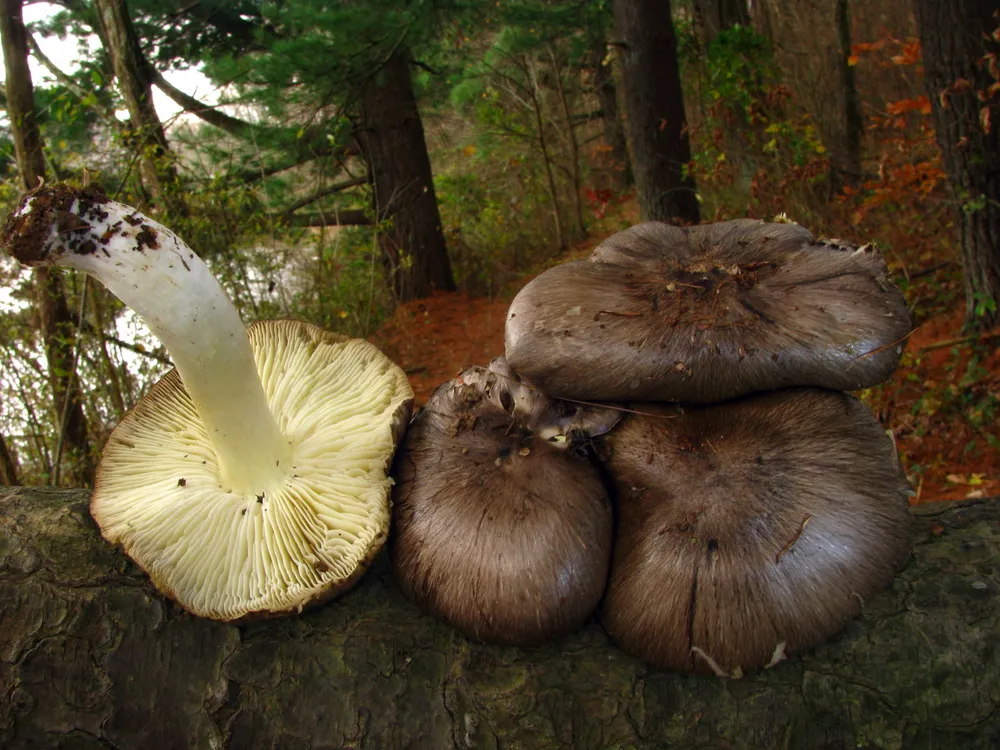
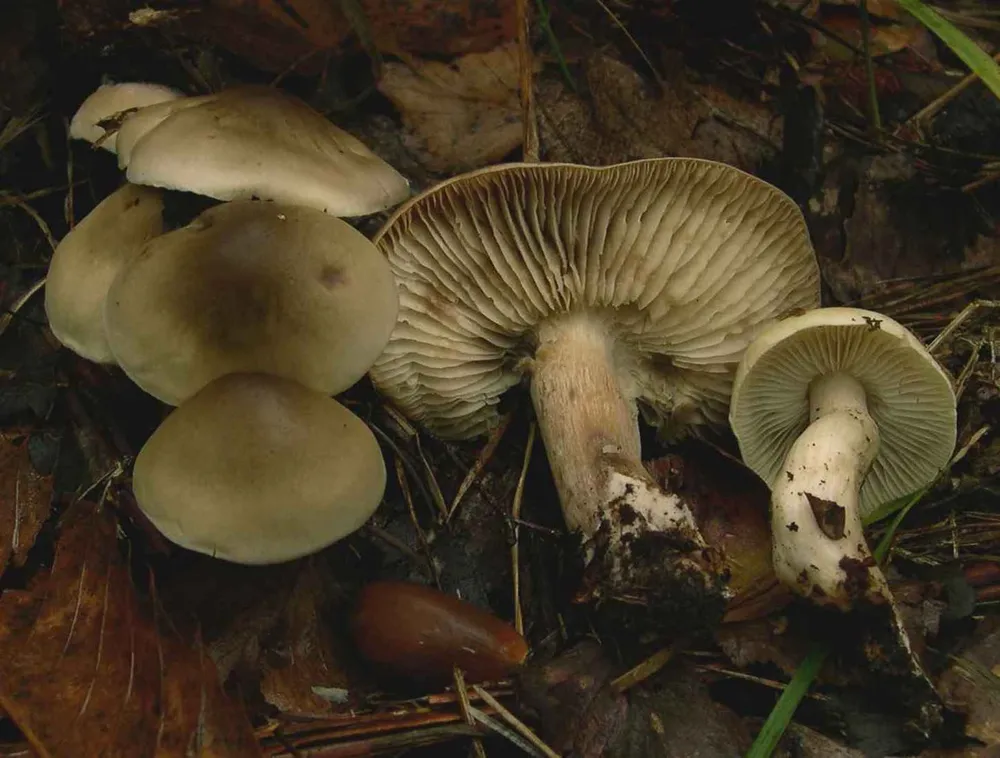
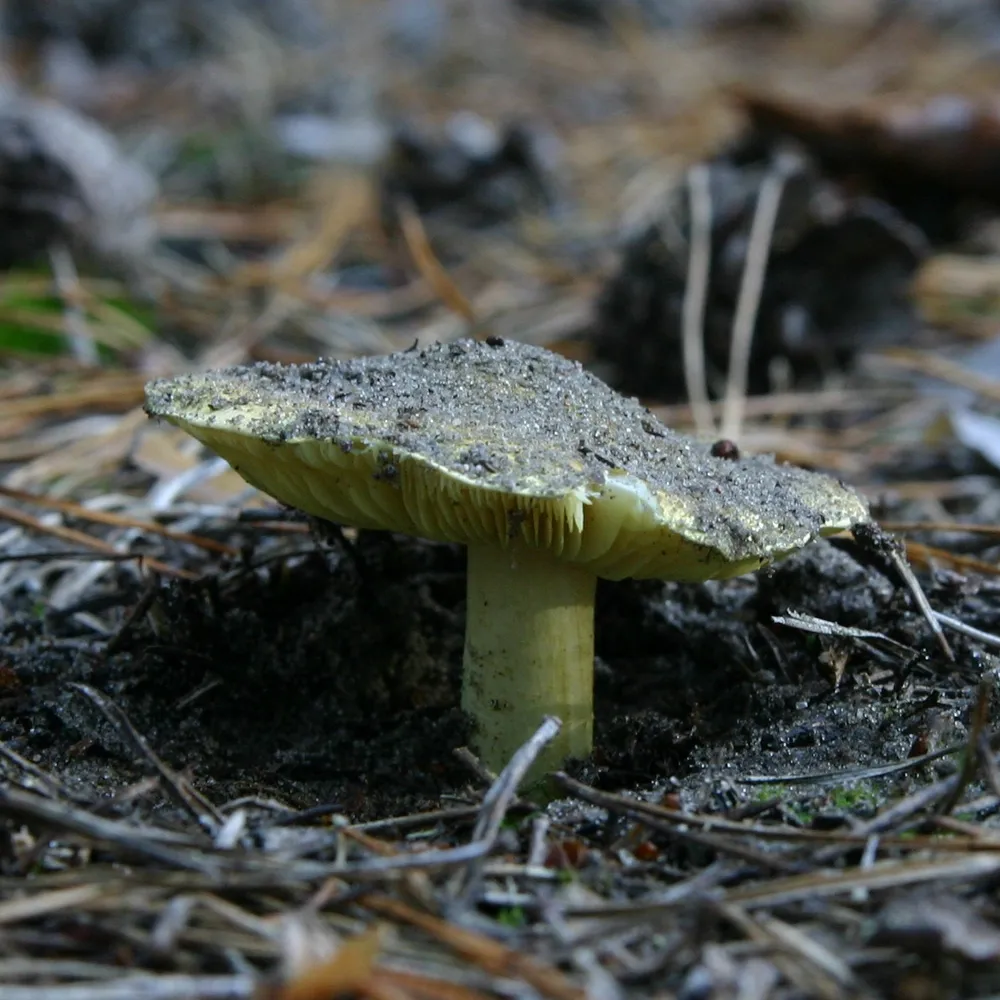
Related species
Mushrooms of the same genus and habitat — to study side by side and never mix up.
_Ricken_185798.webp)
Booted knight
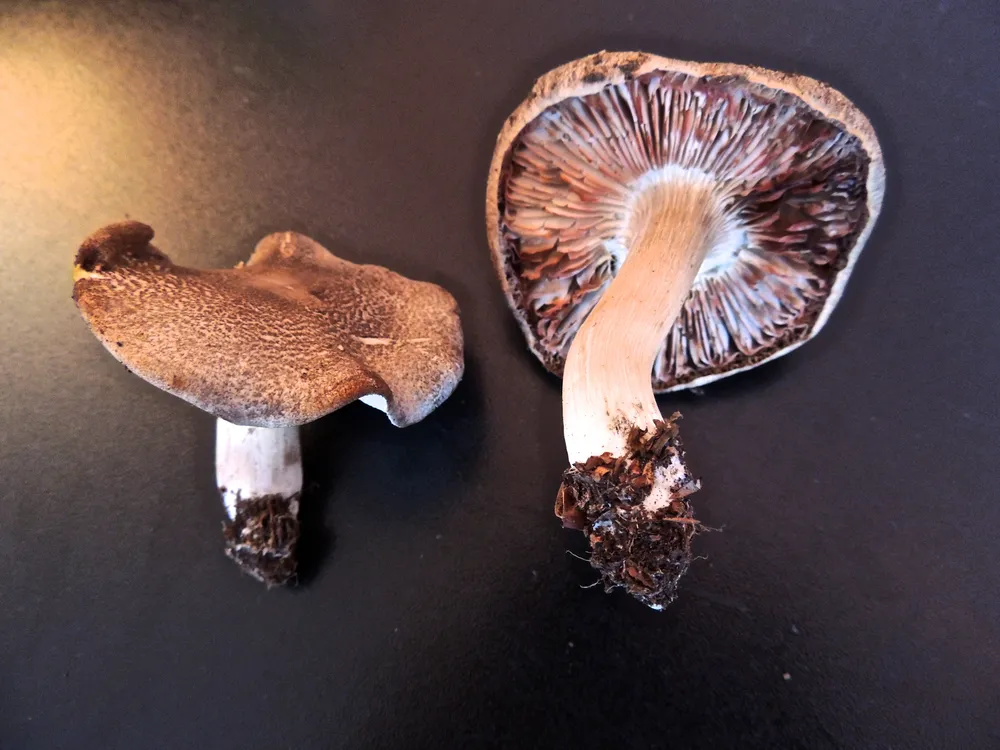
Tricholoma focale
Giant knight
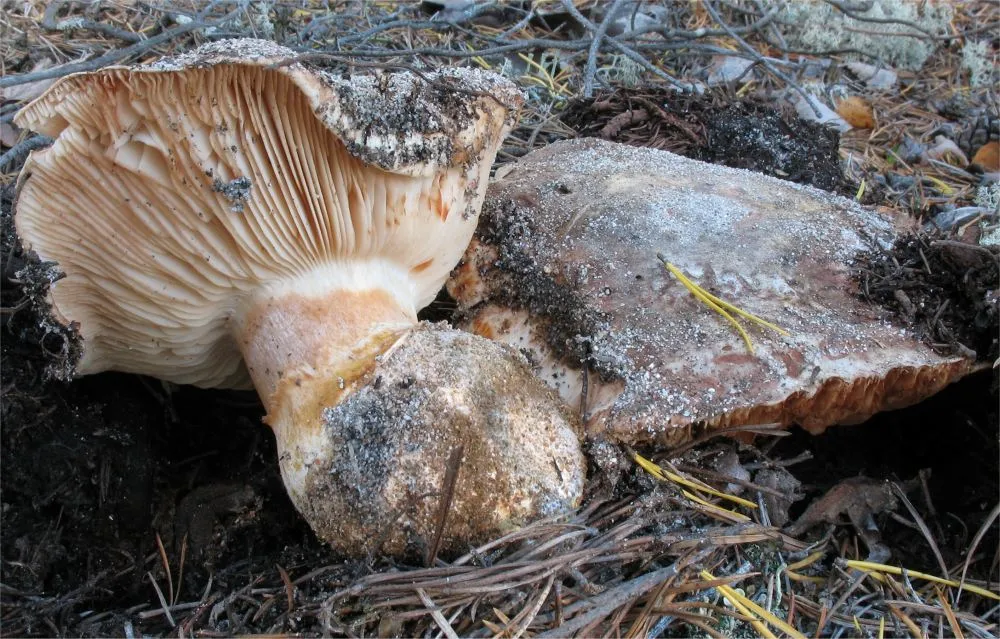
Tricholoma colossus
Matt knight
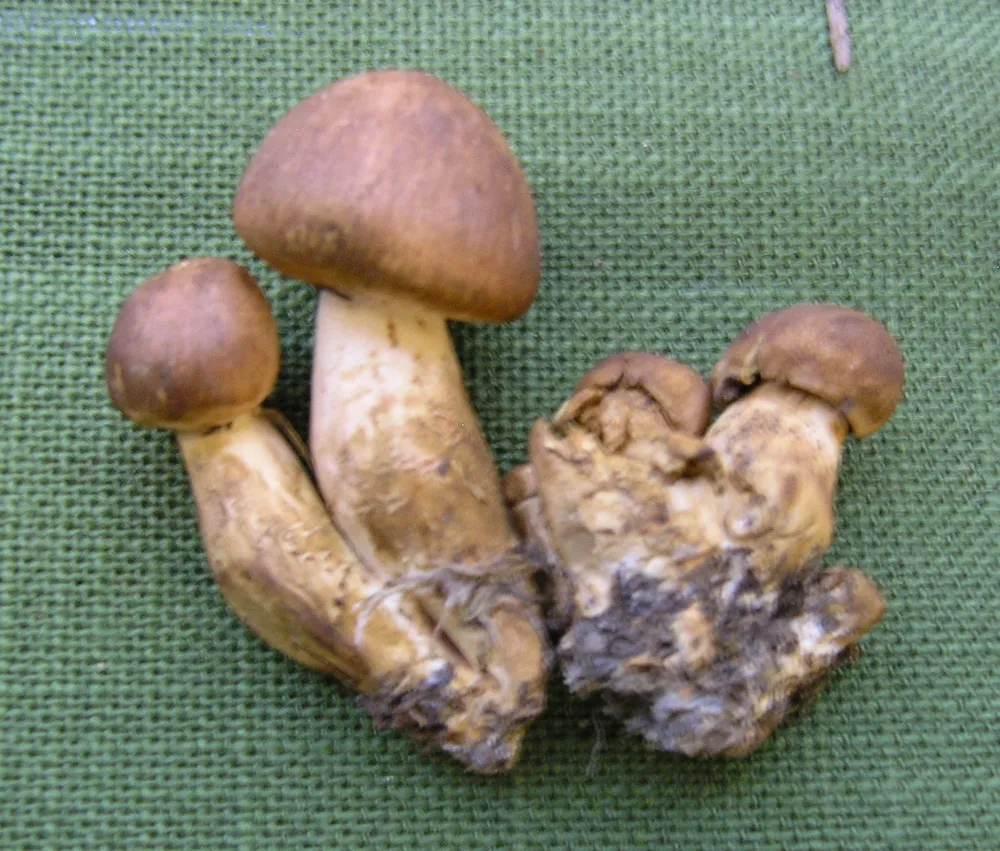
Tricholoma imbricatum
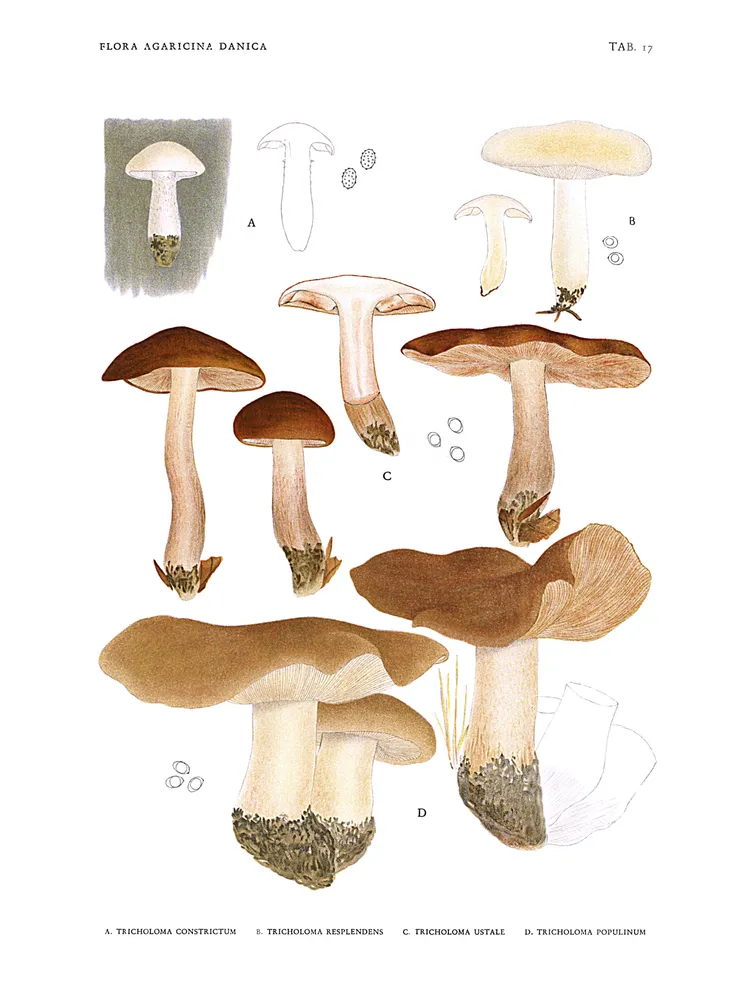
Poplar knight
Рядовка тополева
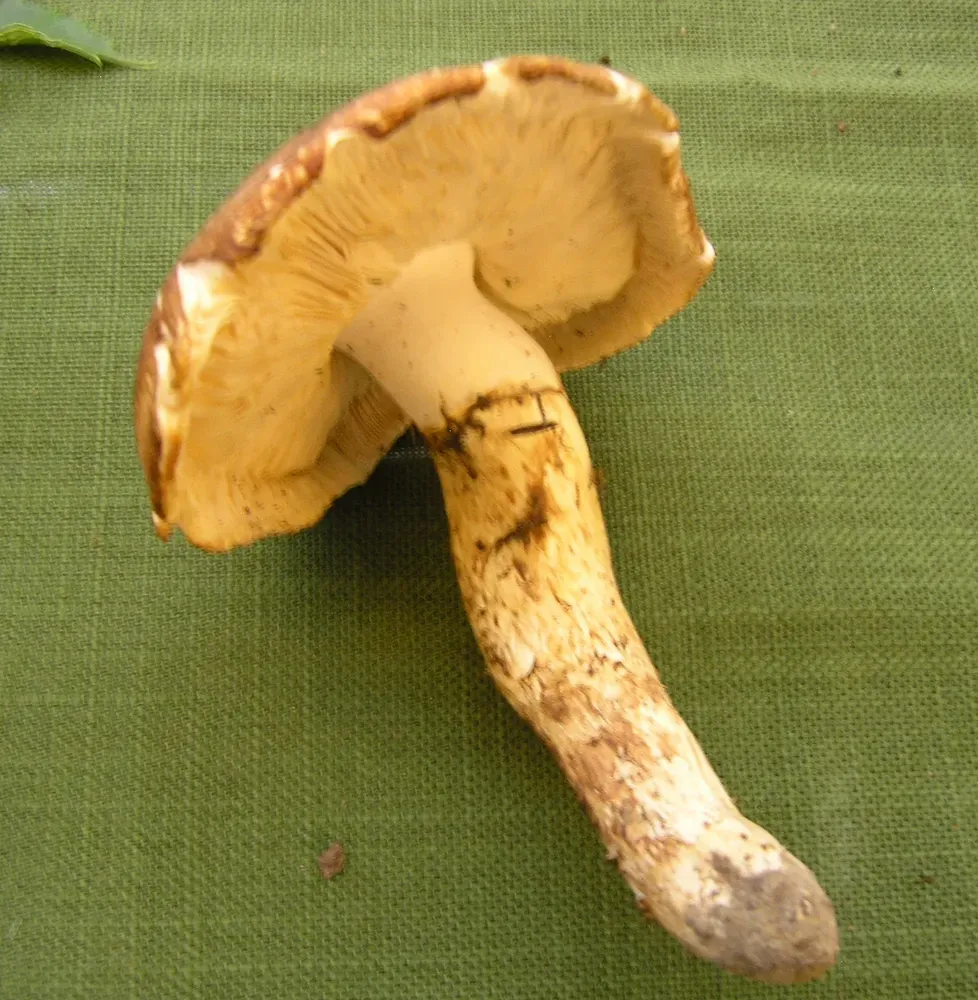
Tricholoma caligatum
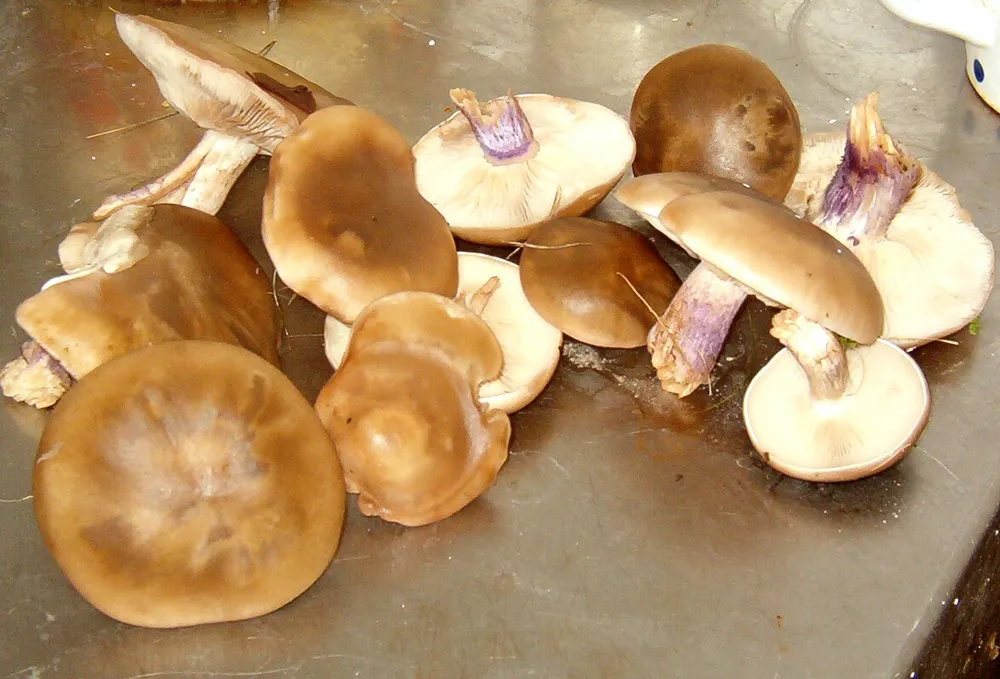
Field blewit
Collybia personata
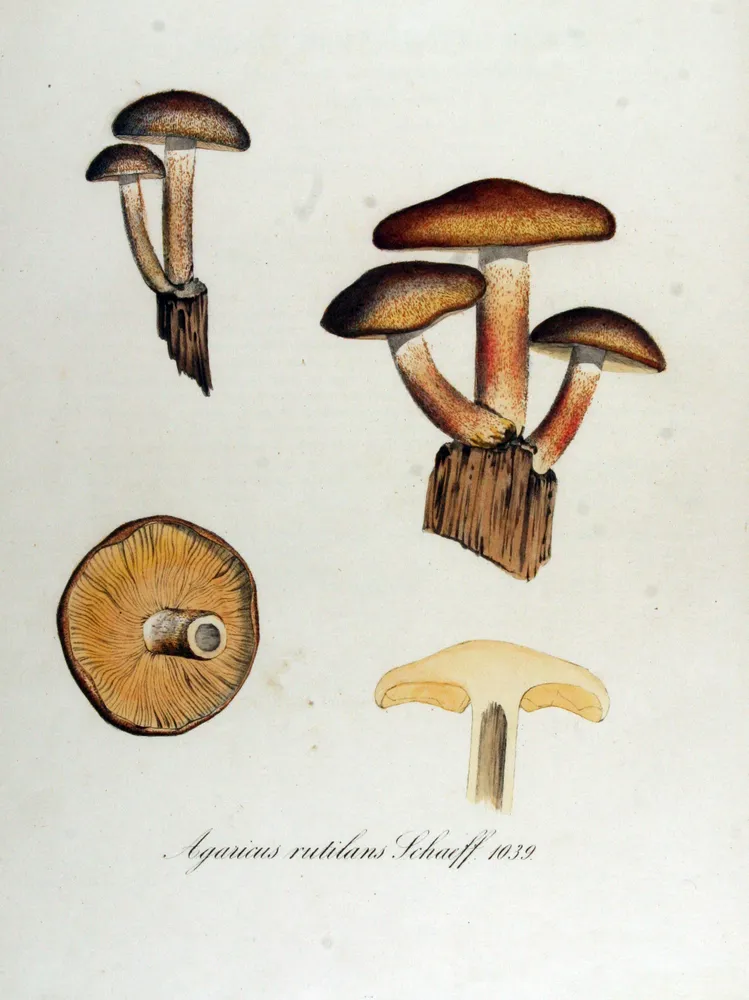
Plums and custard
Рядовка червона
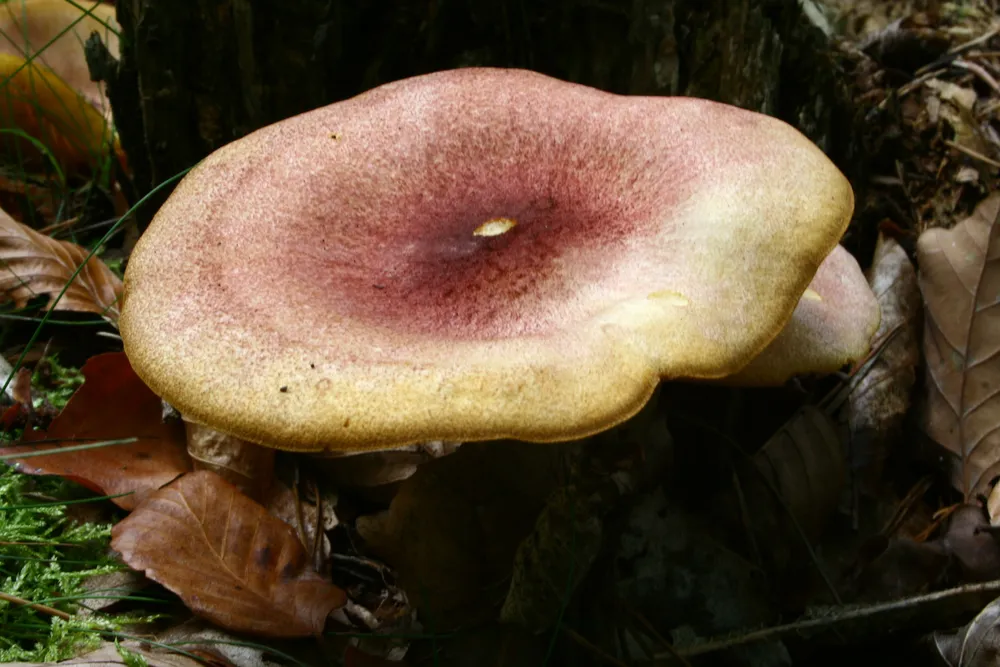
Plums and custard
Tricholomopsis rutilans
Related reading
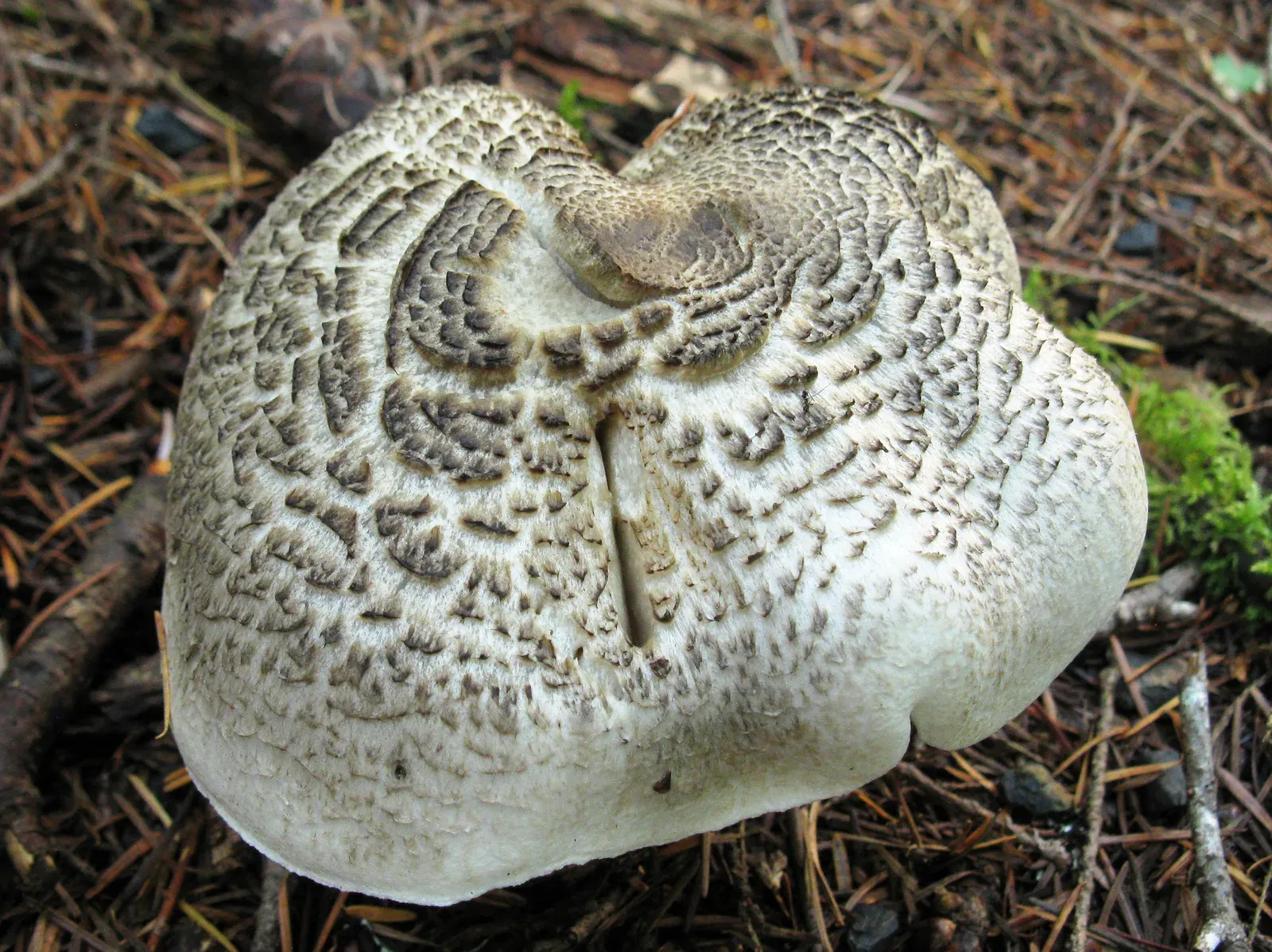 Safety
Tricholoma lookalikes: false and poisonous species
Knights (Tricholoma) are a rewarding autumn family, but it includes poisonous lookalikes, above all the tiger…
July 20, 2026·2 min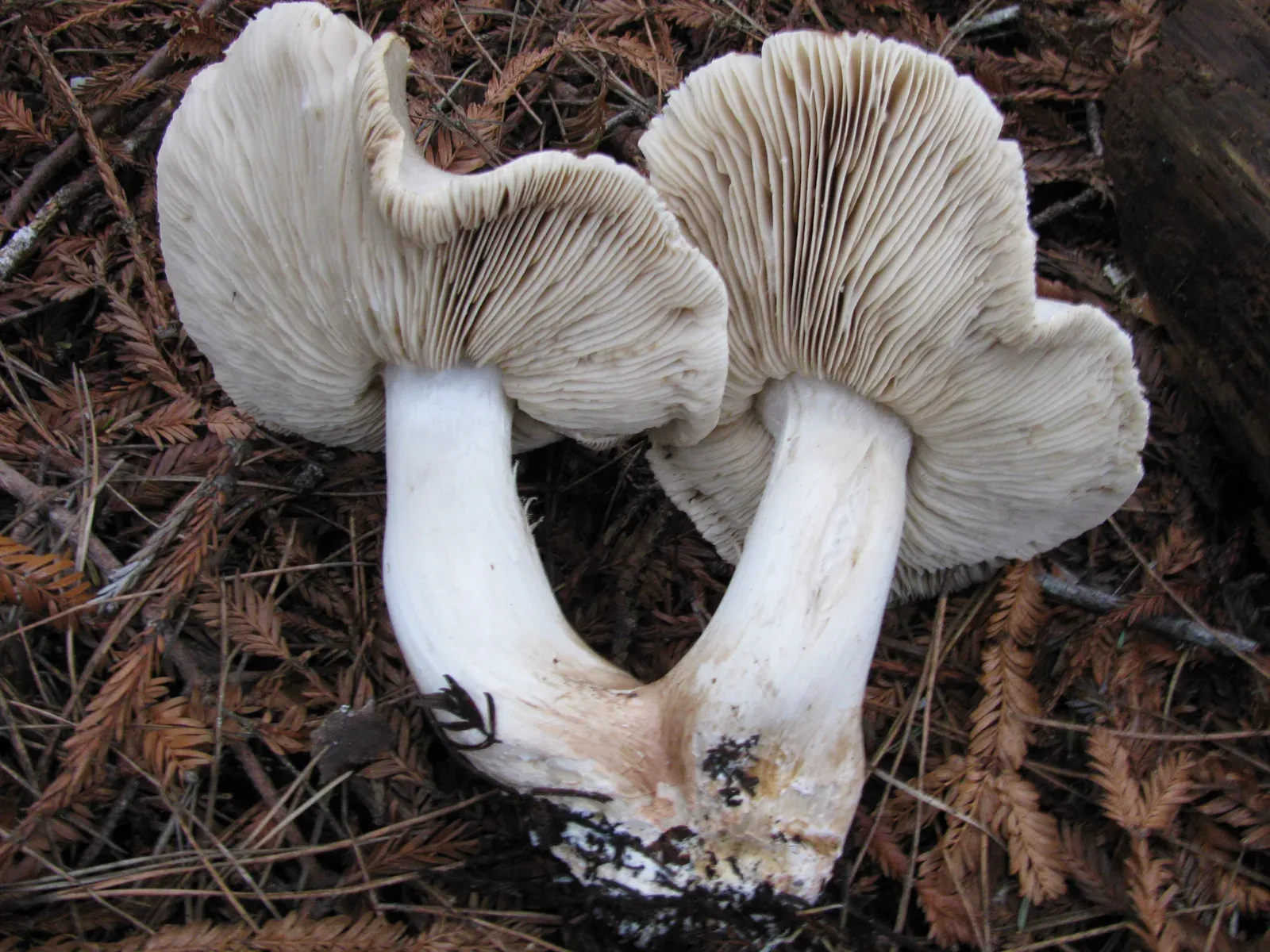 Safety
Poisonous Tricholomas: the tiger tricholoma and other dangerous species
Most knights are edible, but a few species are poisonous — and the most dangerous of them is the tiger (leopar…
July 14, 2026·2 min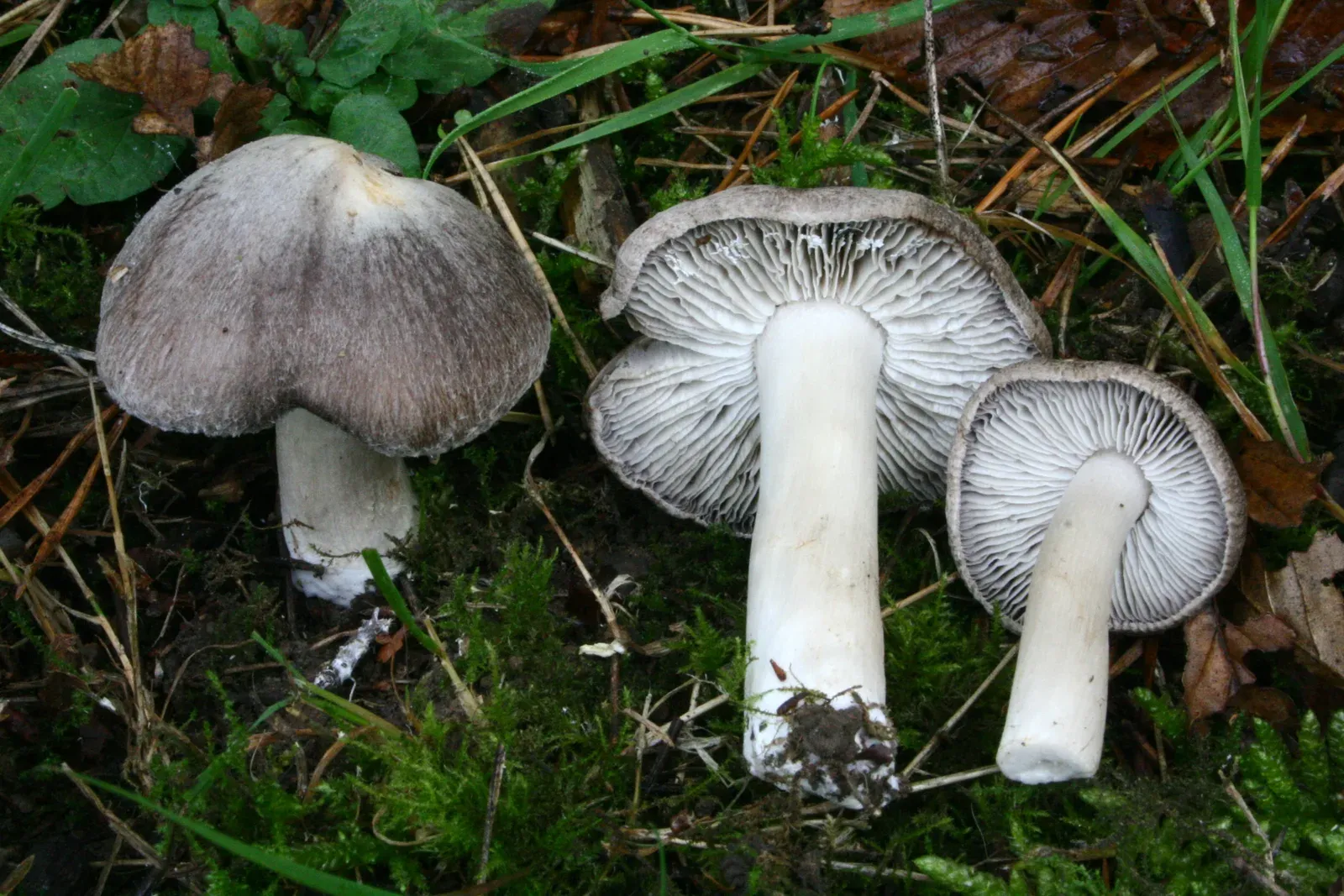 How to identify
Grey knight: how to identify it, and is it edible?
The grey knight, or “mousey”, is a tasty fall mushroom of pine forests. But a large gray cap is easy to confus…
July 14, 2026·2 min
Frequently asked questions
How do you recognize it for sure, so you can avoid it?
Six features taken together. (1) Large size — cap 8-15 cm (sometimes up to 20), very fleshy, heavy. (2) Distinctly scaly, concentric "leopard" spots on a grayish-white cap — not streaks, but actual scales. (3) Very thick flesh, fleshy stem (2-4 cm thick). (4) White gills and white flesh, with no yellowish tint. (5) Mealy smell (not soapy). (6) Grows in deciduous and mixed forests on limestone soils. In doubt — do NOT take it.
How much do you have to eat to be poisoned?
Just 30-50 g of raw or undercooked mushroom is enough to cause gastroenteritis in an adult. For children the dose is smaller. Boiling does not fully neutralize the toxins. There is no "safe dose" — this mushroom is not food in any form.
What should you do if you ate it by mistake?
Call an ambulance immediately — 112 or your local emergency number, even before symptoms appear. Save a sample of the mushroom (fresh or from vomit). If vomiting starts — do NOT suppress it (it is the body's natural cleansing). Drink plenty of oral rehydration solution (Regidron). In hospital — intravenous rehydration, monitoring of electrolytes and kidneys. Do not take loperamide or drink milk!
How do you tell it from the edible T. portentosum (charbonnier)?
T. portentosum is slimmer (5-12 cm), with fine radial streaks on the cap (not scales!), yellowish gills and flesh in the stem, grows in pine forests. T. pardinum is much larger and fleshier, a cap with distinct gray scales in concentric rows, pure white gills and flesh with no yellow, grows in deciduous and mixed forests on limestone. The key check: scales or streaks? Yellowish gills or white?
How do you tell it from T. terreum (grey knight)?
T. terreum is much smaller (3-8 cm), with a cap that is downy and felty (like a mouse's fur), not scaly and spotted. The key difference is the size and texture of the cap: small and downy — that's T. terreum (conditionally edible); large, scaly and spotted — that's T. pardinum (poisonous).
Can it kill?
Under normal circumstances — no (among healthy adults there are practically no deaths with adequate rehydration). But there is a real risk for children under 5, people over 70 with cardiovascular disease, and people with kidney failure — through complications of severe dehydration (collapse, kidney failure, cardiac arrhythmia). Severity depends on how much was eaten and how quickly medical help arrives.
Where might you come across it, so you can recognize it?
In deciduous and mixed forests on limestone or carbonate soils — beech, oak and hornbeam forests on base-rich soil. On the forest floor among grass and moss. In young plantings and in mature dry forests. It does NOT occur in pine forests on sandy soils.
Where in Ukraine does it grow?
Mostly in the Carpathians and Prykarpattia (Zakarpattia, Lviv and Ivano-Frankivsk regions) — beech forests on limestone. Its range is expanding eastward — in recent decades it has been found more often in western Podillia (Ternopil and Khmelnytskyi regions) and in part Polissia.
When might you come across it?
August — November, peaking in September–October. This coincides with the main season of edible knights — hence the risk of picking it by mistake.
Could someone sell it at a market?
Sadly, yes — there have been cases in the Carpathians and Prykarpattia where inexperienced foragers sold it as a "big gray knight". Buy mushrooms only from trusted sellers, and identify what you buy yourself. Large gray knights with scales are a risky mushroom; better to walk past and pick up saffron milk caps, slippery jacks or honey fungus at the market instead.
Is Tiger tricholoma edible or poisonous?
Does Tiger tricholoma have gills or pores?
Sources
- [1]Вікіпедія (українська)
- [2]Атлас грибів України, Зеров Д.К. (1979)
- [3]MycoBank Database
- [4]Index Fungorum
- [5]GBIF
- [6]iNaturalist Ukraine