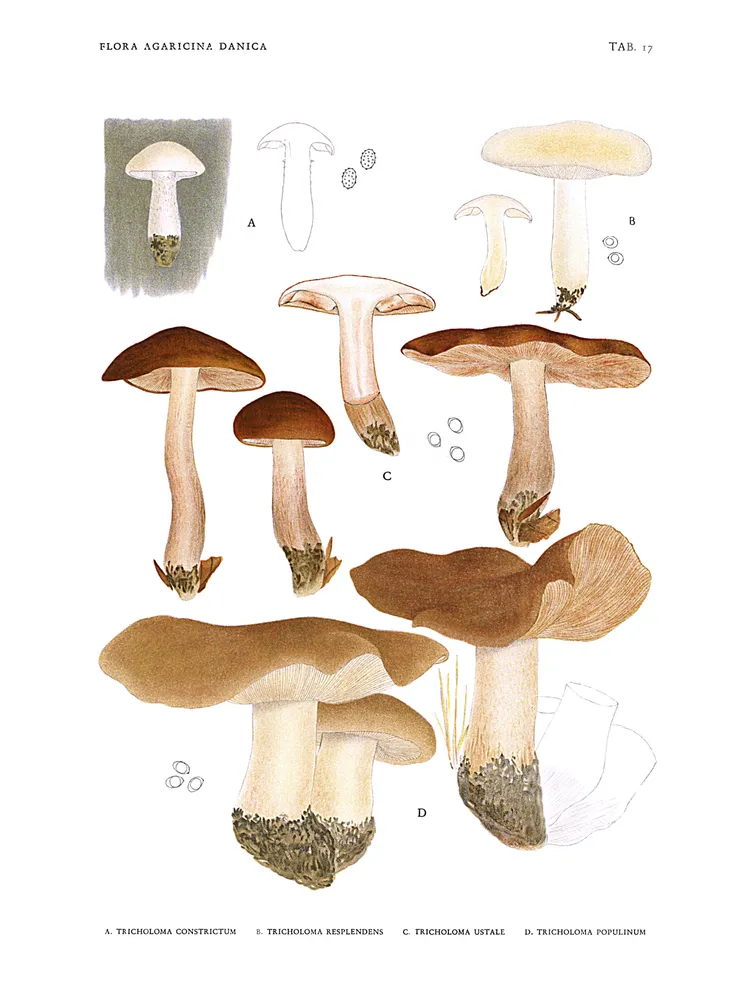
Poplar knightРядовка тополева
Expert-verifiedUpdated June 13, 2026
Passport
- Edibility
- Conditionally edible
- Season
- Aug — Nov
- Hymenophore
- Gilled
- Cap color
- Red
- Size
- Medium (5–15 cm)
- Smell
- Floury
- Reviewed
- Yes ✓
Quick answers
Where to look?
Deciduous forest
When does it appear?
Aug — Nov
Active months: August, September, October, November.
How to recognize it? Three signs
- Cap color: Red, Brown
- Cap shape: Convex
- Smell: Floury
Fruiting season
August – November
Description
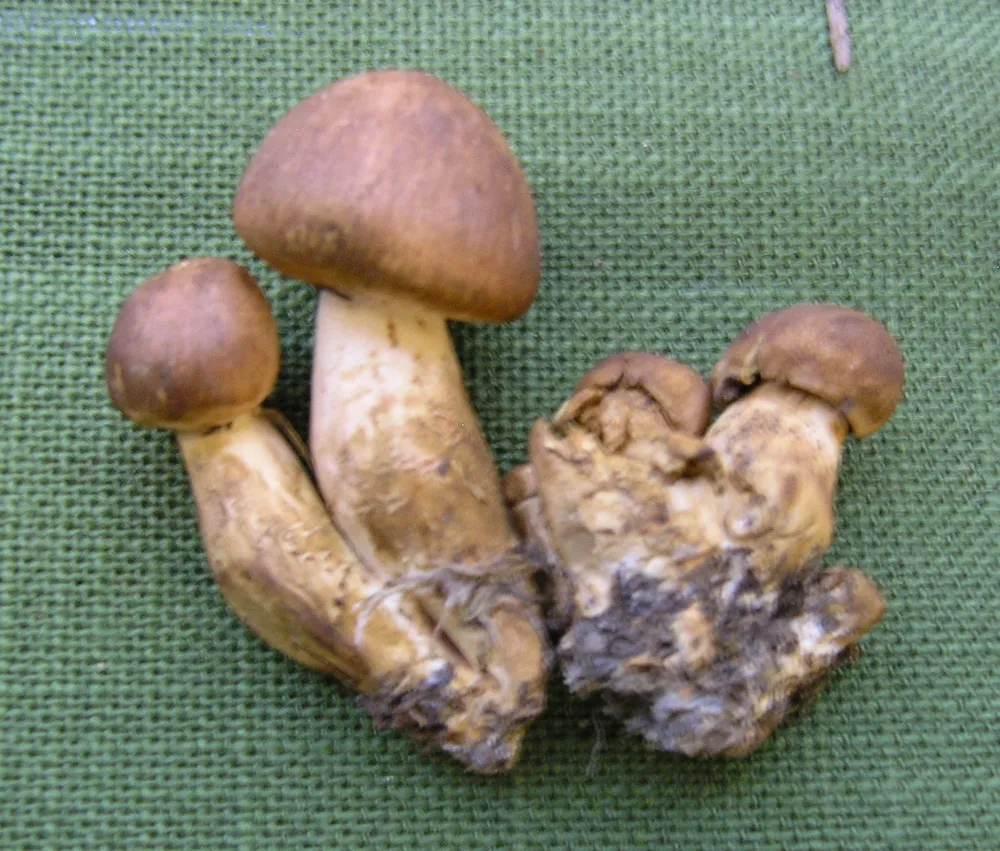
Poplar knight (Tricholoma populinum) is a typical symbiotic knight of poplar stands that fruits wherever poplars grow: shelterbelts, parks, poplar groves, riverside floodplains. The Latin epithet populinum — "of poplars" — points precisely to its mycorrhizal partner: Populus (poplar, aspen). The cap is 5-12 cm across, fleshy, reddish-chestnut-orange with a finely fibrous skin, slimy-sticky in wet weather.
Conditionally edible after mandatory boiling for 15-20 min, discarding the water. In young fruiting bodies the raw flesh has a bitterish, mealy taste that disappears after boiling. Foragers rarely pick it, because its culinary quality is mediocre and people with sensitive digestion often get stomach and gut trouble even after boiling. Older literature calls it "edible, category 4"; today the advice is thorough boiling and starting with a small portion.
The main risk is confusing it with similar brown knights (T. pessundatum, a damp-loving species, and T. ustaloides) and with young poisonous webcaps (Cortinarius spp.), which can also be reddish brown. The key difference: T. populinum's spore print is WHITE, webcaps' is rusty orange. A spore print is a must the first time you pick it.
The mushroom is strictly tied to poplar stands — you won't find it in a pine forest. This is an important diagnostic feature: if you found it under a poplar in a shelterbelt, it is probably T. populinum; if under pines in a pine forest, it is a different brown knight.
In Ukraine, poplar knight is common in poplar stands of the forest-steppe and steppe (especially in the southern regions, where poplar is the main tree of shelterbelts). The season is August — November. It often grows in groups of 5-15 fruiting bodies in the grass near poplar trunks.
Cap
The cap is 5-12 cm across; when young it is convex with an inrolled margin, with age becoming flat and spread out with a slightly wavy margin. The skin is finely fibrous or smooth; slimy-sticky in wet weather, dry and matte in dry weather. Color: reddish chestnut, reddish orange, richer at the center and paler toward the margin. Old fruiting bodies are brownish chestnut with small cracks. The margin is even; in damp conditions it has lengthwise grooves.
Hymenophore
Lamellate hymenophore: the gills are notched (emarginate) at the stem, moderately crowded, fleshy. When young they are whitish, with age becoming cream with rusty spots at the edges. Spore print white.
Stem
The stem is 5-10 cm tall, 1-2.5 cm thick, firm, cylindrical, thickening toward the base when young. Color: whitish at the top, brownish lower down with ochre-chestnut spots. Surface: smooth with lengthwise fibers. No ring.
Flesh
The flesh is firm, white; where cut, it slowly takes on a creamy-brownish tint. Smell: faintly mealy; taste mild at first, then bitterish and mealy with the typical Tricholoma aftertaste.
Smell
Faintly mealy, with a hint of fresh cucumber — typical of many knights.
Lookalikes
Related species
Mushrooms of the same genus and habitat — to study side by side and never mix up.
_Ricken_185798.webp)
Booted knight
Tricholoma focale
Charbonnier
Tricholoma portentosum
Giant knight
Tricholoma colossus
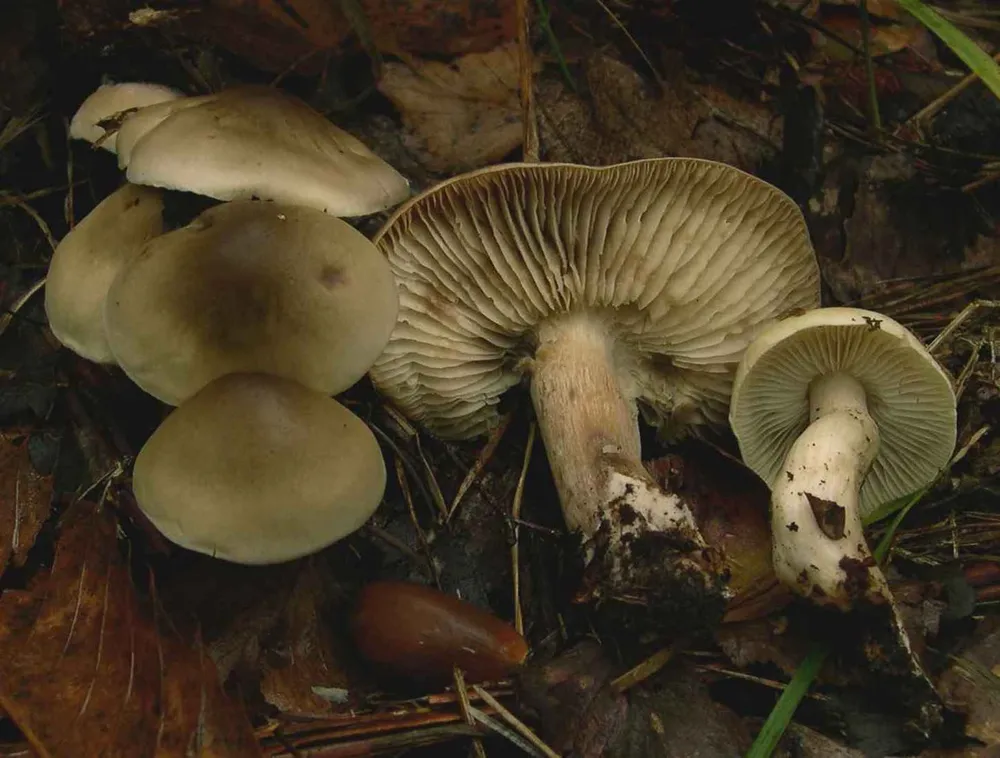
Soapy knight
Tricholoma saponaceum
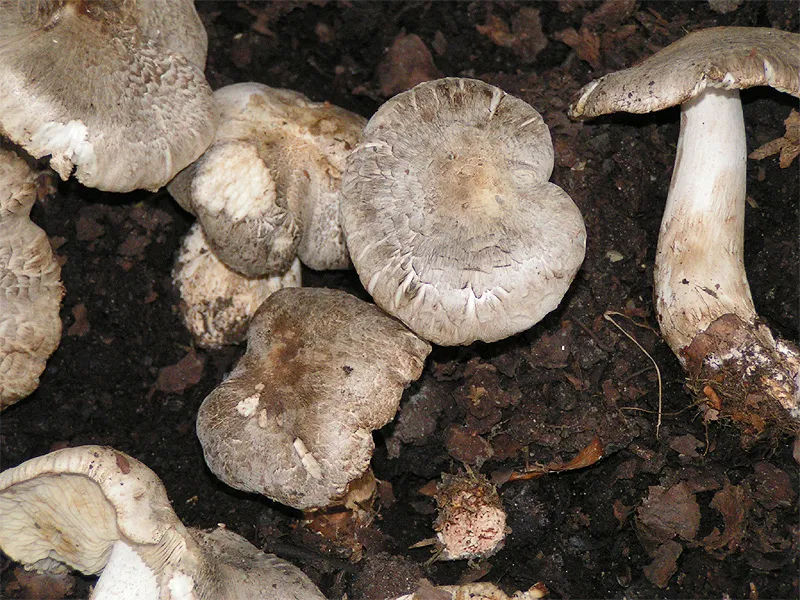
Tiger tricholoma
Tricholoma pardinum
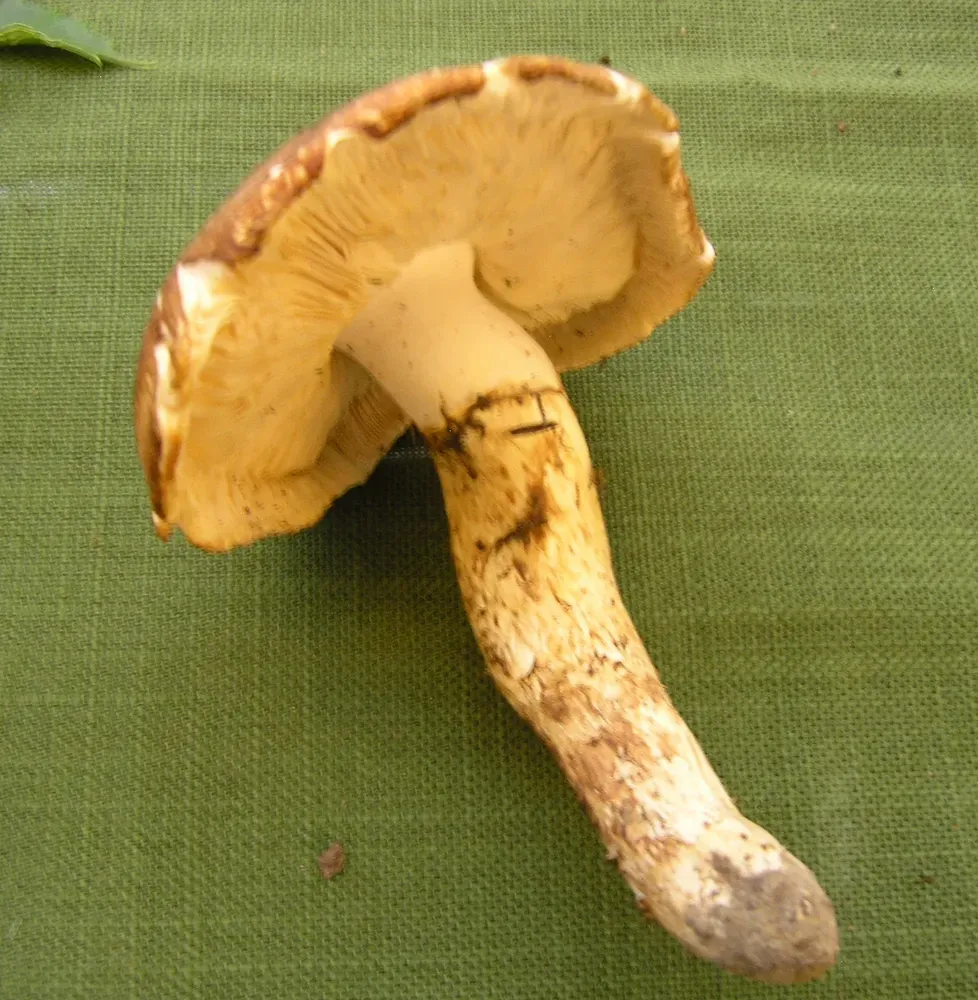
Tricholoma caligatum
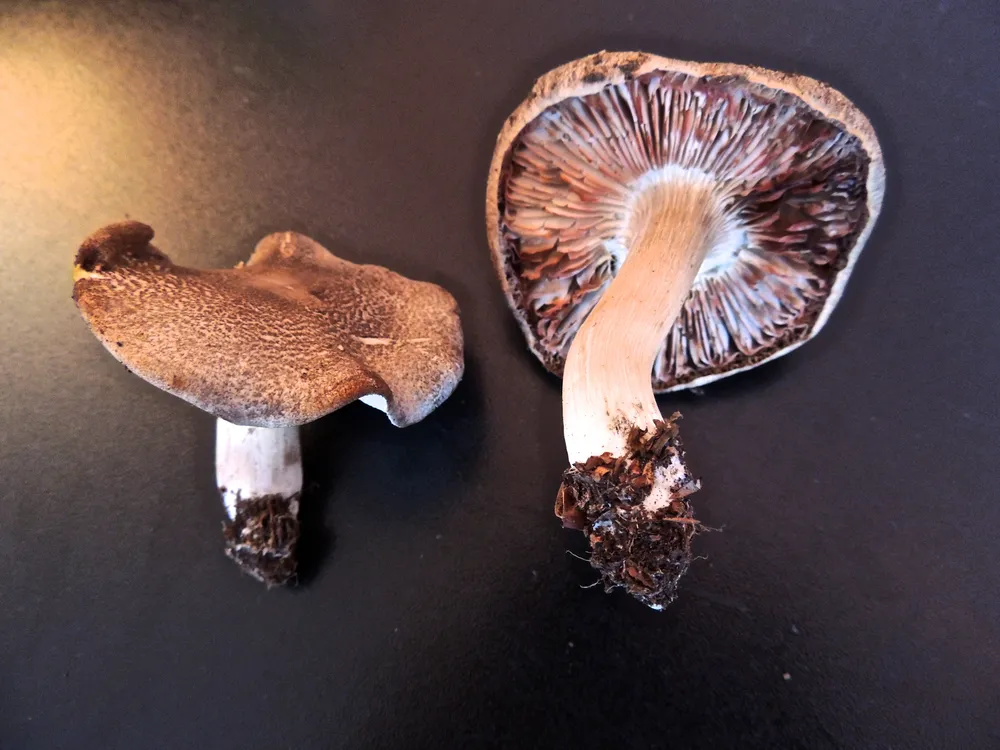
Tricholoma orirubens
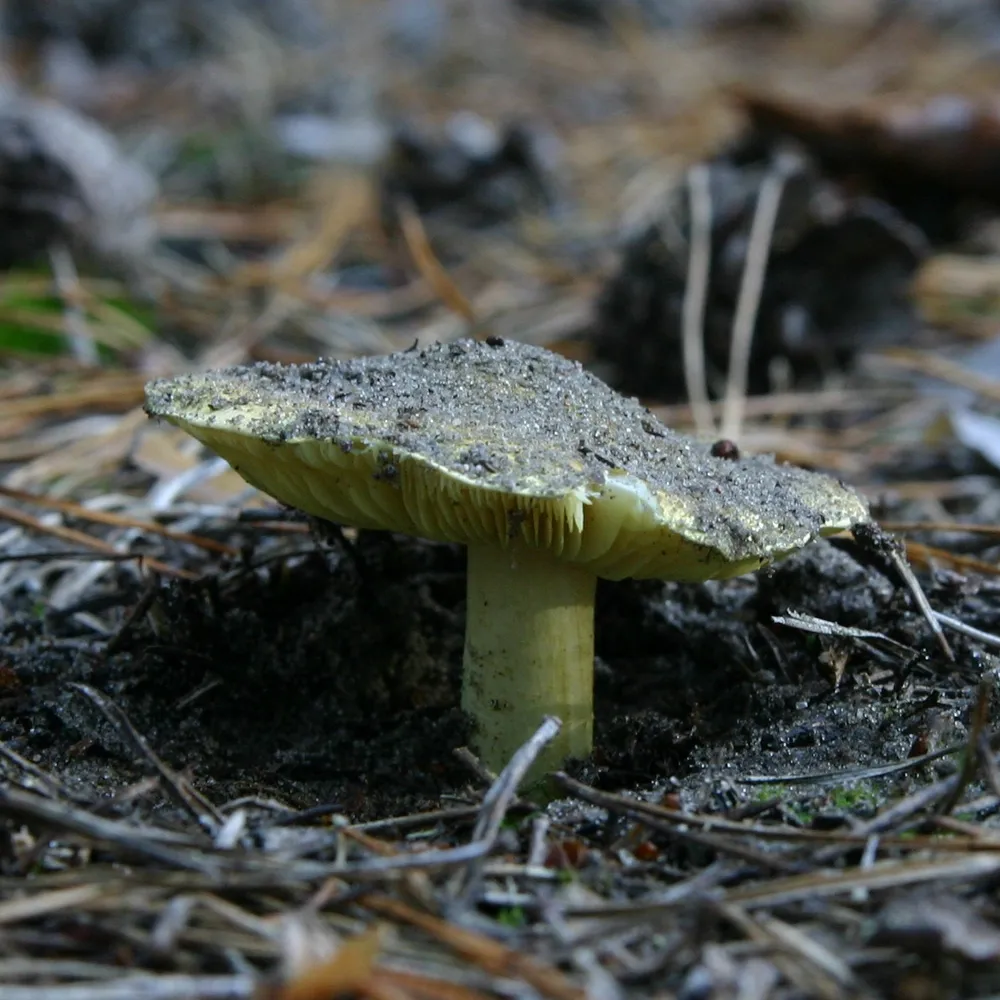
Yellow knight
Tricholoma equestre
Related reading
.webp) How to identify
How to identifyPoplar knight: how to spot this autumn mushroom of poplars
The poplar knight grows only under poplars, often in huge clusters in late fall. It's little known but valuabl…
July 14, 2026·2 min.webp) How to identify
How to identifyTypes of Tricholoma in Ukraine: a complete guide
Knights are a large family of fall mushrooms: the grey knight, poplar knight, wood blewit, yellow knight and o…
July 14, 2026·2 min
Frequently asked questions
Is it worth picking?
You can, but without much enthusiasm. Its culinary quality is mediocre, it must be boiled, and people with sensitive digestion may feel discomfort even after cooking. If there are no tastier mushrooms in the poplar stands, you can add it to a mix. It is not worth making a dish from poplar knight alone.
How do you tell it from poisonous webcaps?
A spore print is a must the first time you meet it. Leave a cap on white paper for 12-24 h: T. populinum gives white, webcaps' is rusty orange. Second check: young webcaps have a cobweb-like veil (cortina) between the cap margin and the stem; the knight has none. Third: habitat — poplar knight grows strictly under poplars, webcaps mostly in conifer forests.
How do you cook it?
Boil it for 15-20 min in salted water and discard the water — no exceptions. Then fry with onion, stew with potatoes, add to soups or pickle. Make your first portion small (50 g) and check how you react. Drying works fine.
Where should you look for it?
In poplar stands — shelterbelts, parks, poplar groves, riverside floodplains, man-made plantings. Strictly near poplars (Populus alba, P. nigra, P. tremula). It often grows in groups of 5-15 fruiting bodies in the grass near the trunks.
Where in Ukraine does it grow?
All over Ukraine, wherever there are poplar stands. Especially abundant in the forest-steppe and steppe (Kirovohrad, Dnipropetrovsk, Zaporizhzhia, Kherson, Mykolaiv and Odesa regions), where poplars are the main shelterbelt tree.
When should you look for it?
August — November, peaking in September–October. In the southern regions it can fruit until the first frosts.
What is it confused with?
With T. pessundatum — also brown, but the cap is always slimy-sticky, and it grows in pine forests. With T. imbricatum (matt knight) — in pine forests, darker, with a "tiled" scaly cap. With young webcaps (Cortinarius spp.) — rusty-orange spore print, cobweb-like cortina. The key check: habitat (poplars mean this knight, pines mean something else) and a spore print.
Is Poplar knight edible or poisonous?
Does Poplar knight have gills or pores?
What does the cap of Poplar knight look like?
What does the stem of Poplar knight look like?
What do Poplar knight smell and taste like?
Sources
- [1]Вікіпедія (українська)
- [2]Атлас грибів України, Зеров Д.К. (1979)
- [3]MycoBank Database
- [4]Index Fungorum
- [5]GBIF
- [6]iNaturalist Ukraine