Tricholoma orirubens
Expert-verifiedUpdated June 13, 2026
Passport
- Edibility
- Conditionally edible
- Season
- Aug — Oct
- Hymenophore
- Gilled
- Cap color
- Grey
- Size
- Medium (5–15 cm)
- Smell
- Floury
- Reviewed
- Yes ✓
Quick answers
Where to look?
Deciduous forest, Mixed forest
When does it appear?
Aug — Oct
Active months: August, September, October.
How to recognize it? Three signs
- Cap color: Grey, Black
- Cap shape: Convex
- Smell: Floury
Fruiting season
August – October
Description
Tricholoma orirubens is an uncommon but distinctive broadleaf-forest knight with a gray-blackish cap that reddens where it is bruised or handled. The Latin epithet orirubens means "the one that turns red" (ori- — "mouth", "edge"; rubens — "reddening") — a nod to the distinct reddening reaction of the flesh, gills and cap when damaged. This is the most important diagnostic feature of the species.
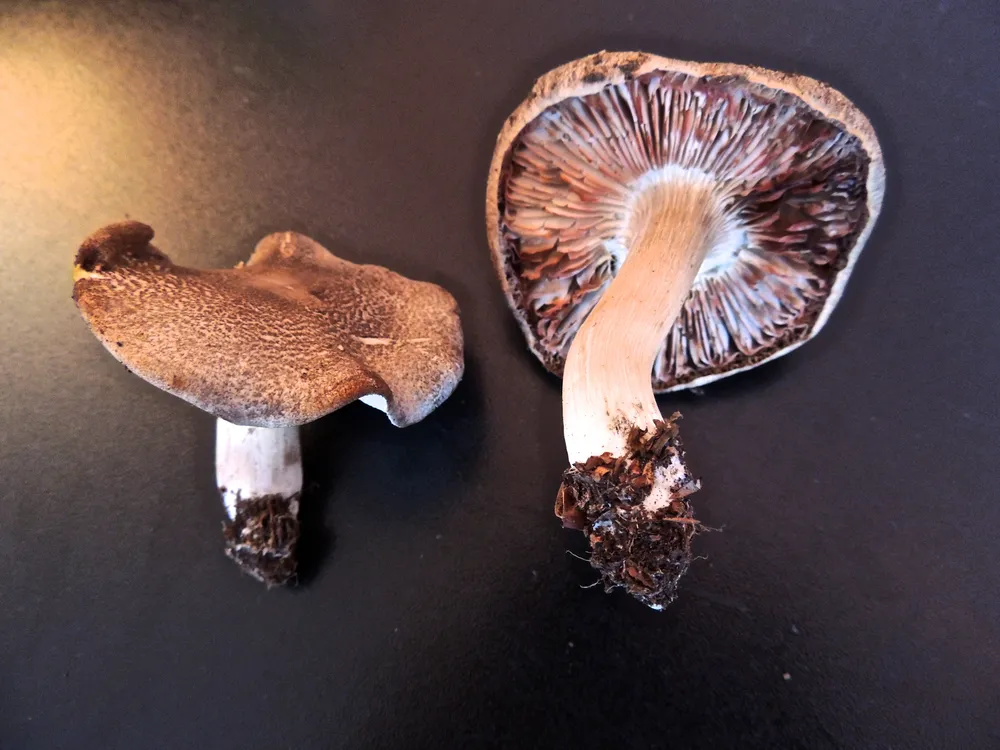
Cap 5-10 cm across, fleshy, convex to flat and spreading, gray to blackish-gray, with distinct fine black fibrous scales, especially in the center. When damaged (pressed or cut), the cap, gills and flesh take on a distinct pink or reddish-pink tint — the reaction is slow, after 15-30 min.
Conditionally edible after boiling. Young fruiting bodies have a pleasant mealy smell and a mild taste with a subtle nutty note; culinary value is moderate. Foragers almost never pick it, since it is uncommon and resembles other gray knights (including the poisonous T. pardinum). The literature lists it as "edible after boiling", but because it is rare and hard to identify, it is not recommended for beginners.
Main diagnostic features: (1) a distinct reddening reaction when damaged; (2) a gray-black cap with fine black fibrous scales; (3) yellowish mycelium remnants at the stem base; (4) it grows in broadleaf forests (beech, oak, hornbeam) on alkaline and neutral soils.
The main risk is confusing it with the poisonous T. pardinum (tiger tricholoma). Key differences: T. orirubens is smaller (5-10 cm vs 8-15 cm), with a distinct reddening reaction (T. pardinum does not change color), with finer black scales (T. pardinum has large concentric leopard-like patches), with yellow mycelium remnants (T. pardinum has no yellow). Even so — if in doubt, DO NOT pick it.
In Ukraine, Tricholoma orirubens is uncommon, known from beech and oak forests of the Carpathians, Prykarpattia (the Carpathian foothills) and Western Podillia. Season: August — October.
Cap
Cap 5-10 cm across, when young convex with an inrolled margin, becoming with age flat-convex with a small umbo. The cap skin is matte, with distinct fine black radially fibrous scales on a gray-white to gray-blackish background. The base color is gray-white to ash-gray, darker in the center. When pressed, or with age, it takes on a pinkish-red tint where touched — a diagnostic feature.
Hymenophore
Gilled hymenophore — the gills are sinuately attached to the stem, moderately crowded, fleshy. When young — whitish, becoming with age cream-colored, with a distinct pinkish-red tint where damaged or touched. Spore print white.
Stem
Stem 5-8 cm tall, 1-2 cm thick, firm, cylindrical, thickening toward the base. Color whitish to grayish, with characteristic yellow-cream mycelium remnants at the stem base — a diagnostic feature. The surface is smooth with fine lengthwise fibers. No ring.
Flesh
Flesh firm, white, turns pinkish-red 15-30 min after being damaged — a characteristic reaction. Smell distinctly mealy, taste mild, not bitter, with a subtle nutty note.
Smell
A distinct, pleasant mealy smell — like freshly ground flour.
Lookalikes
Related species
Mushrooms of the same genus and habitat — to study side by side and never mix up.
_Ricken_185798.webp)
Booted knight
Tricholoma focale
Charbonnier
Tricholoma portentosum
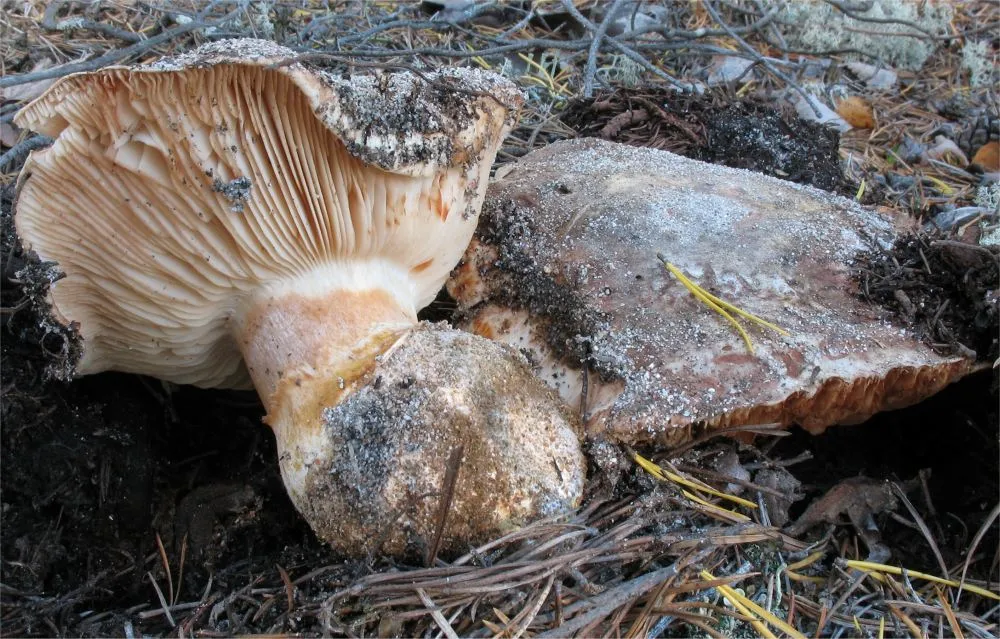
Giant knight
Tricholoma colossus
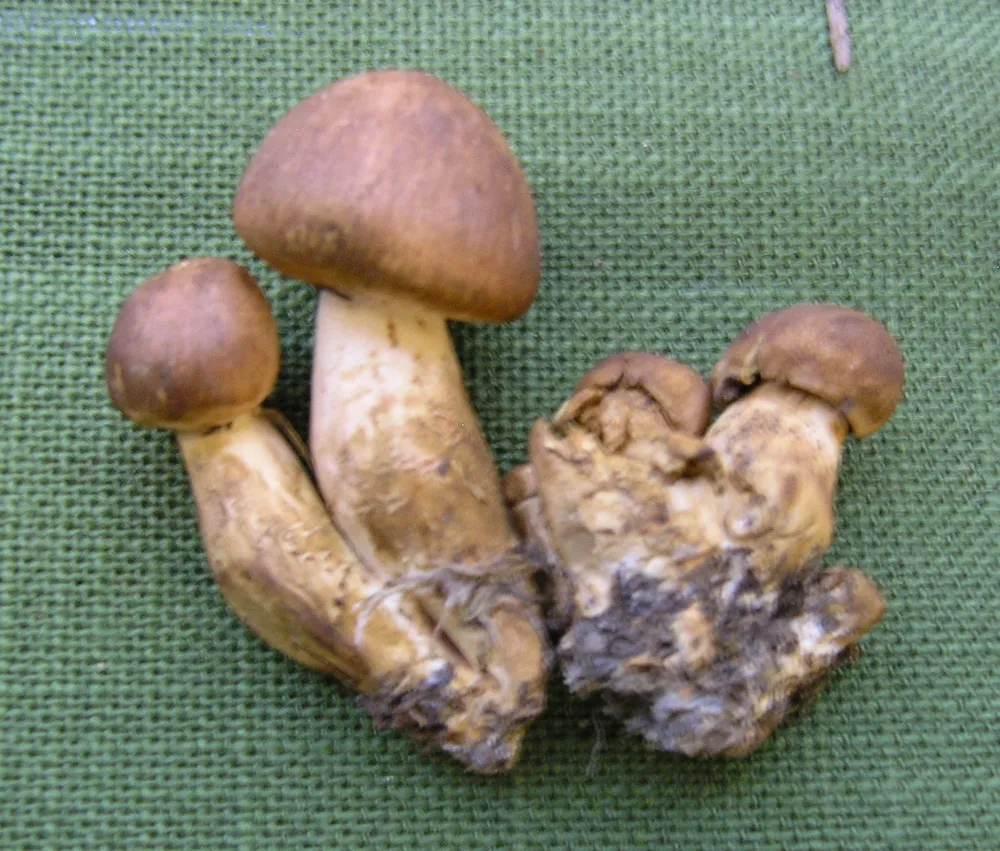
Matt knight
Tricholoma imbricatum
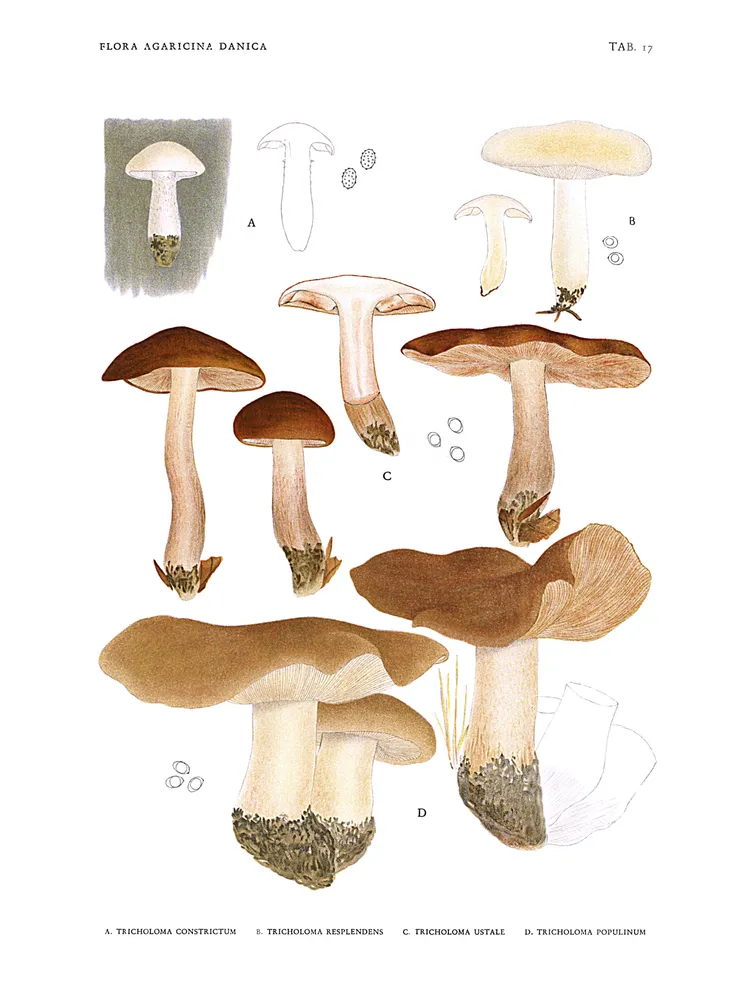
Poplar knight
Рядовка тополева
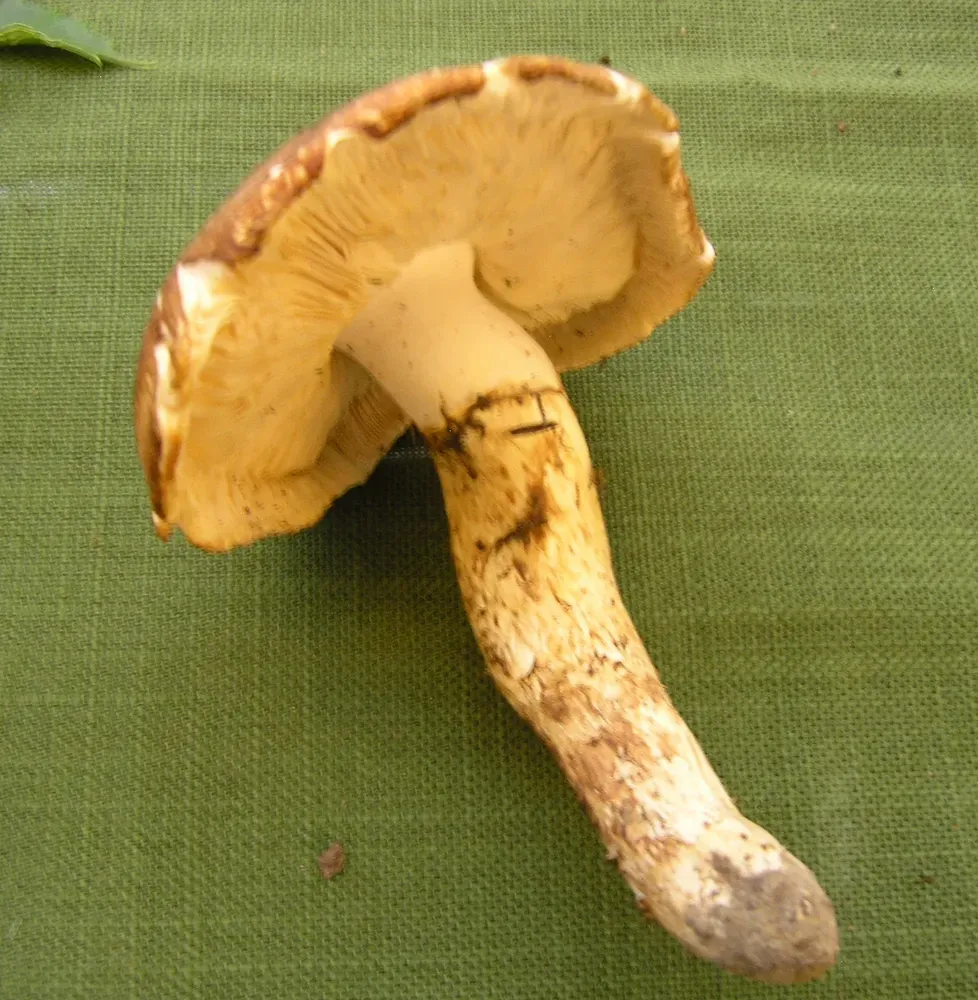
Tricholoma caligatum
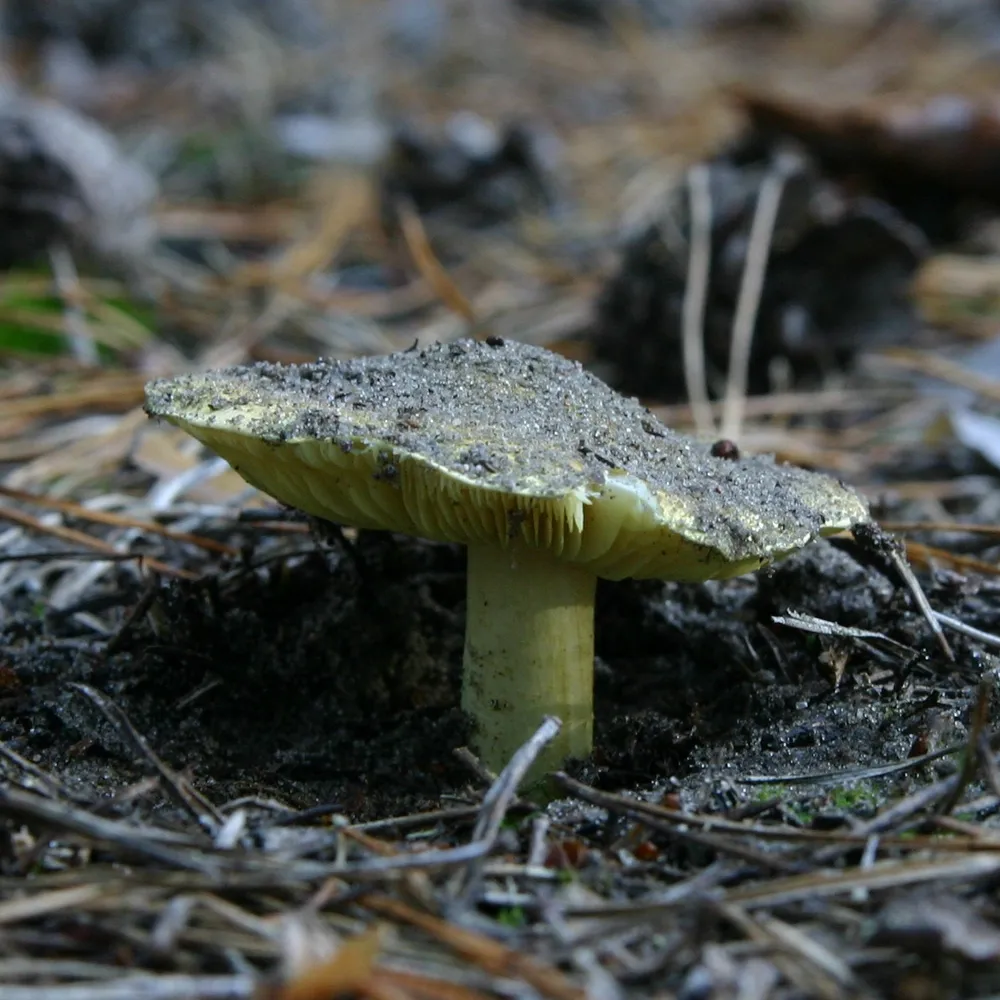
Yellow knight
Tricholoma equestre
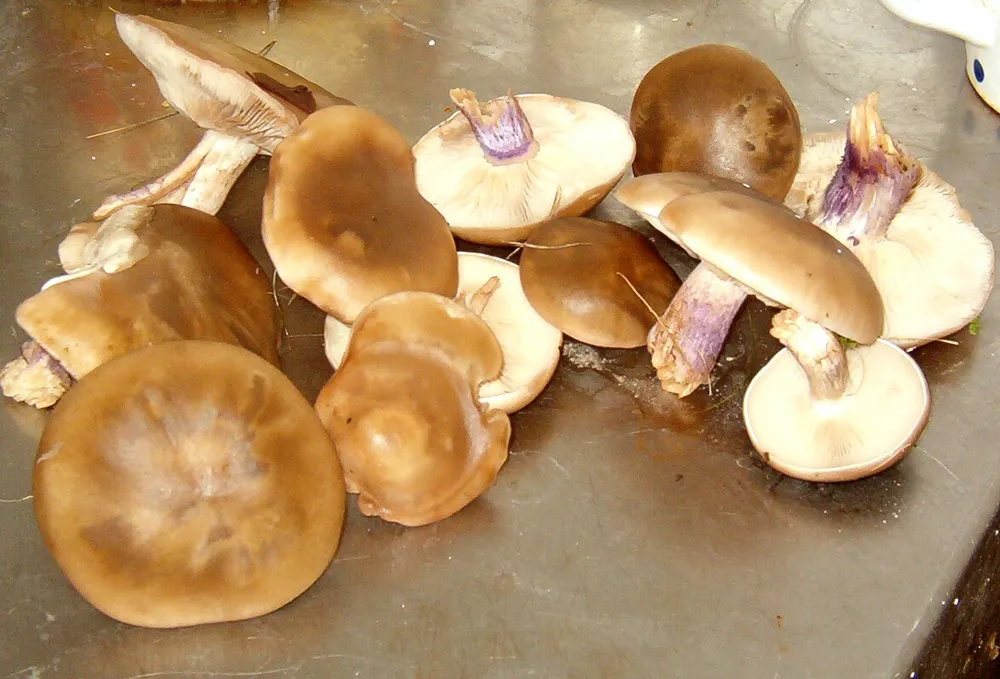
Field blewit
Collybia personata
Frequently asked questions
How can you identify it for sure?
Four features taken together. (1) A distinct reddening reaction of the flesh and gills when damaged (after 15-30 min) — the most important one. (2) A gray-black cap with fine black fibrous scales. (3) Yellow-cream mycelium remnants at the stem base. (4) It grows in broadleaf forests on alkaline and neutral soils (beeches, oaks). If not all the features are there — don't pick it.
How do you tell it apart from the poisonous T. pardinum?
Key differences. T. orirubens: smaller (5-10 cm), with a reddening reaction, scales fine, black and fibrous (not large patches), with yellow mycelium at the base. T. pardinum: much larger (8-15 cm), NO reddening reaction (the flesh stays white), with large gray-white scales in concentric rows ("leopard-like"), no yellow mycelium. If it's a large mushroom with leopard-like scales and the flesh doesn't redden — DO NOT pick it, it's T. pardinum (poisonous!).
How do you cook it?
First boil it for 10-15 min in salted water, then drain the water. After that — fry it with onions, stew it, or add it to soups. Culinary value is moderate — best in a mix with tastier mushrooms. Keep your first portion small to check how you react.
Is it worth picking?
Not for beginners, because it is hard to identify among the gray knights and could be confused with the poisonous T. pardinum. If you can confidently recognize it by the reddening reaction and yellow mycelium — go ahead, but its culinary value is moderate. If in doubt — walk on by.
Where should you look for it?
In broadleaf forests on alkaline and neutral soils — beech, oak and hornbeam woods. On the forest floor among moss and grass. It loves limestone or carbonate soils.
Which regions of Ukraine is it found in?
Mainly in the Carpathians, Prykarpattia and western Podillia — in beech and oak forests on limestone. Less often in Polissia. It does not occur in the steppe.
When should you look for it?
August — October, peaking in September.
Which mushrooms is it confused with?
With T. pardinum (poisonous) — no reddening reaction, large scales. With T. saponaceum (soapy knight) — it can also turn pinkish, but the smell is distinctly soapy. With T. atrosquamosum (black-scaled) — also gray with black scales, but with no reddening reaction. The key test is the flesh reaction: wait 30 min after cutting and take a look.
Is Tricholoma orirubens edible or poisonous?
Does Tricholoma orirubens have gills or pores?
What does the cap of Tricholoma orirubens look like?
What does the stem of Tricholoma orirubens look like?
Sources
- [1]Вікіпедія (українська)
- [2]Атлас грибів України, Зеров Д.К. (1979)
- [3]MycoBank Database
- [4]Index Fungorum
- [5]GBIF
- [6]iNaturalist Ukraine