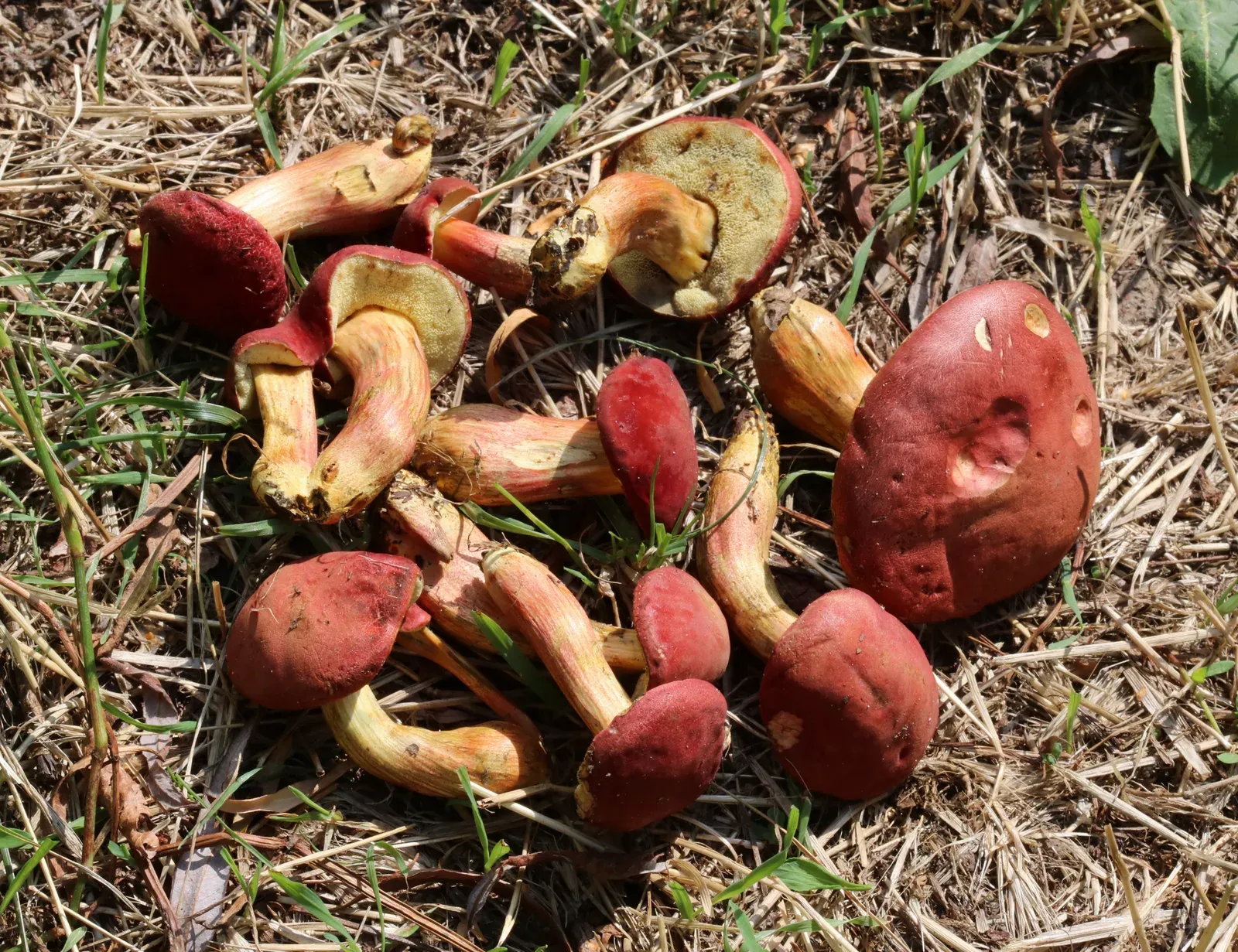
If a bright red mushroom cap flashes at you from the moss or grass, chances are it's the ruby bolete (Boletus rubellus), which field guides also call the many-colored bolete. It's the most colorful of our Xerocomus boletes.
It's small and delicate, but it fully deserves its share of attention: it's hard to mistake for anything else. Let's look at how to recognize it, where to find it, and whether it belongs in your basket.
How to recognize it
The ruby bolete's main feature is right there in its name: its vivid color.
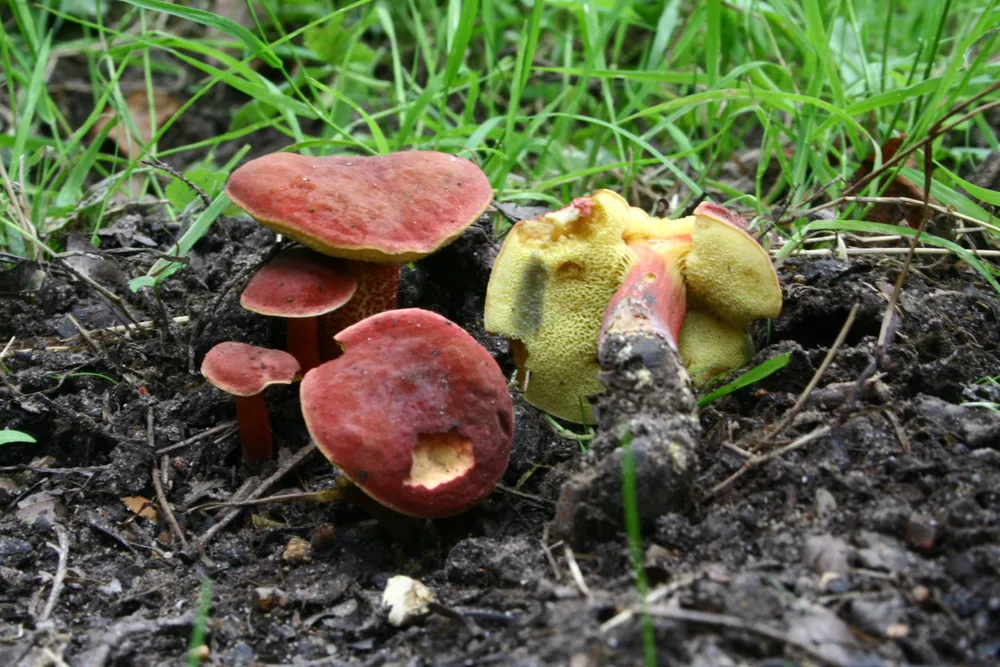
- Cap red, carmine, cherry or pinkish brown, dry and velvety, cracking slightly with age.
- Tubes yellow or greenish yellow, with large pores.
- Stem slender, often with a distinct red or pink tint toward the base.
- Flesh yellowish, turning blue when cut, especially at the base of the stem.
It's the bright red cap combined with yellow pores and blue-staining flesh that makes this mushroom so recognizable. Among its modest gray-brown relatives, it looks like a guest dressed for a party.
Why it turns blue when cut
Like most Xerocomus boletes, the ruby bolete turns blue when cut, and that's perfectly normal.
When you cut the mushroom, the flesh quickly takes on a bluish tint in the air, especially at the base of the stem. This is an ordinary oxidation reaction, not a sign of poison.
Near the base of the stem, this species often shows tiny reddish dots in the flesh, another telltale feature. The blue color disappears during cooking.
Where and when to look for it
The ruby bolete loves bright, warmer spots, most often in deciduous forests.
- in deciduous forests, along forest edges and in clearings, often under oak;
- in mixed forests, where broadleaf trees grow alongside conifers;
- on grassy roadsides, in parks and old plantations.
Its season is long, from June through October. It's a warmth-loving mushroom, so it fruits more actively in warm weather after rain.
Is it worth picking
The ruby bolete is edible, but it has a quirk: it's small, thin-fleshed and fragile. You won't get a big harvest out of it.
Its flesh is soft and watery, so the mushroom ages fast and turns mushy. Pick it while very young and cook it right away, together with other mushrooms.
It's poorly suited to pickling and drying, but works just fine fried or in soup. You can easily tell it from the suede and red cracking boletes by its bright cap, but all of them are edible.
The only unpleasant lookalike among these boletes is the fiery peppery bolete with reddish pores. To know exactly when to head out for Xerocomus boletes, check our mushroom radar: it shows when moisture and warmth line up just right for mushrooms to appear.
Sources
- “Identification Guide to the Fungi of Ukraine” (Kyiv, Naukova Dumka publishers).
- Hortiboletus rubellus on GBIF, the global biodiversity database.
- Hortiboletus on MycoBank, the international fungal nomenclature database.
- Hortiboletus rubellus on Wikipedia.
Frequently asked questions
How do you recognize the ruby bolete?
By its bright red, carmine or cherry velvety cap, yellow pores underneath, a slender stem with a reddish tint, and flesh that turns blue when cut.
Which Xerocomus bolete is red?
It's the (Boletus rubellus), the most colorful of our Xerocomus boletes. Its bright cap makes it very easy to recognize.
Why does the ruby bolete turn blue when cut?
It's a natural oxidation reaction of the flesh in the air, especially at the base of the stem. The bluing is harmless, isn't a sign of poison, and disappears during cooking.
Where does the ruby bolete grow?
Mostly in and , along forest edges, in clearings and on grassy roadsides, often under oak. It's a warmth-loving mushroom.
Is the ruby bolete edible?
Yes, it's edible, but small, thin-fleshed and fragile. Pick it young and cook it fresh, ideally together with other mushrooms.
Why are there reddish dots at the base of the stem?
It's a hallmark of the species: tiny reddish dots show in the flesh near the base of the stem. They're harmless and help you identify the mushroom.
When should you pick the ruby bolete?
The season runs from June through October. As a warmth-loving mushroom, it fruits more actively in warm weather after rain.
Can the ruby bolete be confused with a poisonous mushroom?
It has no poisonous lookalikes. The only one to watch out for is the fiery , which stands out with its reddish pores and hot, peppery taste.
Mushrooms in this article
Related articles
 How to identify
Truffles in Ukraine: do they grow here, and where to look
Truffles aren't just a French delicacy. Several species grow in Ukraine too. Here's which ones, where they occ…
August 24, 2026·2 min Recipes & cooking
How to store fresh mushrooms, and for how long
Fresh mushrooms spoil faster than you might think. Here's how long they keep in the fridge, how to store them…
August 21, 2026·4 min Recipes & cooking
How long to boil mushrooms
Boiling time depends on the type of mushroom and on what you're cooking next. Here's a clear cheat sheet: how…
August 22, 2026·4 min