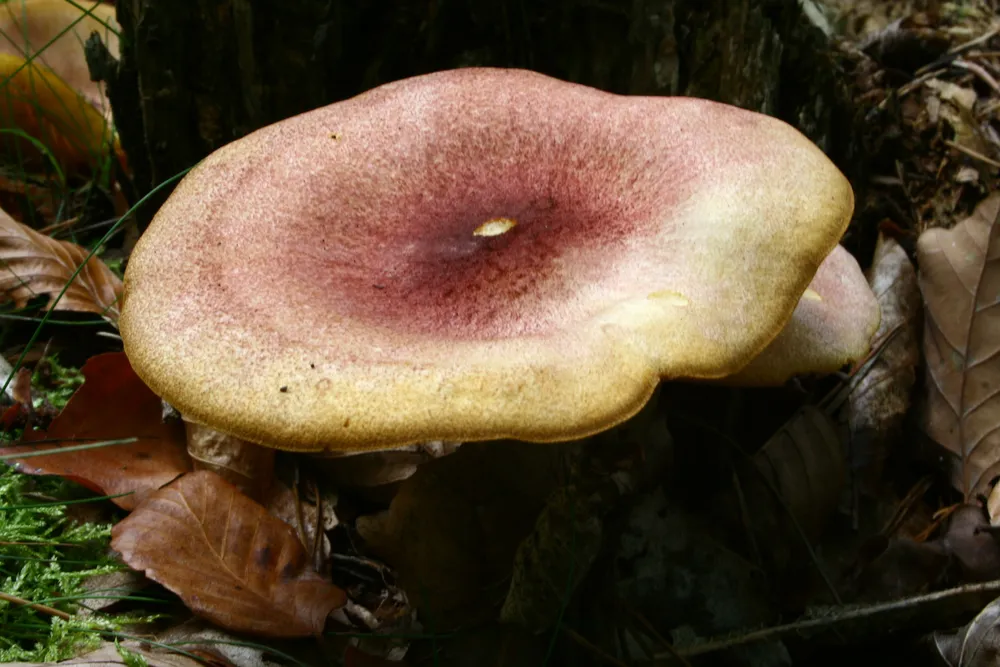
Plums and custardTricholomopsis rutilans
Expert-verifiedUpdated October 3, 2026
Passport
- Edibility
- Conditionally edible
- Season
- Aug — Oct
- Hymenophore
- Gilled
- Cap color
- Yellow
- Size
- Medium (5–15 cm)
- Smell
- Odorless
- Reviewed
- Yes ✓
Quick answers
Where to look?
Conifer forest, Mixed forest
When does it appear?
Aug — Oct
Active months: August, September, October.
How to recognize it? Three signs
- Cap color: Yellow, Red, Violet
- Cap shape: Convex
- Smell: Odorless
Fruiting season
August – October
Description
Plums and custard (Tricholomopsis rutilans) is a bright, easy-to-recognize mushroom of conifer stumps with a distinctive combination of yellow gills and a red-purple-raspberry downy cap. The Latin epithet rutilans, "reddening, glowing raspberry," captures the color perfectly. The cap is 4-12 cm across, convex to flat, golden-yellow, but covered in dense, tiny red-purple fibrous scales that create the effect of a "mottled carpet" or "flames." Young ones are especially bright, with red clearly dominating; old ones are more yellow with rusty streaks.
Conditionally edible: young fruit bodies can be cooked after boiling for 10-15 min and discarding the water, but its culinary value is low — the flesh is cottony, with a sourish-bitter taste that doesn't fully disappear in cooking. Old Soviet literature lists it as "edible, category 4"; today the advice is to boil it first, and when in doubt, walk on by. It usually doesn't cause serious gastrointestinal reactions.
This mushroom is a saprotroph of dead conifer wood (pine, spruce), growing on stumps and fallen trunks. Thanks to its bright coloring it's easy to spot even from a distance. Unlike the true knights (Tricholoma), it belongs to a separate genus, Tricholomopsis, with related but somewhat different ecology and anatomy.
The main thing is to recognize it, because it's very photogenic and often turns up in photo collections. It's hard to confuse with anything seriously poisonous (no lookalikes share its combination of yellow gills and red scales).
In Ukraine plums and custard is common in coniferous and mixed forests: the Carpathians, Prykarpattia, Polissia, and in places the forest-steppe within pine woodlands. The season runs August to October. It often grows in groups of 3-10 fruit bodies on a single stump.
Cap
Cap 4-12 cm across, in young specimens convex with an inrolled margin, becoming with age flattened and spreading, with a slightly wavy margin. The cap skin is golden-yellow, densely covered in tiny red-purple fibrous scales, especially in the center, where the scales can merge into a solid red field. Toward the margin the scales thin out and yellow dominates. In old fruit bodies it is mostly yellow-ochre with rusty spots.
Hymenophore
Gilled hymenophore — the gills are notched-attached to the stem, crowded, fleshy, distinctly golden-yellow (one of the brightest yellow hymenophores among the knights). Spore print white to cream — a hallmark of the genus Tricholomopsis (not pink, as in Rhodocollybia).
Stem
Stem 4-8 cm tall, 0.8-2 cm thick, cylindrical, hollow inside in older specimens. Color: yellowish to yellow-orange, the lower part covered in the same red-purple scales as the cap. Surface dry and fibrous. No ring.
Flesh
Flesh yellowish, thin and cottony in the cap, rather tough in the stem. No noticeable color change when cut. Smell faintly mushroomy, with a note of wood or rotten wood in mature specimens, taste mild, with a sourish-bitter aftertaste.
Smell
Faintly mushroomy with woody notes, nothing distinctive. Not sharp.
›Scientific synonyms (7)
Agaricus aurantius Batsch, Gymnopus rutilans (Schaeff.) Gray, Tricholoma rutilans (Schaeff.) P. Kumm., Cortinellus rutilans (Schaeff.) P. Karst., Gyrophila rutilans (Schaeff.) Quél., Pleurotus rutilans (Schaeff.) Dumée, Flammula squamulosa Velen.
Lookalikes
Related species
Mushrooms of the same genus and habitat — to study side by side and never mix up.
_Ricken_185798.webp)
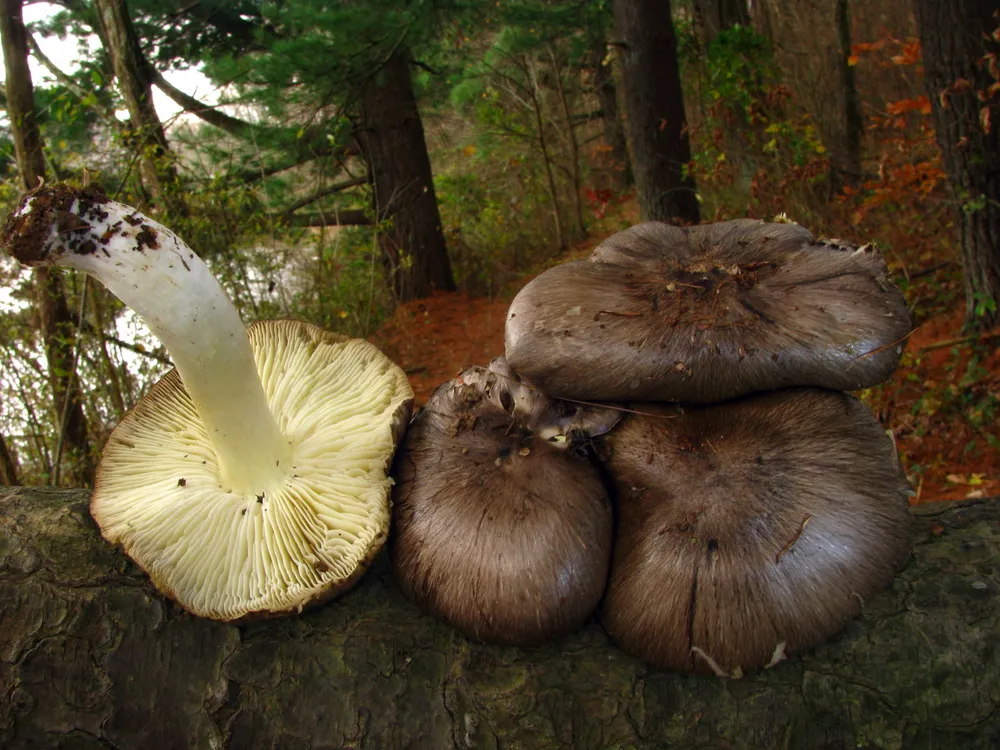
Booted knight
Tricholoma focale
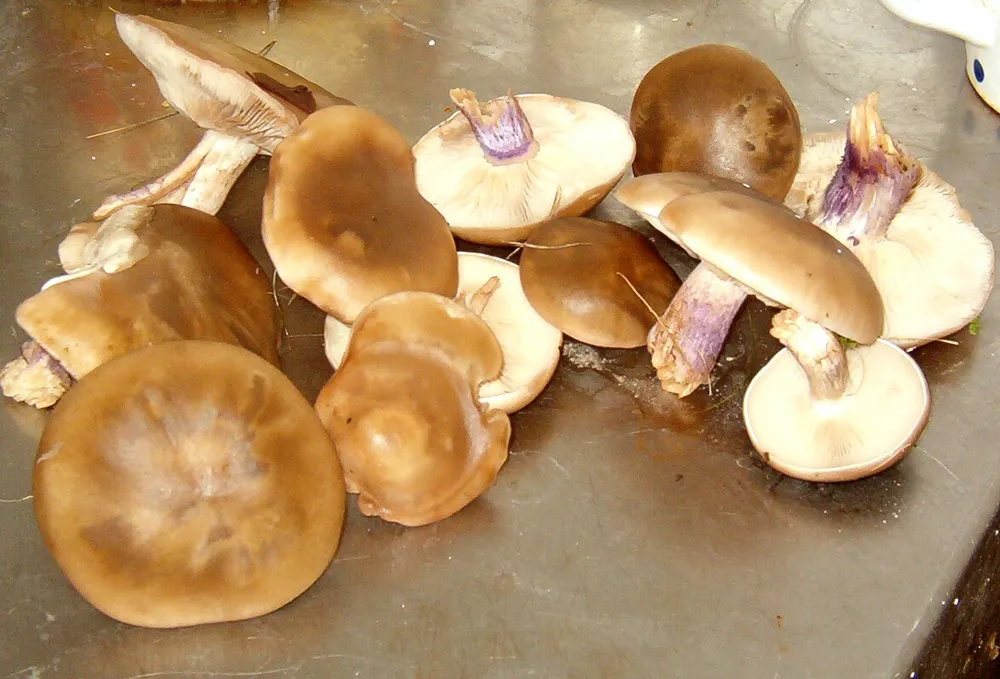
Charbonnier
Tricholoma portentosum
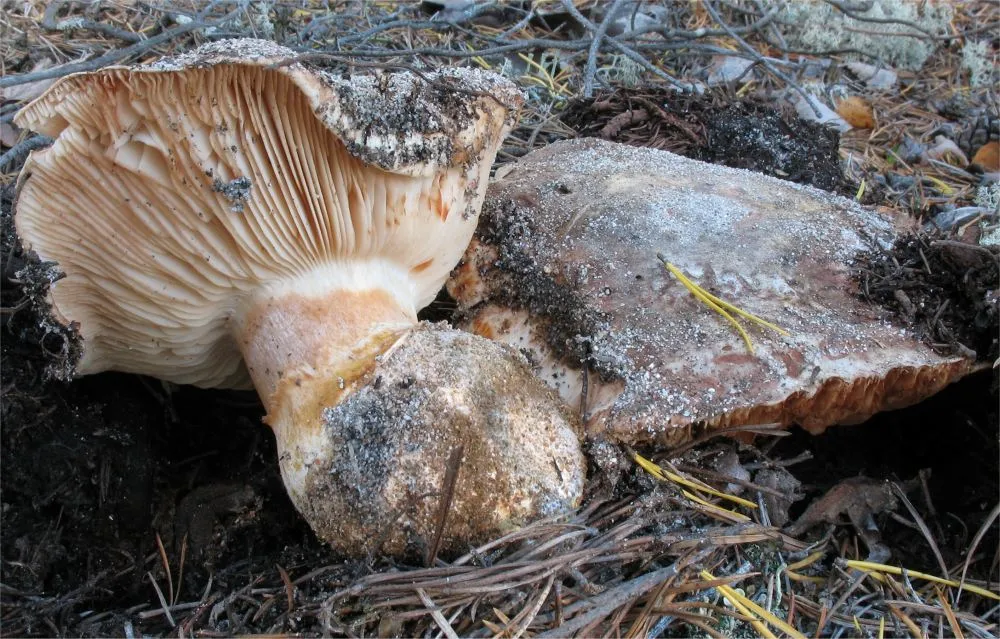
Field blewit
Collybia personata
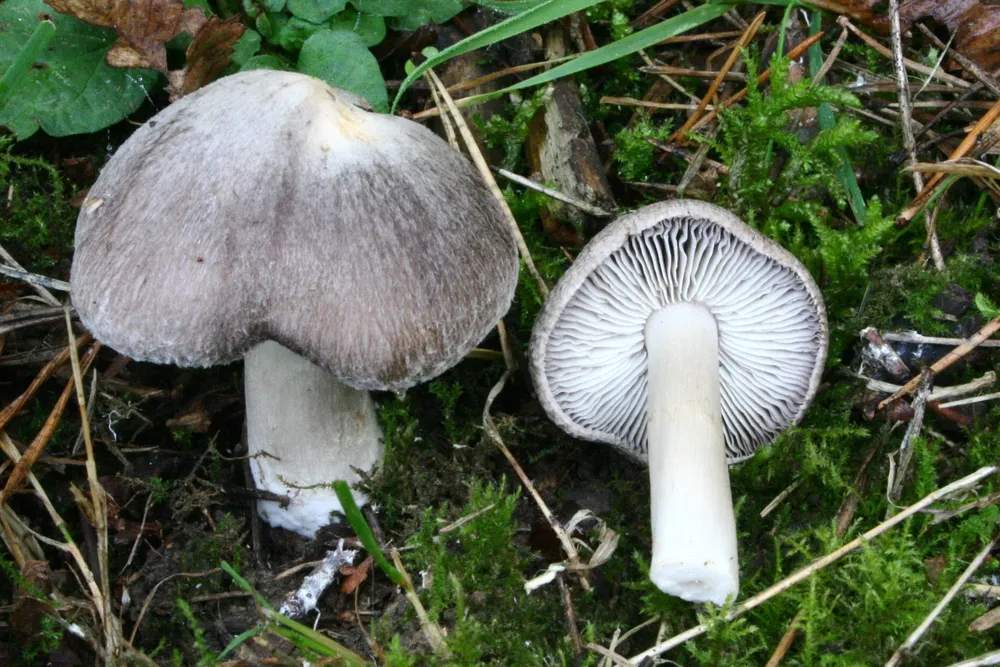
Giant knight
Tricholoma colossus
Grey knight
Рядовка наземна
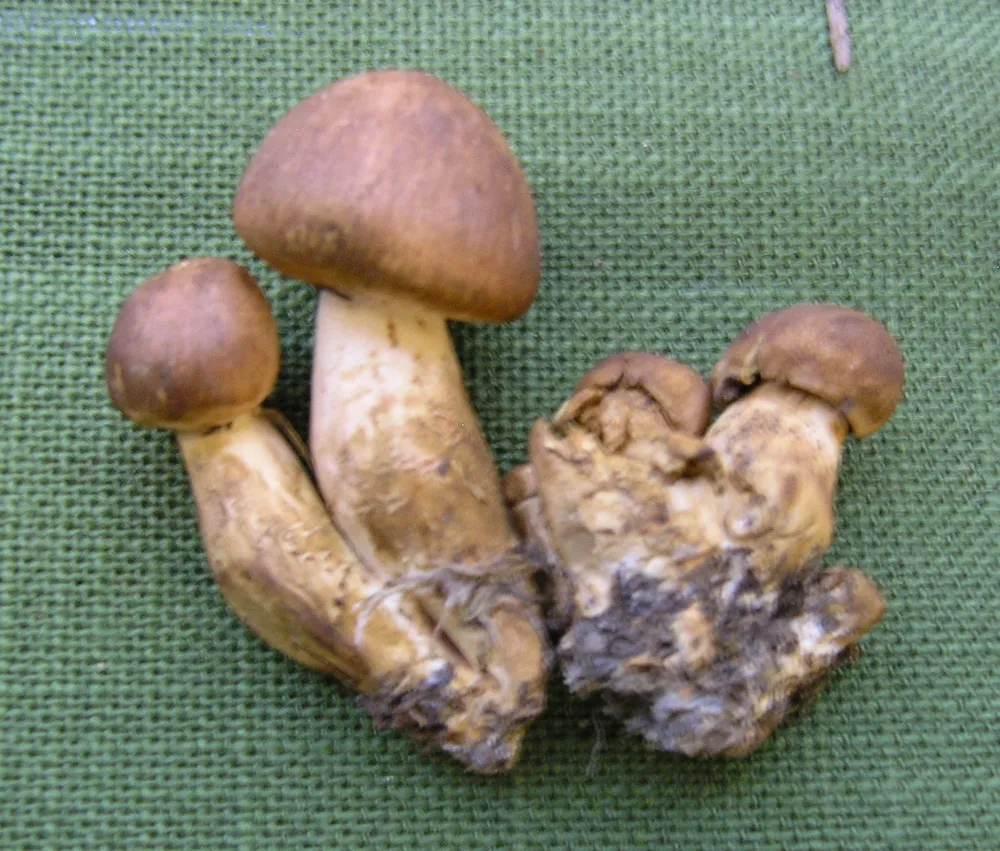
Matt knight
Tricholoma imbricatum
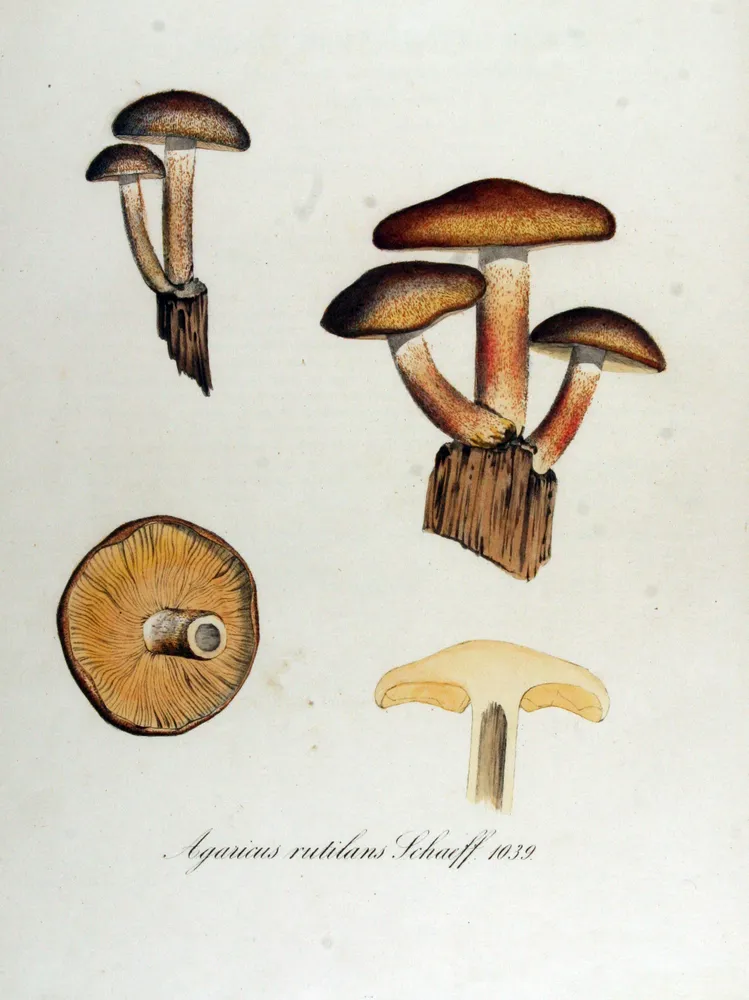
Plums and custard
Рядовка червона
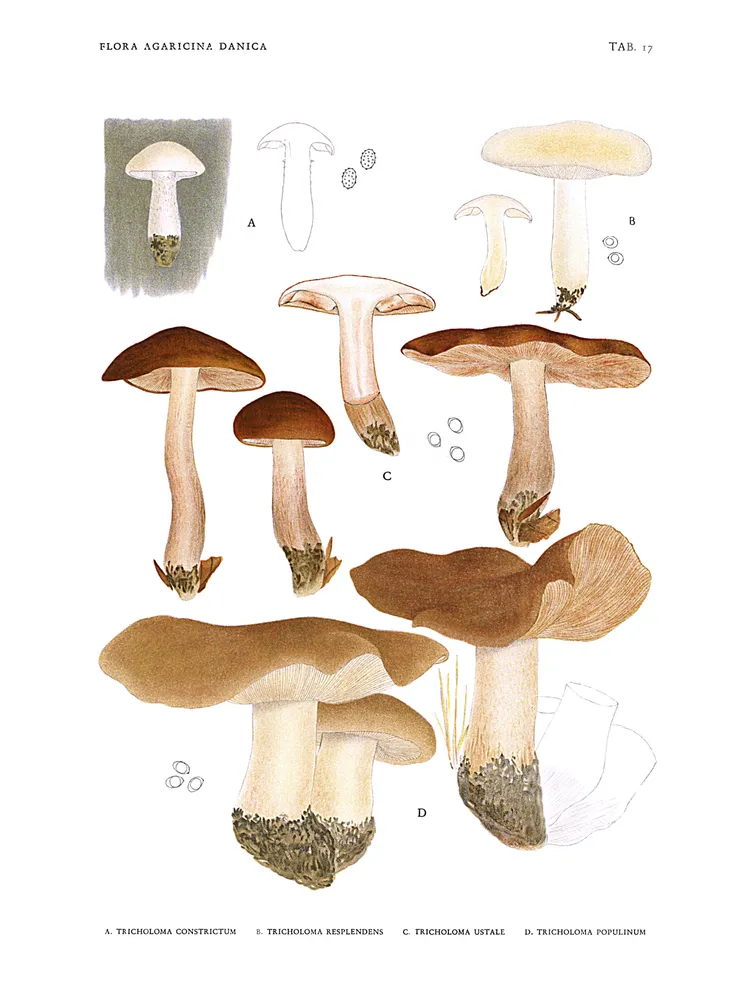
Poplar knight
Рядовка тополева
Frequently asked questions
Can you eat it?
You can, but without much enthusiasm. Its culinary value is low — cottony flesh with a sourish-bitter taste. In western and central Ukraine folk foragers hardly ever put it in their baskets. If you'd like to try it, pick young, bright red ones and be sure to boil them for 10-15 min before frying. Start with a small portion to check how you react.
Does it have dangerous lookalikes?
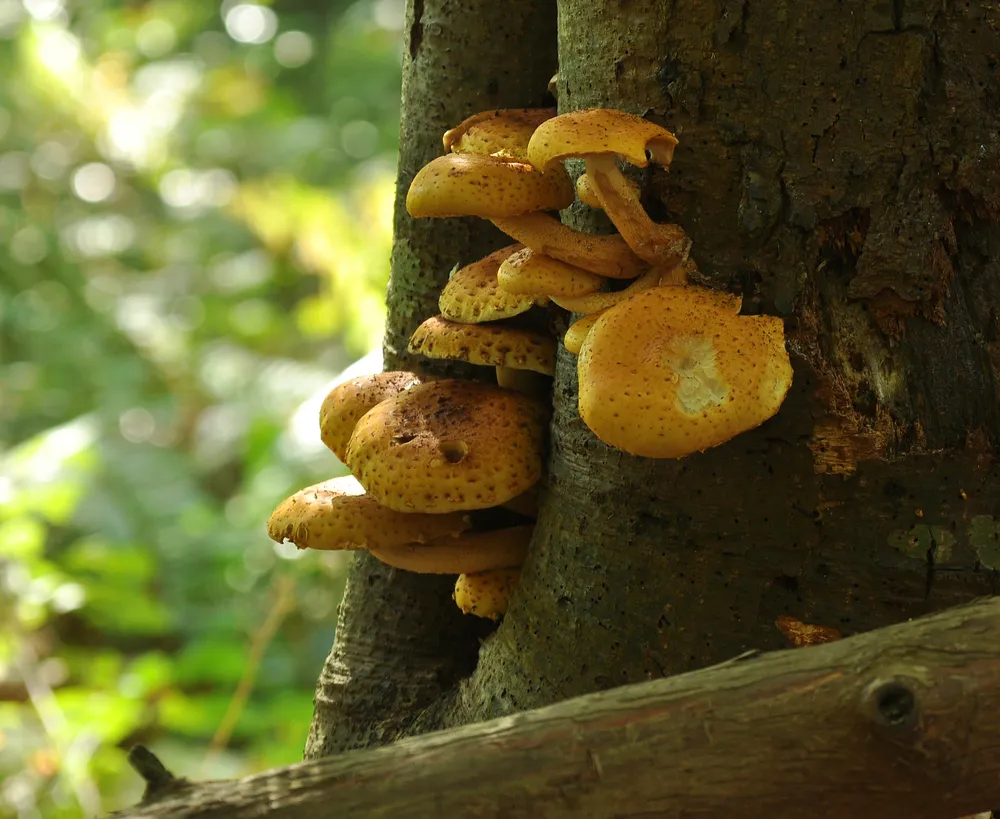
Not seriously poisonous ones. The combination of yellow gills and red-purple scales on a yellow cap on a conifer stump is unique, so you won't confuse it with anything dangerous. Some people mix it up with Pholiota aurivella (golden scalycap) — that one is also yellow and scaly, but its scales are golden-rusty, not purple, and its gills are cream-rusty, not distinctly yellow.
How do you cook it if you still want to?
Always boil it for 10-15 min in salted water and discard the water. Then fry it with onions and cream, stew it, or add it to a mix with tastier mushrooms. Pickling works fine, but the flavor is less pronounced than in honey fungus. Drying works poorly: the flesh loses its aroma.
Where do you look for it, so you can recognize it?
On dead conifer stumps and fallen trunks (pine, spruce), sometimes on heavily rotted litter next to a stump. In coniferous and mixed forests. Not on soil — this is crucial, and it sets it apart from the ordinary knights (Tricholoma).
Which regions of Ukraine is it found in?
Common in the forest zone with conifers: the Carpathians, Prykarpattia, Polissia, and in places the forest-steppe within pine woodlands.
When do you look for it?
August to October, peaking in September. It loves a damp autumn.
What does it resemble?
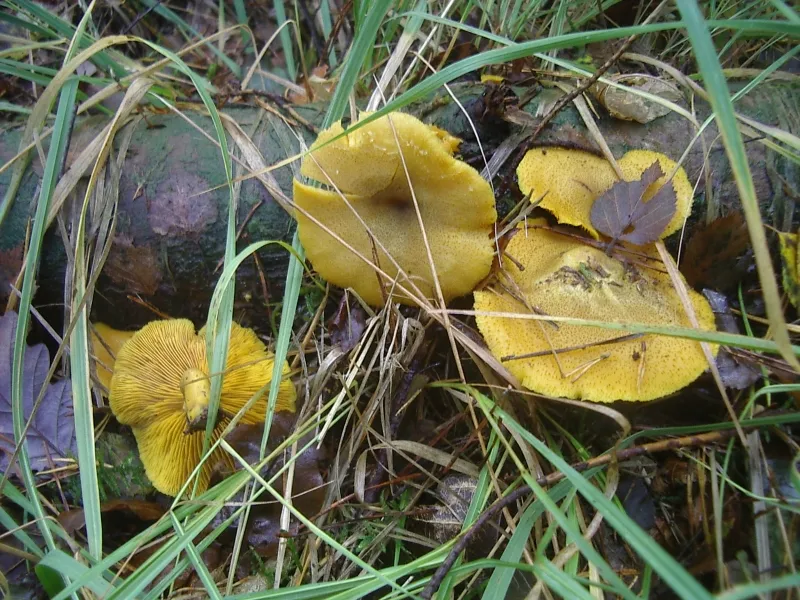
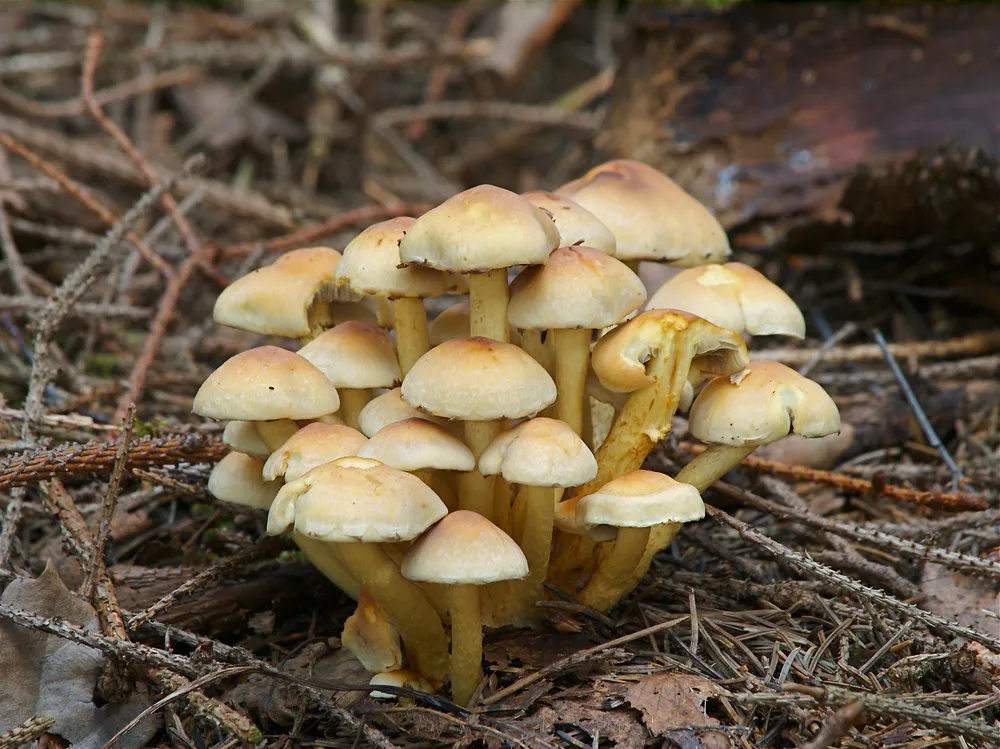
Vs. Tricholomopsis decora (prunes and custard) — a close relative, but entirely yellow with no red scales, only fine yellow-brown fibers. Vs. Pholiota aurivella (golden scalycap) — golden-yellow scales, not purple, on deciduous trees. Vs. Hypholoma fasciculare (sulphur tuft) — smaller, growing in clusters on stumps, poisonous (greenish-gray gills).
Is Plums and custard edible or poisonous?
Does Plums and custard have gills or pores?
What does the cap of Plums and custard look like?
What does the stem of Plums and custard look like?
What do Plums and custard smell and taste like?
Sources
- [1]Вікіпедія (українська)
- [2]Атлас грибів України, Зеров Д.К. (1979)
- [3]MycoBank Database
- [4]Index Fungorum
- [5]GBIF
- [6]iNaturalist Ukraine