
The bay bolete is one of the tastiest and most popular boletes, a relative of porcini. But one thing often scares beginners: a cut mushroom quickly turns blue. Does that mean poison? Let's look at whether the bay bolete is edible, what bluing is, and how not to confuse it with dangerous boletes.
The bay bolete is edible
The answer is clear: the bay bolete is edible and very tasty. It's fried, boiled, dried and pickled, and in flavor it's nearly as good as porcini. There are no poisonous “bay boletes” — only similar boletes that you need to be able to tell apart.
Why the bay bolete turns blue, and is it dangerous?
Bluing of the flesh when cut is a normal and safe reaction. When the flesh meets air, the mushroom's natural compounds oxidize, and within a few seconds the cut turns blue or green. It isn't poison: the same thing happens in Xerocomus boletes and many edible boletes. More details in the article why Xerocomus boletes turn blue when cut.
How to recognize the bay bolete
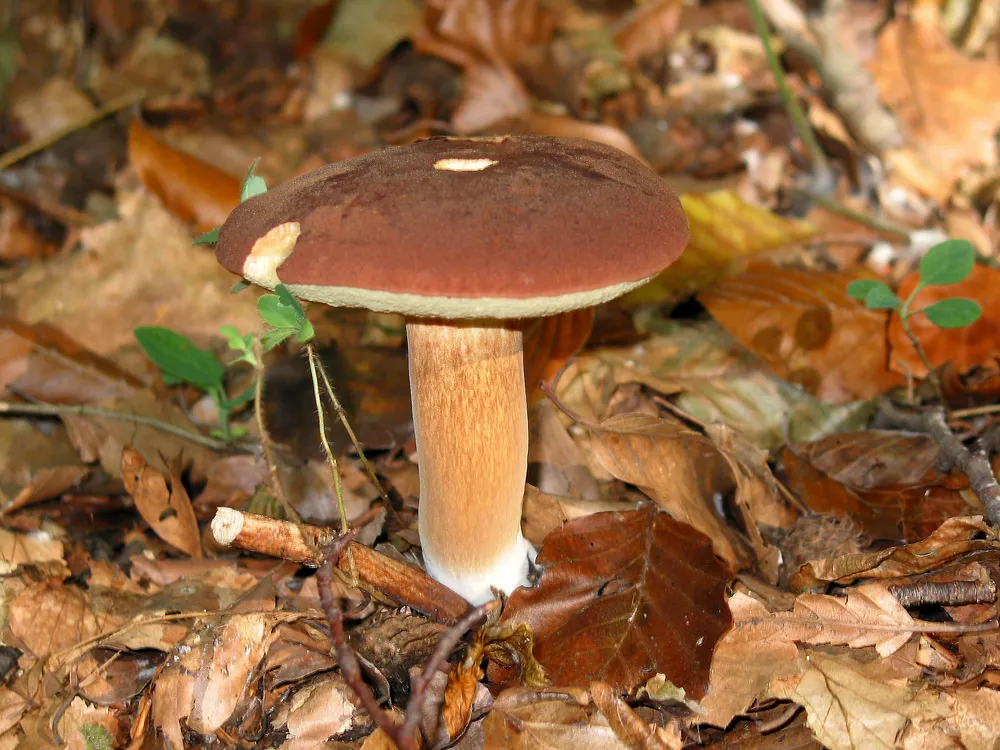
- Cap velvety, dark brown, chestnut, up to 12 cm.
- Spongy underside, yellowish-greenish, turns blue when pressed.
- Stem light brown, without a net (unlike porcini).
- Flesh pale, turns blue when cut, with a pleasant mushroomy smell.
How fast it grows and when it appears — in the article how long it takes a bay bolete to grow, and how it differs from porcini — how the bay bolete differs from porcini.
Which poisonous mushrooms not to confuse it with
Although the bay bolete itself is safe, some boletes that also turn blue are poisonous:
- Devil's bolete — it has red pores and a red net on a thick stem. The bay bolete has yellow-greenish pores and a stem without a net. More about it in the article Devil's bolete.
The rule is simple: yellow-greenish pores are good, red pores mean danger. Bluing by itself does not mean poison.
Sources
- “Field Guide to the Fungi of Ukraine” (Kyiv, Naukova Dumka publishing house).
- Imleria badia in GBIF, the global biodiversity database.
- Bay bolete on Wikipedia.
Frequently asked questions
Is the bay bolete edible or poisonous?
The bay bolete is edible and very tasty — a relative of porcini. It's fried, boiled, dried and pickled. There are no poisonous “bay boletes,” only similar boletes you need to tell apart.
Why does the bay bolete turn blue when cut?
It's the flesh's normal reaction to air: natural compounds oxidize, and the cut turns blue within a few seconds. The bluing is harmless and isn't a sign of poison — Xerocomus boletes turn blue the same way.
Can you eat a bay bolete that has turned blue?
Yes. Bluing is an ordinary property of the mushroom; it doesn't affect edibility and disappears with cooking. The bay bolete always turns blue, and it's completely safe.
How do you tell the bay bolete from the Devil's bolete?
The bay bolete has yellow-greenish pores and a stem without a net. The poisonous Devil's bolete has red pores and a red net on its thick stem. Red pores are the main danger signal.
How do you recognize the bay bolete?
By its velvety dark brown cap, yellow-greenish spongy underside that turns blue when touched, light brown stem without a net, and pale flesh that turns blue when cut.
Do you need to boil a bay bolete before frying it?
You can fry a bay bolete right away after cleaning it. Like all mushrooms, it must not be eaten raw, but it doesn't need the mandatory long boiling required for conditionally edible species.
Where does the bay bolete grow?
In damp coniferous and mixed forests, on acidic soils under pines and spruces. It's a hardy autumn species that fruits until November and isn't afraid of light frosts.
Mushrooms in this article
Related articles
 Recipes & cooking
How to store fresh mushrooms, and for how long
Fresh mushrooms spoil faster than you might think. Here's how long they keep in the fridge, how to store them…
August 21, 2026·4 min How to identify
Truffles in Ukraine: do they grow here, and where to look
Truffles aren't just a French delicacy. Several species grow in Ukraine too. Here's which ones, where they occ…
August 24, 2026·2 min Safety
False morel: why this spring mushroom is dangerous
The false morel looks like a morel, but it contains a poison. Here's how to recognize it, why it's dangerous a…
August 24, 2026·2 min