
The saffron milk cap is a special mushroom. It is perhaps the only one of our mushrooms so good that it is salted almost raw, simply layered with salt. For its flavor and aroma it has long been prized as a delicacy. But to enjoy it, you need to know when it appears, where it grows and how to identify it for sure.
Let's go through everything about the saffron milk cap: timing, places and the reliable features that keep you from mixing it up.
When the saffron milk cap appears
The saffron milk cap is a mushroom of the second half of the season.
The first saffron milk caps appear at the end of summer, usually in August, and the main flush comes in September–October, along with the autumn chill and rains. It is a classic autumn mushroom that copes well with the first cold nights.
Like all mushrooms, the saffron milk cap loves moisture: plentiful flushes come a few days after a good rain. The exact moment for your forest is shown by the mushroom radar, and the overall picture of the season by the mushroom calendar.
Where to look for saffron milk caps
The saffron milk cap is inseparable from conifers.
The saffron milk cap grows under pines, and the false saffron milk cap, accordingly, under spruces. Look for them in young conifer plantations, on forest edges, in clearings and along forest roads, where there is more light. They often grow in groups, so once you find one, take a careful look all around.
The conifer forests of Polissia and the Carpathians are especially generous with saffron milk caps — we write about them in our articles on mushrooms of Polissia and mushrooms of the Carpathians.
How to recognize the saffron milk cap
The saffron milk cap has several features that make it easy to recognize.
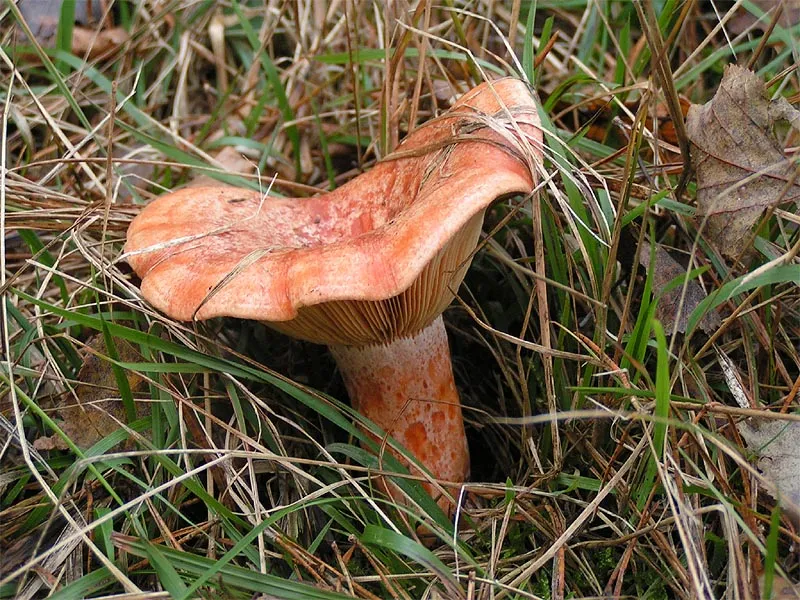
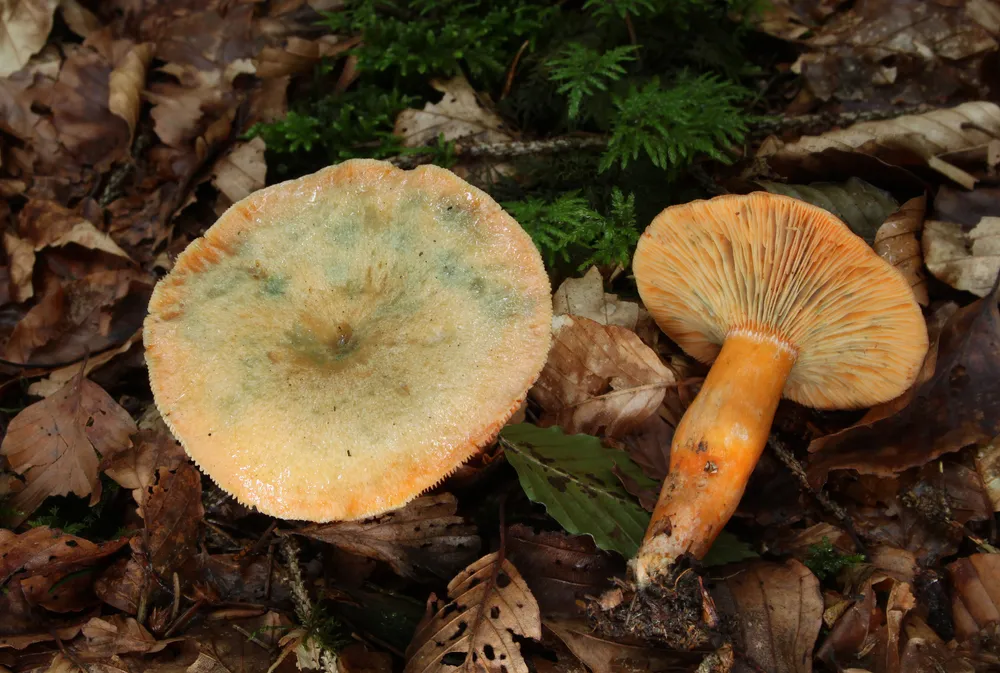
- Color. An orange, rusty or carrot-colored cap with darker concentric rings.
- Shape. The cap is convex at first, then funnel-shaped, with a slightly inrolled margin.
- Orange milk. When broken, it releases an orange milky juice that is not bitter. This is the key feature.
- Greening. When pressed and with age, the mushroom turns green, especially at the edges. This is normal and does not spoil it.
It is the combination of orange, non-bitter milk and greening at the cut that reliably sets the saffron milk cap apart from other mushrooms.
How the saffron milk cap differs from other milk caps and the woolly milk cap
The saffron milk cap belongs to the milk cap family, so it has similar-looking relatives.
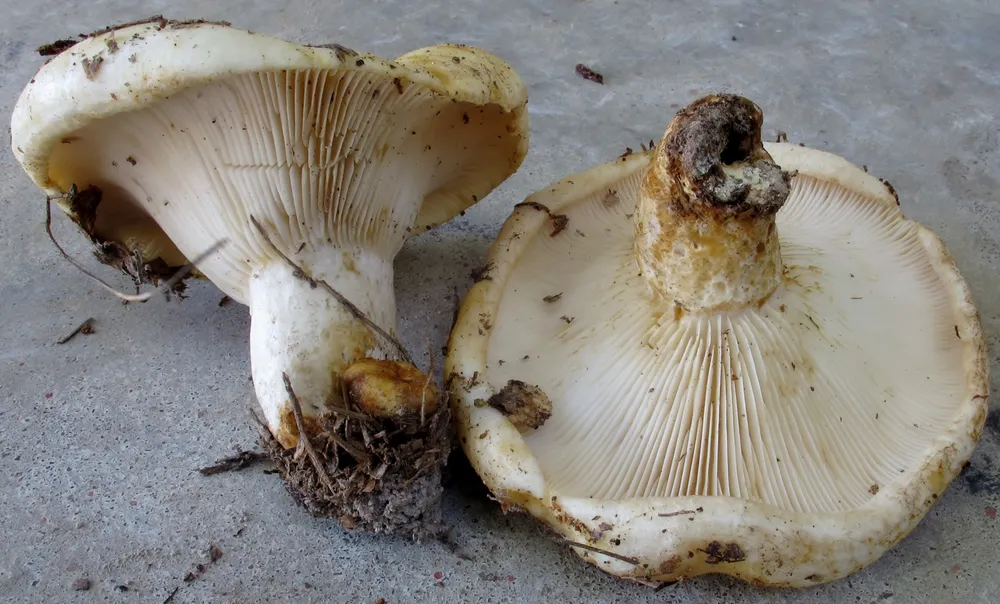
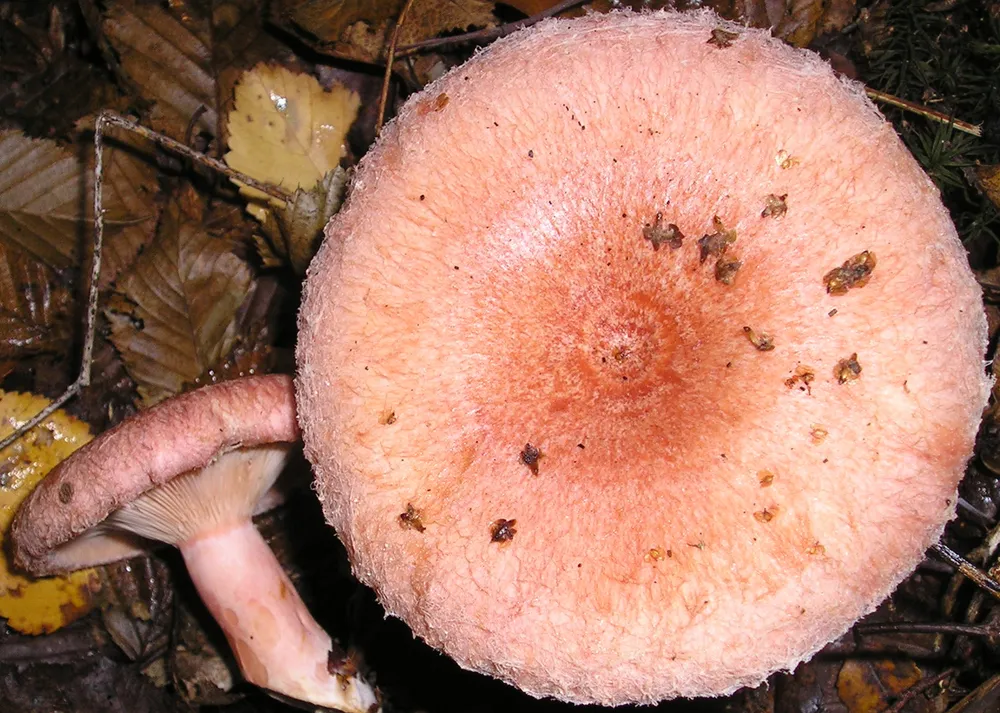
Unlike milk caps with their white acrid milk and the woolly milk cap with its pink fuzzy cap, the saffron milk cap has sweet orange milk. So it needs no soaking and is suited to dry salting, while milk caps and the woolly milk cap must always be soaked before salting.
How exactly to salt the saffron milk cap and how it differs from other milk caps in the kitchen, we explain in detail in our article on saffron milk caps and milk caps, mushrooms for salting.
Sources
- “Key to the Fungi of Ukraine” (Kyiv, Naukova Dumka publishing house).
- Lactarius deliciosus in GBIF, the global biodiversity database.
- Lactarius deliciosus in MycoBank, the international fungal nomenclature database.
- Lactarius deliciosus on Wikipedia.
Frequently asked questions
When do saffron milk caps appear?
The first ones at the end of summer, in August, and the main flush in September–October with the autumn chill and rains. It is a classic autumn mushroom that copes well with cold nights.
Where should you look for saffron milk caps?
In conifer forests: under pines, the under spruces. Best in young plantations, on forest edges and in clearings, where there is more light. They grow in groups.
How do you tell the saffron milk cap from other mushrooms?
By the orange milk it releases when broken, which is not bitter, and by the way it turns green when pressed. The cap is orange-rusty with concentric rings. These are reliable features.
Why does the saffron milk cap turn green?
It is a natural reaction: when pressed, damaged and with age, the saffron milk cap turns green, especially at the edges. The greening doesn't spoil the mushroom and even confirms that it really is a saffron milk cap.
How does the saffron milk cap differ from other milk caps?
The saffron milk cap has sweet orange milk, so it is salted almost raw. have white acrid milk, which is why they must always be soaked before salting.
Do saffron milk caps need soaking?
No. Since the saffron milk cap's milk is not bitter, it isn't soaked. It is one of the few mushrooms salted the dry way, simply layered with salt.
Can the saffron milk cap be confused with a poisonous mushroom?
The saffron milk cap has no deadly lookalikes. The main thing is not to confuse it with bitter milk caps: the orange, non-bitter milk saves you. Less experienced foragers may mix up the saffron milk cap species with one another, but they are all edible.
How do you cook saffron milk caps?
Salting is best. Thanks to its non-bitter milk, the saffron milk cap is salted the dry way. More on salting in our article on .
Mushrooms in this article
Related articles
 How to identify
Truffles in Ukraine: do they grow here, and where to look
Truffles aren't just a French delicacy. Several species grow in Ukraine too. Here's which ones, where they occ…
August 24, 2026·2 min Recipes & cooking
How to store fresh mushrooms, and for how long
Fresh mushrooms spoil faster than you might think. Here's how long they keep in the fridge, how to store them…
August 21, 2026·4 min Recipes & cooking
How long to boil mushrooms
Boiling time depends on the type of mushroom and on what you're cooking next. Here's a clear cheat sheet: how…
August 22, 2026·4 min