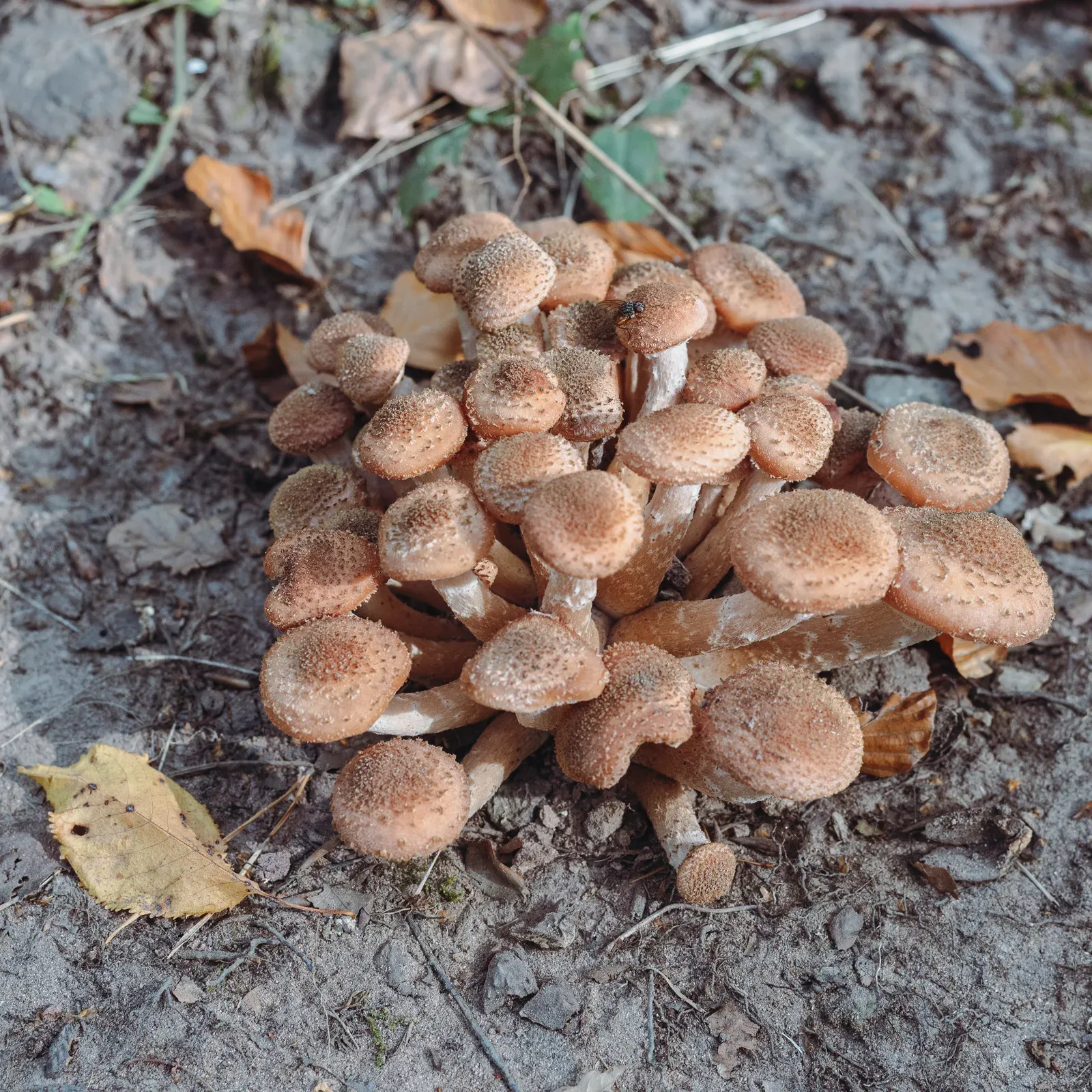
Honey fungus is a favorite autumn mushroom that grows so abundantly you can fill a bucket in a single outing. Besides its flavor, it's valuable for its nutrition too. Let's look at why honey fungus is good for you, why it must always be cooked and who should eat it with care.
> This article is for general information only and does not replace advice from a doctor or dietitian.
Why honey fungus is good for you
Protein. Honey fungus contains plant protein, so it's satisfying for few calories.
Minerals. It's rich in potassium, iron, phosphorus and zinc — good for the blood and metabolism.
Fiber. Mushroom fiber supports gut function and keeps you feeling full for a long time.
Vitamins. Honey fungus contains B vitamins and precursors of vitamin D.
For an overview of the health benefits of mushrooms in general, see the article why mushrooms are good for you.
Why honey fungus must always be boiled
Honey fungus is conditionally edible: raw or undercooked, it can cause stomach upset. So it must always be:
- sorted, keeping only young, firm mushrooms;
- boiled, and the first water is often poured off;
- only then fried or pickled.
Honey fungus must not be eaten raw — on the dangers of eating mushrooms raw, see the article which mushrooms can be eaten raw.
Who should be careful
Honey fungus is rather hard to digest, so it is not given to young children, and people with a sensitive stomach should eat it in small portions and well boiled. A large portion of poorly processed honey fungus can cause a feeling of heaviness.
Don't confuse it with dangerous ones
Benefits are one thing, but safety comes first: honey fungus has poisonous look-alikes. How to tell them apart — see the article false honey fungus: how to tell it from the real thing. And how fast honey fungus grows — how fast honey fungus grows.
Sources
- “Key to the Fungi of Ukraine” (Kyiv, Naukova Dumka publishing house).
- Armillaria mellea in GBIF, the global biodiversity database.
- Honey fungus on Wikipedia.
Frequently asked questions
Why is honey fungus good for you?
Honey fungus is rich in plant protein, potassium, iron, phosphorus and zinc, as well as B vitamins — all for few calories. That makes it filling and good for the blood and metabolism.
Can honey fungus do any harm?
Honey fungus is conditionally edible: raw or undercooked, it can cause stomach upset. That's why it must always be boiled. A large portion is hard to digest.
Why does honey fungus need to be boiled?
Because it's a conditionally edible mushroom: without boiling it can cause stomach upset. Honey fungus is sorted, boiled, the first water is often poured off, and only then is it fried or pickled.
Can you eat honey fungus raw?
No. Raw or undercooked honey fungus can cause poisoning. It must always be boiled thoroughly — only then does it become safe.
Who shouldn't eat honey fungus?
Mushrooms are not given to young children, and people with a sensitive stomach should eat honey fungus in small portions and well boiled. For everyone else it's good for you in moderation.
Does pickled honey fungus keep its benefits?
Yes, pickled honey fungus keeps some of its protein and minerals, but because of the salt and vinegar it's eaten as a snack in small amounts. Freshly boiled mushrooms give you the most benefit.
Is honey fungus good for the blood?
Honey fungus contains iron and other minerals that support blood formation and metabolism. But it's an ordinary food, not medicine, so don't rely on mushrooms alone.
Mushrooms in this article
Related articles
 Science & taxonomy
Bay bolete: health benefits and nutritional value
The bay bolete is a match for porcini in both flavor and nutrition. Here's why the bay bolete is good for you,…
August 20, 2026·2 min Science & taxonomy
Chanterelles: medicinal properties and health benefits
Chanterelles are credited with plenty of health-giving properties. Here's what really makes them valuable, wha…
August 23, 2026·2 min Recipes & cooking
How to store fresh mushrooms, and for how long
Fresh mushrooms spoil faster than you might think. Here's how long they keep in the fridge, how to store them…
August 21, 2026·4 min