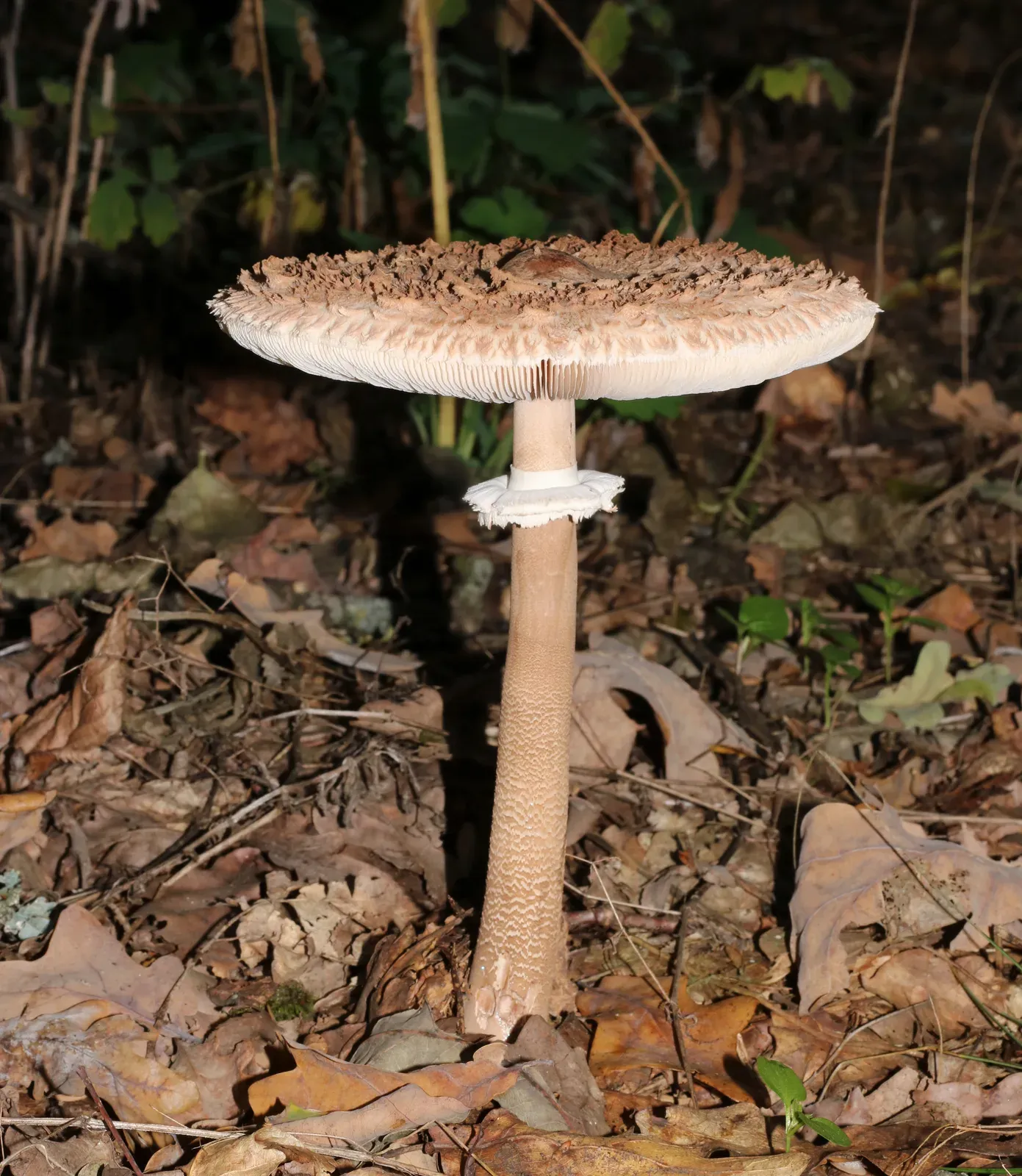
The ring, or skirt, on a mushroom's stem is one of the most important features every forager has to learn to read. It shows up on very different mushrooms: on the tasty honey fungus and on the deadly death cap. So a ring on its own decides nothing, but together with other details it becomes the key to identification and to safety.
Let's look at where the ring comes from, which mushrooms have one and when it turns into a danger signal.
Where the ring comes from
While the mushroom is young, its gills are covered from below by a thin veil that protects the ripening spores.
As the mushroom grows and the cap opens, this veil tears. What's left of it stays on the stem as a ring or skirt. So the ring is a trace of the mushroom's youth that remains on the mature mushroom too.
The ring varies from mushroom to mushroom: thick and wide, thin and membranous, movable or fixed. Sometimes all that's left of it is a faint band or traces, so you need to look carefully.
Which mushrooms have a ring
A ring appears both on excellent edible mushrooms and on deadly poisonous ones.
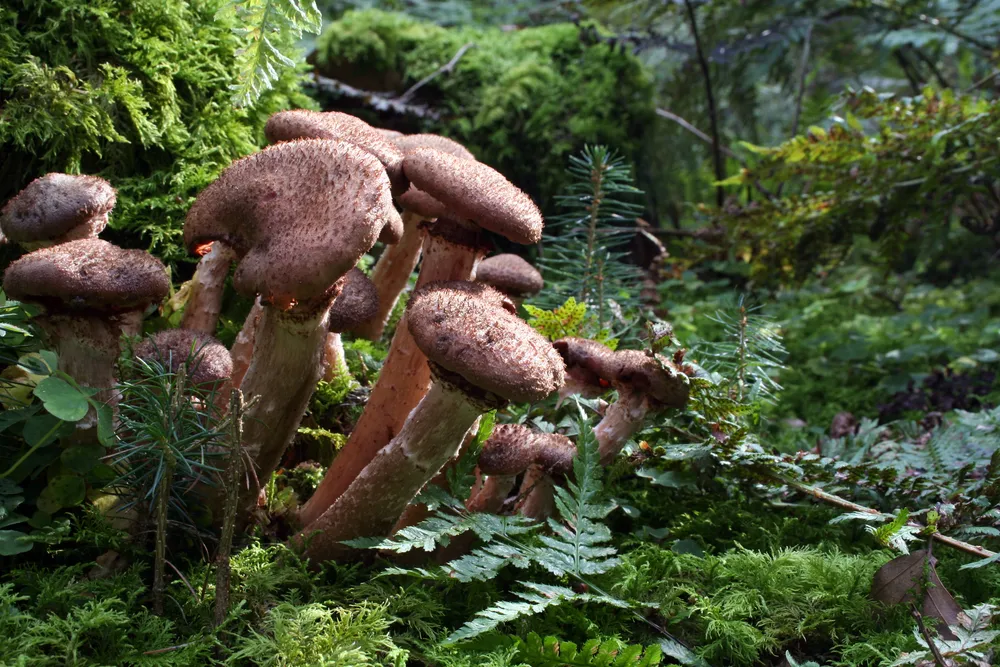
- **Honey fungus.** Has a white membranous ring, the main feature that sets it apart from the poisonous ringless false honey fungi.
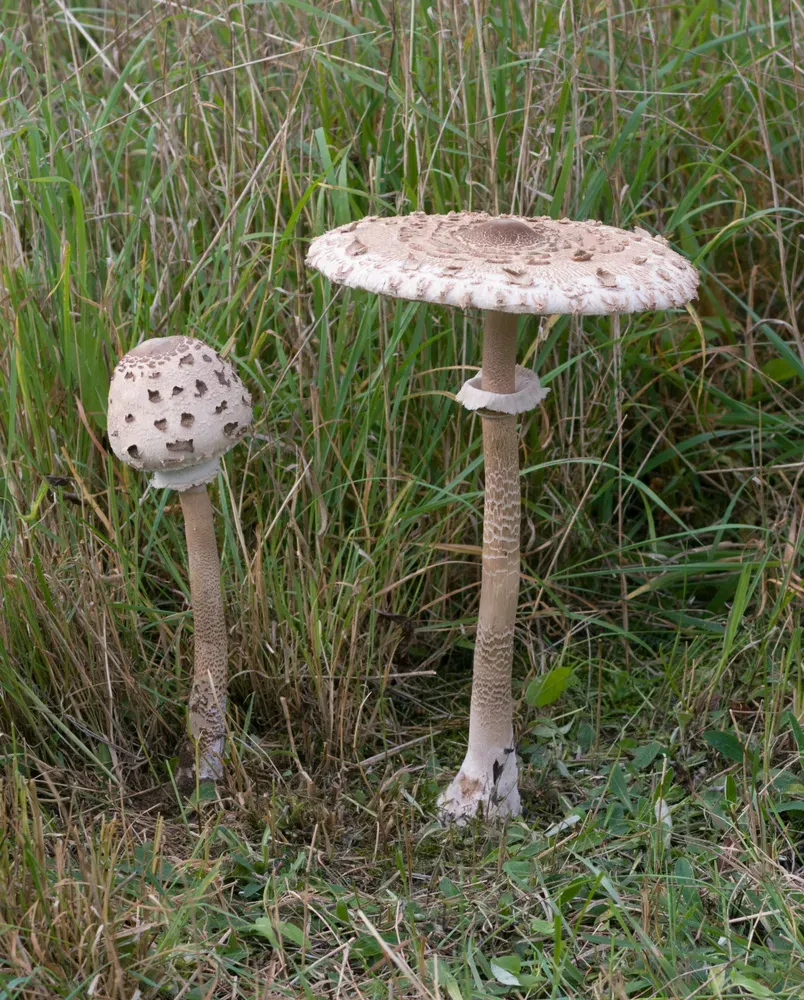
- **Parasol mushroom.** Has a wide, movable ring that you can slide freely along the stem.
- **Agaricus.** Also has a ring on the stem, along with pink and later dark gills.
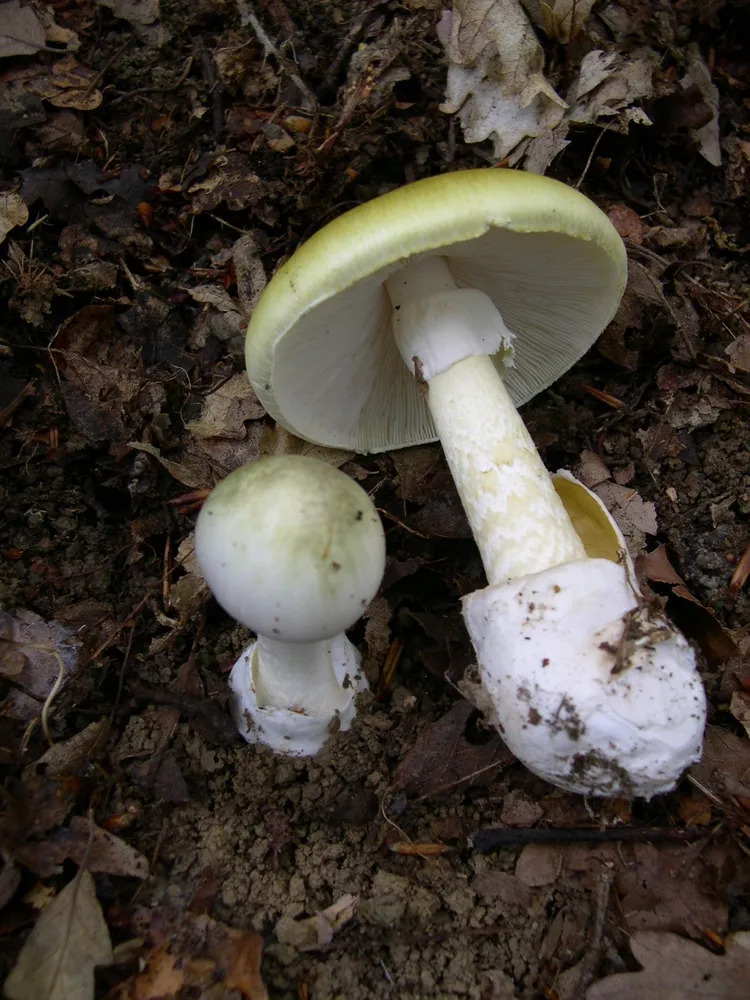
- **Death cap and amanitas.** Have a skirt, but along with it, a sac at the base.
As you can see, a ring by itself doesn't tell you whether a mushroom is good or dangerous. What decides it is what comes with it.
When a ring is a danger signal
The most important rule is about the combination of features.
If the stem has a ring-skirt, and at the base there's a sac or a noticeable swelling with a rim, you're most likely looking at an amanita, possibly even the deadly death cap. This exact combination, skirt plus sac, is the main danger signal in the whole mushroom world.
So whenever you see a ring, always dig the mushroom up carefully and look at the base of the stem. No sac is a point in favor of an edible mushroom (honey fungus, parasol, Agaricus). A sac means the mushroom stays in the forest. More about the most dangerous mushroom of this kind in the article on the death cap.
How to read a ring correctly
A few steps will help you avoid mistakes.
- Check whether there's a ring. If a mushroom that looks like honey fungus has none, that's a reason to be on your guard.
- Look at the base of the stem. Dig up the whole mushroom to see whether there's a sac.
- Check whether the ring moves. On a parasol it slides freely; on amanitas it's fixed.
- Consider the gills. White gills together with a skirt are a warning sign.
More mushrooms with a skirt in the collection by ring, and the full safety guide in the rules for safe foraging.
Sources
- “Key to the Fungi of Ukraine” (Kyiv, Naukova Dumka publishing house).
- Amanita phalloides in GBIF, the global biodiversity database.
- Annulus (mycology) in MycoBank, the international nomenclature database for fungi.
- Annulus (mycology) on Wikipedia).
Frequently asked questions
What does a ring on a mushroom's stem mean?
It's what's left of the veil that covered the gills of the young mushroom. When the cap opens, the veil tears, and its trace stays on the stem as a ring-skirt.
Are all mushrooms with a ring poisonous?
No. Rings appear on excellent edible mushrooms, , , , and on deadly amanitas. A ring on its own decides nothing.
When is a ring a danger signal?
When it comes together with a sac or swelling at the base of the stem. Skirt plus sac is the main feature of amanitas, including the deadly .
Why look at the base of the stem if there's a ring?
Because it's the base that tells an edible mushroom from a deadly one. No sac is a point in favor of honey fungus or a parasol. If there's a sac (volva), the mushroom is left in the forest.
How is a parasol's ring different from an amanita's?
In the , the ring is wide and slides freely along the stem. In amanitas it's fixed and doesn't move, and there's a sac at the base.
Why is the ring important in honey fungus?
Because it's the ring that sets the true apart from the poisonous false honey fungi, which have none or only a barely visible one. It's the quickest check right there at the stump.
Can a ring disappear?
Yes. In some mushrooms the ring is thin and wears away over time, leaving only a faint band or traces on the stem. So look for it carefully, especially on young mushrooms.
How can you learn to read this feature?
Pick up every mushroom with a ring, dig it up whole and look at the base. With practice, you start spotting the “skirt plus sac” combination instantly. Details in the .
Mushrooms in this article
Related articles
 How to identify
Truffles in Ukraine: do they grow here, and where to look
Truffles aren't just a French delicacy. Several species grow in Ukraine too. Here's which ones, where they occ…
August 24, 2026·2 min Recipes & cooking
How to store fresh mushrooms, and for how long
Fresh mushrooms spoil faster than you might think. Here's how long they keep in the fridge, how to store them…
August 21, 2026·4 min Recipes & cooking
How long to boil mushrooms
Boiling time depends on the type of mushroom and on what you're cooking next. Here's a clear cheat sheet: how…
August 22, 2026·4 min