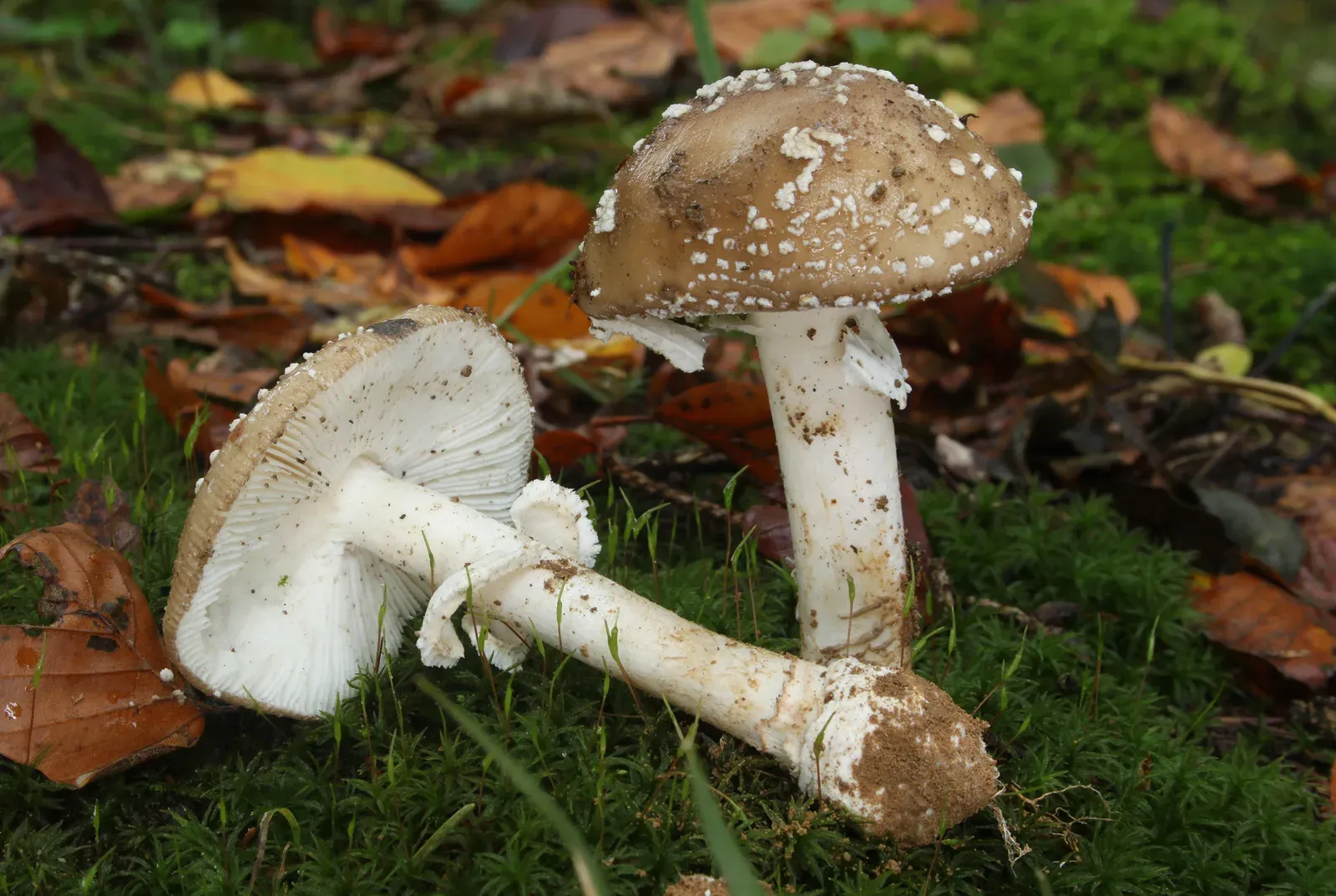
The panther cap is a mushroom you’d better know by sight, because a mistake here is costly. It is highly poisonous, and unlike its bright red relative, it’s disguised as an ordinary forest mushroom: a brown cap with white spots doesn’t stand out much. That’s why it sometimes gets mistaken for edible parasol mushrooms or brittlegills.
Let’s look at how to recognize the panther cap and which features tell it apart from edible mushrooms.
How to recognize the panther cap
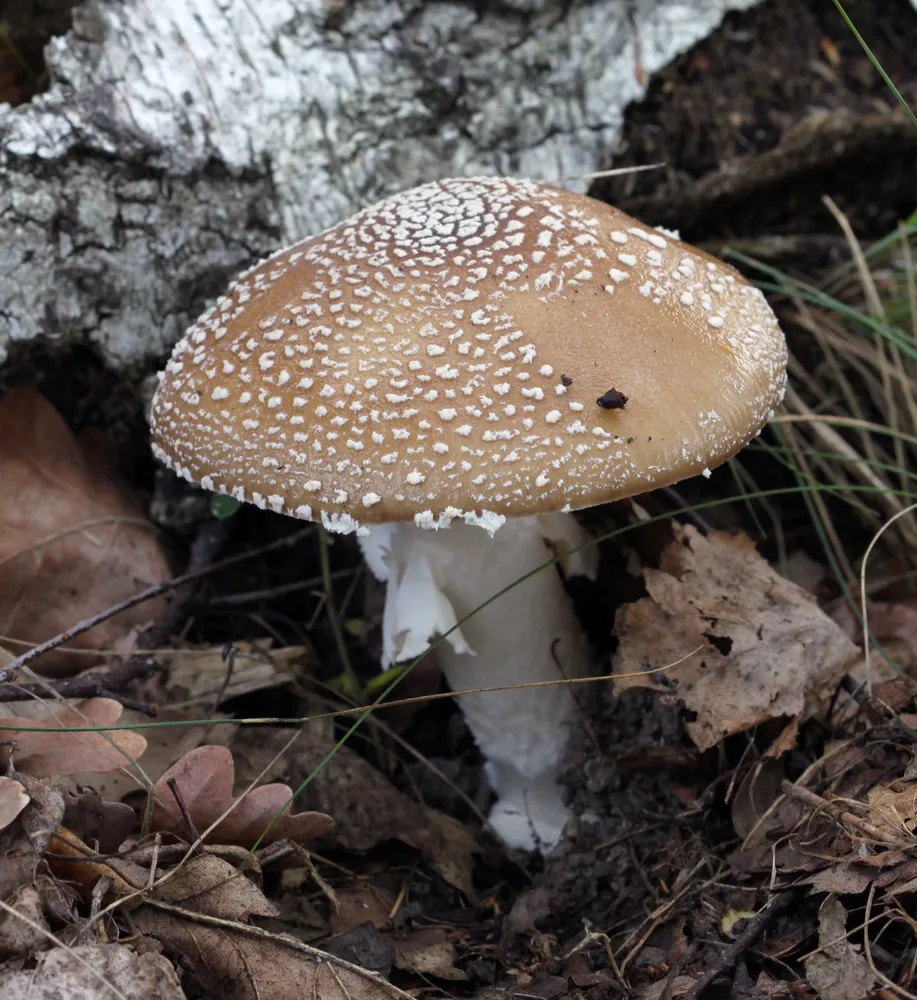
- The cap is gray-brown or olive-brown, covered with small white scales (remnants of the veil), with a grooved margin.
- The gills are white.
- The stem is white, with a ring, and at the base there is a characteristic bulb with an attached volva in the form of rims.
- The flesh is white, with an unpleasant smell.
The combination of white spots on the cap, a white ring and a bulb with a volva is a reliable “portrait” of a poisonous amanita.
Why it’s dangerous
The panther cap contains toxins that affect the nervous system: poisoning sets in within 30 minutes to 2 hours, with nausea, agitation, dilated pupils and sometimes hallucinations. The poisoning is severe and needs urgent medical help. We cover the amanitas of Ukraine, from deadly to edible separately.
How to tell it from edible mushrooms
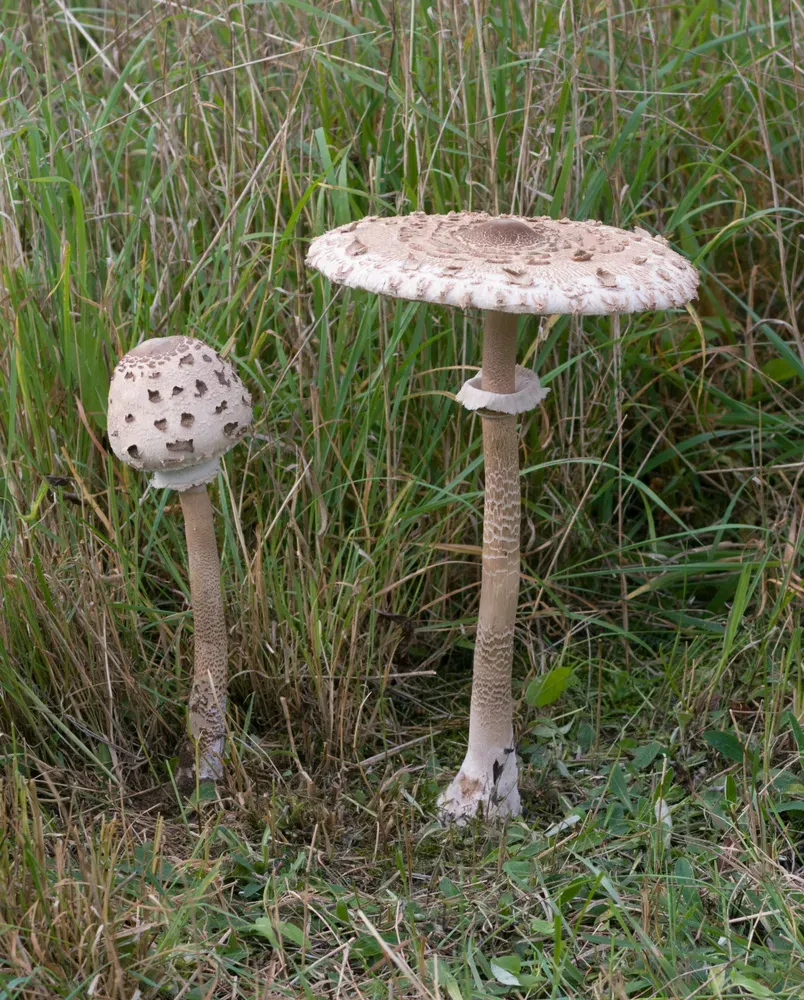
Versus the parasol mushroom:
- A parasol mushroom has a ring that is movable, and there’s no volva at the base; an amanita’s ring is fixed, and it has a bulb with a volva.
- A parasol’s scales are larger and come away; an amanita has small white spots.
Versus a brittlegill:
- A brittlegill has neither a ring nor a bulb with a volva.
- Always check the base of the stem: if there’s a bulb with rims, it’s an amanita.
The main rule
- Check the base of the stem. A bulb with a volva is a stop sign.
- Don’t take mushrooms with white spots on the cap and a ring if you’re not sure.
- Dig the mushroom up whole, so you can see the base, rather than cutting it off at ground level.
Sources
- “Key to the Fungi of Ukraine” (Kyiv, Naukova Dumka publishing house).
- Amanita pantherina in GBIF, the Global Biodiversity Information Facility.
- Amanita pantherina in MycoBank, the international fungal nomenclature database.
- Amanita pantherina on Wikipedia.
Frequently asked questions
How do you recognize the panther cap?
By its gray-brown cap with small white scales, white gills, a ring on the stem and a bulb with a volva at the base.
What makes the panther cap dangerous?
It contains neurotoxins; poisoning sets in quickly, with nausea, agitation and dilated pupils, and needs urgent medical help.
How do you tell the panther cap from a parasol mushroom?
A parasol mushroom has a movable ring and no volva at the base, while an amanita has a fixed ring and a bulb with a volva. Check the base of the stem.
How do you avoid confusing an amanita with a brittlegill?
A brittlegill has neither a ring nor a bulb with a volva. Always check whitish mushrooms at the base of the stem.
How does the panther cap differ from the fly agaric?
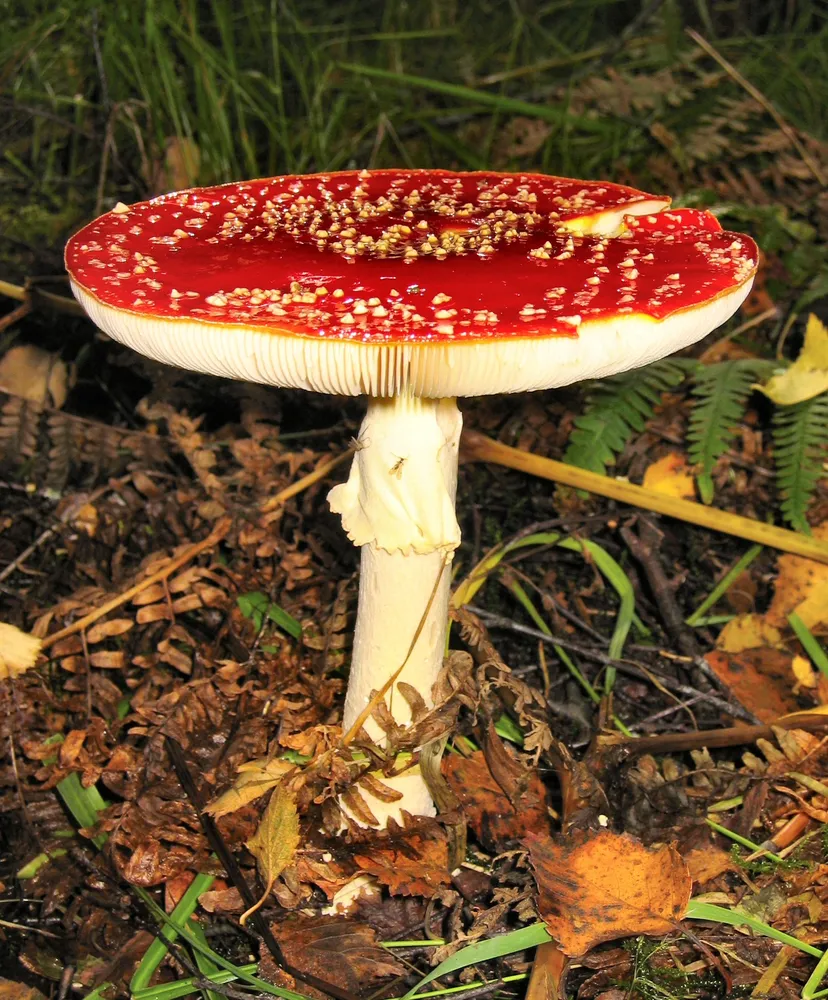
The fly agaric has a bright red cap, while the panther cap has an inconspicuous gray-brown one with white spots, which makes it more treacherous because of its camouflage.
What should you do if you suspect amanita poisoning?
Seek medical help immediately and keep the leftover mushrooms for identification. Delay is dangerous.
Why is it important to dig up a suspicious mushroom whole?
Because the key sign of an amanita is the bulb with a volva at the base of the stem. If you cut the mushroom at ground level, you may miss it.
Where does the panther cap grow?
In deciduous, mixed and coniferous forests from summer to autumn, often right next to edible mushrooms — which is exactly what makes it dangerous.
Mushrooms in this article
Related articles
 Recipes & cooking
How to store fresh mushrooms, and for how long
Fresh mushrooms spoil faster than you might think. Here's how long they keep in the fridge, how to store them…
August 21, 2026·4 min How to identify
Truffles in Ukraine: do they grow here, and where to look
Truffles aren't just a French delicacy. Several species grow in Ukraine too. Here's which ones, where they occ…
August 24, 2026·2 min Safety
False morel: why this spring mushroom is dangerous
The false morel looks like a morel, but it contains a poison. Here's how to recognize it, why it's dangerous a…
August 24, 2026·2 min