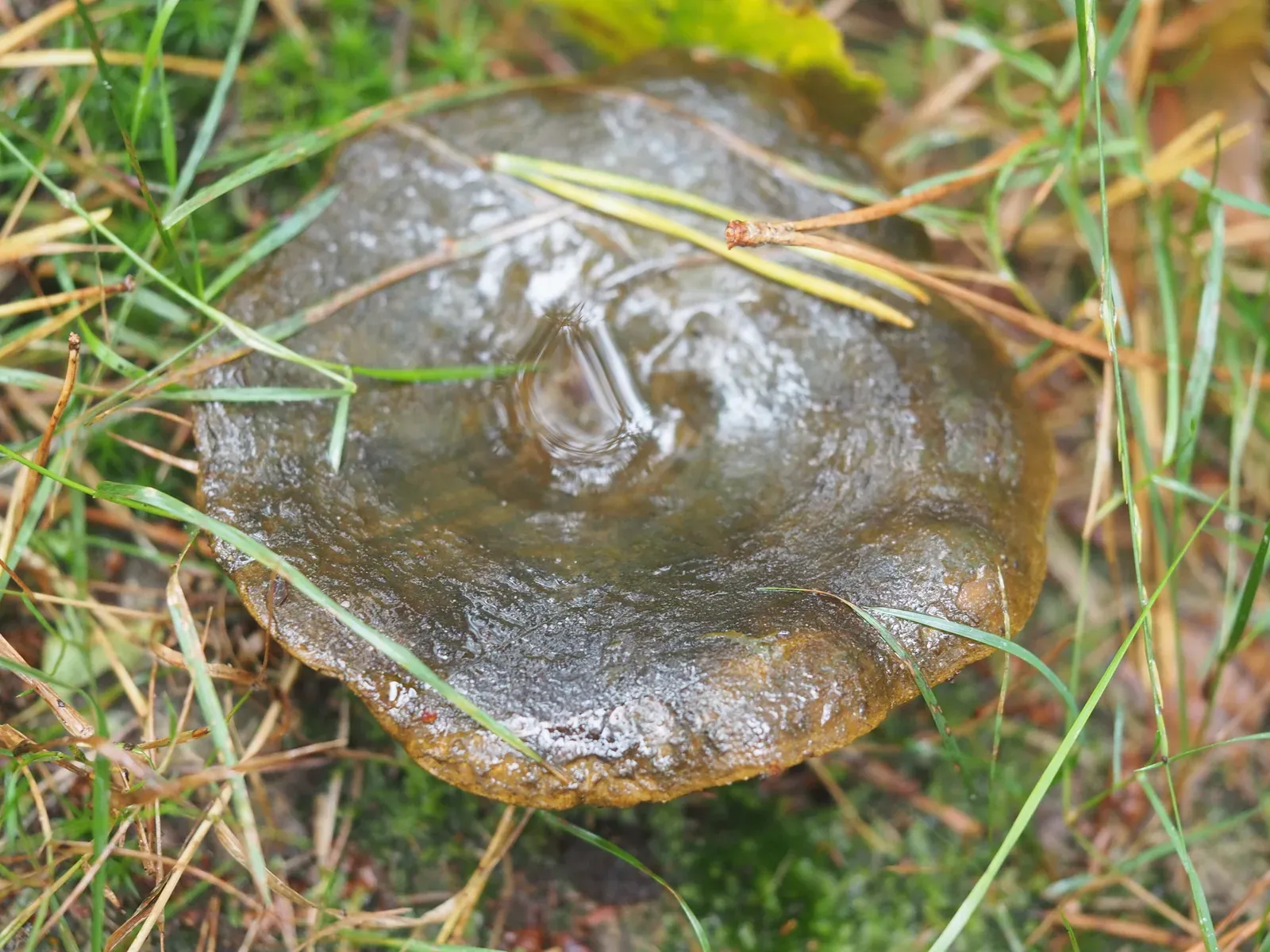
You won't mistake the ugly milk cap for any of the bright forest mushrooms: its dark, almost olive-black cap hides in the moss of damp birch woods. It's a classic salting mushroom, well known to anyone who loves salted mushrooms. Let's look at how to recognize it, where to look for it, and why it always needs special preparation.
What the ugly milk cap looks like
Features of the ugly milk cap:
- Cap dark, olive-brown or almost black, funnel-shaped, with an inrolled margin, up to 15–20 cm, often slimy and dirty with leaves.
- Gills pale, creamy, darkening when touched.
- Flesh firm, white; when cut, it releases an acrid white milky latex that darkens in the air.
- Stem short, thick, often with pits.
The milky latex is the key feature of the genus: the ugly milk cap belongs to the milk caps.
Where and when to pick it
The ugly milk cap loves damp birch and mixed forests, growing in moss and grass, often in large groups. The season is the second half of summer and autumn, August to October. It's a hardy mushroom that copes well with cool weather.
Why the ugly milk cap is soaked
When fresh, the ugly milk cap is bitter and acrid because of its milky latex, so it is never eaten raw. Before salting, the mushroom must always be:
- soaked in cold water for several days, changing the water 2–3 times a day;
- or boiled with the cooking water poured off.
Only after that is the mushroom salted. Why mushrooms can be bitter and how to get rid of the bitterness — in the article why mushrooms taste bitter. Milk caps must never be eaten raw — more on that in which mushrooms can be eaten raw.
How it differs from Lactarius resimus
Lactarius resimus has a pale, creamy cap with a fuzzy margin, while the ugly milk cap has a dark, almost black, funnel-shaped one. Both are edible milk caps for salting, and both are soaked. About Lactarius resimus and how it gets confused with porcini — in the article Lactarius resimus or porcini. Other mushrooms for salting — in the piece saffron milk cap and Lactarius resimus, mushrooms for salting.
Sources
- “Field Guide to the Fungi of Ukraine” (Kyiv, Naukova Dumka publishing house).
- Lactarius turpis in GBIF, the global biodiversity database.
- Ugly milk cap on Wikipedia).
Frequently asked questions
How do you recognize the ugly milk cap?
By its dark olive-black, funnel-shaped cap with an inrolled margin, pale gills that darken when touched, and acrid white milky latex on the cut. It grows in damp birch woods.
Is the ugly milk cap edible?
Yes, the ugly milk cap is conditionally edible and prized for salting. But fresh, it is bitter and acrid, so it must always be soaked or boiled before cooking.
Why does the ugly milk cap need soaking?
Because it contains acrid, bitter milky latex. To remove the bitterness, the mushroom is soaked in cold water for several days, changing the water, or boiled with the water poured off. Only then is it salted.
Where does the ugly milk cap grow?
In damp birch and mixed forests, in moss and grass, often in large groups. The season is August to October. It's a hardy mushroom that copes well with cool weather.
How does the ugly milk cap differ from Lactarius resimus?
Lactarius resimus has a pale creamy cap with a fuzzy margin, while the ugly milk cap has a dark, almost black, funnel-shaped one. Both are soaked and salted, but they differ in color.
Can you salt the ugly milk cap without soaking it?
No. Without soaking or boiling, the mushroom stays bitter and acrid. Preparation is mandatory — otherwise the salted batch will be unfit to eat.
Does the ugly milk cap get wormy?
Young milk caps are wormy less often than thin-fleshed mushrooms, but they're still worth checking. Large old specimens are more often infested with larvae, so people mostly pick young, firm mushrooms.
Mushrooms in this article
Related articles
 How to identify
Truffles in Ukraine: do they grow here, and where to look
Truffles aren't just a French delicacy. Several species grow in Ukraine too. Here's which ones, where they occ…
August 24, 2026·2 min Recipes & cooking
How to store fresh mushrooms, and for how long
Fresh mushrooms spoil faster than you might think. Here's how long they keep in the fridge, how to store them…
August 21, 2026·4 min Recipes & cooking
How long to boil mushrooms
Boiling time depends on the type of mushroom and on what you're cooking next. Here's a clear cheat sheet: how…
August 22, 2026·4 min