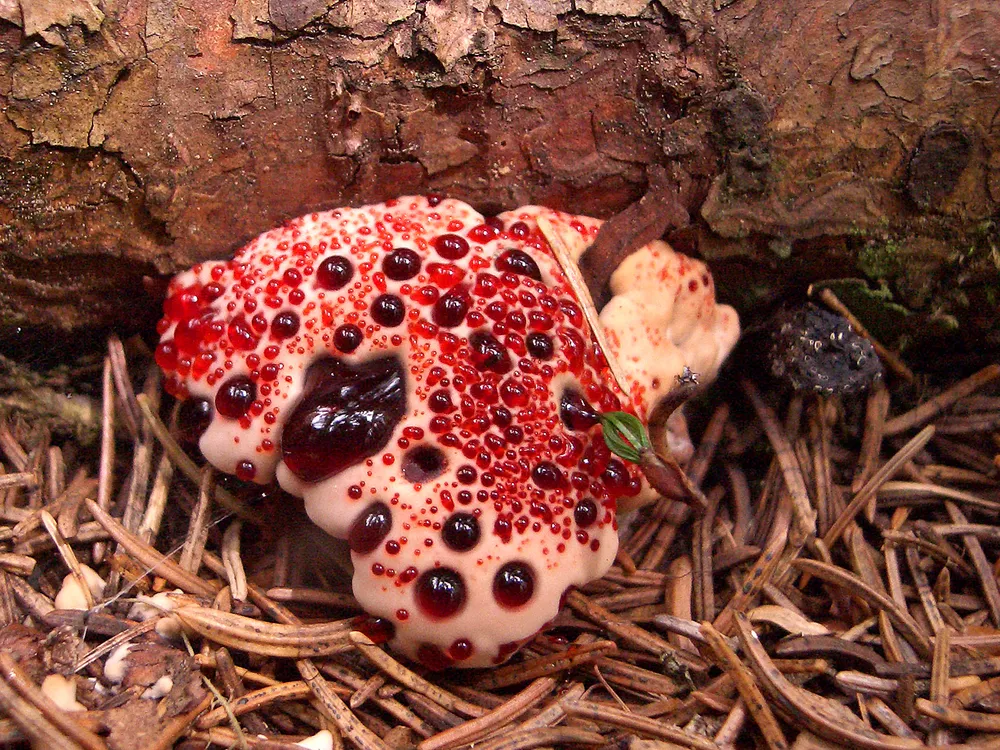
Devil's toothHydnellum peckii
Expert-verifiedUpdated June 13, 2026
Passport
- Edibility
- Inedible
- Season
- Aug — Oct
- Hymenophore
- Spiny
- Cap color
- White
- Size
- Medium (5–15 cm)
- Smell
- Floury
- Reviewed
- Yes ✓
Quick answers
Where to look?
Conifer forest
When does it appear?
Aug — Oct
Active months: August, September, October.
How to recognize it? Three signs
- Cap color: White, Red, Brown, Dark brown
- Cap shape: Irregular
- Smell: Floury
Fruiting season
August – October
Description
Devil's tooth is one of the strangest mushrooms of European forests. It's also called the "bleeding tooth" or "strawberries and cream": young fruiting bodies exude bright red droplets from pores on the cap that look like fresh blood. Against the white, fluffy cap this looks incredibly striking — few mushrooms in nature look so dramatic. With age the red drops dry up, and the mushroom turns brown, then dark brown and lumpy.
The mushroom is not poisonous, but it is completely inedible — the flesh has a very strong burning, bitter-peppery taste that no cooking can fix. In the past it was used in natural fabric dyeing (it gives a bluish tint). This isn't food — it's beauty and a subject for photo hunting. In Scandinavia, Great Britain and other European countries, devil's tooth is a protected species, because as an obligate mycorrhizal partner of conifers on poor soils it disappears when forests are reclaimed.
In Ukraine it is rare. It occurs in the Carpathians and the Carpathian foothills, in pine and spruce-pine forests on poor sandy or mossy soils. The hymenophore under the cap isn't gills or tubes but spines (hence the genus Hydnellum). Season: August–October.
Cap
Cap 4-10 cm, convex at first, then flat and spreading with an uneven, wavy edge, sometimes with a crater-like depression in the center. Young caps are white or cream, with red droplets of exudate on the porous surface. The surface is velvety-felty and rough. With age the red drops dry up, and the cap turns gray-brown to dark brown, with uneven lumpy outgrowths.
Hymenophore
The hymenophore is spiny (small sharp teeth on the underside of the cap) — a typical feature of the genus Hydnellum. The spines are thin, 2-5 mm, whitish at first, turning pinkish brown to purplish brown with age. Spore print brown.
Stem
Stem 2-5 cm tall, 1-3 cm thick, short and coarse, sometimes fused with neighboring stems. Red-brown to brown, with a velvety surface. There is no ring.
Flesh
The flesh is dense, corky, dark reddish brown, with concentric darker and lighter zones when cut. A burning, bitter taste — the mushroom is impossible to eat.
Smell
Faint mealy or earthy smell. The taste is extremely hot, bitter and peppery — even a microscopic taste burns the tongue.
Lookalikes
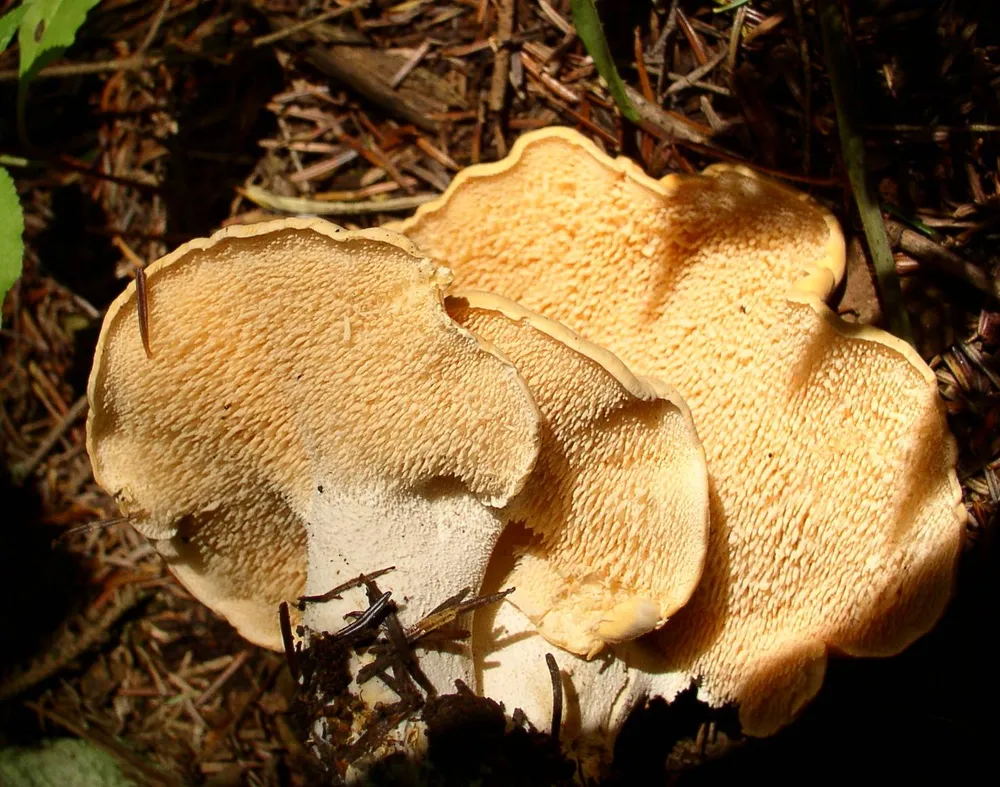
Related species
Mushrooms of the same genus and habitat — to study side by side and never mix up.
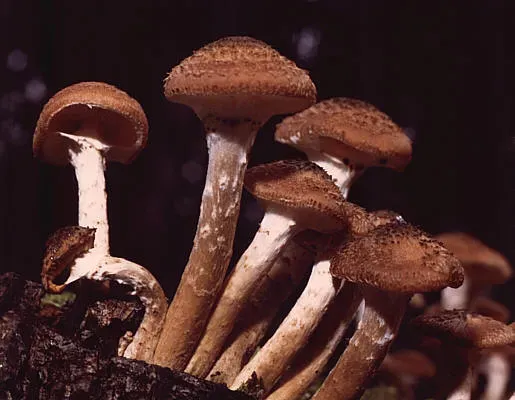
Dark honey fungus
Armillaria ostoyae
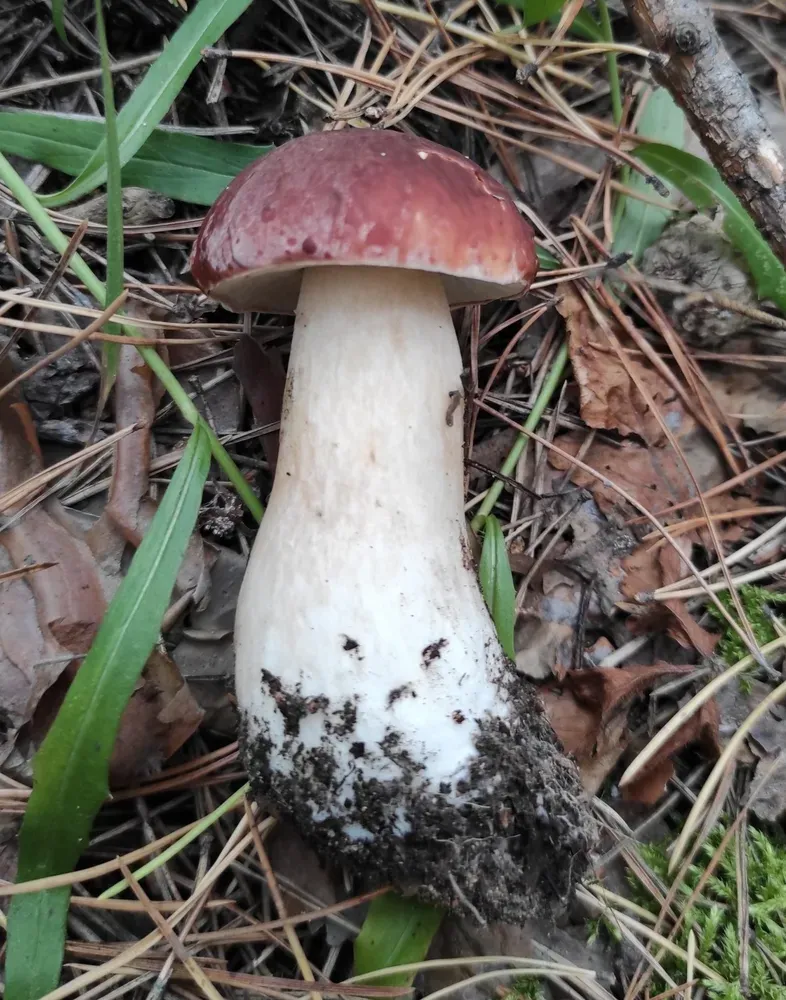
Pine bolete
Boletus pinophilus
Agaricus abruptibulbus
Agaricus haemorrhoidarius
Agaricus haemorroidarius
Cantharellus pallens
Copper brittlegill
Russula decolorans
Grayling
Cantharellula umbonata
Hollow bolete
Suillus cavipes
Frequently asked questions
Is it safe to eat?
The mushroom isn't poisonous, but it is completely inedible because of its extreme burning bitterness. The flesh is so acrid that even a tiny taste causes a strong burning sensation in the mouth. No cooking — boiling, pickling, drying — removes the bitterness. There's no point in picking it for food.
And the red drops on the cap — are they a toxin?
No. It's guttation exudate — a liquid the young mushroom releases through the pores of its cap. It gets its red color from a special pigment, atromentin. It's not poisonous to humans, but pharmacologists study it for its anticoagulant properties. Still, don't put it in your mouth — the mushroom is hot enough as it is.
Where should you look for it?
In coniferous, mostly pine forests on poor sandy or mossy soils. An obligate mycorrhizal partner of pine (less often spruce). It likes old pine woods with a thick moss cover. Individual fruiting bodies often grow fused into groups.
Which regions of Ukraine does it grow in?
A rare species. Most documented finds are from the Carpathians (Zakarpattia and Ivano-Frankivsk oblasts), the Carpathian foothills, and the pine forests of Polissia (Volyn, Rivne and Zhytomyr oblasts).
When should you look for it?
August–October. Peak fruiting is in September. Young fruiting bodies with the characteristic red drops are the most photogenic, but they last only 1-2 weeks. Then the mushroom turns brown and loses its dramatic look.
When are the drops easiest to see?
On young fruiting bodies in damp weather, especially after night dew or rain. Usually this is the first 1-2 weeks of the mushroom's life. In sunny, dry weather the drops dry up quickly. For a good photo, look for fresh mushrooms early in the morning after a damp night.
What is it confused with?
Among Ukrainian mushrooms — practically nothing. The combination of "white felty cap with red drops + spines under the cap + coniferous forest" is unique. Other Hydnellum species (the zoned and the bluish tooth) are also rare, but they have different colors and don't exude blood-red drops.
Could I confuse it with something dangerous?
Unlikely. The mushroom has no poisonous lookalikes in Ukraine. A spiny hymenophore is itself a fairly rare feature — most mushrooms that have it (hedgehog mushrooms, hen of the woods) are edible or just unpalatable. Still, don't eat devil's tooth because of its burning bitterness.
Is Devil's tooth edible or poisonous?
What kind of spore-bearing surface does Devil's tooth have?
What does the cap of Devil's tooth look like?
What does the stem of Devil's tooth look like?
Sources
- [1]Вікіпедія (українська)
- [2]Атлас грибів України, Зеров Д.К. (1979)
- [3]MycoBank Database
- [4]Index Fungorum
- [5]GBIF
- [6]iNaturalist Ukraine