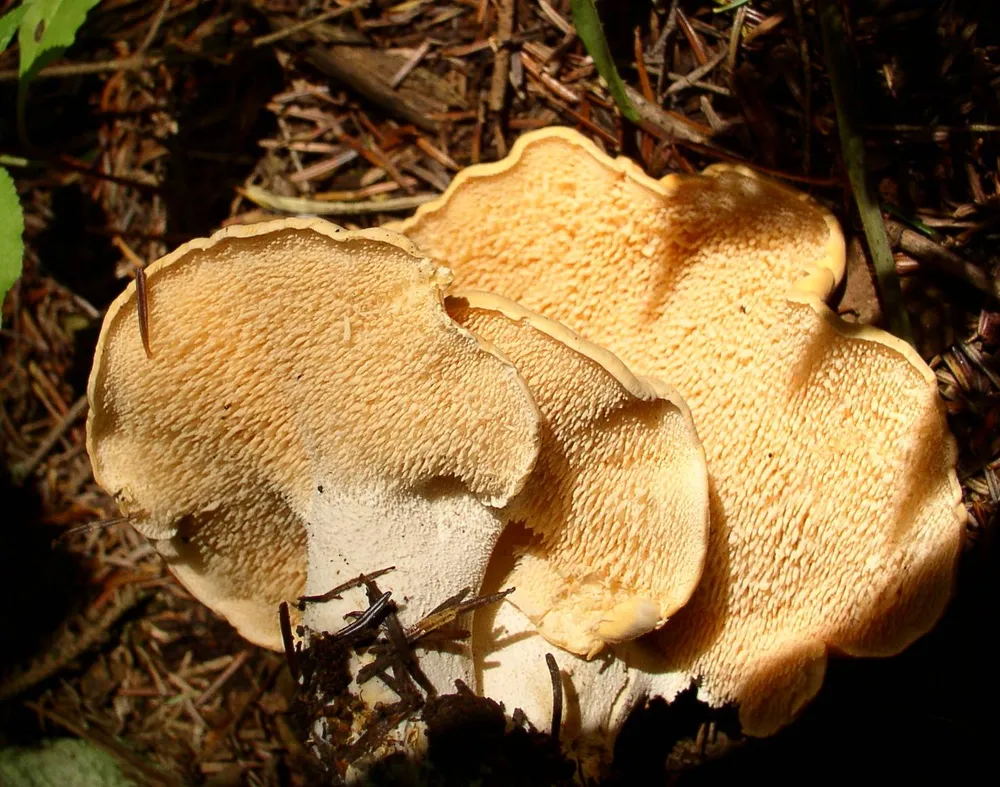
Wood hedgehogHydnum repandum
Expert-verifiedUpdated October 3, 2026
Passport
- Edibility
- Edible
- Season
- Aug — Nov
- Hymenophore
- Spiny
- Cap color
- Cream
- Size
- Medium (5–15 cm)
- Smell
- Pleasant
- Reviewed
- Yes ✓
Quick answers
Where to look?
Conifer forest, Deciduous forest, Mixed forest
When does it appear?
Aug — Nov
Active months: August, September, October, November.
How to recognize it? Three signs
- Cap color: Cream, Yellow, Orange
- Cap shape: Irregular
- Smell: Pleasant
Fruiting season
August – November
Description
The wood hedgehog is one of the most pleasant and safest mushrooms in our forests — a real gift for a beginner. Its distinctive cap is ivory or ochre-yellow, with a pronounced wavy edge, on a sturdy whitish stem. Its main feature: instead of gills or tubes, dense soft spines hang beneath the cap, like a clothes brush. Hence the name: "hedgehog" — the mushroom-hedgehog. It's highly prized in Europe: in France it's known as pied de mouton ("sheep's foot"), in Britain as the hedgehog mushroom. Restaurant menus often list it among the forest delicacies.
This is a good edible mushroom, safe for beginners — it has no lookalikes. Its spiny hymenophore is so recognizable that it's hard to confuse with anything: boletes have pores, gilled mushrooms have gills, and the hedgehog has a brush of spines. Young ones are the most tender, with a delicate nutty flavor; mature ones can be bitter, so it's worth boiling them for 5-10 minutes and pouring off the first water. The classic way to serve them is fried with sour cream and onion, in sauces for meat, or in soups. They pickle and dry very well.
In Ukraine it is widespread in broadleaf, mixed and coniferous forests — most often under pine, spruce, beech and oak. It forms mycorrhiza. It loves mossy patches, compacted conifer litter and forest edges. Season: August–November, peaking in September–October. It often grows in groups and even rings of 10-30 mushrooms — a lovely find for a forager.
Cap
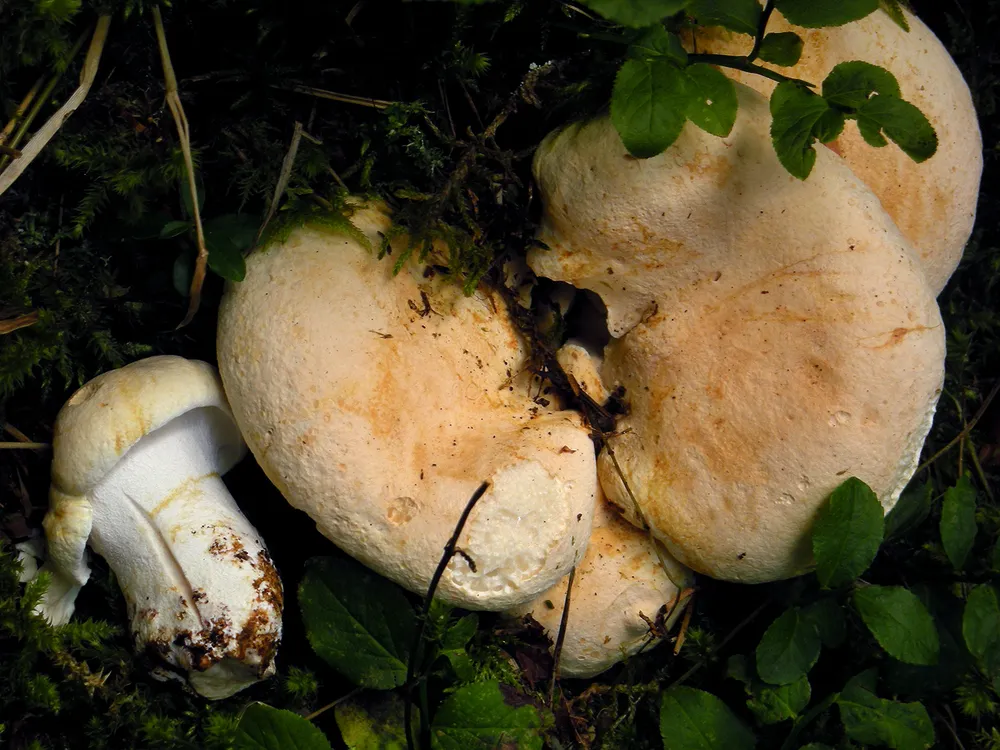
The cap is 4-15 cm across, irregular, with an unevenly wavy margin; convex in young mushrooms, flat and spread out in mature ones, with a lumpy surface and a depressed center. The color is ivory, cream, ochre-yellow to light orange, turning reddish-brown in old mushrooms. The surface is dry and silky-suede, slightly sticky in wet weather. The cap skin is thin and peels easily.
Hymenophore
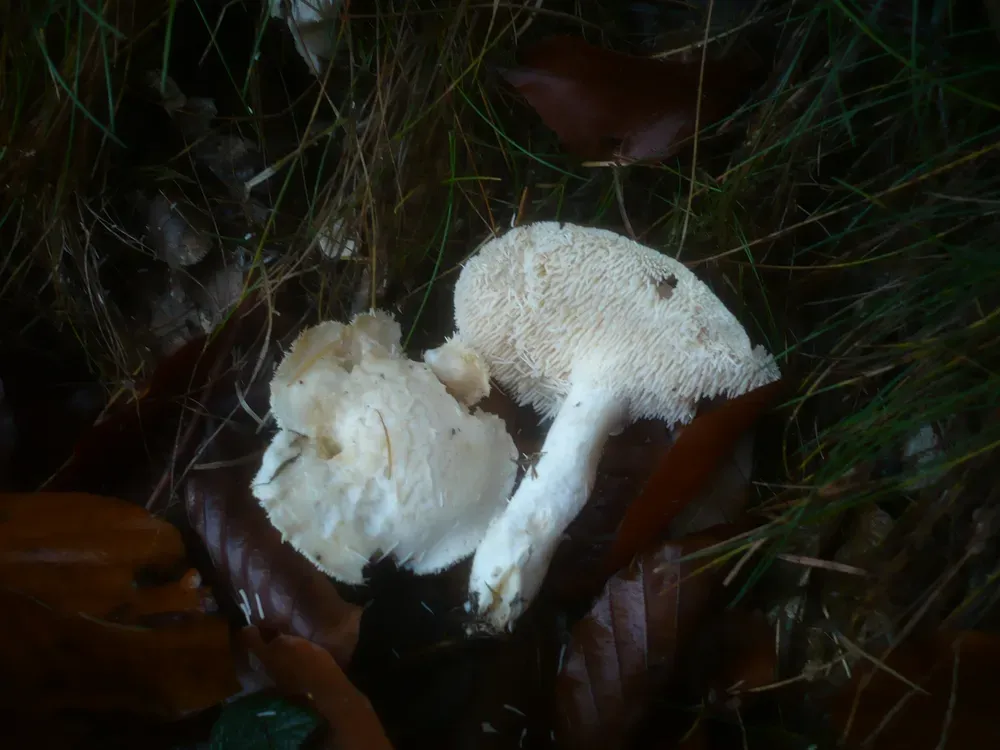
The spiny hymenophore is the key diagnostic feature. Under the cap there are densely packed thin, pointed spines 3-6 mm long that break off easily. The spines are white to cream, yellowing with age and turning reddish-ochre in old mushrooms. The spore print is white.
Stem
The stem is 3-8 cm tall and 1-3 cm thick, cylindrical, often widening toward the base, sometimes eccentric (off-center from the cap). It's white to cream, yellowing slightly where pressed. The surface is smooth, with no ring. The stem flesh is firm, becoming spongy in old mushrooms.
Flesh
The flesh is thick, white, firm and brittle. When cut, it slowly turns pale ochre (a slight yellowing). Young mushrooms have a delicate, pleasant nutty flavor; mature ones have a slightly bitter aftertaste that disappears after brief boiling.
Smell
A faint, pleasant mushroomy-fruity aroma with a note of fresh nuts. The taste is mild and delicate; slightly bitter in old mushrooms.
Lookalikes
Related species
Mushrooms of the same genus and habitat — to study side by side and never mix up.
Bulbous honey fungus
Armillaria gallica
Dark honey fungus
Armillaria ostoyae
Poplar fieldcap
Cyclocybe aegerita
Ringless honey fungus
Desarmillaria tabescens
Agaricus abruptibulbus
Agaricus haemorrhoidarius
Agaricus haemorroidarius
Ashen chanterelle
Cantharellus cinereus
Blushing bolete
Leccinum roseofractum
Frequently asked questions
Is it safe to eat?
Yes, it's one of the safest edible mushrooms — it has practically no lookalikes in nature. Its hymenophore of soft spines rather than gills or pores is so recognizable that you can't confuse it with poisonous mushrooms. It's suitable for beginner foragers. Old mushrooms may be slightly bitter — 5-10 minutes of boiling takes care of that.
How do you cook it properly?
Clean and slice. Young mushrooms (with white spines) can go straight into the pan for 10-15 minutes — that's when they taste best. Mature or slightly bitter ones should first be boiled for 5-10 min in salted water; pour off the water, then fry, stew or add to soups. The classic way to serve them is fried with sour cream and onion. They pickle and dry well.
Can children eat it?
Yes, from age 3-4 in small portions — it's one of the very first mushrooms that pediatricians conditionally allow as an experiment in a child's diet. The hedgehog-like hymenophore guarantees safe identification. Prepare it as you would for an adult: boil, then stew with potatoes or cream. Children under 3 should not be given any mushrooms at all.
Where should you look for it?
In coniferous, mixed and broadleaf forests — most often under pine, spruce, beech, oak and hornbeam. It loves mossy patches, compacted conifer litter, forest edges and the slopes of wooded ravines. It often grows in groups and rings of 10-30 fruiting bodies — a lovely find for a forager.
Which regions of Ukraine is it found in?
Throughout the forest zone — the Carpathians, the Carpathian foothills, Polissia and all three forest-steppe belts. It's especially abundant in the beech and fir forests of the Carpathians and in the mossy pine woods of Polissia. In the steppe, it turns up in ravine woodlands and park plantings.
When should you look for it?
August — November, peaking in September–October. It loves a damp autumn with moderate temperatures of +10..+15°C. It survives the first frosts — you can find it even in November under fallen leaves. It doesn't fruit in the summer heat.
What is it confused with?
With two close relatives: Terracotta hedgehog (Hydnum rufescens) — smaller, a more intense orange-russet color, with the stem in the center of the cap; both are edible. And Shingled hedgehog (Sarcodon imbricatus) — with a scaly cap surface and grayish-brown spines, bitter, conditionally edible. All hedgehogs with soft spines are safe (edible); there are no poisonous hedgehog mushrooms in our forests.
How do you identify it for sure?
Turn the cap upside down: underneath there are soft white or cream spines (3-6 mm). If you see gills, it's not a hedgehog. If you see pores (like on a porcini), it's not a hedgehog either. Only spines = hedgehog. It's the simplest and most reliable test.
Is Wood hedgehog edible or poisonous?
What kind of spore-bearing surface does Wood hedgehog have?
What does the cap of Wood hedgehog look like?
What does the stem of Wood hedgehog look like?
Sources
- [1]Вікіпедія (українська)
- [2]Атлас грибів України, Зеров Д.К. (1979)
- [3]MycoBank Database
- [4]Index Fungorum
- [5]GBIF
- [6]iNaturalist Ukraine