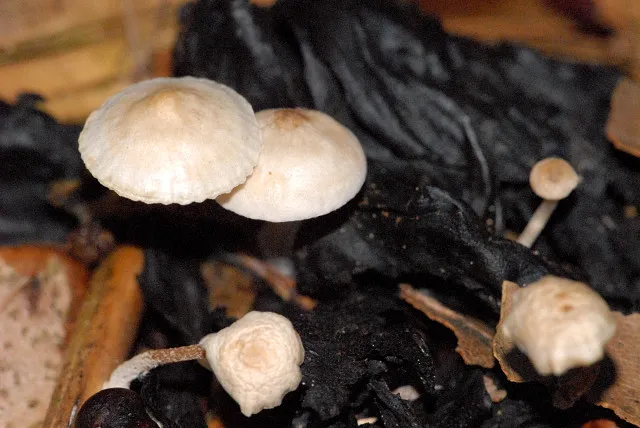
Silky piggybackAsterophora parasitica
Expert-verifiedUpdated October 3, 2026
Passport
- Edibility
- Inedible
- Season
- Jul — Oct
- Hymenophore
- Gilled
- Cap color
- White
- Size
- Very small (<3 cm)
- Smell
- Odorless
- Reviewed
- Yes ✓
Quick answers
Where to look?
Deciduous forest, Mixed forest
When does it appear?
Jul — Oct
Active months: July, August, September, October.
How to recognize it? Three signs
- Cap color: White, Red, Grey
- Cap shape: Convex
- Smell: Odorless
Fruiting season
July – October
Description
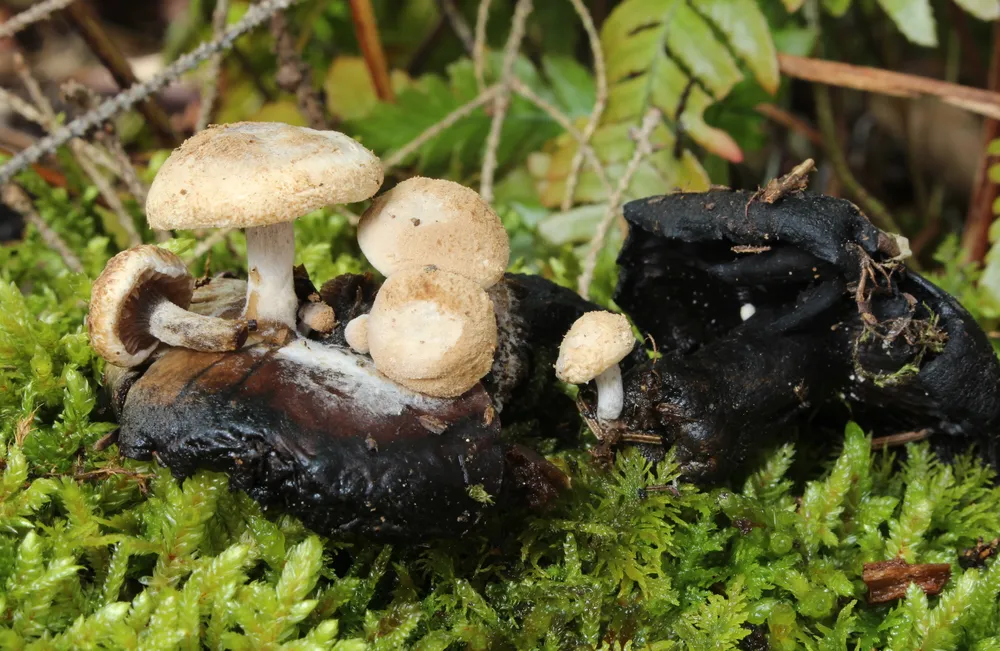
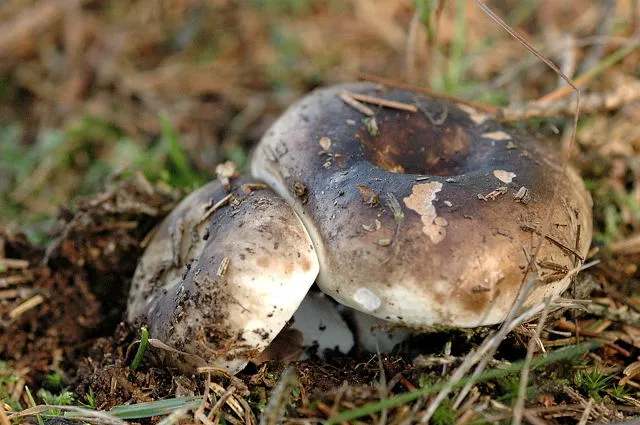
The Silky piggyback is a close relative of the Powdery piggyback, and also a mycophile. It lives on capped mushrooms of the genera Lactarius (milk caps) and Russula (brittlegills). You'll only find it where those mushrooms form stable "colonies".
In appearance the Silky piggyback is more modest than its relative: the cap is 1.5–2.5 cm, bell-shaped at first, then flattening. Color — white, turning reddish or grayish with age. It doesn't crack as noticeably as the Powdery piggyback — that's the main difference for quick identification.
In Ukraine it occurs wherever its hosts are — mostly in broadleaf and mixed forests of the temperate zone. Not edible, but interesting as an example of fungal parasitism.
Cap
Cap 1.5–2.5 cm. Bell-shaped at first, then flattening. Color: white → reddish or grayish. Surface smooth, not cracked.
Hymenophore
Gilled hymenophore. Spore print white. Spores ellipsoid, 5–6 × 3–4 µm. Secondary chlamydospores are often formed.
Stem
Stem 1–5 cm tall, 2–5 mm thick. Hairy, often bent, hollow, fibrous. Whitish to grayish. No ring or volva.
Flesh
flesh thin, fragile, white. No notable color changes.
Smell
Faint, mushroomy. No sharp notes.
›Scientific synonyms (5)
Agaricus parasiticus Bull. 1791, Agaricus parasiticus Bull. ex Pers. (1801), Gymnopus parasiticus (Bull.) Gray (1821), Merulius parasiticus (Pers. ex Bull.) Purton (1821), Nyctalis parasitica (Bull.) Fr. (1838)
Lookalikes
Related species
Mushrooms of the same genus and habitat — to study side by side and never mix up.
St George's mushroom
Calocybe gambosa

Clustered domecap
Lyophyllum decastes
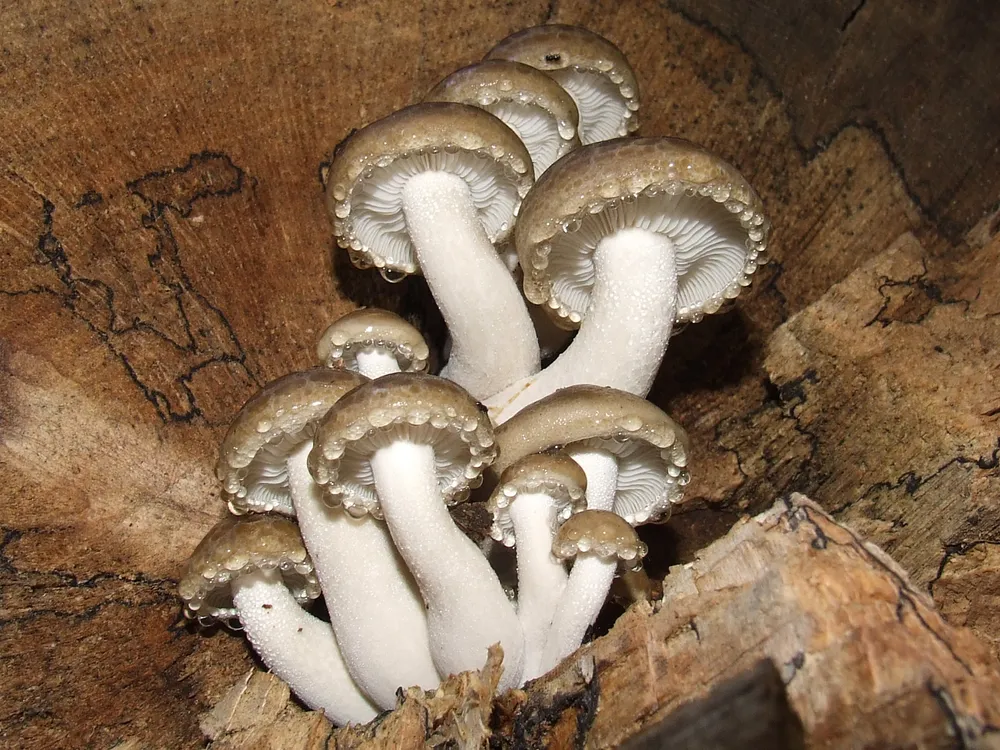
Elm oyster
Hypsizygus ulmarius
Gilded domecap
Lyophyllum favrei
Lyophyllum fumatofoetens
,_to_serve_as_an_atlas_to_the_Handbook_of_British_Fungi_(Pl._81)_(8163893789).webp)
Lyophyllum immundum
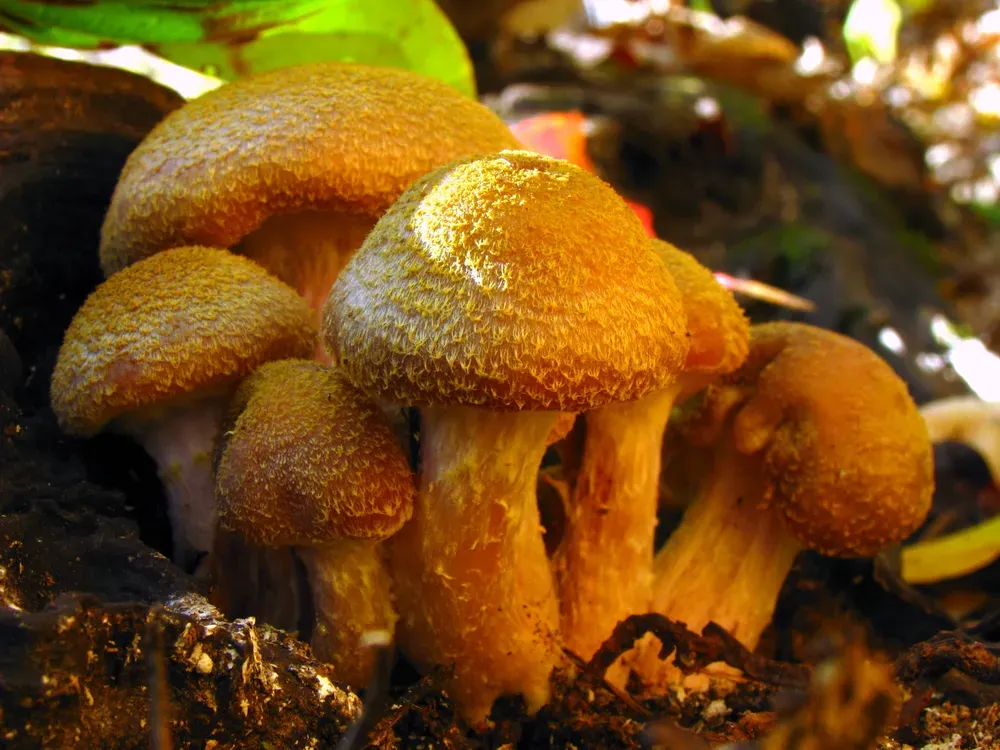
Bulbous honey fungus
Armillaria gallica
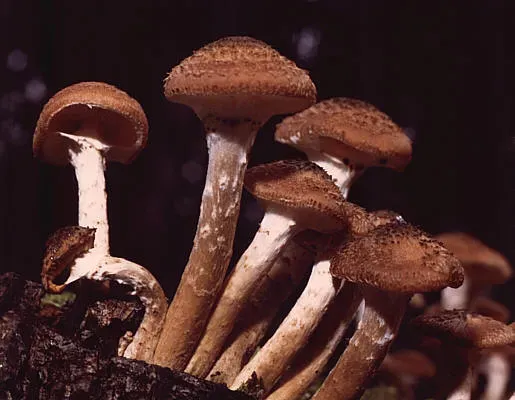
Dark honey fungus
Armillaria ostoyae
Frequently asked questions
Can you eat it?
No. It's inedible in itself, and the host mushroom it sits on isn't worth taking either — it's already weakened by the parasite.
Is it poisonous?
No specific toxins have been described, but it's not an edible species. The mushroom isn't eaten because of its small size and parasitic lifestyle.
Where should you look for it?
On old or damaged fruiting bodies of brittlegills (Russula) and milk caps (Lactarius). Most often in broadleaf and mixed forests.
In which regions of Ukraine?
Wherever its hosts grow — Polissia, the Forest-Steppe, the Carpathians. Rare in the steppe zone, where conditions are less favorable for brittlegills.
When can you see it?
Late summer to autumn, at the peak of brittlegill and milk cap season. If you find an old, battered brittlegill, take a closer look: there may be a piggyback sitting on it.
Does it appear in spring?
No, in spring Ukrainian forests don't have its hosts in the right condition.
What is it confused with?
With the Powdery piggyback (Asterophora lycoperdoides) — its closest relative. The Powdery piggyback has a cracked brown top; the Silky piggyback has a smooth, whitish one.
How do you identify it for sure?
A small white cap on another mushroom is already a strong hint. If the cap is smooth and not cracked, it's the Silky piggyback. If it's cracked and powdery, it's the Powdery piggyback.
Is Silky piggyback edible or poisonous?
Does Silky piggyback have gills or pores?
What does the cap of Silky piggyback look like?
What does the stem of Silky piggyback look like?
Sources
- [1]Вікіпедія (українська)
- [2]Атлас грибів України, Зеров Д.К. (1979)
- [3]MycoBank Database
- [4]Index Fungorum
- [5]GBIF
- [6]iNaturalist Ukraine