Powdery piggybackAsterophora lycoperdoides
Expert-verifiedUpdated October 3, 2026
Passport
- Edibility
- Inedible
- Season
- Jul — Oct
- Hymenophore
- Gilled
- Cap color
- White
- Size
- Very small (<3 cm)
- Smell
- Floury
- Reviewed
- Yes ✓
Quick answers
Where to look?
Deciduous forest, Mixed forest
When does it appear?
Jul — Oct
Active months: July, August, September, October.
How to recognize it? Three signs
- Cap color: White, Brown
- Cap shape: Convex
- Smell: Floury
Fruiting season
July – October
Description
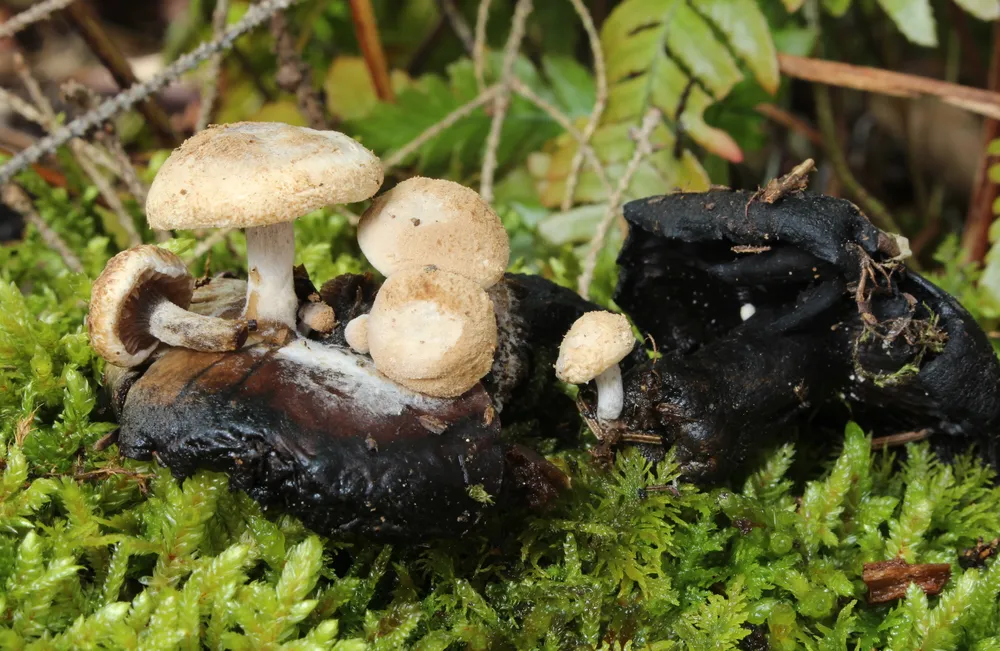
The Powdery piggyback is a mushroom that hunts mushrooms. It's a mycophile: it parasitizes other capped mushrooms, mainly the Fleecy milk cap (Lactarius vellereus) and the Smoky brittlegill (Russula adusta). You'll only find it where those species have their "homes".
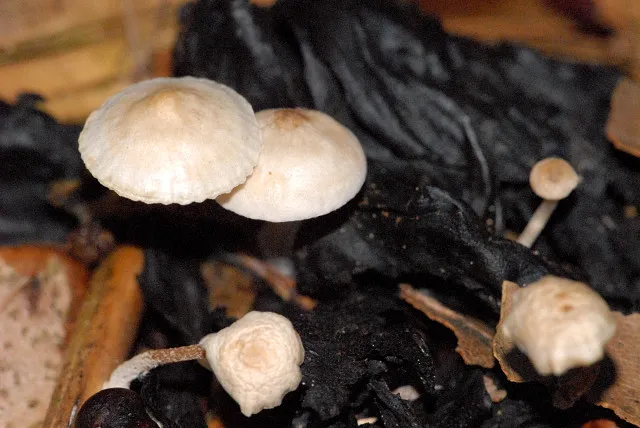
The fruiting bodies are small — the cap is 0.5–2.5 cm. White at first, it cracks and turns brown with time, becoming something like a puffball — hence the name. A powder of chlamydospores (vegetative spores) forms on the gills and cap, and the mushroom reproduces with them more effectively than with ordinary basidiospores.
In Ukraine the Powdery piggyback occurs in Polissia and the Forest-Steppe — wherever its hosts grow. The mushroom isn't edible, but it's fascinating precisely as an example of parasitic fungal ecology.
Cap
Cap 0.5–2.5 cm. Hemispherical at first, then convex-flat. The surface is white at first, then cracks and turns brown with time — it looks like a tiny puffball sitting on top of gills.
Hymenophore
Gilled hymenophore, but the gills are often underdeveloped or deformed. A powder of chlamydospores forms on the cap surface. Spore print white. Basidiospores ellipsoid, colorless, 5–7 × 3–4.5 µm.
Stem
Stem 1–3 cm tall, thin, white. No ring or volva.
Flesh
flesh thin, fragile, white. No clear color change.
Smell
Faint mealy smell — typical of many mycophilic species.
›Scientific synonyms (1)
Agaricus lycoperdoides Bull. 1784
Lookalikes
Related species
Mushrooms of the same genus and habitat — to study side by side and never mix up.
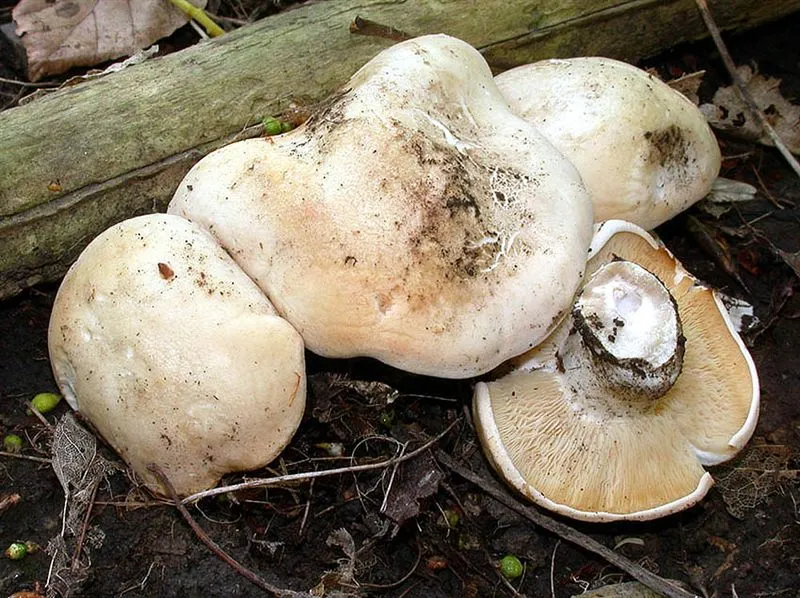
St George's mushroom
Calocybe gambosa

Clustered domecap
Lyophyllum decastes
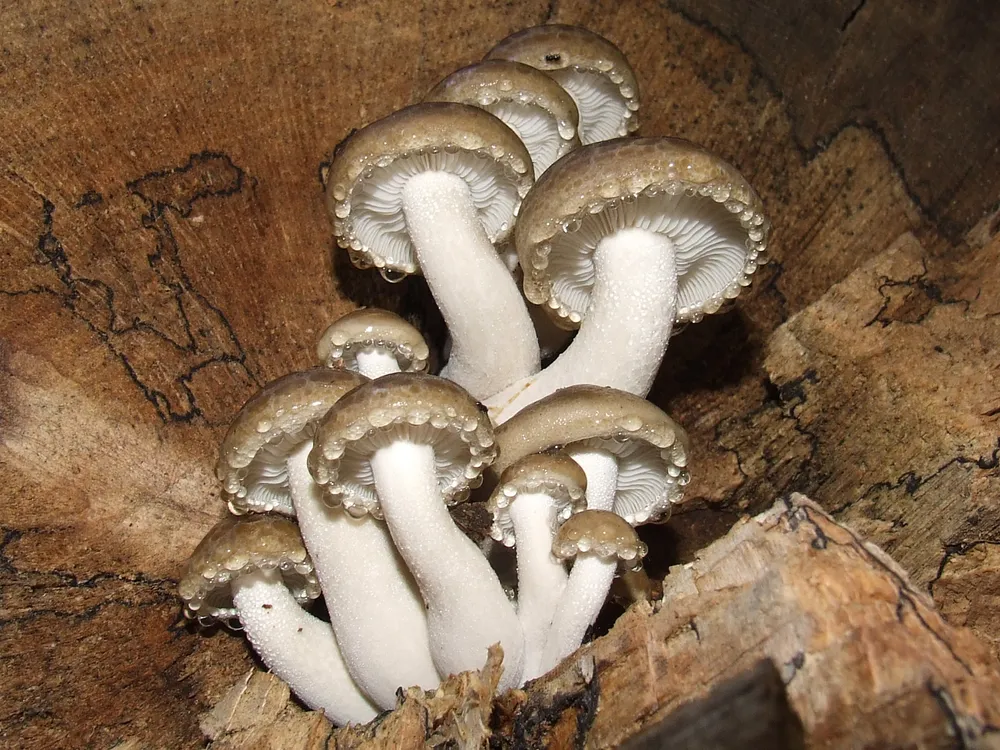
Elm oyster
Hypsizygus ulmarius
Gilded domecap
Lyophyllum favrei
Lyophyllum fumatofoetens
,_to_serve_as_an_atlas_to_the_Handbook_of_British_Fungi_(Pl._81)_(8163893789).webp)
Lyophyllum immundum
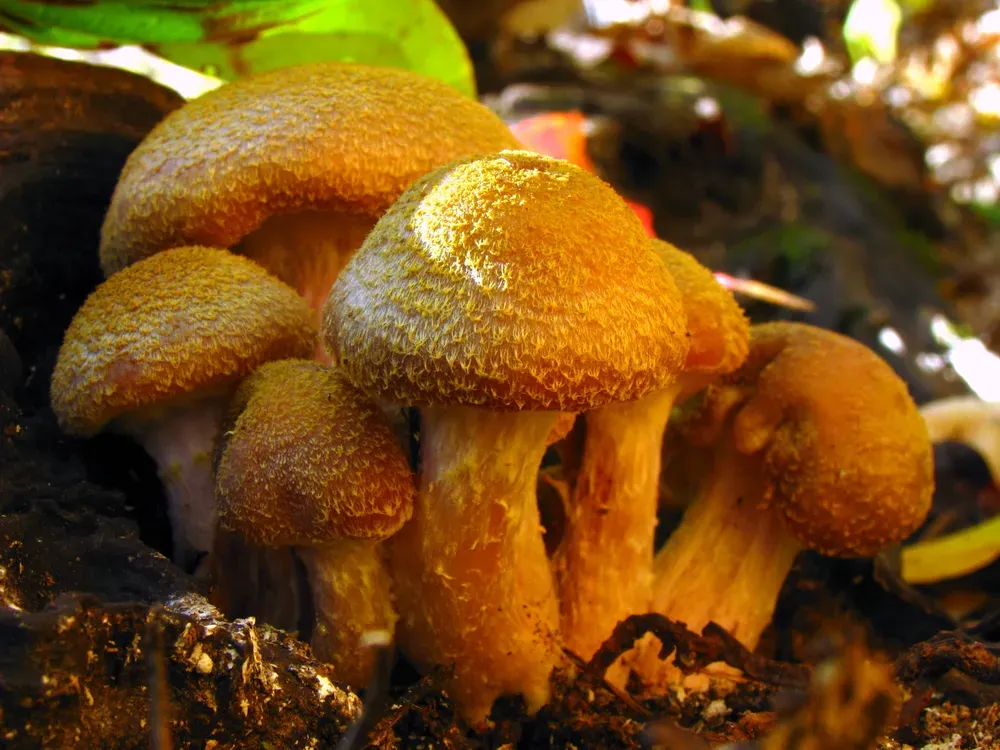
Bulbous honey fungus
Armillaria gallica
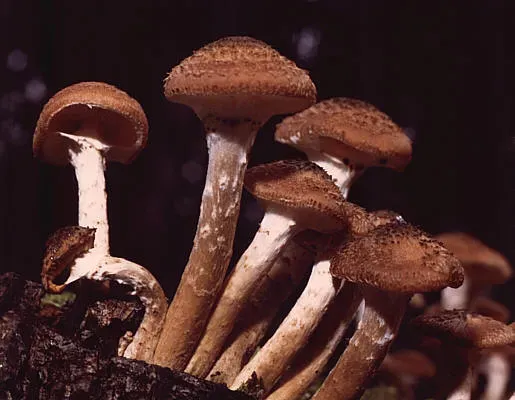
Dark honey fungus
Armillaria ostoyae
Frequently asked questions
Can you eat it?
No. Not only is it inedible in itself, it also grows on hosts that aren't edible in that state either — a mushroom weakened by a parasite doesn't belong in your basket.
Will it spoil my brittlegill haul?
Brittlegills with a piggyback on them don't go in the basket — they're already partly decomposed. Check every mushroom: if there's a white-brown film on the cap, put it back.
Where should you look for it?
Where Lactarius vellereus (Fleecy milk cap) and Russula adusta (Smoky brittlegill) grow — typically in broadleaf and mixed forests. Don't look for the mushroom itself; look for old or damaged fruiting bodies of those species.
In which regions of Ukraine?
Polissia and the Forest-Steppe. It practically never occurs in the Steppe and southern regions — conditions there don't suit its hosts.
When can you see it?
In late summer and autumn — at the same time as its hosts grow. Your chances are highest in August–September.
How long does its "hunt" last?
Each fruiting body lives for several weeks. A colony may return to the same groups of hosts year after year.
What is it confused with?
With the other piggyback — the Silky piggyback (Asterophora parasitica), which also sits on brittlegills and milk caps. The Powdery piggyback stands out with its cracked, "puffball-like" top, while the Silky piggyback's is smooth.
How do you recognize it at first glance?
A small mushroom on the cap of another mushroom is a strong clue in itself. If the top is cracked and turning brown, it's the Powdery piggyback.
Is Powdery piggyback edible or poisonous?
Does Powdery piggyback have gills or pores?
What does the cap of Powdery piggyback look like?
What does the stem of Powdery piggyback look like?
Sources
- [1]Вікіпедія (українська)
- [2]Атлас грибів України, Зеров Д.К. (1979)
- [3]MycoBank Database
- [4]Index Fungorum
- [5]GBIF
- [6]iNaturalist Ukraine