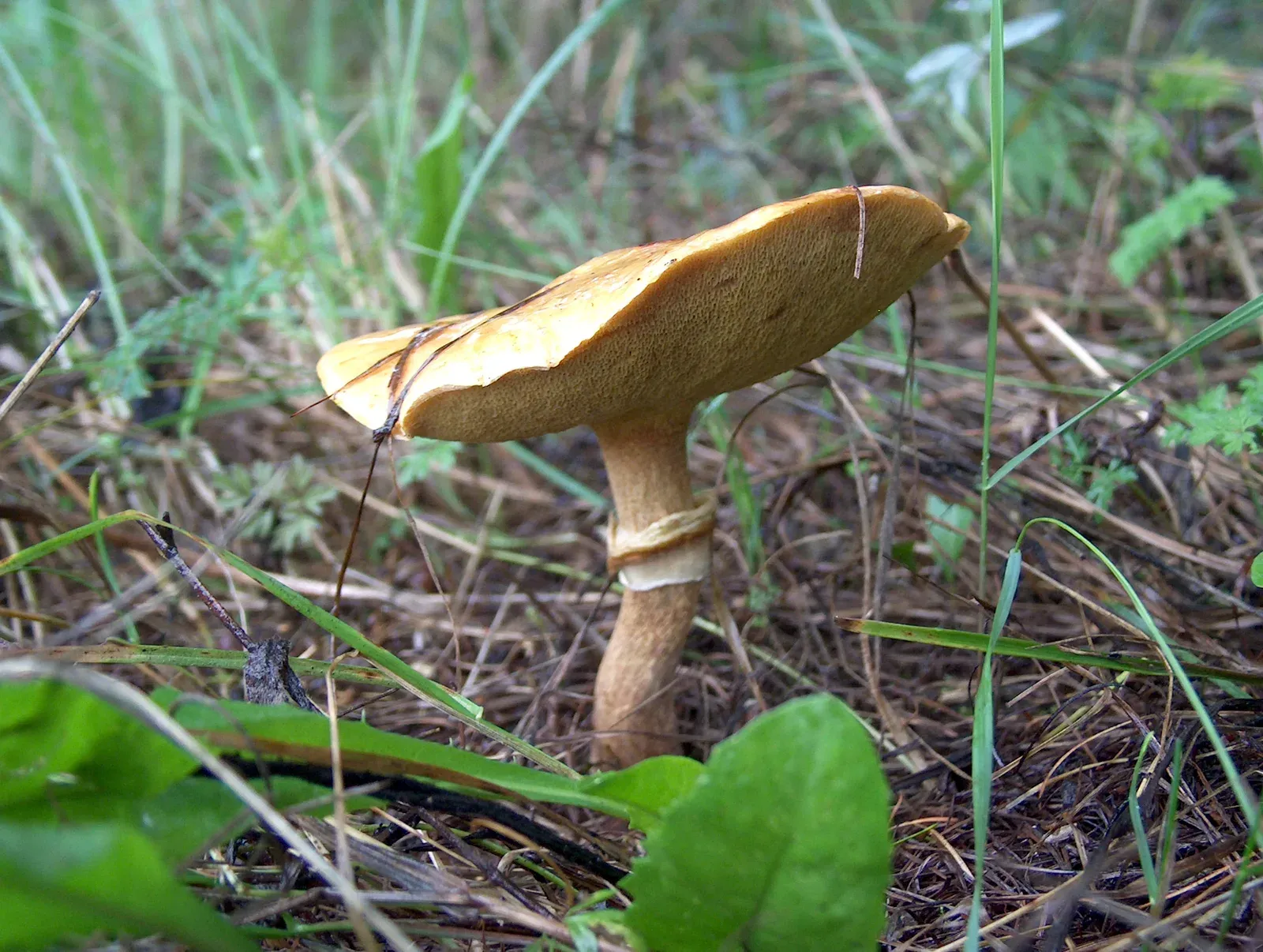
When a forager says "I picked some slippery jacks," they rarely specify which ones. No wonder: the name "slippery jack" hides not one species but a whole family of closely related mushrooms. They all have a slimy or greasy cap, a spongy underside and grow under conifers.
Working out who's who among slippery jacks is useful not for the Latin but for practice. Knowing which slippery jack grows under which tree and when it appears, you plan your outings more precisely and read your finds with more confidence.
What all slippery jacks have in common
First, the common ground. All slippery jacks belong to the genus Suillus and share several traits.
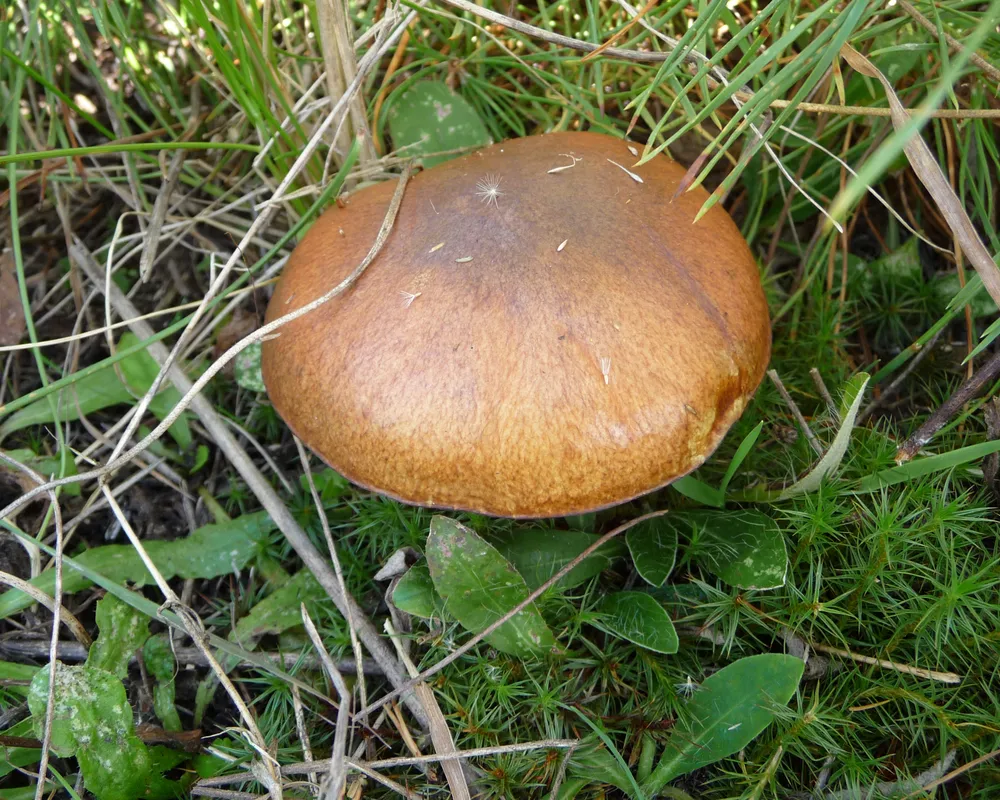
- A slimy or greasy cap. Hence the name. In wet weather the cap is especially sticky.
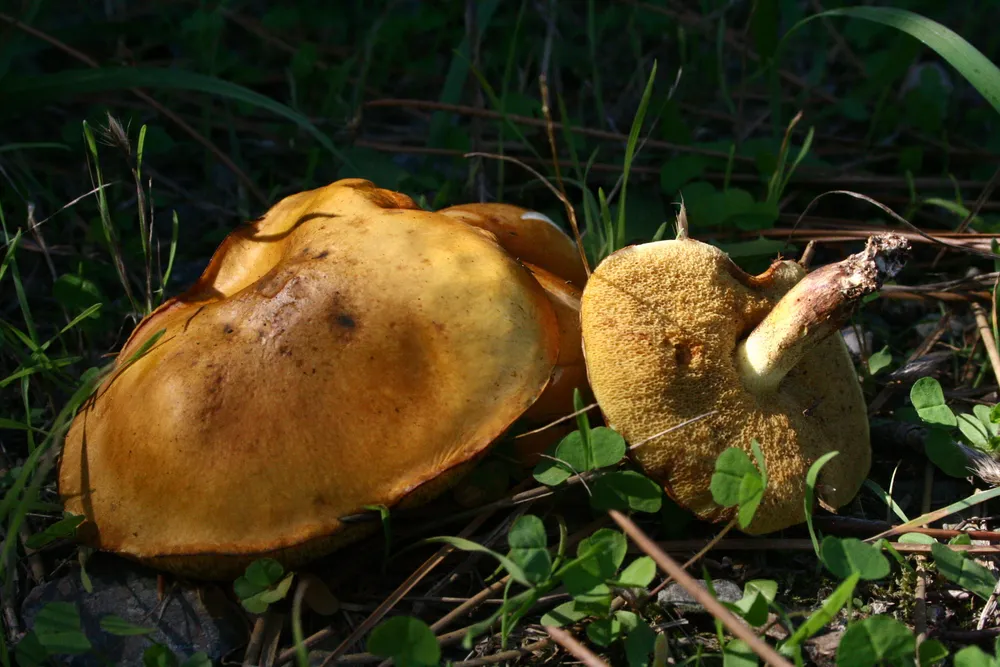
- A spongy underside. Under the cap there's a layer of tubes, not gills. The color ranges from yellow to olive.
- A partnership with conifers. Almost all slippery jacks live in mycorrhiza with pine or larch, that is, in a mutually beneficial partnership with the roots of these trees.
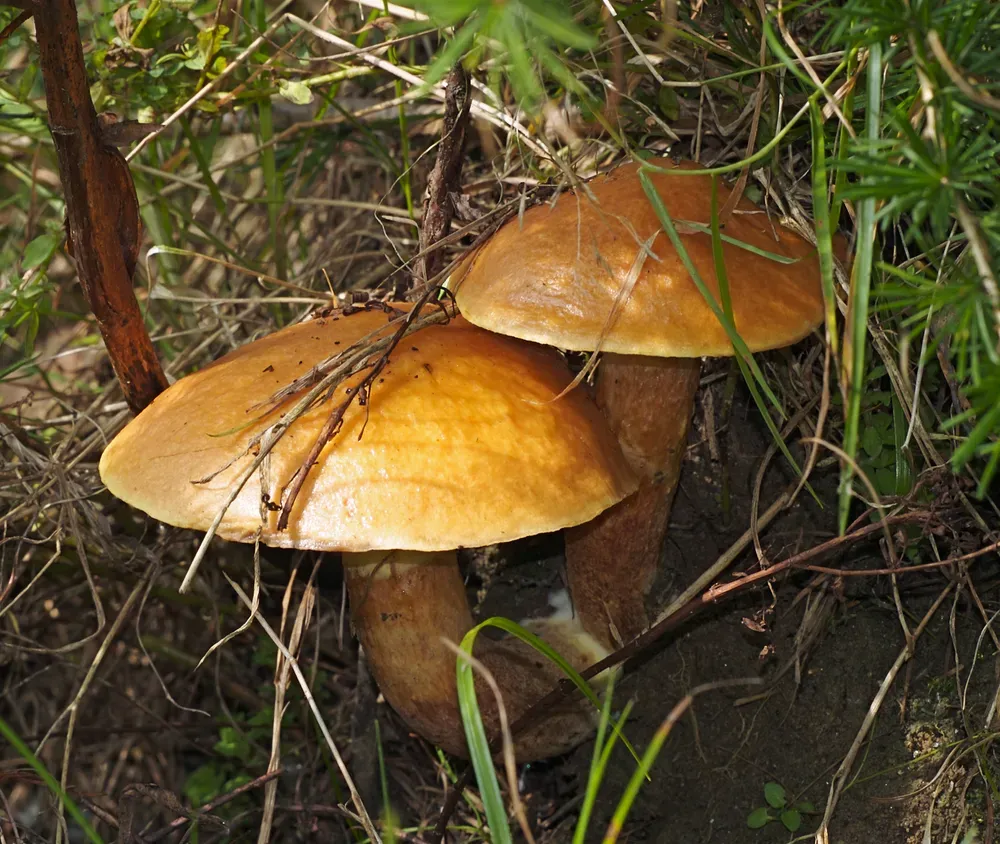
- Fast growth in clusters. Slippery jacks rarely grow alone; more often they come in whole groups.
The species differ in their trees, whether the stem has a ring, cap color and season. These are the traits we'll use to sort out the family.
Slippery jacks with and without a ring
The handiest way is to split slippery jacks into two groups by one detail: the ring on the stem.
With a ring. The classic slippery jack (Suillus luteus) has a noticeable ring on its stem, the remnant of the membrane that covered the young pores. It's the most common and the latest slippery jack of our pine forests. The bright larch bolete (Suillus grevillei), which grows under larch, has a ring too.
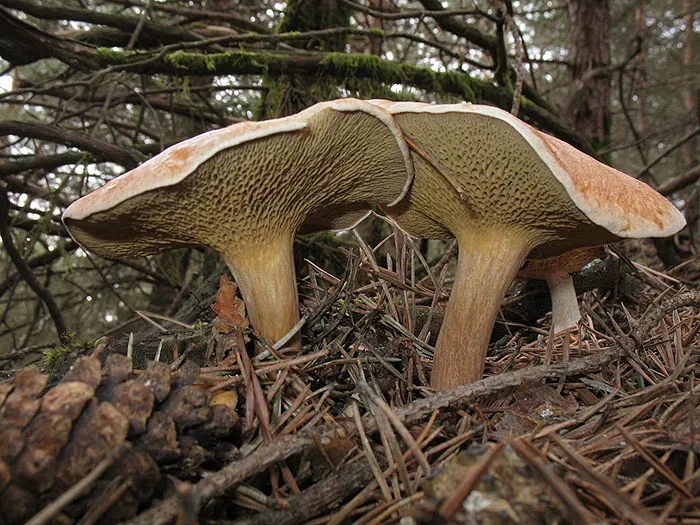
Without a ring. Weeping bolete (Suillus granulatus) has no ring, but its stem shows tiny granules and droplets, especially on a young mushroom. It comes up earlier than the slippery jack. Also ringless is the delicate, pale Suillus placidus of young pine forests.
Slippery jacks by tree
The partner tree is the best hint about which species you can expect.
- Scots pine. Here the slippery jack and the weeping bolete rule, along with the bovine bolete and Suillus placidus.
- Larch. Its faithful companion is the bright yellow larch bolete, along with the grayish sticky bolete.
- Mixed pine forests. In a mixed forest, where pine grows alongside birch, slippery jacks turn up especially abundantly.
That's why an experienced forager first looks at which conifers are around, and only then at the ground.
Close relatives of the slippery jack
Alongside the classic slippery jacks, it's worth knowing a few closely related mushrooms.
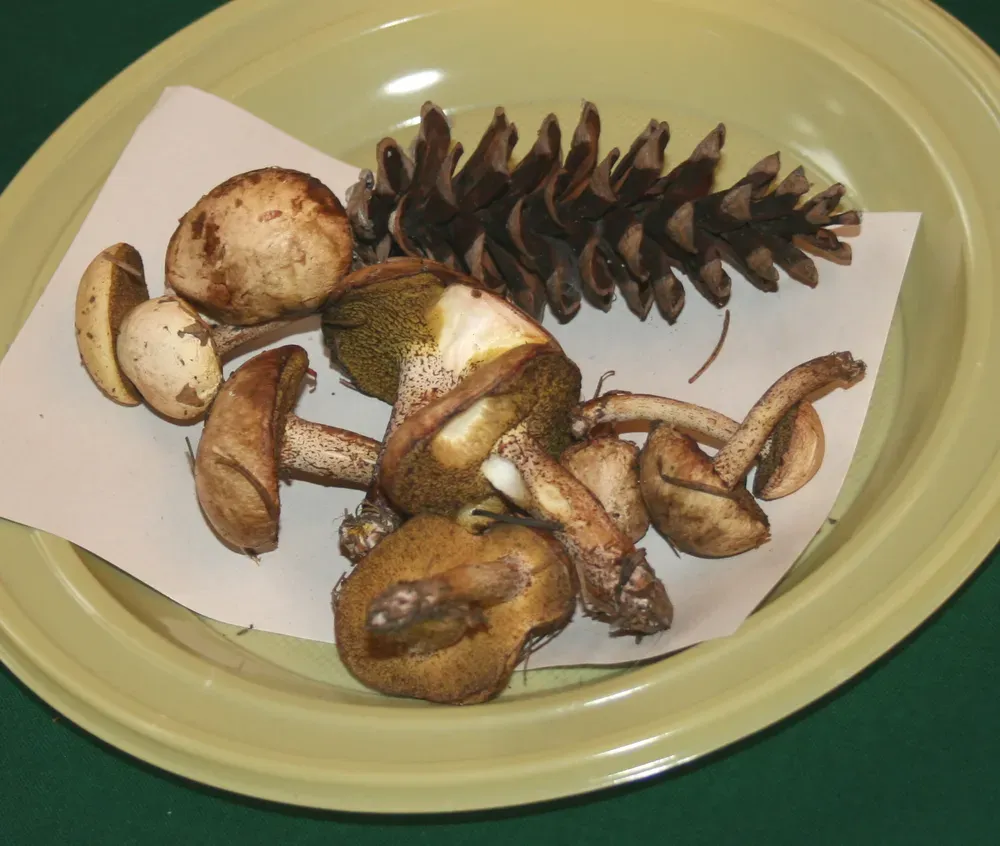
Bovine bolete (Suillus bovinus) has a reddish-brown, dryish cap and larger pores. It's often underrated, though it's perfectly edible. Velvet bolete stands out because its skin hardly peels, and its flesh turns slightly blue when cut. And Suillus spectabilis is a rare relative with a scaly cap.
How the season changes them
The slippery jack family shares the season out among its members, so these mushrooms keep foragers company for almost the whole warm half of the year.
The weeping bolete comes up first, as early as June, on bright forest edges. The larch bolete holds on all summer wherever there's larch. And the classic slippery jack brings its main flushes at the end of summer and in autumn, right up to the first frosts.
So you don't have to guess when exactly to go, keep an eye on conditions with our mushroom radar: it shows when moisture and warmth line up well for mushrooms to appear.
Sources
- "Key to the Fungi of Ukraine" (Kyiv, Naukova Dumka publishing house).
- Suillus on GBIF, a global biodiversity database.
- Suillus on MycoBank, an international fungal nomenclature database.
- Suillus luteus on Wikipedia.
Frequently asked questions
How many species of slippery jack are there?
In Ukrainian forests it's worth knowing at least five or six species: the , , , , , and the related .
How do slippery jack species differ from each other?
Mainly by their partner tree, whether there's a ring on the stem, cap color and season. The slimy cap and spongy underside are common to all. The slippery jack has a ring, the weeping bolete doesn't, and the larch bolete is bright yellow and grows under larch.
Which slippery jack tastes best?
Connoisseurs often praise the slippery jack and the larch bolete. But in practice all edible slippery jacks are equally good: young, firm mushrooms of any species are wonderful fried or pickled.
Which slippery jack has a ring on its stem?
The ring is found on the and the . The has no ring; instead, its stem shows tiny granules and droplets.
How is the slippery jack different from the bovine bolete?
has a dryish, reddish-brown cap without slime and larger pores. Slippery jacks have a slimy, shiny cap and finer pores. Both grow under pines and are edible.
Are all slippery jacks edible?
Yes, all true slippery jacks are edible. There are no dangerous lookalikes among them. The main thing is to make sure the underside of the cap is spongy, not gilled, and to pick young, firm mushrooms.
Which slippery jack comes up earliest?
Usually the , as early as June on bright pine forest edges. The classic brings its main flushes closer to autumn.
Can you pick different slippery jack species on one outing?
Yes, especially in a mixed pine forest where pine and larch grow side by side. On a single walk you can come across the slippery jack, the weeping bolete and the larch bolete.
Mushrooms in this article
Related articles
 Recipes & cooking
How to store fresh mushrooms, and for how long
Fresh mushrooms spoil faster than you might think. Here's how long they keep in the fridge, how to store them…
August 21, 2026·4 min Recipes & cooking
How long to boil mushrooms
Boiling time depends on the type of mushroom and on what you're cooking next. Here's a clear cheat sheet: how…
August 22, 2026·4 min Science & taxonomy
Bay bolete: health benefits and nutritional value
The bay bolete is a match for porcini in both flavor and nutrition. Here's why the bay bolete is good for you,…
August 20, 2026·2 min