Devil's urnUrnula craterium
Expert-verifiedUpdated October 3, 2026
Passport
- Edibility
- Inedible
- Season
- Apr — Jun
- Hymenophore
- Smooth
- Cap color
- Black
- Size
- Small (up to 5 cm)
- Smell
- Odorless
- Reviewed
- Yes ✓
Quick answers
Where to look?
Deciduous forest, Mixed forest
When does it appear?
Apr — Jun
Active months: April, May, June.
How to recognize it? Three signs
- Cap color: Black, Violet
- Cap shape: Depressed
- Smell: Odorless
Fruiting season
April – June
Description
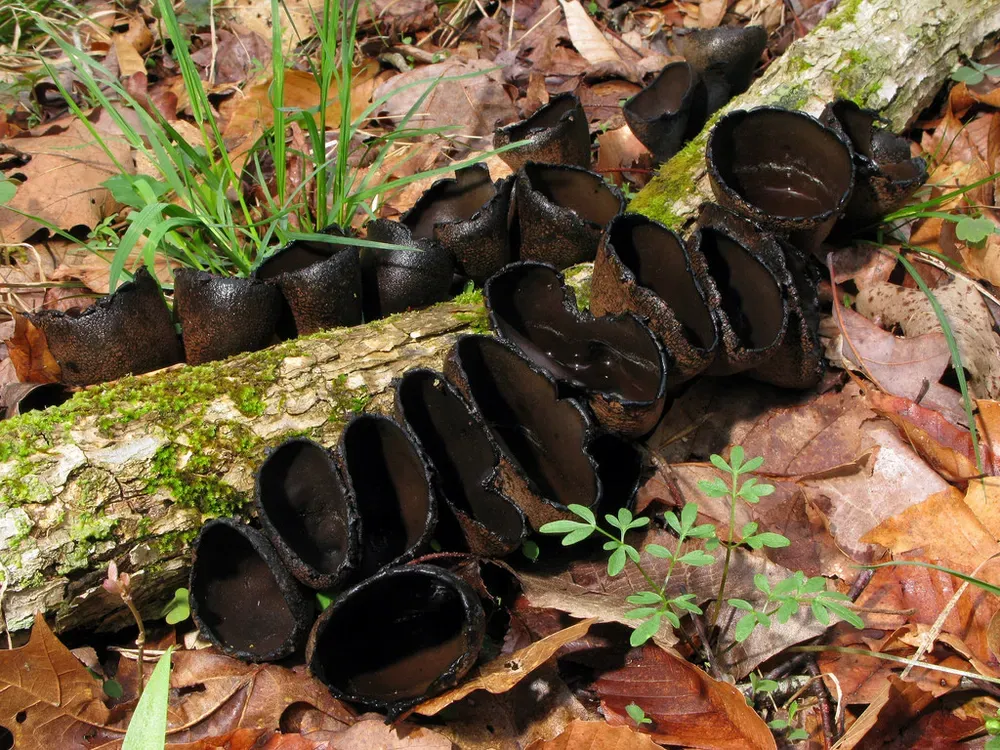
The devil's urn (Urnula craterium, synonym — Plectania melastoma) is a distinctive dark violet to black cup-shaped ascomycetethat appears in spring on rotting wood of broadleaf trees. The Latin name literally means "a little urn resembling a crater" — and it captures the shape exactly: a deep crater-shaped cup on a slender stalk, with a smooth black-violet inner surface and a downy dark outer one. The fruiting body is 3-8 cm across, 5-10 cm tall, and resembles a small black goblet or cartridge case.
Inedible — the flesh is very thin, leathery and black, with no culinary value. Nobody gathers it. It is of mycological interest as a spring ascomycete indicator of old broadleaf forests with dying wood (especially hornbeam, oak and beech).
Diagnostic features of Urnula craterium: Crater-shaped fruiting body (a deep cup on a stalk) Dark violet to black coloring Inner surface smooth and glossy Outer surface downy with short hairs Slender dark stalk (1-3 cm) Flesh very thin, leathery Grows on rotting branches and stumps of broadleaf trees (hornbeam, oak, beech) Spring season (April–May) — rarely in summer
The main thing is to recognize it as one of the spring ascomycetes and not to confuse it with the related species Sarcosphaera coronaria (a pinkish-violet cup on soil) and Plectania melastoma (a close relative).
A mushroom that is remarkably photogenic — in a spring forest, dark violet cups on rotting wood look like fairy-tale goblets of woodland elves.
In Ukraine, Urnula craterium is uncommon, found mainly in broadleaf forests: the Carpathians, Prykarpattia, and in part Polissia and the forest-steppe. The season is April — May, less often June.
Cap
Fruiting body 3-8 cm across, 5-10 cm tall, deeply crater-shaped (like a goblet or urn), closed and globular when young, opening with age into a distinctly cup-like shape. Outer surface dark, brownish black, downy with short warty hairs. Inner surface smooth, dark violet to black, glossy.
Hymenophore
Ascomycete — the spore-bearing surface lines the inner surface of the cup. Spores form in sacs (asci). Color dark violet-black, glossy. Spore print white to pale cream.
Stem
Stalk 1-3 cm tall, 0.3-0.7 cm thick, slender, cylindrical, dark brown to black, often hidden in the substrate (rotting wood).
Flesh
Flesh very thin, leathery, dark brown to black, unfit for the kitchen. It does not change color when cut.
Smell
Faint and neutral, with nothing distinctive.
Related species
Mushrooms of the same genus and habitat — to study side by side and never mix up.
Bulbous honey fungus
Armillaria gallica
Dark honey fungus
Armillaria ostoyae
Poplar fieldcap
Cyclocybe aegerita
Ringless honey fungus
Desarmillaria tabescens
Agaricus abruptibulbus
Agaricus haemorrhoidarius
Agaricus haemorroidarius
Ashen chanterelle
Cantharellus cinereus
Blushing bolete
Leccinum roseofractum
Frequently asked questions
Is it poisonous?
Not poisonous, but inedible because of its thin, leathery flesh.
How do you identify it for sure?
Four features. (1) A deep crater-shaped (goblet-like) form of the fruiting body. (2) Dark violet to black coloring of the inner surface. (3) A downy, hairy outer surface. (4) Grows in spring on rotting branches and stumps of broadleaf trees. (5) A slender dark stalk.
Where should you look for it, to learn to recognize it?
On rotting branches and stumps of broadleaf trees (hornbeam, oak, beech) in broadleaf and mixed forests. In damp, shady spots, often partly hidden in leaf litter or moss.
Which regions of Ukraine is it found in?
Uncommon: mainly in the Carpathians and Prykarpattia, and in part in Polissia and the forest-steppe — in natural broadleaf forests.
When can you come across it?
April — May (less often into June) — it is a spring ascomycete. One of the early spring mushrooms.
Which mushrooms is it confused with?
With Sarcosphaera coronaria — a pinkish-violet cup on soil (not on wood). With Plectania melastoma — a close relative, also a dark cup. With young Geopora arenicola — also crater-shaped, but paler, on soil under pines.
Is Devil's urn edible or poisonous?
What kind of spore-bearing surface does Devil's urn have?
What does the cap of Devil's urn look like?
What does the stem of Devil's urn look like?
What do Devil's urn smell and taste like?
Where does Devil's urn grow?
Sources
- [1]Вікіпедія (українська)
- [2]Атлас грибів України, Зеров Д.К. (1979)
- [3]MycoBank Database
- [4]Index Fungorum
- [5]GBIF
- [6]iNaturalist Ukraine