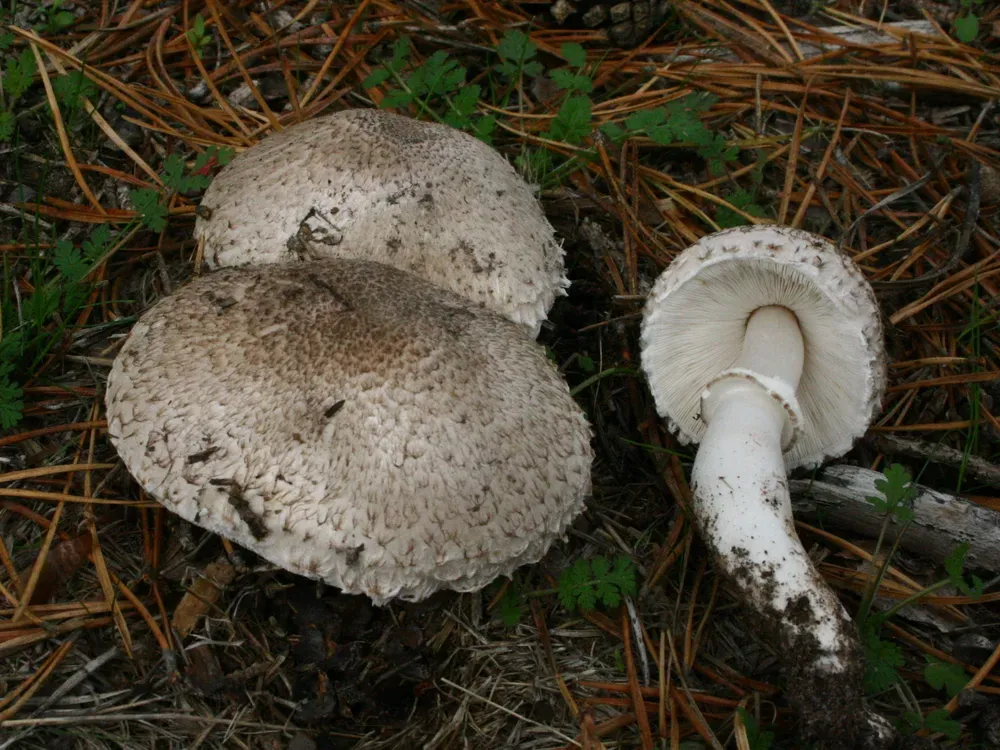
Leucoagaricus barssii
Expert-verifiedUpdated October 3, 2026
Passport
- Edibility
- Edible
- Season
- Jul — Nov
- Hymenophore
- Gilled
- Cap color
- White
- Size
- Medium (5–15 cm)
- Smell
- Pleasant
- Reviewed
- Yes ✓
Quick answers
Where to look?
Deciduous forest
When does it appear?
Jul — Nov
Active months: July, August, September, October, November.
How to recognize it? Three signs
- Cap color: White, Cream
- Cap shape: Convex
- Smell: Pleasant
Fruiting season
July – November
Description
Leucoagaricus barssii (synonym: Leucocoprinus barssii) is a rare species of large white gilled mushroom in the Agaricaceae family. Its name refers to the characteristic elongated stem base, which sometimes looks like a "root" sunk into the soil. It's a large mushroom with a white or cream cap covered in fine fibers and small scales.
In Ukraine it's rare, found mostly in open places: meadows, pastures, open parks, forest edges, and less often in neglected orchards and vegetable gardens. It loves soils rich in organic matter. It occurs throughout the forest-steppe belt and the Forest-Steppe, less often in Polissia. It isn't tied to any particular mycorrhizal partner — it's a saprotroph. In the United States (especially on the West Coast) it's noticeably more common; in Europe it's rarer.
Edibility: formally edible, but of limited practical value. The flesh is white and tender, with a pleasant smell and a mild taste. However, the genus Leucoagaricus / Leucocoprinus is close to the poisonous small Lepiota species (dapperlings), so it's not a mushroom for beginners: pick it only after an expert identification. Taste tells you nothing here: the deadly Lepiota species and the death cap taste pleasant too, so never taste it to check. Old specimens become tough and fibrous and inedible. Young, firm caps are best.
Cap
Cap 4–8 cm, hemispherical in young mushrooms, then flattening to plano-convex; in mature ones often depressed or with a small central bump. The surface is fibrous, with scattered fine scales. Color white to cream, slightly darker in the center.
Hymenophore
Gills free (not touching the stem), white or cream, crowded. Spore print white.
Stem
Stem 4–8 cm tall, cylindrical or slightly tapering downward. White, smooth. The most distinctive feature is a broad membranous ring in the upper part (annulus), which often falls away in mature mushrooms. The stem base sometimes has a small root-like extension sunk into the soil.
Flesh
Flesh white, thin, springy in young mushrooms and fibrous in old ones. Does NOT change color when cut. The texture is tender in the cap and firmer in the stem.
Smell
Smell pleasant, fresh, faintly mushroomy. Taste mild, with no distinct notes.
›Scientific synonyms (10)
Lepiota barssii Zeller (1934), Leucocoprinus macrorhizus Locq. (1943), Lepiota pinguipes A. Pearson (1952), Leucoagaricus pinguipes Bon (1981), Leucoagaricus macrorhizus var. pinguipes Alessio (1988), Lepiota macrorhiza Locq. (1953), Leucoagaricus macrorhizus Locq. (1968), Leucocoprinus macrorhizus D.A. Reid (1989), Leucoagaricus barssii Vellinga (2000), Leucoagaricus barssii var. bulbobasilarus B. Kumari & Atri (2013)
Related species
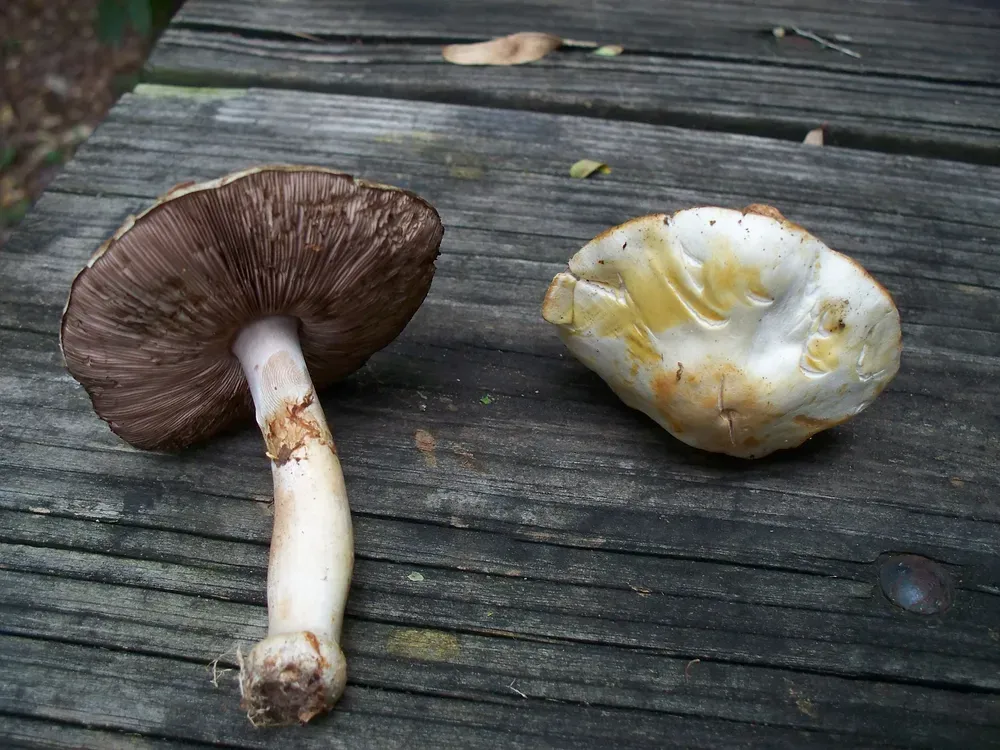
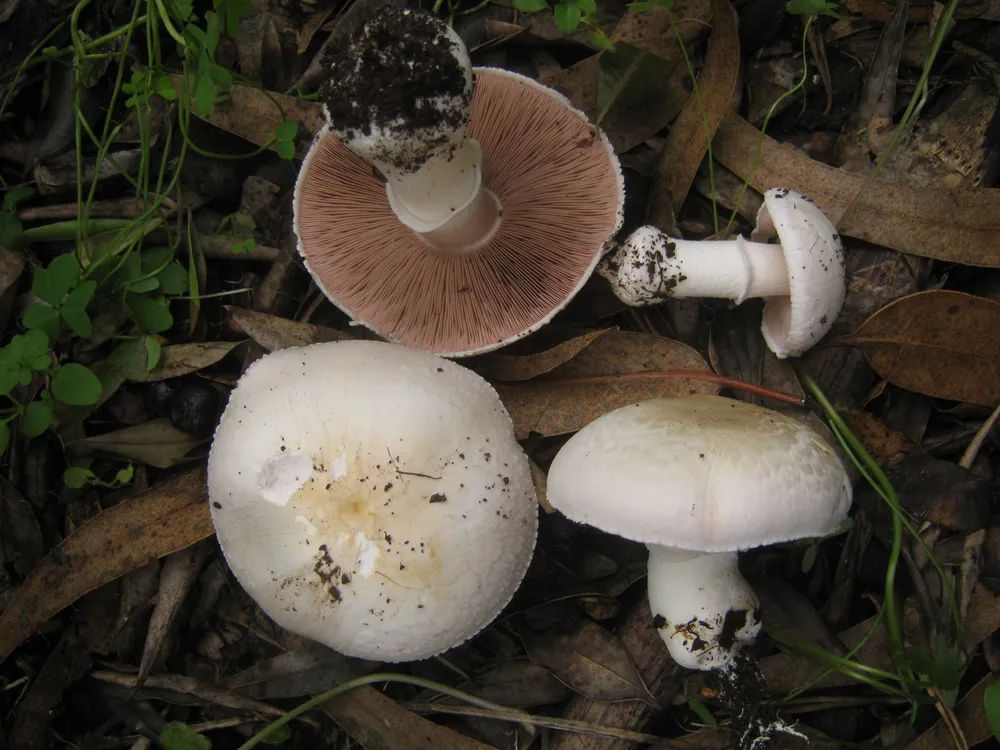
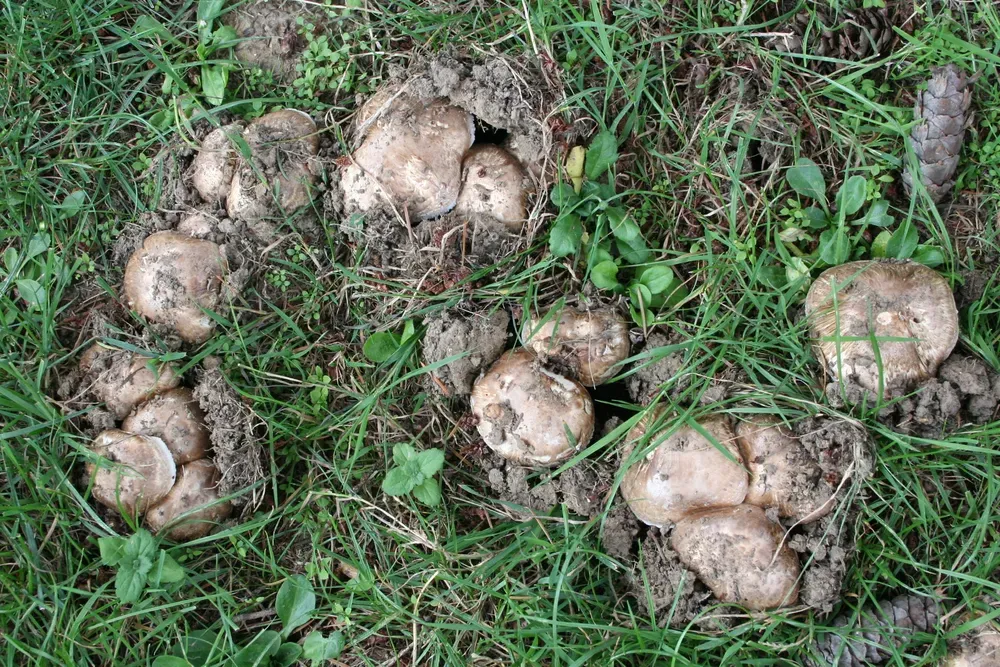
Mushrooms of the same genus and habitat — to study side by side and never mix up.
_M.M._Moser_ex_Bon_61894_crop.webp)
.webp)
_Fr._4948278370-2.webp)
Frequently asked questions
Is it safe to pick?
Only if you can confidently identify the genus Leucoagaricus and tell it apart from the poisonous small Lepiota species. If you have even the slightest doubt, do NOT take it. Among Lepiota-like mushrooms there are deadly species. A large size and a broad membranous ring are only supporting features; they don't guarantee safety. This is not a mushroom for beginners.
How does it differ from the poisonous small Lepiota species?
Size is only a supporting feature: Leucoagaricus barssii is usually stockier, with a thicker stem, while the deadly Lepiota species are more often small, with a thin stem. But the sizes overlap, especially in young mushrooms, so you can't rely on them. This is not a mushroom for beginners. The flesh of the poisonous ones sometimes turns pinkish or has reddish tones; in Leucoagaricus it stays white.
Where to look in Ukraine?
Meadows, pastures, open parks, forest edges, and less often neglected village vegetable gardens. Throughout the forest-steppe and steppe belts, less often in Polissia. It loves soils rich in organic matter. It doesn't occur in typical forests.
When does it fruit?
From midsummer to late fall: July — November. Peak in September–October. It loves a moderately damp, warm fall. In very dry or cold years it's rare.
How does it differ from other Leucoagaricus species?
Leucoagaricus leucothites (white dapperling) is a more common species; in young mushrooms its gills turn pink. In L. barssii the gills stay white. L. naucinus also has white gills, but a smoother cap. Leucoagaricus barssii is larger than both species.
Does it grow in the forest?
Rarely. It's mainly an open-ground species — meadows, pastures, the edges of field roads. It doesn't occur in typical shady forests. It's more common in parks with sparse trees and in gardens with lawns.
How to cook it?
A young cap with the gills still closed is best. Peel the tough skin off the stem. Bread the cap in flour and fry it in butter (like a schnitzel) or stew it with vegetables. Avoid cooking it with alcohol (in some people it can cause a side reaction — be careful, as with the whole genus).
Is there a side reaction with alcohol?
No specific reaction with alcohol, like the one caused by the common ink cap, has been described for Leucoagaricus. Still, mushrooms are heavy on the stomach, so the cautious approach is not to combine them with alcohol.
Is Leucoagaricus barssii edible or poisonous?
Does Leucoagaricus barssii have gills or pores?
What does the cap of Leucoagaricus barssii look like?
What does the stem of Leucoagaricus barssii look like?
Sources
- [1]Вікіпедія (українська)
- [2]Атлас грибів України, Зеров Д.К. (1979)
- [3]MycoBank Database
- [4]Index Fungorum
- [5]GBIF
- [6]iNaturalist Ukraine