Podosphaera plantaginis
Expert-verifiedUpdated October 3, 2026
Passport
- Edibility
- Inedible
- Season
- May — Oct
- Hymenophore
- Smooth
- Cap color
- White
- Size
- Very small (<3 cm)
- Smell
- Odorless
- Reviewed
- Yes ✓
Quick answers
Where to look?
Deciduous forest, Mixed forest
When does it appear?
May — Oct
Active months: May, June, July, August, September, October.
How to recognize it? Three signs
- Cap color: White, Grey
- Cap shape: Irregular
- Smell: Odorless
Fruiting season
May – October
Description
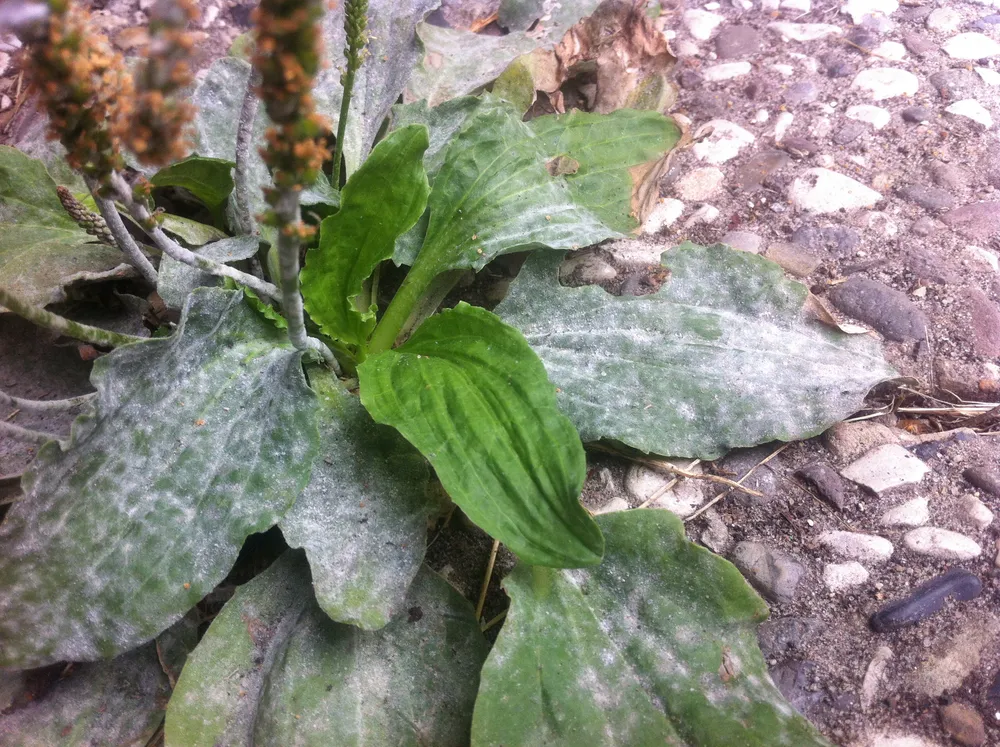
Podosphaera plantaginis is a microscopic plant-pathogenic fungus that causes powdery mildew on plantain leaves (Plantago lanceolata, P. major and related species). It isn't a cap mushroom and has no use in cooking at all — it's an obligate parasite of leafy plants from the family Erysiphaceae. It's included in the atlas as a representative of "fungal" Ukraine, because it's a true fungus from the ascomycete division.
On the outside it looks like a white, powdery, cottony coating on the upper (less often the lower) surface of plantain leaves. At first these are separate white spots 0.5-1 cm across, which gradually spread and cover the whole leaf. In August–September the coating darkens to yellow-brown as dark dots form — cleistothecia, the fungus's fruiting bodies, in which ascospores ripen for overwintering.
In Ukraine it's very common in all meadows, forest edges, lawns and wastelands where plantain grows. On its own it has no economic importance (it doesn't parasitize crops), but it's actively studied in plant pathology and evolutionary ecology as a model organism for research on parasite-host co-evolution. The season is May–October, most active in a wet summer.
Cap
It has no classic "cap". The fungus grows as a thin white mycelial coating on the surface of plantain leaves. Colonies are 0.5-3 cm across, white at first, grayish-yellow over time, with dark dots of cleistothecia in August–September.
Hymenophore
Asexual spores (conidia) form on conidiophores that rise above the surface of the mycelium — this is the white "powdery" substance that rubs off easily with a finger. The sexual fruiting bodies — cleistothecia — are 80-120 µm across, dark brown, spherical, with characteristic long branched "appendages" that help identify the genus.
Stem
There's no stem. The fungus doesn't form any macroscopic structure.
Flesh
The mycelium is thin, thread-like and superficial — the fungus doesn't penetrate deep into the leaf tissue, it only sends special haustoria into the epidermal cells to feed. That's why it rubs off easily when touched.
Smell
There's no smell in the usual sense. A very fresh coating may have a faint mushroomy-moldy smell if you sniff it up close.
›Scientific synonyms (2)
Sphaerotheca plantaginis (Castagne) L. Junell 1966, Erysiphe plantaginis Castagne 1845
Related species
Mushrooms of the same genus and habitat — to study side by side and never mix up.
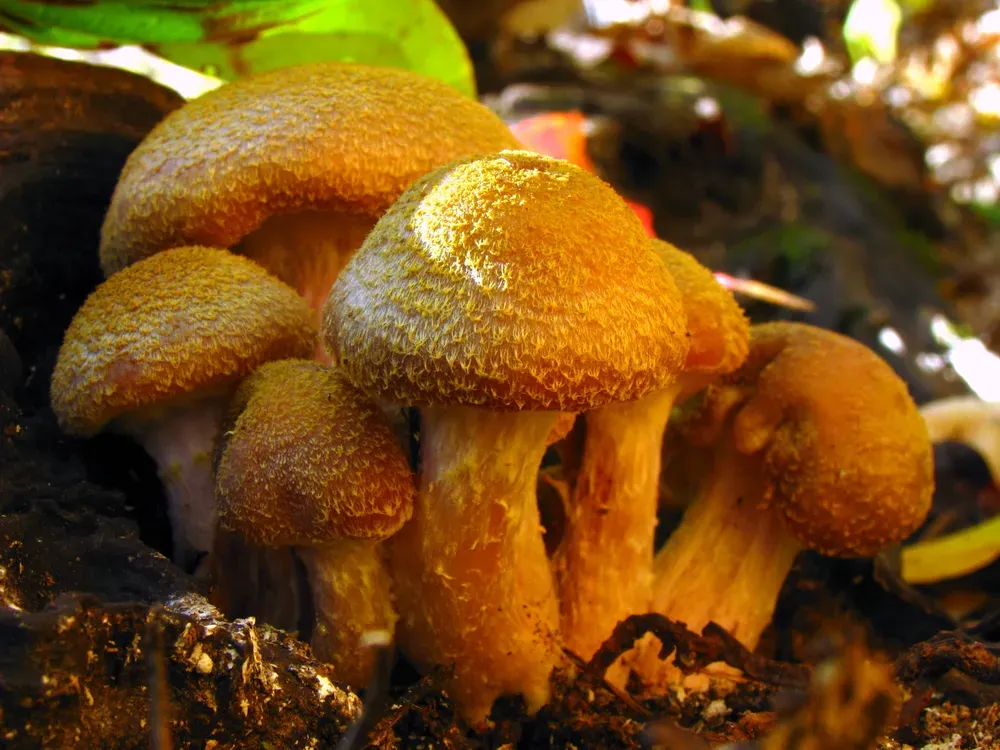
Bulbous honey fungus
Armillaria gallica
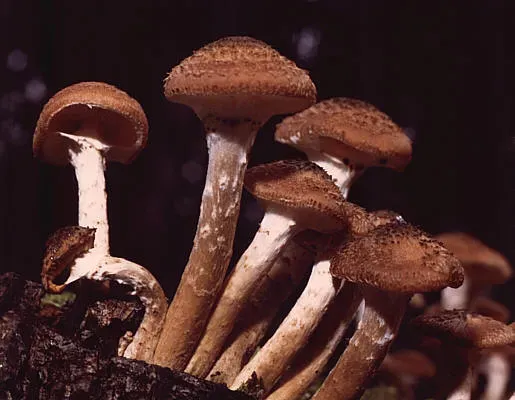
Dark honey fungus
Armillaria ostoyae
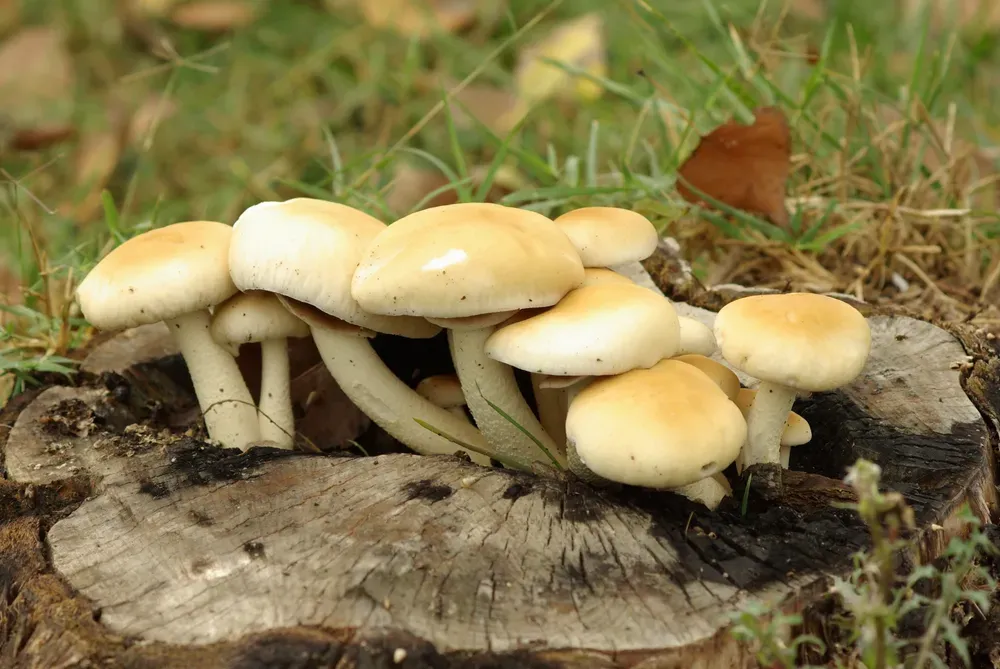
Poplar fieldcap
Cyclocybe aegerita
Ringless honey fungus
Desarmillaria tabescens
Agaricus abruptibulbus
Agaricus haemorrhoidarius
Agaricus haemorroidarius
Ashen chanterelle
Cantharellus cinereus
Blushing bolete
Leccinum roseofractum
Frequently asked questions
Is this a mushroom in the usual sense?
No — it's a microscopic plant-pathogenic fungus, which has no cap, no stem and no fruiting body in the usual sense. It's an obligate parasite of plantain from the family Erysiphaceae. We see it as a white powdery coating on the leaves.
Can you be poisoned by accident?
There are no acute toxins — plantain with this coating isn't poisonous. But leaves with powdery mildew shouldn't be gathered for medicinal use or salads, because: 1) the fungus damages the plant's cells; 2) lots of other microorganisms come along with the coating. Better to pick clean leaves.
Where is it found?
On plantain leaves in meadows, forest edges, lawns, wastelands and roadsides — anywhere plantain grows. In Ukraine it's found throughout the country, without exception.
Does it spread to other plants?
No, this species is strictly specific to plantain (genus Plantago). It doesn't parasitize cereals, vegetable crops or fruit trees. Powdery mildew on other plants is caused by other species from the family Erysiphaceae (for example, Erysiphe pisi on peas).
When does it appear?
The first coating appears in May, with mass development in June–July. In August–September cleistothecia form for overwintering. In October the plantain leaves die back along with the fungus, and the spores overwinter in cleistothecia in the soil.
What can it be confused with?
With other powdery mildew species (Erysiphaceae) on plantain — hard to tell apart without a microscope. On the outside, every "white powdery film" looks the same. For everyday identification, it's enough to know: white flour on leaves = powdery mildew.
Isn't it just mold?
Technically it's a fungus too, but a different group. Classic "mold" is a saprotroph on organic remains (bread, fruit). Powdery mildew is an obligate parasite on LIVING plants. Mold doesn't grow on plantain leaves, but powdery mildew does.
Is it harmful to plantain?
In the wild — moderately: a heavy infection reduces the plantain's seed production, but the plant doesn't die. It's part of the natural balance of meadows. In cultivated plantings of medicinal plantain (Plantago major and ribwort plantain as raw material) it's unwelcome, but chemical treatments against it are hardly ever used.
Is Podosphaera plantaginis edible or poisonous?
What kind of spore-bearing surface does Podosphaera plantaginis have?
What does the cap of Podosphaera plantaginis look like?
What does the stem of Podosphaera plantaginis look like?
Sources
- [1]Вікіпедія (українська)
- [2]Атлас грибів України, Зеров Д.К. (1979)
- [3]MycoBank Database
- [4]Index Fungorum
- [5]GBIF
- [6]iNaturalist Ukraine