Tree fluteMenegazzia terebrata
Expert-verifiedUpdated June 13, 2026
Passport
- Edibility
- Inedible
- Season
- Jan — Dec
- Hymenophore
- Smooth
- Cap color
- Grey
- Size
- Small (up to 5 cm)
- Smell
- Odorless
- Reviewed
- Yes ✓
Quick answers
Where to look?
Deciduous forest, Mixed forest, Conifer forest
When does it appear?
Jan — Dec
Active months: January, February, March, April, May, June, July, August, September, October, November, December.
How to recognize it? Three signs
- Cap color: Grey, Olive
- Cap shape: Irregular
- Smell: Odorless
Fruiting season
January – December
Description
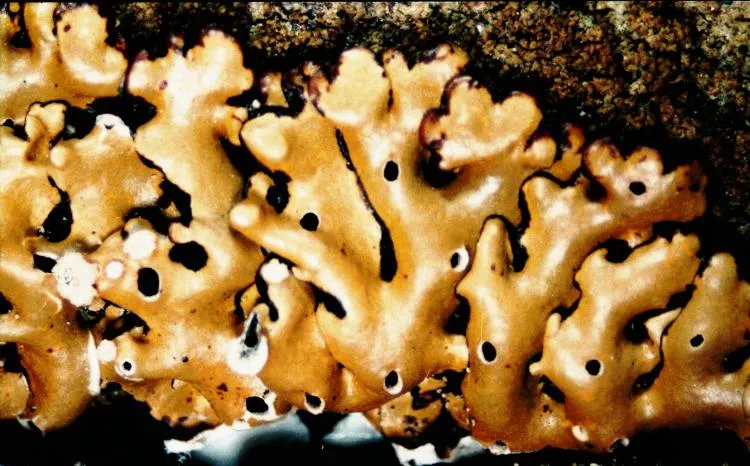
Tree flute (Menegazzia terebrata) isn't actually a typical gilled or pored mushroom at all, but a foliose (leafy) lichen, meaning a symbiotic organism made of an ascomycete fungus and an alga. It made it into the "Mushrooms of Ukraine" category thanks to international taxonomy: the fungal partner in the symbiosis is a true member of the kingdom Fungi (order Lecanorales). On the outside it's a grayish-green rosette on tree bark that looks like fine lace, with distinctive round holes that go all the way through the thallus — hence the name "terebrata", or "perforated".
Not edible in any culinary sense — lichens aren't used as food in Ukraine (unlike reindeer lichen among northern peoples). There are several reasons not to cut or pick it: it grows very slowly (1-3 mm a year), doesn't recover, and is also a sensitive bioindicator of air quality — if Menegazzia is present, there haven't been acid rains or heavy pollution here for years.
In Ukraine, tree flute is listed in the Red Data Book and on some regional red lists. You'll find it in old mountain beech and mixed forests of the Carpathians, less often in the Carpathian foothills and northern Polissia — wherever old-growth stands with clean air have survived. It grows on tree bark (beech, hornbeam, oak, spruce), on sunlit or partly shaded trunks. Finding Menegazzia is a sign of a healthy forest, which is rare in Ukraine. If you spot it, take a photo, note the location and report it on iNaturalist UA.
Cap
It has no cap in the usual mushroom sense. The thallus (the lichen's body) is a leafy rosette 3-15 cm across, attached to the substrate (bark) at the center, with raised, wavy, deeply cut edges. The color is grayish-green, a brighter greenish-olive in wet weather, ash-gray when dry. The telltale feature: the thallus surface is covered in numerous round holes 1-3 mm across that go all the way through — which is what gave the species its name terebrata ("perforated").
Hymenophore
Lichens rarely form fruiting bodies (apothecia). If they're present, they're disc-shaped apothecia, brownish-black in color, 1-3 mm across, on the surface of the thallus. They hold the spores of the fungal partner. Most finds of Menegazzia have no apothecia — it reproduces through soredia (tiny clusters of fungal and algal cells that spread together).
Stem
There's no stem — the lichen attaches to the substrate by its lower surface through the hyphae of the fungal partner.
Flesh
In cross-section, the body (thallus) is thin, layered, gray-green. Inside, it's a dense tangle of fungal hyphae dotted with green algal cells. It doesn't change color when cut or damaged.
Smell
No distinctive smell. In wet weather — a faint scent of damp wood and moss.
Related species
Mushrooms of the same genus and habitat — to study side by side and never mix up.
Wolf lichen
Letharia vulpina
Bulbous honey fungus
Armillaria gallica
Dark honey fungus
Armillaria ostoyae
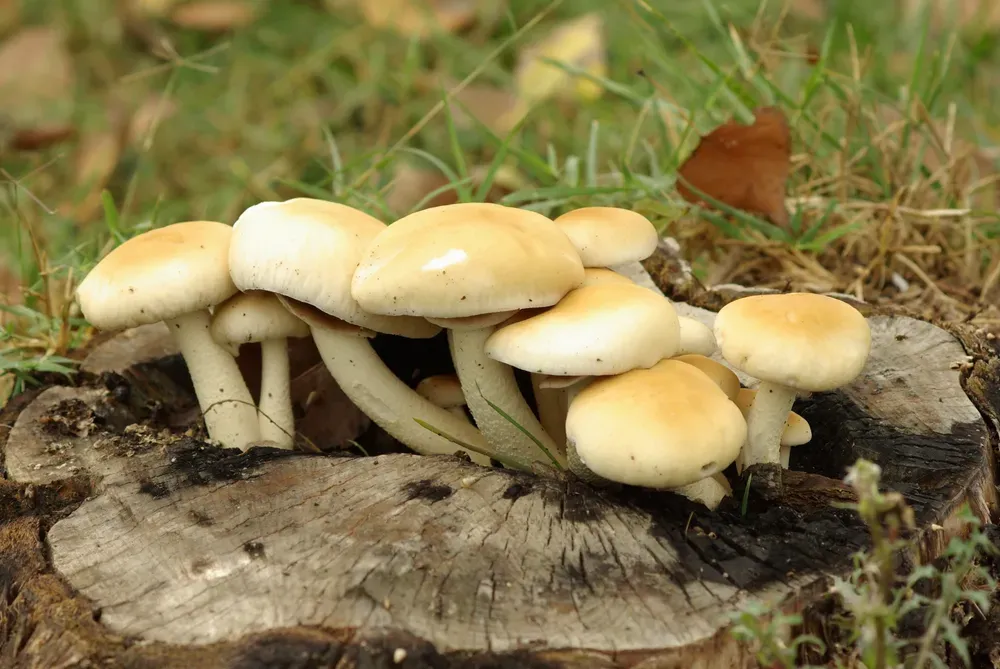
Poplar fieldcap
Cyclocybe aegerita
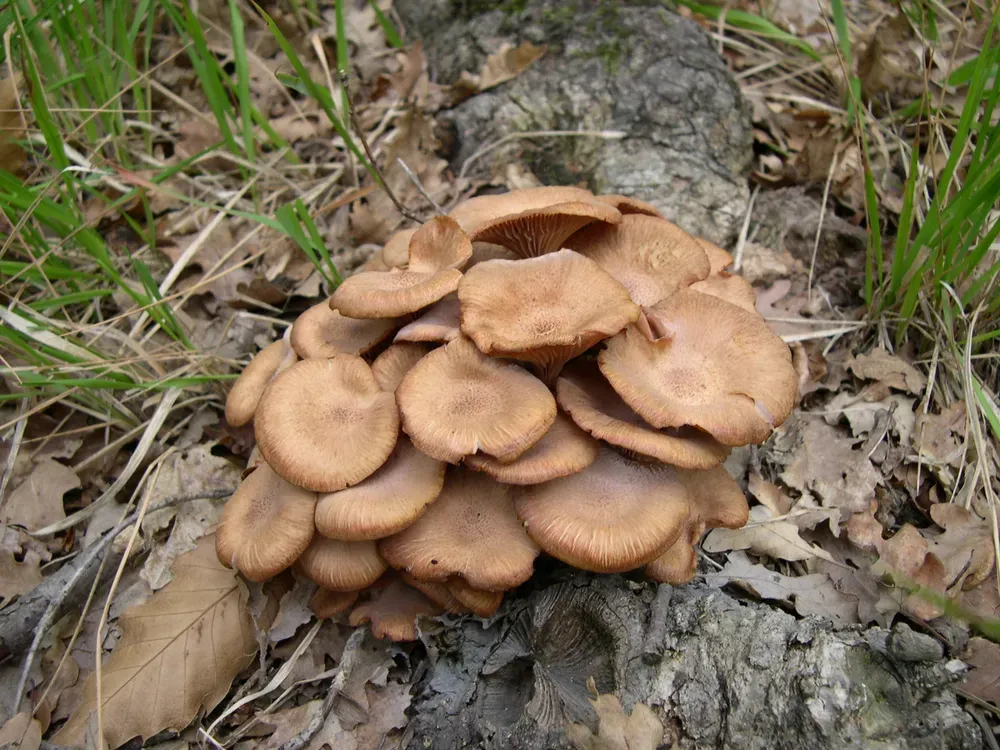
Ringless honey fungus
Desarmillaria tabescens
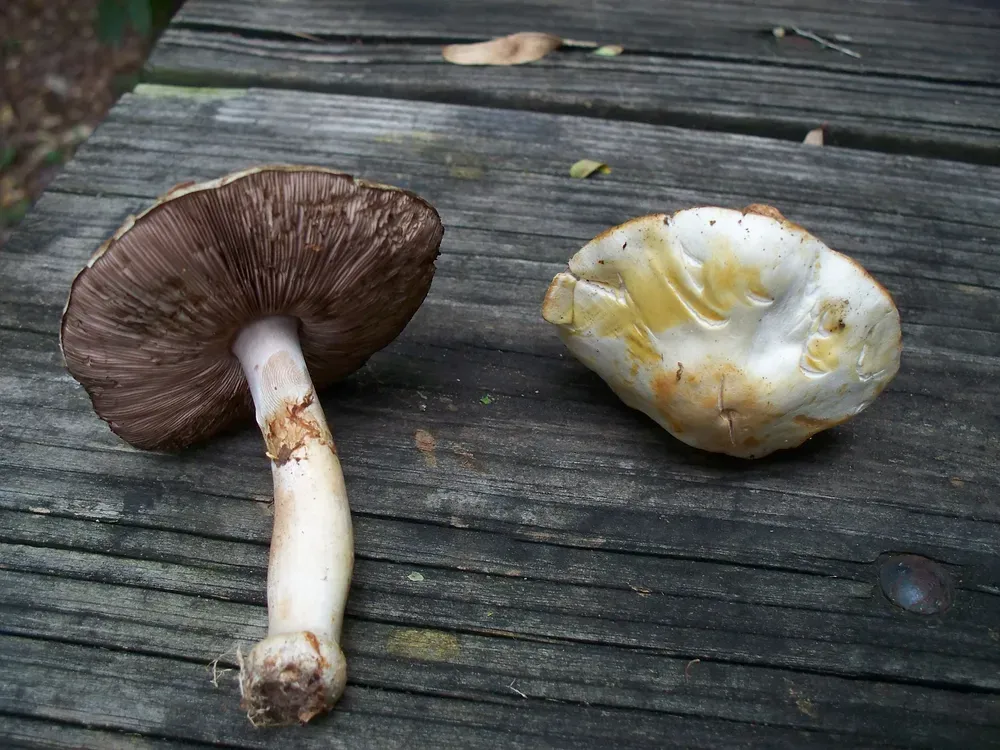
Agaricus abruptibulbus
Agaricus haemorrhoidarius
Agaricus haemorroidarius
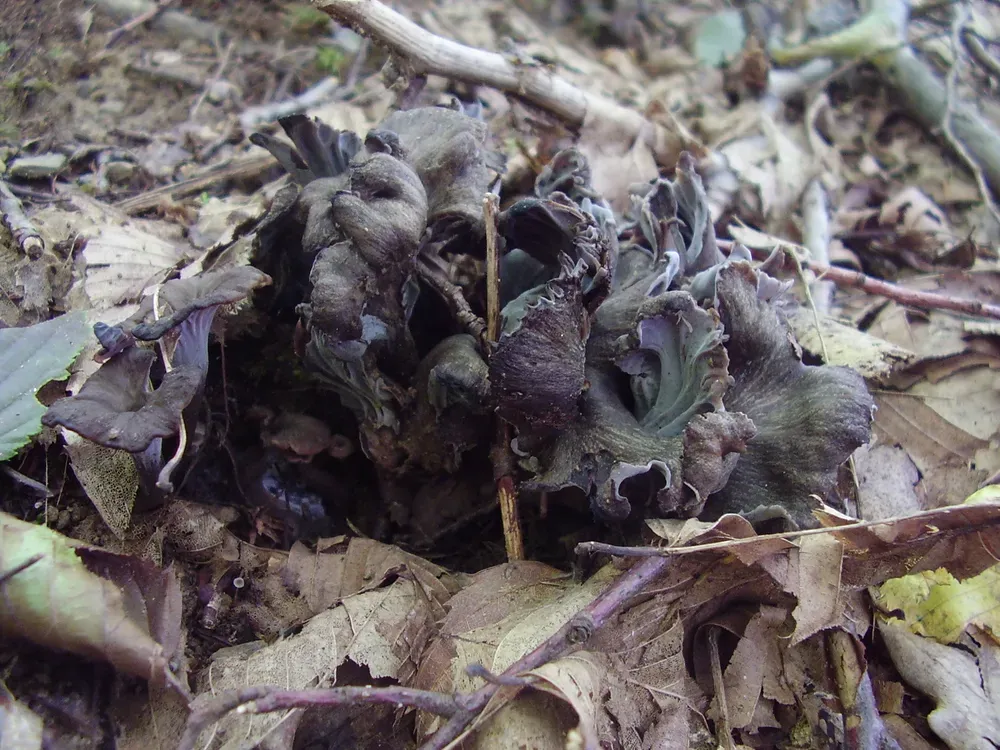
Ashen chanterelle
Cantharellus cinereus
Frequently asked questions
Can you eat it?
No. Lichens aren't used in Ukrainian cooking, and on top of that this one is a rare Red Data Book species that must not be collected. It isn't poisonous — just inedible. Some lichens contain bitter and even toxic acids (vulpinic, usnic), so as a rule nobody tastes lichens raw.
Why is it in the "mushrooms" category if it's a lichen?
In modern systematics, lichens are classified by their fungal partner in the symbiosis. The fungal part of Menegazzia is a true ascomycete from the family Parmeliaceae, so formally it belongs to the kingdom Fungi. Wikipedia and international databases (GBIF, Index Fungorum) include lichens among the fungi. It's not a mistake — it's modern taxonomy.
Where should you look for it?
On tree bark in old mountain forests — beech, hornbeam, oak, spruce. It likes sunlit or partly shaded trunks and lower branches. It's sensitive to air pollution — it won't grow near highways, industrial sites or in cities. You can find it 0.5-3 m above the ground.
Which regions of Ukraine is it found in?
Mainly the Carpathians (Zakarpattia, Ivano-Frankivsk, Lviv and Chernivtsi regions) — in old-growth virgin beech forests and mixed Carpathian forests. Less often in the Carpathian foothills and northern Polissia. It doesn't occur in the steppe or forest-steppe. A Red Data Book species.
When should you look for it?
All year round — lichens are perennial and have no distinct fruiting season. In wet weather (spring, autumn) the thallus is greener and easier to spot; when it's dry, it turns grayer and blends in. The best time to search is May-June or September-October after rain.
What can it be confused with?
With other foliose lichens of the genera Parmelia, Hypogymnia, Pseudevernia. The key feature of Menegazzia is the round holes going right through the thallus. If there are no holes, it's a different lichen. Also with young thalli of monk's-hood lichen (Hypogymnia physodes), our most common leafy lichen, but that one has no holes, only sorediate patches.
Is it worth knowing for a forager?
Yes — as an example of how blurry the borders of the "fungi" kingdom are. Lichens, endophytic fungi, yeasts, molds — they're all relatives of the beauties we put in our baskets. Knowing the basic lichens of an old forest adds another layer of understanding of where you're walking. Find Menegazzia and you'll find porcini too, because both love clean air and undisturbed forest.
What should you do if you find it?
Photograph the overall look plus a close-up of the holes in the thallus. Write down the GPS coordinates. Upload it to iNaturalist UA with the tag "Red Data Book". This helps scientists track the species' distribution. Don't pick it, don't collect it — the lichen grows 1-3 mm a year, and a torn-off rosette won't take root again.
Is Tree flute edible or poisonous?
What kind of spore-bearing surface does Tree flute have?
What does the cap of Tree flute look like?
What does the stem of Tree flute look like?
Sources
- [1]Вікіпедія (українська)
- [2]Атлас грибів України, Зеров Д.К. (1979)
- [3]MycoBank Database
- [4]Index Fungorum
- [5]GBIF
- [6]iNaturalist Ukraine