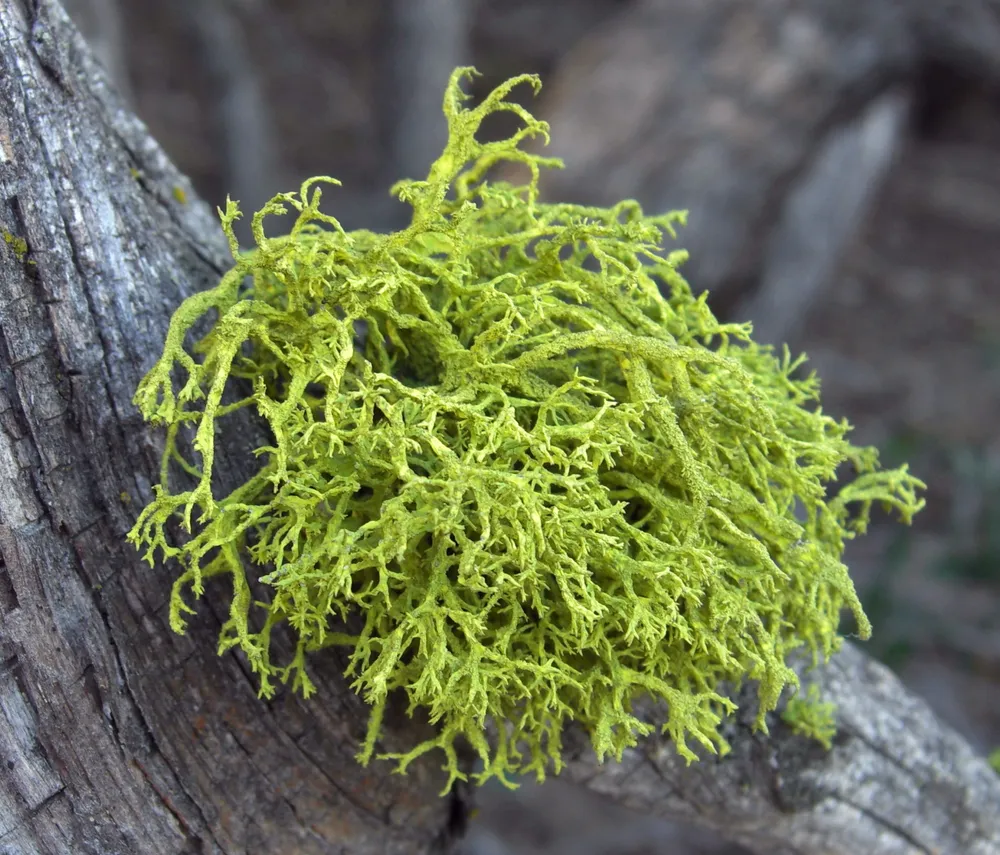
Wolf lichenLetharia vulpina
Expert-verifiedUpdated October 3, 2026
Passport
- Edibility
- Poisonous
- Season
- Jan — Dec
- Hymenophore
- Smooth
- Cap color
- Yellow
- Size
- Small (up to 5 cm)
- Smell
- Chemical
- Reviewed
- Yes ✓
POISONOUS
Eating it causes poisoning. Do not pick it unless you have identified it with certainty.
Poisonous. The main toxin is vulpinic acid (a distinctive yellow polyphenolic pigment). Mechanism: it inhibits mitochondrial respiration and blocks oxidative phosphorylation, and is especially effective against carnivorous mammals. In wolves and foxes it causes rapid death through organ failure and respiratory failure. For humans the oral lethal dose has not been precisely established, but cases of serious poisoning with damage to the kidneys, liver and CNS after accidental ingestion have been described (rarely — mostly children who chewed the bright “beards”). Symptoms: nausea, vomiting, abdominal pain, weakness, hypothermia, and in severe cases seizures, coma and multiple organ failure. There is no specific antidote; treatment is symptomatic: gastric lavage, activated charcoal, IV fluid therapy, monitoring of kidney and liver function. Skin — prolonged contact may cause contact dermatitis. External use as a wool dye (historically widespread in Scandinavia) is relatively safe, but you should wear gloves. The rule: don’t taste it, don’t chew it, don’t leave it where children or pets can reach it. This is one of the few truly poisonous lichens, and that’s worth remembering.
If you suspect poisoning, call an ambulance immediately: 112 (the European emergency number) or your local emergency number
Quick answers
Where to look?
Conifer forest
When does it appear?
Jan — Dec
Active months: January, February, March, April, May, June, July, August, September, October, November, December.
How to recognize it? Three signs
- Cap color: Yellow, Olive
- Cap shape: Irregular
- Smell: Chemical
Fruiting season
January – December
Description
The Wolf lichen, or “fox poison” (Letharia vulpina), is not an ordinary capped mushroom but a lichen from the Parmeliaceae family. A lichen is a symbiotic organism made of a fungal partner (the mycobiont) and an alga (the photobiont), and modern taxonomy places it in the kingdom Fungi. Letharia looks like bright yellow-green bushy “beards” spreading over the bark of conifers (especially spruce, larch and stone pine) in mountain areas. Its color is so intensely yellow-green that it was used as a natural dye for wool.
The lichen got the name “fox poison” (vulpina is Latin for “of the fox”) from its historical role: in Scandinavia, Siberia and Alaska it was used to poison wolves and foxes — meat sprinkled with powdered Letharia, or animal carcasses stuffed with a mixture containing it. The poison is vulpinic acid, a distinctive yellow pigment that is a powerful inhibitor of mitochondrial respiration. This makes Letharia one of the few truly toxic lichen species — most lichens are harmless or even mildly edible.
In Ukraine it is very rare — there are only scattered finds in high-mountain Carpathian forests, on old spruces and firs. It is not collected — neither for food (it’s poisonous) nor commercially (there’s too little of it). In cultural history it’s a fascinating example of a lichen used as a hunting poison.
Cap
It has no classic “cap.” The thallus (the body of the lichen) is shrubby, yellow-green to bright sulfur-yellow, 3-10 cm tall, forming dense “beards” or cushions on tree bark. The lobes of the thallus are thin (1-3 mm), fibrous and branched.
Hymenophore
Its fungal partner is an ascomycete — spores form in apothecia (open, cup-shaped fruiting bodies) on the surface of the thallus. Apothecia are rare in nature, dark brown, 2-5 mm across. Most reproduction is by fragmentation (broken-off pieces of the thallus).
Stem
There is no stem — the lichen attaches to its substrate (bark) by the base of the thallus.
Flesh
The lichen tissue is dense and leathery-fibrous; brittle when dry, it becomes elastic when wet. The yellow pigment (vulpinic acid) runs through the whole thallus and does not fade when it dries.
Smell
Odor faint, a distinctive “lichen-like,” slightly earthy smell. Freshly rubbed thallus may smell faintly chemical as vulpinic acid is released.
›Scientific synonyms (1)
Evernia vulpina (L.) Ach.
Related species
Mushrooms of the same genus and habitat — to study side by side and never mix up.
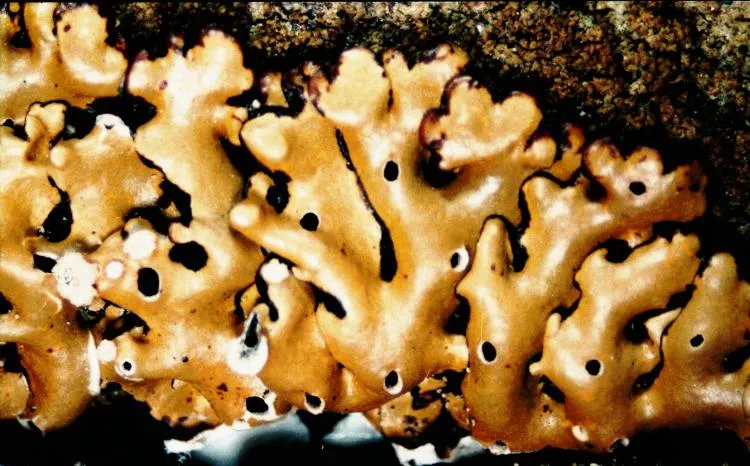
Tree flute
Menegazzia terebrata
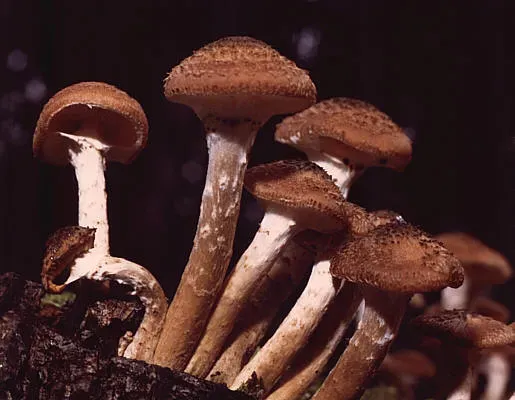
Dark honey fungus
Armillaria ostoyae
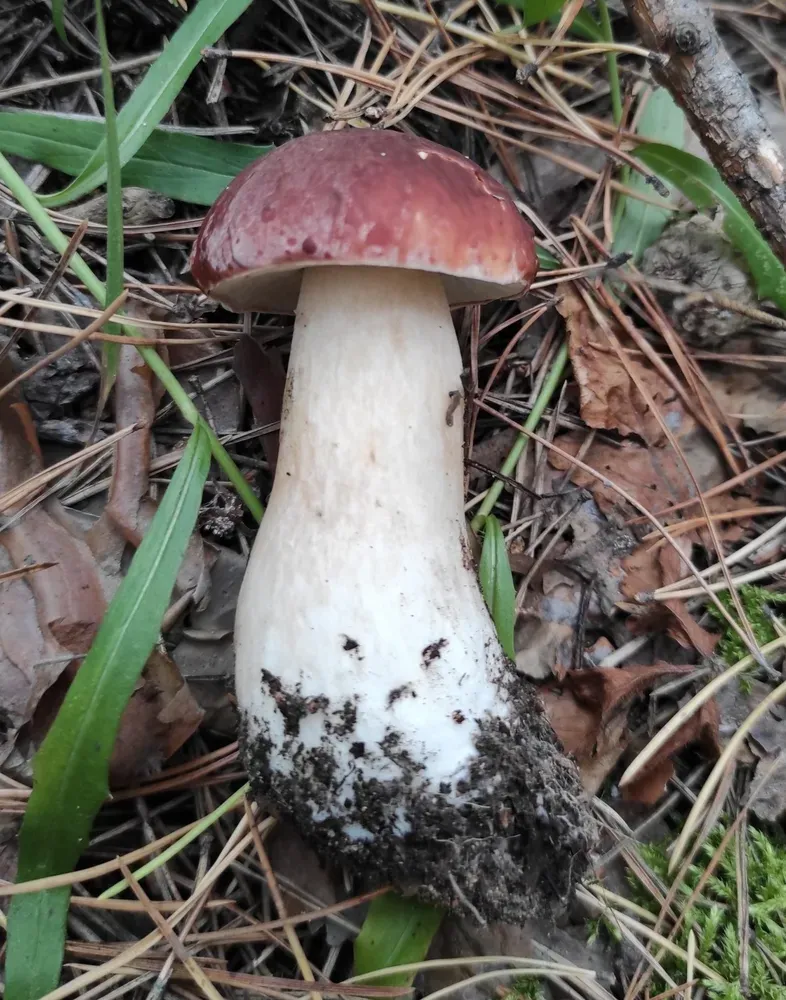
Pine bolete
Boletus pinophilus
Agaricus abruptibulbus
Agaricus haemorrhoidarius
Agaricus haemorroidarius
Cantharellus pallens
Copper brittlegill
Russula decolorans
Grayling
Cantharellula umbonata
Frequently asked questions
Can a lichen be poisonous?
Yes, but it’s rare. Most lichens are harmless or edible (like the “reindeer lichen” that reindeer eat). The Wolf lichen is one of a short list of truly poisonous ones: it contains vulpinic acid, which blocks cellular respiration. Don’t taste it, don’t chew it, don’t put it in your mouth.
Why is it called “fox poison”?
Because in Scandinavia, Siberia and Alaska it was historically used to poison wolves and foxes — meat sprinkled with powdered Letharia was left out as bait. The animals died of organ failure. Today this practice is banned in all civilized countries, but the name stuck.
What happens if you eat it by accident?
After 1-4 hours — nausea, vomiting, abdominal pain, weakness. In serious cases the kidneys, liver and central nervous system are affected. Immediately call an ambulance (112 or your local emergency number) and say that you ate a “yellow-green lichen from a spruce.” Hospital treatment: gastric lavage, activated charcoal, IV fluid therapy. The sooner, the better.
Where does it grow?
On the bark of old conifers — mainly spruce, larch, fir and stone pine. In mountain areas, in unpolluted forests (lichens are sensitive to air pollution). In Ukraine — rare finds in high-mountain Carpathian forests.
Which regions of Ukraine?
High-mountain forests of the Carpathians (Zakarpattia, Lviv and Ivano-Frankivsk oblasts) — scattered finds on old spruces and firs in Chornohora, the Gorgany and the Skole Beskids. It does not occur in the lowlands.
When can you see it?
Lichens don’t fruit seasonally — they are there all year round, grow slowly (1-3 mm a year) and live for decades. You can spot it on a tree in any season, and it stands out especially well in a gray winter or spring forest thanks to its bright yellow-green color.
What is it confused with?
With Usnea — another genus of “beard” lichens, but they are gray-green or greenish-white, not bright yellow. With Evernia — also a lichen, but greenish-gray in tone. A bright sulfur-yellow color is an unmistakable sign of Letharia.
Are there edible lichens too?
Yes — northern peoples traditionally eat “Iceland moss” (Cetraria islandica), “reindeer lichen” (Cladonia) and some Umbilicaria species. They are rich in polysaccharides and serve as a “forest insurance” when food is scarce. But they are prepared in a special way (long soaking to remove the bitterness).
Is Wolf lichen edible or poisonous?
What kind of spore-bearing surface does Wolf lichen have?
What does the cap of Wolf lichen look like?
What does the stem of Wolf lichen look like?
Sources
- [1]Вікіпедія (українська)
- [2]Атлас грибів України, Зеров Д.К. (1979)
- [3]MycoBank Database
- [4]Index Fungorum
- [5]GBIF
- [6]iNaturalist Ukraine