Common earthballДощовик несправжній
Expert-verifiedUpdated June 13, 2026
Passport
- Edibility
- Poisonous
- Season
- Jul — Oct
- Hymenophore
- Chambered
- Cap color
- Yellow
- Size
- Medium (5–15 cm)
- Smell
- Chemical
- Reviewed
- Yes ✓
POISONOUS
Eating it causes poisoning. Do not pick it unless you have identified it with certainty.
The mushroom contains the toxin sclerodermatoxin (its exact structure has not been fully described), which causes gastrointestinal intoxication. Symptoms 1-3 hours after eating: nausea, vomiting, pain in the abdomen, in severe cases, diarrhea, dizziness, tachycardia, sweating, and sometimes brief visual disturbances (blurred vision, floating spots). Symptoms last 6-24 hours. No deaths among adults have been documented, but serious poisonings do happen, especially in children. Treatment is symptomatic: gastric lavage (if less than 2 hours have passed), adsorbents, rehydration. If you suspect poisoning — immediately go to a hospital and keep any leftover mushrooms for identification. Prevention: always cut puffballs open before cooking. White, uniform flesh = a true edible puffball; dark purple-black flesh = a poisonous earthball, throw it out. This is the most important rule for anyone gathering puffballs. Don't be fooled: an earthball's smell is often chemical and unpleasant — unlike the sweet mushroomy smell of true puffballs.
If you suspect poisoning, call an ambulance immediately: 112 (the European emergency number) or your local emergency number
Quick answers
Where to look?
Deciduous forest, Mixed forest, Conifer forest
When does it appear?
Jul — Oct
Active months: July, August, September, October.
How to recognize it? Three signs
- Cap color: Yellow, Brown, Black
- Cap shape: Irregular
- Smell: Chemical
Fruiting season
July – October
Description
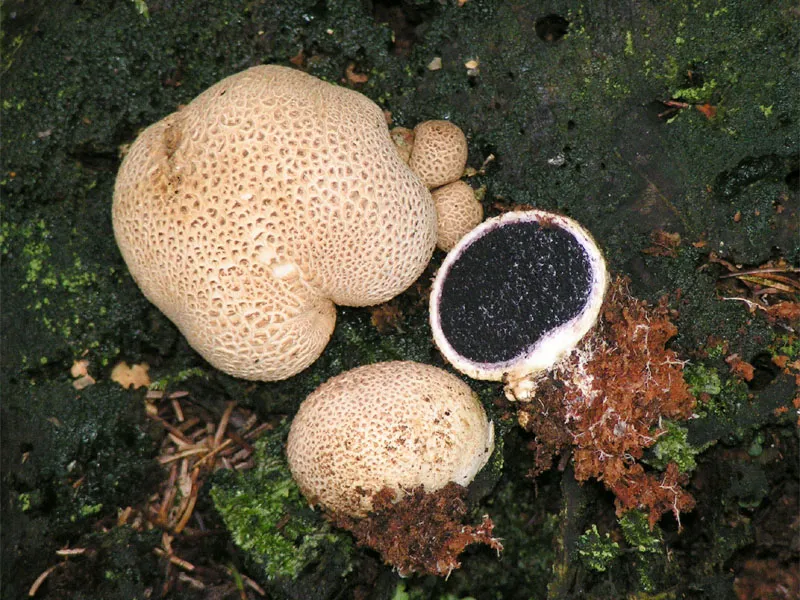
The common earthball, or “Scleroderma,” is a poisonous mushroom that is often confused with edible puffballs and picked by mistake. The fruiting body is rounded or flattened, with no distinct “stalk” (unlike true puffballs) — the mushroom sits on the ground like an apple with a thick rind. The key difference — the skin. In a true puffball it is thin, white and brittle; in the earthball it is thick, hard, yellow-brown, with coarse warts, like a nutshell. Size 3-10 cm across.
This is a poisonous mushroom. It causes gastrointestinal poisoning — nausea, vomiting, abdominal pain, and in severe cases diarrhea, dizziness and temporary loss of vision. Symptoms begin 1-3 hours after eating and last 6-24 hours. No deaths have been documented, but the poisonings are serious, especially in children and people in poor health. The key check, always before cooking a puffball: cut the fruiting body in half. In a true edible puffball the flesh is uniformly white. In the earthball, even when young, it is dark purple-black or grey-black with white veins. This marbled black flesh is an unmistakable sign of poison.
In Ukraine it is widespread in deciduous and mixed forests, floodplain forests, forest edges and parks. It likes acidic sandy soils and mossy spots. Found in the Carpathians, Polissia and the Forest-Steppe. Season: July-October.
Cap
The fruiting body is globular or flattened, 3-10 cm across, WITHOUT a distinct “stalk” (it sits on the ground). Color: yellow-brown, ochre-yellow, darker and browner with age. The skin is thick, hard, like a shell, with coarse, prominent scaly warts. This sets it fundamentally apart from the thin-skinned edible puffballs. In mature specimens the top splits into ragged pieces, exposing the spore mass.
Hymenophore
Internal hymenophore (gleba). The young gleba is already dark purple-black — this is the key diagnostic feature that distinguishes it from the white gleba of true puffballs. Often with white or greyish veins (a “marbled” pattern). With age it turns into a dark grey-black powdery mass. Spore print dark purple-black.
Stem
There is no separate stem. The fruiting body is attached to the soil by a short tuft of white rhizomorphs. Unlike true puffballs, there is no distinct “stalk-base.”
Flesh
The flesh is, already at a young age, dark purple-black or grey-black, sometimes with thin white veins (marbled). When cut, this color is unambiguous — it is a sign of poison. In true edible puffballs the young flesh is uniformly white.
Smell
Chemical, unpleasant, sometimes with a hint of rubber or phenol — a telltale difference from the pleasant mushroomy smell of edible puffballs. Taste: do not taste it.
Lookalikes
Related species
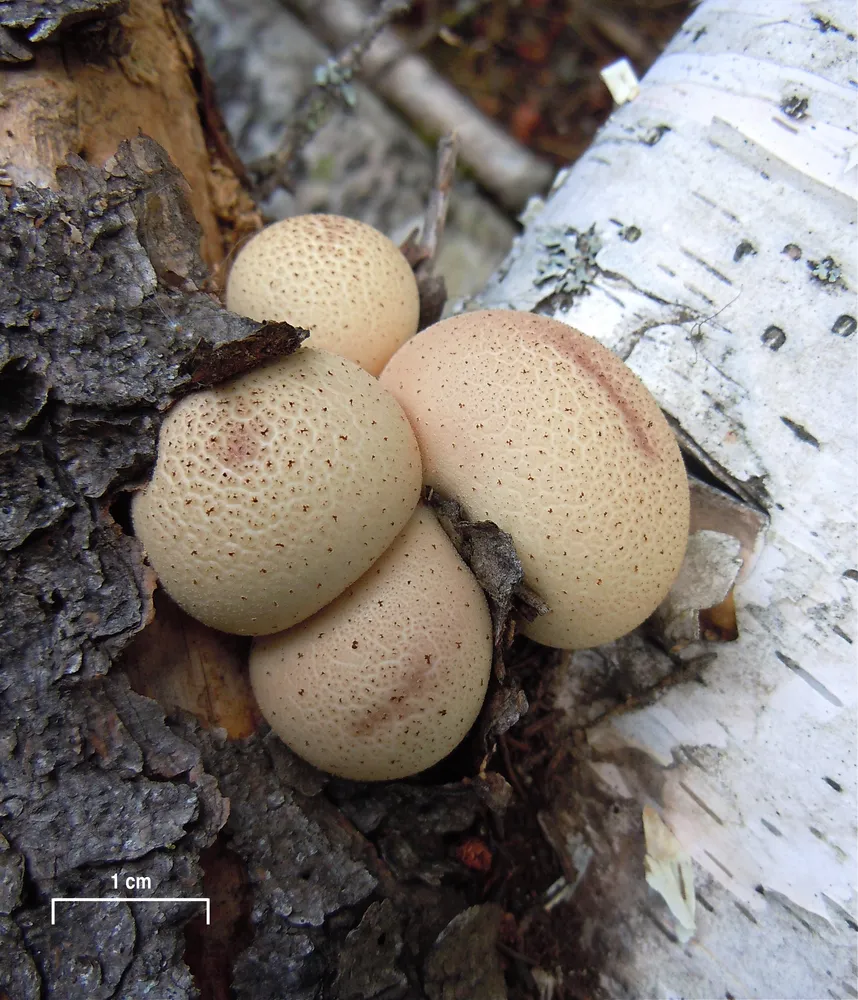
Mushrooms of the same genus and habitat — to study side by side and never mix up.
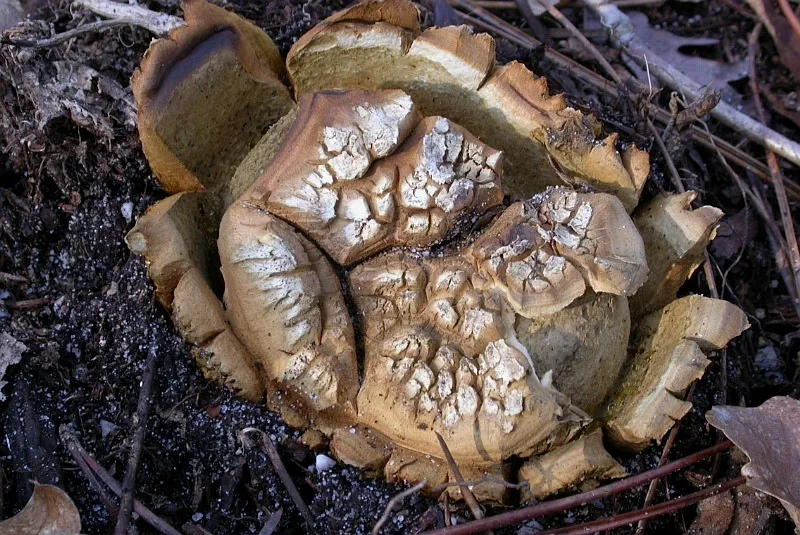
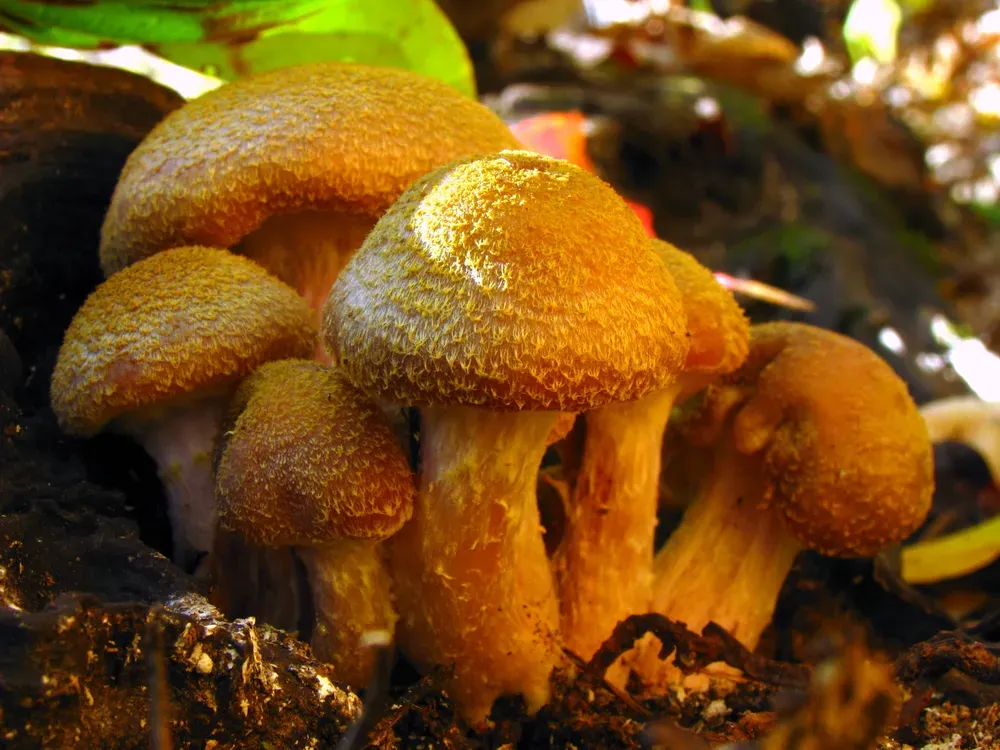
Many-rooted earthball
Scleroderma geaster
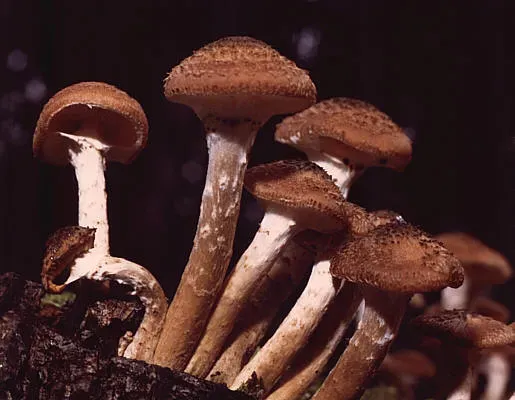
Bulbous honey fungus
Armillaria gallica
Dark honey fungus
Armillaria ostoyae
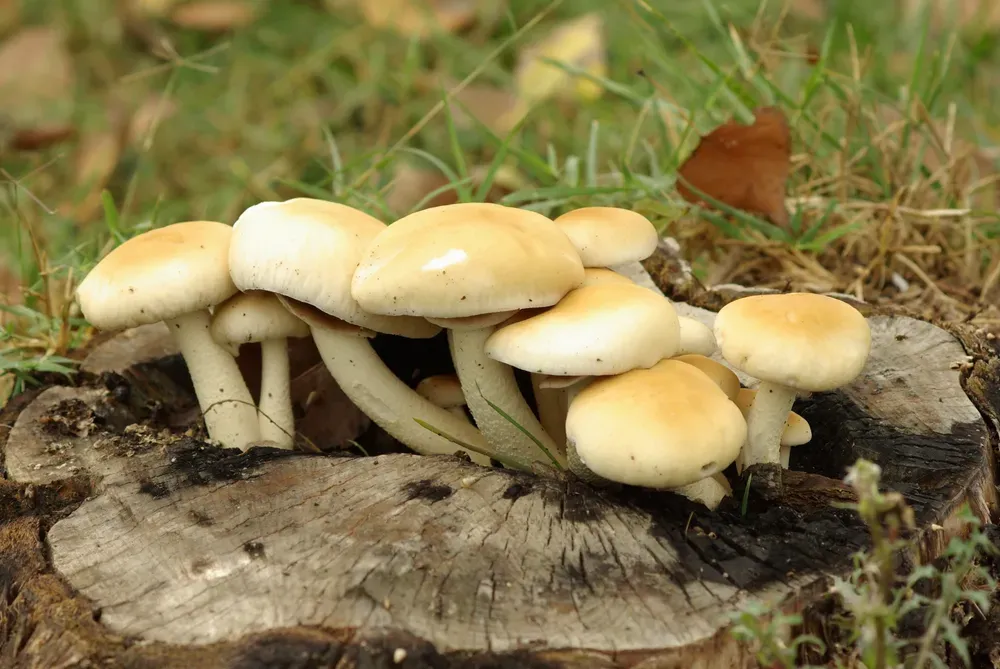
Poplar fieldcap
Cyclocybe aegerita
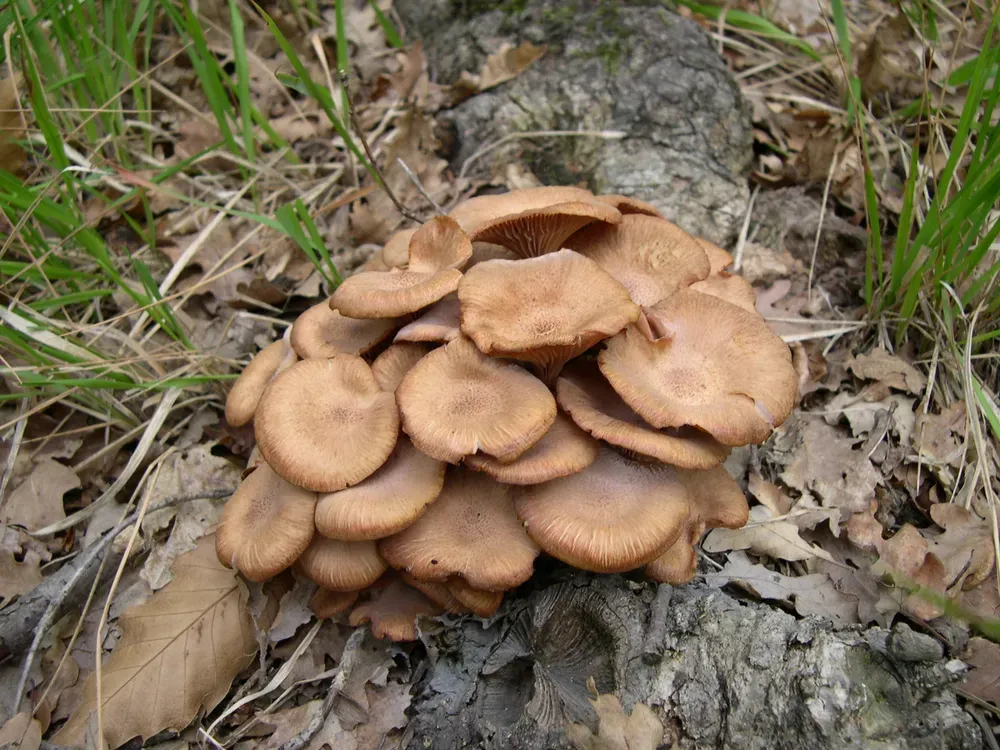
Ringless honey fungus
Desarmillaria tabescens
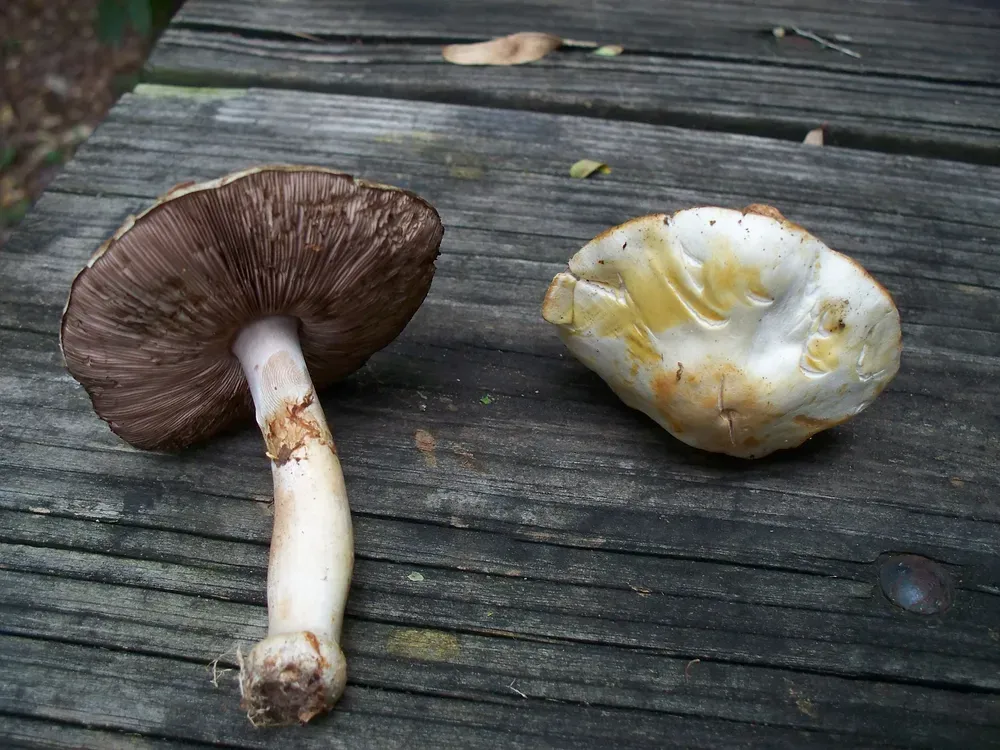
Agaricus abruptibulbus
Agaricus haemorrhoidarius
Agaricus haemorroidarius
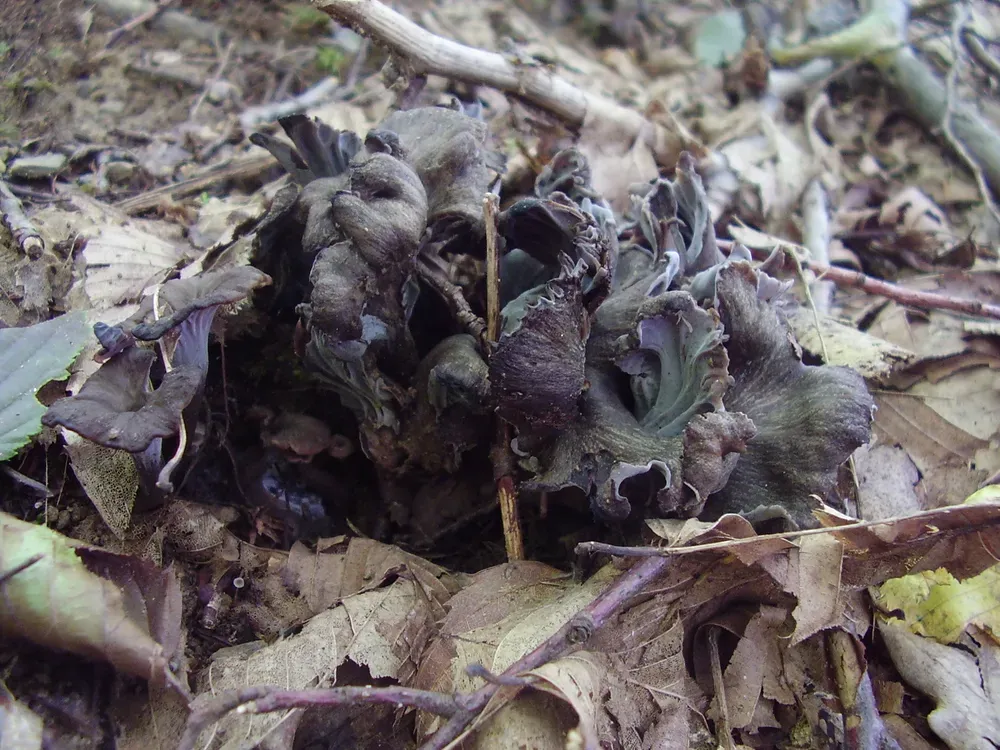
Ashen chanterelle
Cantharellus cinereus
Frequently asked questions
Can you eat it?
NO. It's a poisonous mushroom that causes gastrointestinal intoxication (nausea, vomiting, abdominal pain) 1-3 hours after eating. Deaths are rare, but the poisonings are serious, especially in children. Always cut puffballs open before cooking. Dark purple-black flesh = throw it out.
How do you tell it from a true puffball?
THREE key checks: (1) flesh when cut — in a true puffball it is white, in the earthball dark purple-black even when young. (2) skin — thin and white in a true puffball, in the earthball thick, hard and yellow-brown like a shell. (3) smell — pleasantly mushroomy in a true puffball, in the earthball chemical and unpleasant. (4) shape — a true puffball has a distinct “stalk-base,” the earthball is a ball with no stalk.
What should you do in case of poisoning?
If you've eaten it and symptoms appear (after 1-3 hours — nausea, vomiting, pain) — immediately go to a hospital or call an ambulance. Keep any leftover mushrooms for identification. Until the doctors arrive, drink water and don't take any medication on your own. Gastric lavage is effective only in the first 2 hours. The outlook is good with timely treatment.
Where does it grow?
In deciduous and mixed forests, floodplain forests, forest edges, parks and grassy clearings. It likes acidic sandy soils and mossy spots. It often grows in groups of 3-10 fruiting bodies, sometimes right next to true puffballs — so a mix-up is a real possibility.
In which regions of Ukraine is it found?
Throughout the forest and forest-steppe zones: the Carpathians, Prykarpattia, Polissia, and the Western, Right-Bank and Left-Bank Forest-Steppe. In the steppe it is rarer, found in floodplain plantings. A common species on the sandy soils of coniferous and mixed forests.
When does it appear?
July-October. Fruiting peaks in August-September, after rain. Young fruiting bodies with a shiny yellow-brown shell are the most photogenic — but already poisonous.
What is it confused with?
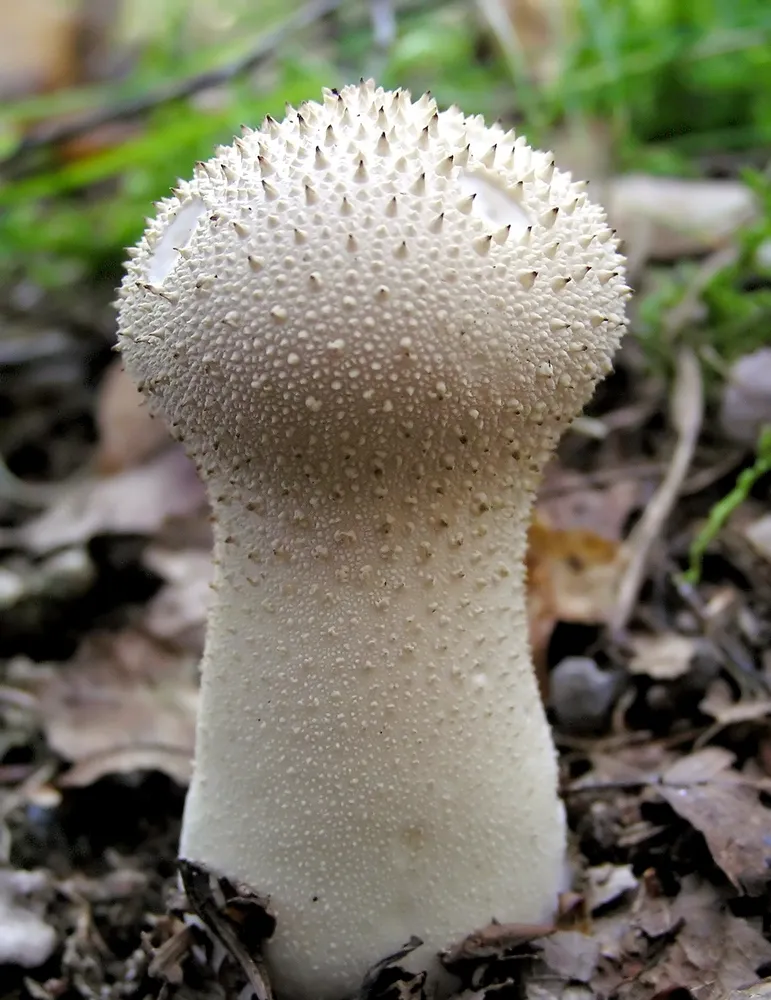
With the edible puffballs (Lycoperdon perlatum, Lycoperdon pyriforme) — this is the most common mistake. The check is simple: cut every fruiting body open. White flesh = a true edible puffball; dark purple-black = a poisonous earthball. The skin — thick, hard and yellow-brown in the earthball, thin and white in a true puffball.
Are all earthballs poisonous?
Yes, the whole genus Scleroderma (earthballs) is considered poisonous or inedible and is not fit to eat. The most common here are Scleroderma citrinum (yellow-brown, the most familiar) and S. verrucosum (with more noticeable warts). Both are poisonous. They all have dark purple or black inner flesh — and that is the simple test.
Is Common earthball edible or poisonous?
What kind of spore-bearing surface does Common earthball have?
What does the cap of Common earthball look like?
What does the stem of Common earthball look like?
Sources
- [1]Вікіпедія (українська)
- [2]Атлас грибів України, Зеров Д.К. (1979)
- [3]MycoBank Database
- [4]Index Fungorum
- [5]GBIF
- [6]iNaturalist Ukraine