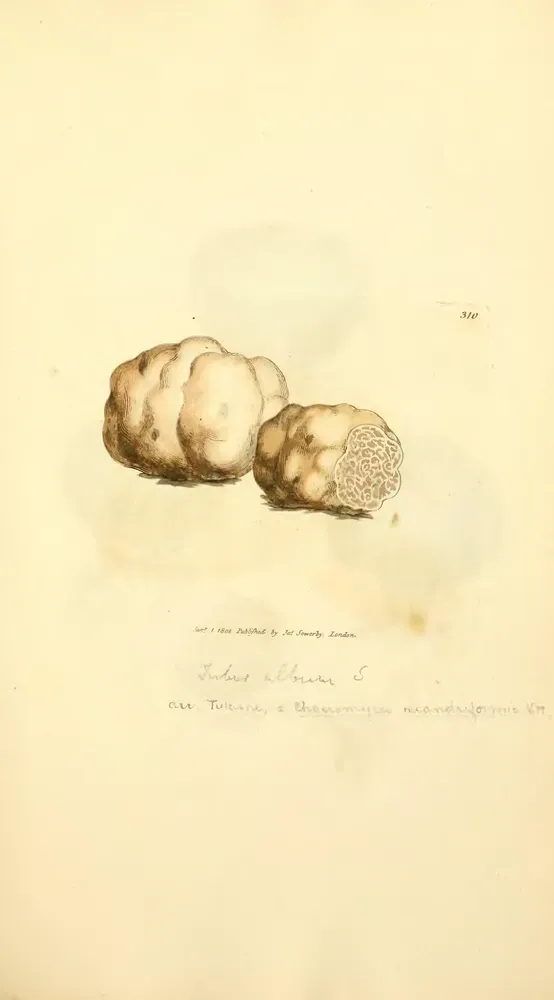
Choiromyces venosusChoiromyces meandriformis
Expert-verifiedUpdated October 3, 2026
Passport
- Edibility
- Conditionally edible
- Season
- Aug — Oct
- Hymenophore
- Chambered
- Cap color
- White
- Size
- Small (up to 5 cm)
- Smell
- Pleasant
- Reviewed
- Yes ✓
Quick answers
Where to look?
Deciduous forest, Mixed forest
When does it appear?
Aug — Oct
Active months: August, September, October.
How to recognize it? Three signs
- Cap color: White, Cream, Yellow
- Cap shape: Irregular
- Smell: Pleasant, Chemical
Fruiting season
August – October
Description
Choiromyces venosus, also known as Choiromyces meandriformis, is an underground ascomycete mushroom from the truffle family. Don’t confuse it with the famous Italian “white truffle,” Tuber magnatum: the Ukrainian species is far more modest in flavor, aroma and value. Still, for Ukraine’s mycoflora it’s a true rarity and a fascinating thing to observe — a truffle mushroom almost nobody has seen, because it grows underground.
In Ukraine the species occurs in the Carpathian foothills, Zakarpattia, the Carpathians, and less often in the Western Forest-Steppe, in oak-beech woods and mixed forests with pine. It forms mycorrhiza with oak and conifers (pines, spruce, Douglas fir). The fruiting bodies sit 5–15 cm deep in the soil, sometimes poking just slightly above the surface. They’re found by chance, when digging up plants, or with specially trained truffle dogs.
Edibility is controversial. In Germany, Sweden and Hungary, Choiromyces venosus is considered a delicacy and served in restaurants. In Spain, France and Italy it’s banned from sale as poisonous: it causes gastrointestinal poisoning in a certain share of people, especially when old or raw fruiting bodies are eaten. In Ukraine it has no official status. If the mushroom has been identified with certainty (ideally confirmed by a mycologist), the general advice is: the first time, eat only a small portion to check your own tolerance, always cook it before eating, and don’t give it to children. This isn’t a way to check whether a mushroom is edible: never “test” an unidentified mushroom with small portions. The safest choice is simply to record your finds as an interesting scientific fact.
Cap
The fruiting body is an irregular, tuber-like lump, 2–8 cm (sometimes up to 12 cm) across. When young it’s white or cream, with a smooth surface. With age it turns yellowish-brown with reddish-brown blotches. The surface is matte and may wrinkle slightly as it matures.
Hymenophore
The spore-bearing layer is inside — in a young mushroom the “flesh” is uniformly white; as it matures, distinctive labyrinth-like, net-like darker veins develop, running through the white base. Cut open, a mature mushroom shows a striking marbled pattern — which is where the name “meandriformis” comes from (after the meanders of a river).
Stem
There’s no stem — the fruiting body is hypogeous (underground), fully buried in the soil. It is attached to the substrate by thin mycelial strands.
Flesh
In young mushrooms the flesh is solid white, dense and meaty. In mature ones it’s a white base with a network of yellow-brown or grayish veins. The texture resembles a firm cheese.
Smell
The smell is strong and peculiar — like a mix of Camembert cheese, canned mushrooms and raw potato. In fresh specimens it’s pleasant; in overripe ones it becomes sharp and unpleasant. The taste is mild, with a nutty note.
›Scientific synonyms (2)
Choiromyces leonis Tul. & C. Tul., Rhizopogon leonis (Tul. & C. Tul.) Payer
Lookalikes
Related species
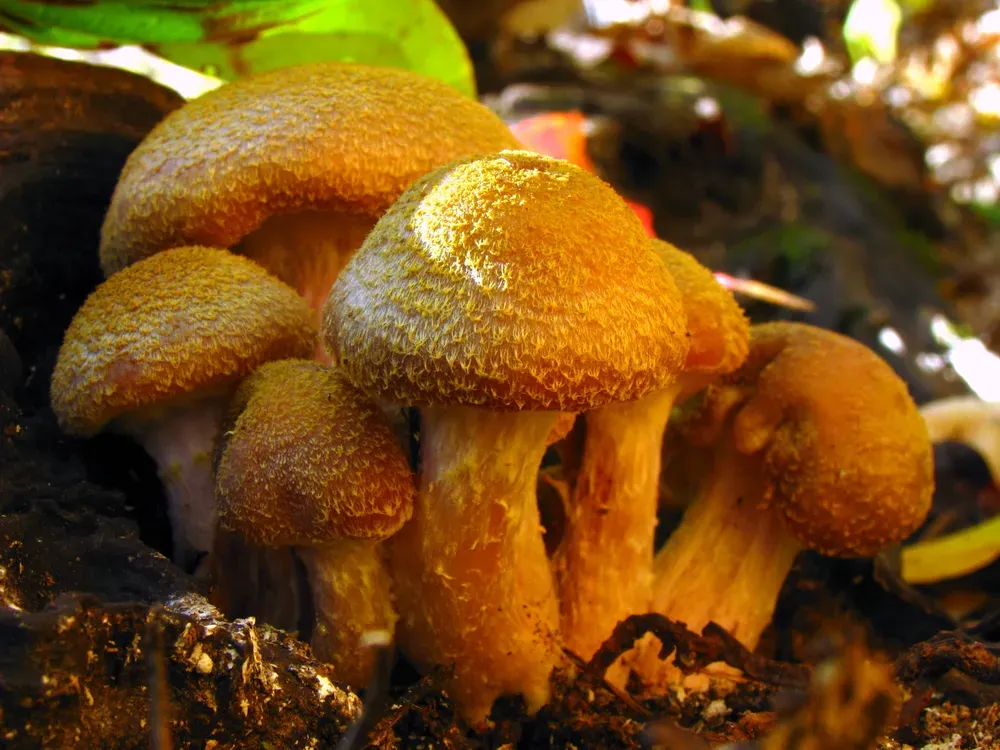
Mushrooms of the same genus and habitat — to study side by side and never mix up.
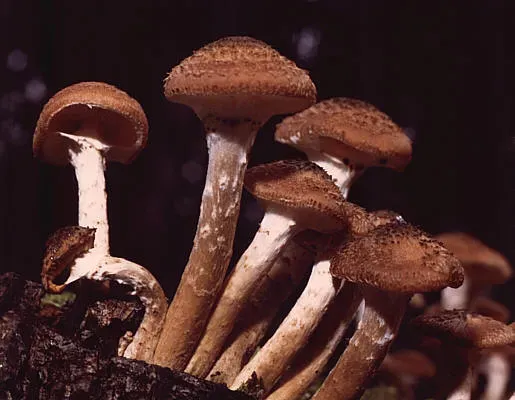
Bulbous honey fungus
Armillaria gallica
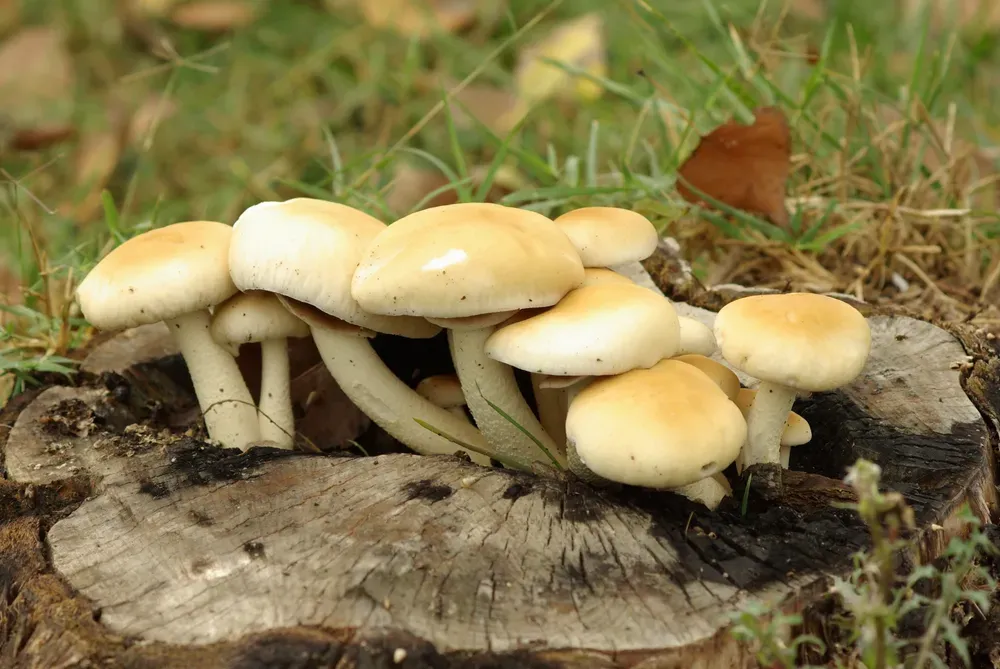
Dark honey fungus
Armillaria ostoyae
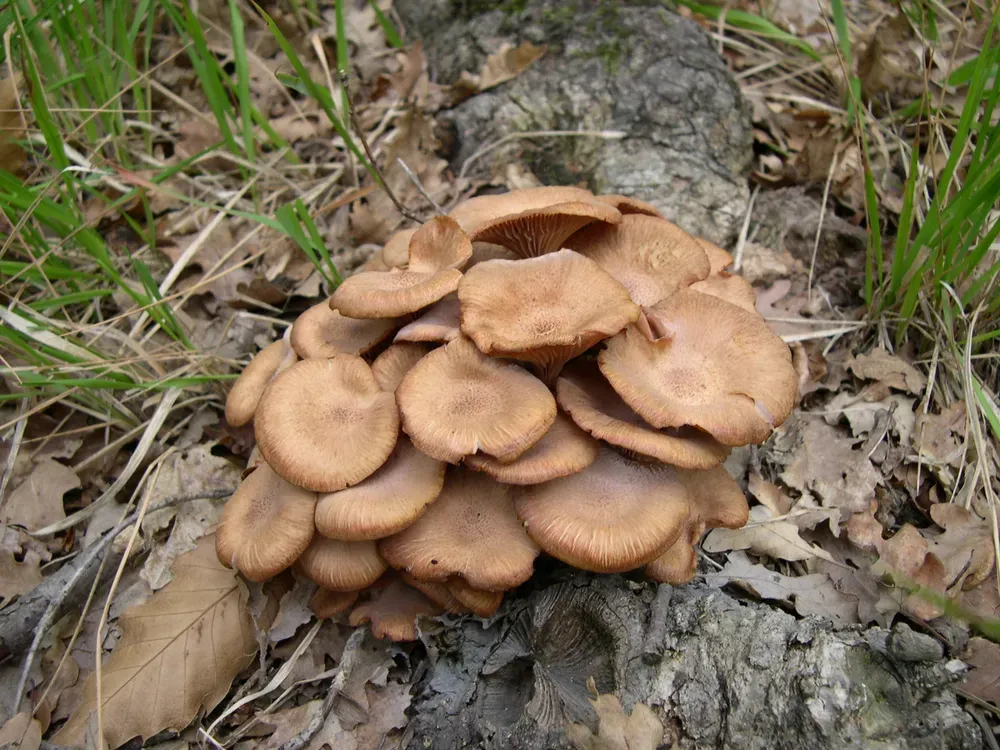
Poplar fieldcap
Cyclocybe aegerita
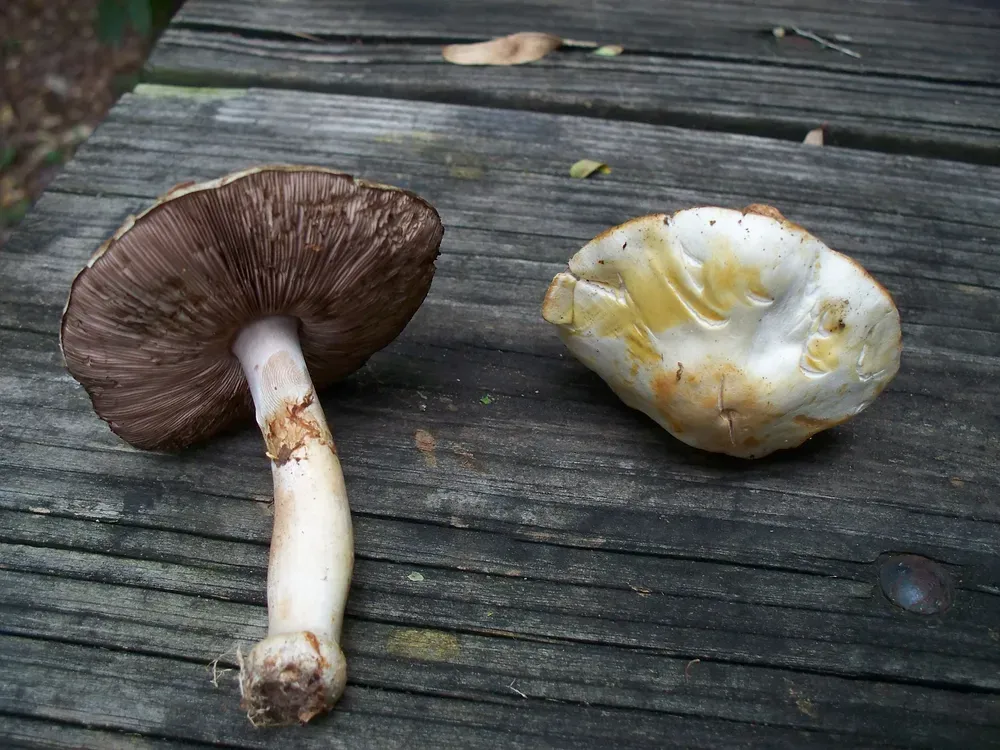
Ringless honey fungus
Desarmillaria tabescens
Agaricus abruptibulbus
Agaricus haemorrhoidarius
Agaricus haemorroidarius
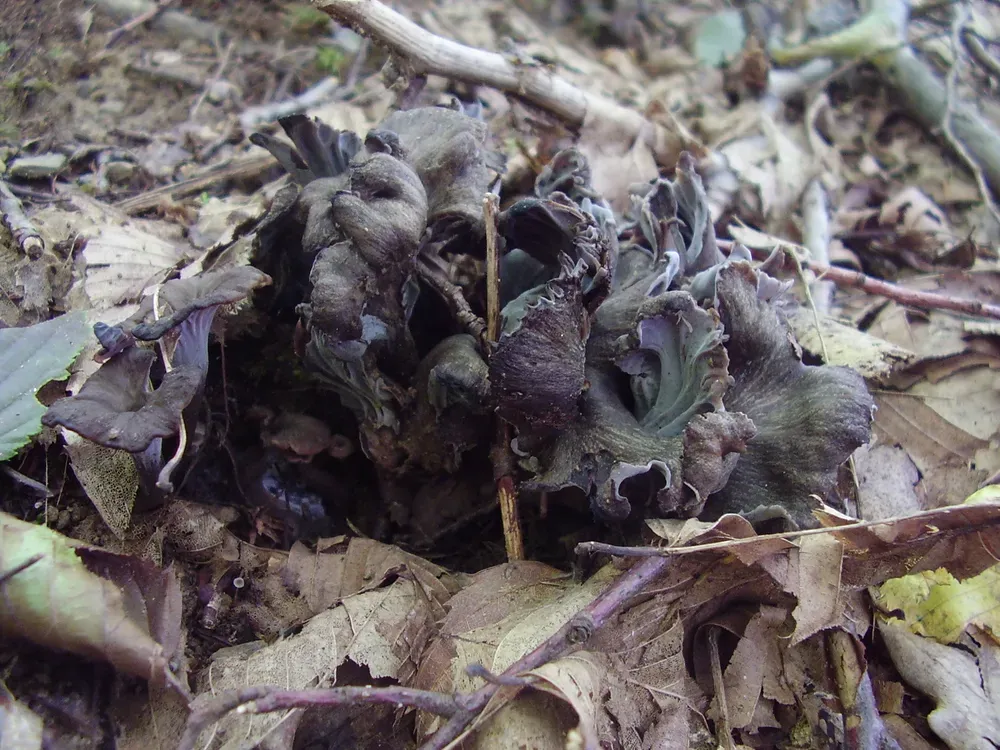
Ashen chanterelle
Cantharellus cinereus
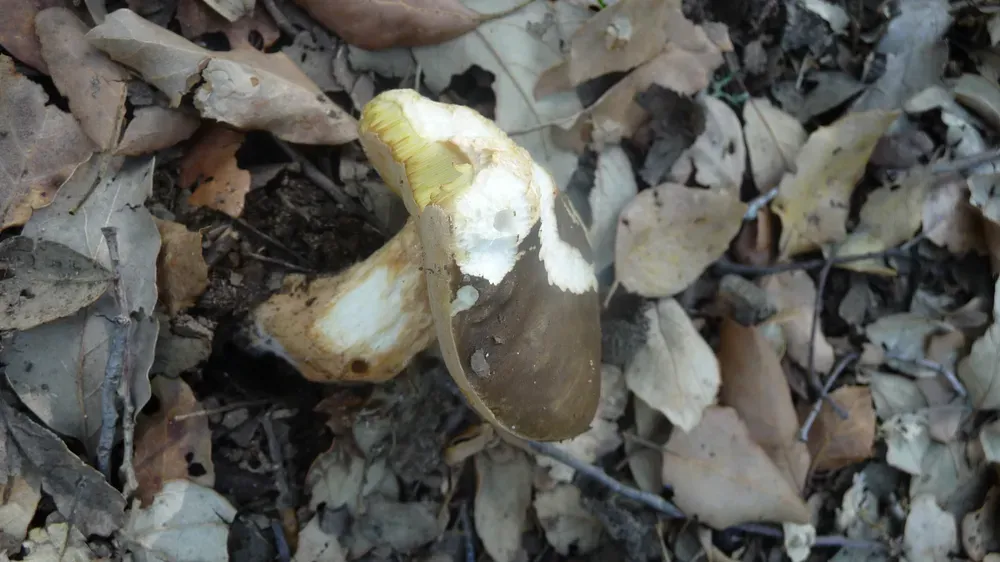
Blushing bolete
Leccinum roseofractum
Frequently asked questions
Is it safe to eat?
It’s a disputed question. In Germany, Sweden and Hungary the mushroom is officially edible; in Spain it’s banned as poisonous. It can affect different people differently — from no problems at all to severe gastrointestinal poisoning. If you decide to try it: only young white specimens identified with certainty (ideally confirmed by a mycologist), always boiled for 20–30 min. The first time, eat a small portion and wait 24 hours — this checks your personal tolerance of this species, not whether a mushroom is edible. Never use a small portion to test an unidentified mushroom.
How is it different from the real gourmet truffles?
The true white truffle (Tuber magnatum) and the black truffle (Tuber melanosporum) belong to a different genus (Tuber, not Choiromyces). Their aroma is finer and more complex, and they never come up to the surface. Choiromyces is a simpler “peasant” truffle that partly pokes out of the ground, and its aroma is coarser.
Where should you look in Ukraine?
The Carpathian foothills, Zakarpattia, the Carpathians, less often the Western Forest-Steppe. In oak and oak-pine forests on light soils. You have to search underground at a depth of 5–15 cm. People hunt for it with trained dogs or by watching for small bumps on the soil.
When does it fruit?
August to October, peaking in September. Unlike above-ground mushrooms, hypogeous truffles ripen more slowly and keep longer in the soil. They can even be found during the quiet autumn stretch after the first frosts.
Can it be confused with the deer truffle?
The deer truffle (Elaphomyces) is also underground, but darker, shaped like smaller nuts, with a hard black-brown rind. It’s inedible, but not poisonous either. Choiromyces is larger and paler, with a characteristic marbled interior when cut.
Which trees does it form mycorrhiza with?
Mostly oak (Quercus), also pine, spruce and Douglas fir. It’s most likely in oak woods and mixed forests with conifers. It does turn up in purely coniferous or purely broadleaf forests, but more rarely.
Why is it edible in some countries and poisonous in others?
Perhaps different European populations have a chemically different mix of toxins. Or it comes down to preparation — in Germany the mushroom is boiled, while in Italy it was traditionally eaten raw in salads. It’s safer to go by the southern European warnings: the mushroom can cause a severe upset stomach.
Is it worth collecting at all?
Given how rare it is, how hard it is to find, its disputed edibility and its lack of real culinary value — for most foragers there’s no practical point. This species is of interest to mycologists and collectors of rare finds, not to the kitchen.
Is Choiromyces venosus edible or poisonous?
What kind of spore-bearing surface does Choiromyces venosus have?
What does the cap of Choiromyces venosus look like?
What does the stem of Choiromyces venosus look like?
Sources
- [1]Вікіпедія (українська)
- [2]Атлас грибів України, Зеров Д.К. (1979)
- [3]MycoBank Database
- [4]Index Fungorum
- [5]GBIF
- [6]iNaturalist Ukraine