THIS DATA HAS NOT BEEN VERIFIED BY AN EXPERT. Use at your own risk.
_Redhead,_Vilgalys_&_Moncalvo_593470.webp)
Grey shagCoprinopsis cinerea
Under reviewUpdated October 3, 2026
Passport
- Edibility
- Conditionally edible
- Season
- Apr — Oct
- Hymenophore
- Gilled
- Cap color
- Grey
- Size
- Small (up to 5 cm)
- Smell
- Odorless
- Reviewed
- Under review
Quick answers
Where to look?
Meadow, Field
When does it appear?
Apr — Oct
Active months: April, May, June, July, August, September, October.
How to recognize it? Three signs
- Cap color: Grey, Black, White
- Cap shape: Conical, Umbonate
- Smell: Odorless
Fruiting season
April – October
Description
The grey shag, known to science as Coprinopsis cinerea (formerly Coprinus cinereus), is a small gray ink cap that, like all ink caps, self-destructs as it matures, dissolving into an inky mush. It settles on dung, humus, compost and fertilized soil, which is how it got its Ukrainian name (from the word for dung). This mushroom is far better known in science than in the kitchen: thanks to the fast, synchronized development of its fruiting bodies, it is widely used as a model organism for studying fungal reproduction and fruiting body formation.
In Ukraine, the grey shag occurs on pastures, in vegetable gardens, on compost heaps, near livestock farms and on fertilized soil all over the country. It appears quickly, often in groups, throughout the warm season — from spring to autumn, especially after rain in warm weather; within a day or two the fruiting bodies manage to grow, open and dissolve.
In terms of edibility, the grey shag is a conditionally edible mushroom. Young, unopened fruiting bodies are theoretically edible, but the mushroom has almost no culinary value: it is small, thin-fleshed and digests itself very quickly, so it has to be cooked immediately after picking. Because it grows on dung and compost, and because of the general rule not to combine ink caps with alcohol, most foragers pass it by. It is more of a scientific and natural curiosity than an edible mushroom.
Cap
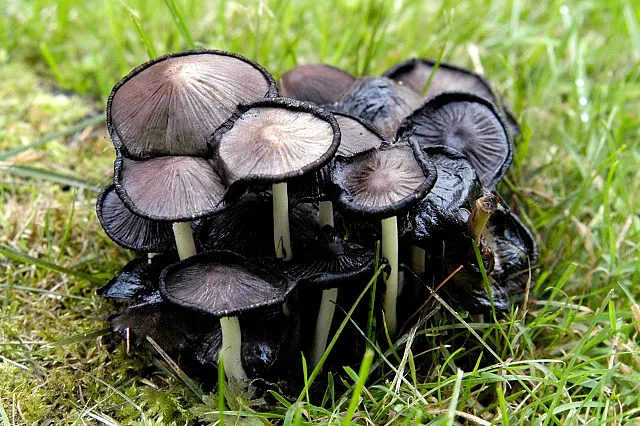
The cap of the grey shag is small — from 1 to 5 centimeters tall, at first egg-shaped-oval or bell-shaped; with age it opens out and dissolves into inky liquid at the margin. The surface is gray, ash-gray, often covered with small whitish scales or a mealy coating — remnants of the veil. When young the cap is paler; as it matures it grays and blackens from the edges. The whole cap is thin and pleated-striate.
Hymenophore
The hymenophore is gilled. The gills are free and very crowded, whitish at first, then quickly blacken and dissolve together with the cap margin into inky liquid (autolysis). The spore print is black. Rapid self-digestion of the gills into ink is a characteristic feature of all ink caps.
Stem
The stem is thin, hollow, white or whitish gray, up to 10 centimeters tall, smooth, often with a slightly thickened base. There is usually no ring, or only a trace of the veil remains. There is no volva. The stem is fragile and thin, typical of small ink caps.
Flesh
The flesh is extremely thin, grayish or whitish, with no particular taste. Because of rapid autolysis it does not last long: within a few hours of maturity the fruiting body dissolves. That is why only very young, unopened specimens are fit to eat, and even those have almost no culinary value.
Smell
The smell is faint and nondescript, mushroomy or slightly musty. The scent is not a defining feature; the mushroom is recognized by its gray, pleated cap that dissolves into ink, its black gills and its growth on dung, compost and fertilized soil.
›Scientific synonyms (3)
Coprinus cinereus (Schaeff.) Gray (1821), Agaricus cinereus Schaeff. (1774), Coprinus macrorhizus (Pers.) Rea (1922)
Lookalikes
.webp)
Related species
Mushrooms of the same genus and habitat — to study side by side and never mix up.
.webp)
_Fr._4948278370-2.webp)
.webp)
Frequently asked questions
Is Grey shag edible or poisonous?
Does Grey shag have gills or pores?
What does the cap of Grey shag look like?
What does the stem of Grey shag look like?
What do Grey shag smell and taste like?
Where does Grey shag grow?
When should you pick Grey shag?
What can Grey shag be confused with?
How do you cook Grey shag?
Can you dry Grey shag?
What is the scientific name of Grey shag?
Sources
- [1]Вікіпедія (українська)
- [2]Атлас грибів України, Зеров Д.К. (1979)
- [3]MycoBank Database
- [4]Index Fungorum
- [5]GBIF
- [6]iNaturalist Ukraine