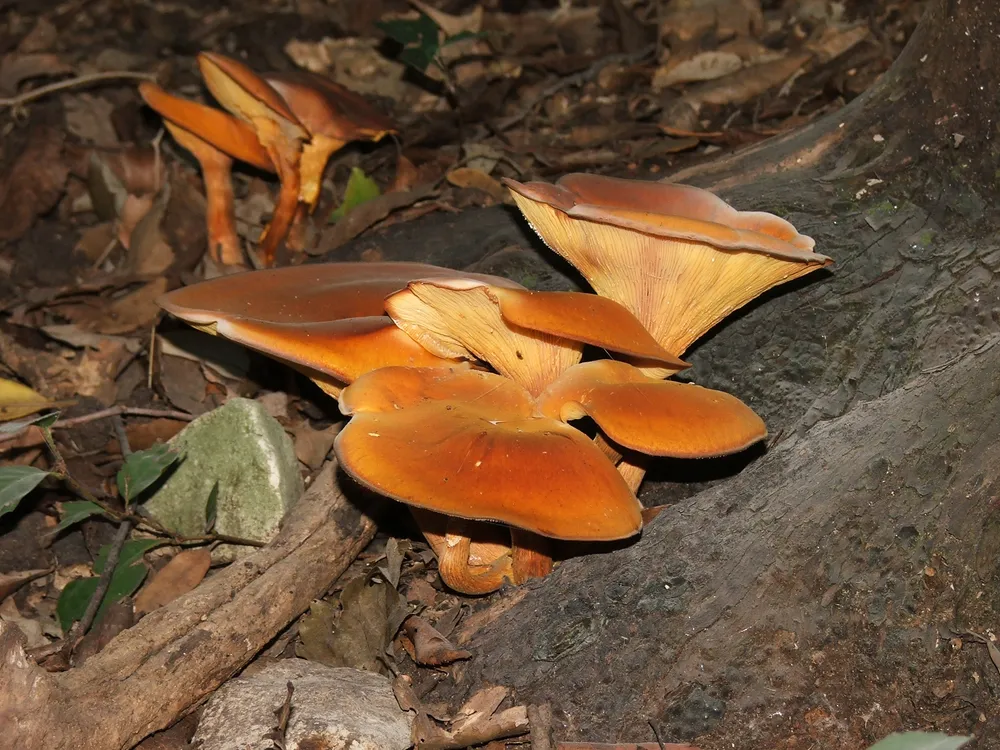
Jack-o'-lantern mushroomOmphalotus olearius
Expert-verifiedUpdated October 3, 2026
Passport
- Edibility
- Poisonous
- Season
- Jul — Nov
- Hymenophore
- Gilled
- Cap color
- Orange
- Size
- Medium (5–15 cm)
- Smell
- Odorless
- Reviewed
- Yes ✓
POISONOUS
Eating it causes poisoning. Do not pick it unless you have identified it with certainty.
It contains illudin S (and related illudins), a sesquiterpene cytotoxin that damages the cells of the stomach and intestinal lining, causing severe gastroenteritis. Symptoms appear 30 min - 4 h after eating: intense nausea, repeated vomiting, watery or bloody diarrhea, severe abdominal pain, dehydration, tachycardia, hypotension.
Symptoms last 6-24 hours. Deaths are almost unheard of, but the poisonings are severe and require hospitalization, especially in children and the elderly because of the risk of dehydration. Treatment is symptomatic: gastric lavage, activated charcoal, intensive IV fluid therapy, electrolyte monitoring, antiemetics.
What to do if you suspect poisoning: call an ambulance. With severe vomiting and diarrhea, don't try to keep drinking at home on your own; intravenous fluids are needed. Keep the mushroom leftovers so the toxin can be identified.
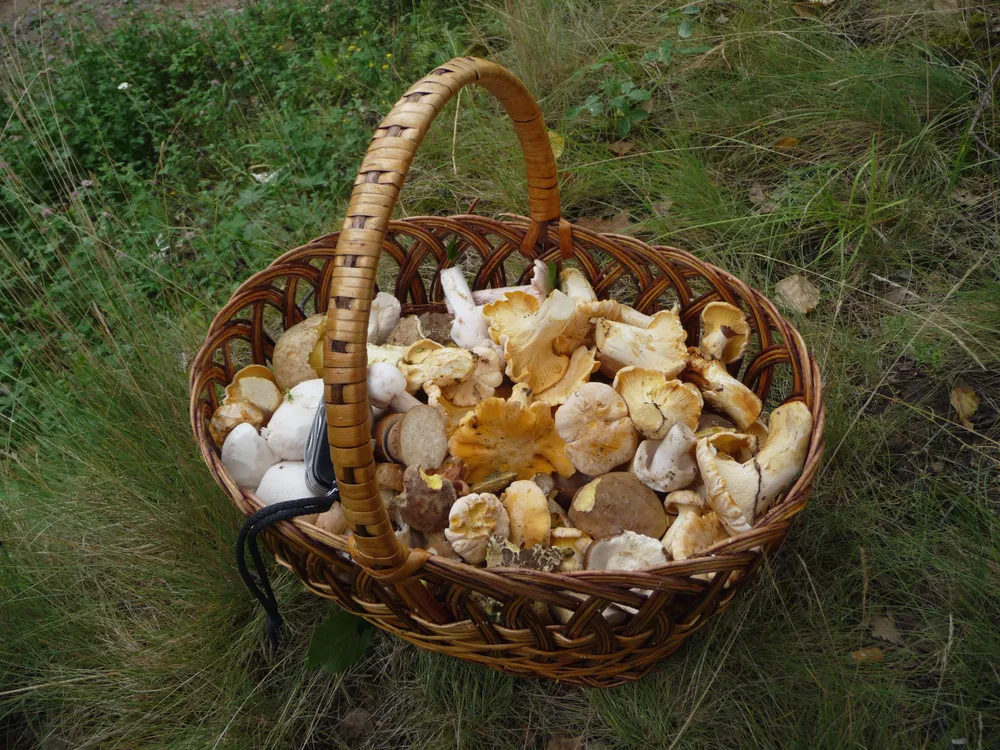
Prevention: orange mushrooms growing in clusters ON A STUMP or among broadleaf roots are NOT chanterelles. A true chanterelle is mycorrhizal and grows singly or in twos and threes on humus-rich soil among moss, with a characteristic fruity apricot smell. In the southern regions of Ukraine, the careful forager's rule is: skip every orange mushroom that grows in clusters and has crowded true gills.
If you suspect poisoning, call an ambulance immediately: 112 (the European emergency number) or your local emergency number
Quick answers
Where to look?
Deciduous forest
When does it appear?
Jul — Nov
Active months: July, August, September, October, November.
How to recognize it? Three signs
- Cap color: Orange, Yellow, Red
- Cap shape: Funnel-shaped
- Smell: Odorless
Fruiting season
July – November
Description
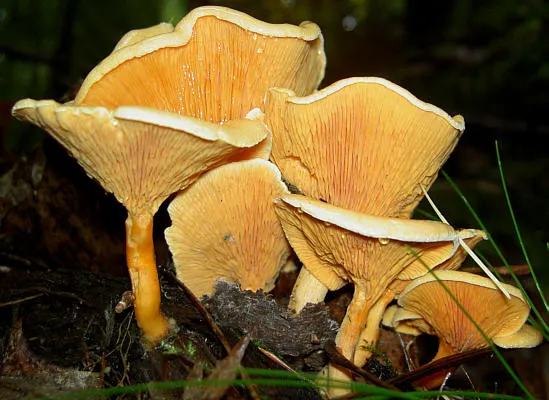
The jack-o'-lantern mushroom (Omphalotus olearius), known in Western naming as the "Jack-o'-lantern mushroom" for its remarkable ability to glow faintly in the dark (bioluminescence), is a poisonous mushroom that many people pick by mistake instead of chanterelles. It looks similar to them: a bright orange to fiery yellow-orange cap, growth in clusters, a fleshy stem. But it's a real trap: the jack-o'-lantern contains illudin S (a sesquiterpene toxin), which causes severe gastroenteritis.
Poisoning symptoms appear 30 min - 4 h after eating: intense nausea, repeated vomiting, watery or bloody diarrhea, abdominal pain, severe dehydration. Deaths are almost unheard of, but the poisonings are severe and require hospitalization and IV fluid therapy. There is no specific antidote; treatment is symptomatic.
In Ukraine it is found mainly in the southern and southwestern regions: Crimea (especially the Black Sea coast), Odesa region, Zakarpattia, and more rarely the Carpathians. A saprotroph or weak parasite, it grows in clusters on the roots and stumps of broadleaf trees (oak, and olive trees in Crimea). The season runs August to November. In the northern and central regions it is practically never found; there, an "orange mushroom on a stump" more often turns out to be sulphur tuft or false chanterelle. The rule: an orange mushroom growing in clusters ON A STUMP is almost always NOT a chanterelle (chanterelles are mycorrhizal and grow on the ground among moss, singly or a few together).
Cap
The cap is 5-15 cm across, convex-conical with an inrolled edge in young mushrooms, later becoming funnel-shaped with a thin wavy edge. The color is bright orange, yellow-orange, brick, darker in the center. The surface is smooth, shiny in wet weather, without scales. The cap edge is thin.
Hymenophore
Gilled hymenophore: true crowded decurrent gills (not pronounced ridges like in a true chanterelle), yellow-orange, matching the cap. They run down the stem. The spore print is pale cream to yellowish. In the dark they may glow faintly with a pale green light (bioluminescence driven by luciferase enzymes).
Stem
The stem is 5-12 cm tall and 1-2 cm thick, cylindrical, often tapering toward the base, frequently curved. The color is yellow-orange, matching the cap or slightly paler. The surface is smooth, without a ring. Several stems are often fused at the base into a cluster.
Flesh
The flesh is dense, yellow-orange; when cut it does not change color. The smell is faint, mushroomy, without unpleasant notes. The taste is mild at first, then bitterish, an additional warning sign.
Smell
Faint and pleasantly mushroomy. It does NOT have the characteristic fruity apricot aroma of a true chanterelle. That is the key diagnostic difference.
›Scientific synonyms (2)
Clitocybe olearia, Clitocybe phosphorea
Lookalikes
Related species
Mushrooms of the same genus and habitat — to study side by side and never mix up.
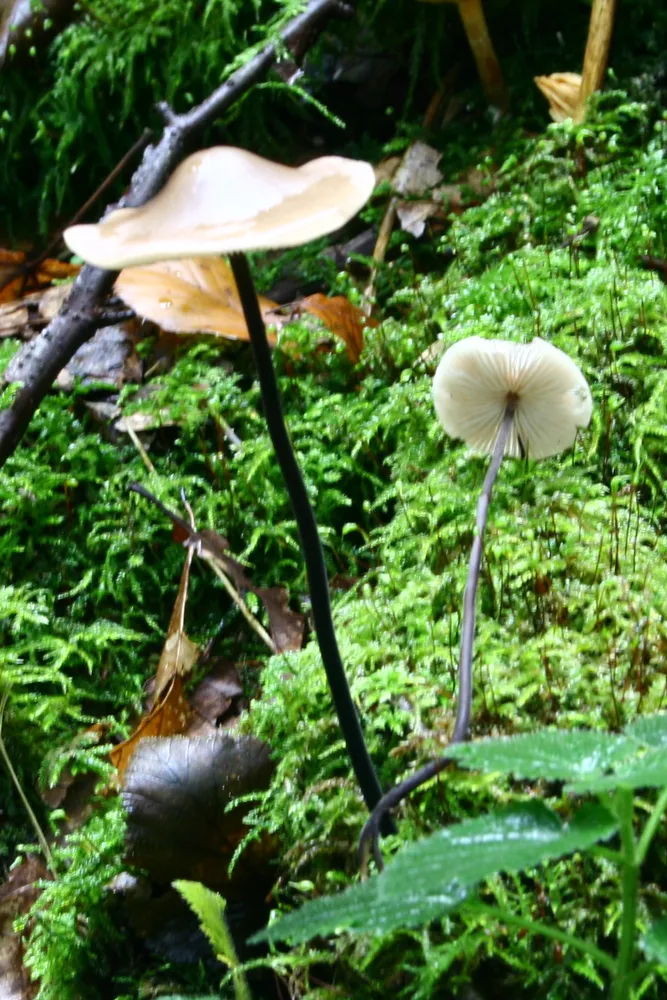
Garlic parachute
Mycetinis alliaceus
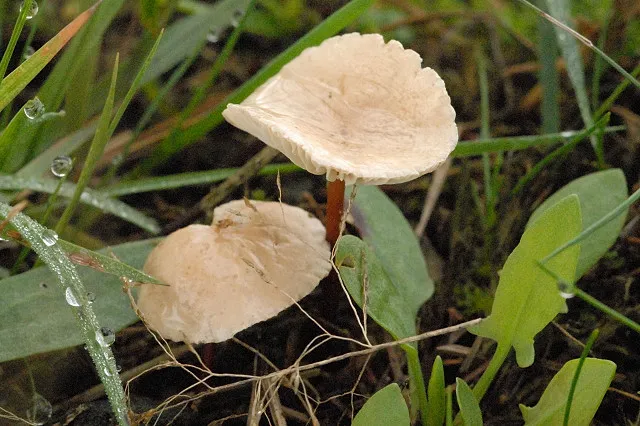
Mycetinis scorodonius
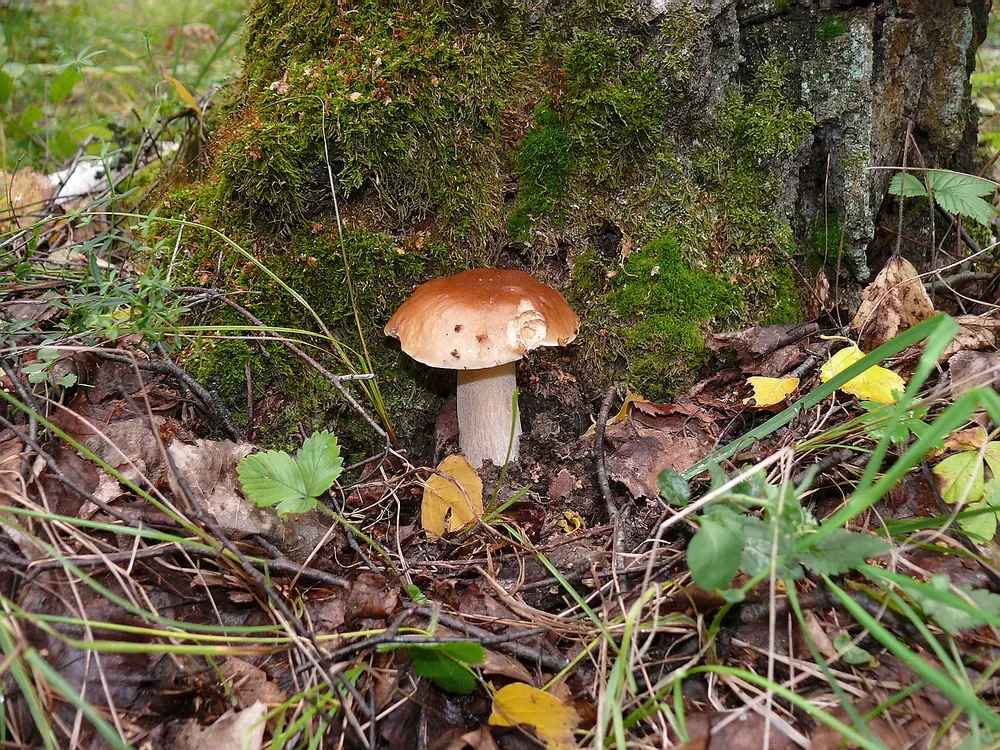
Boletus betulicola
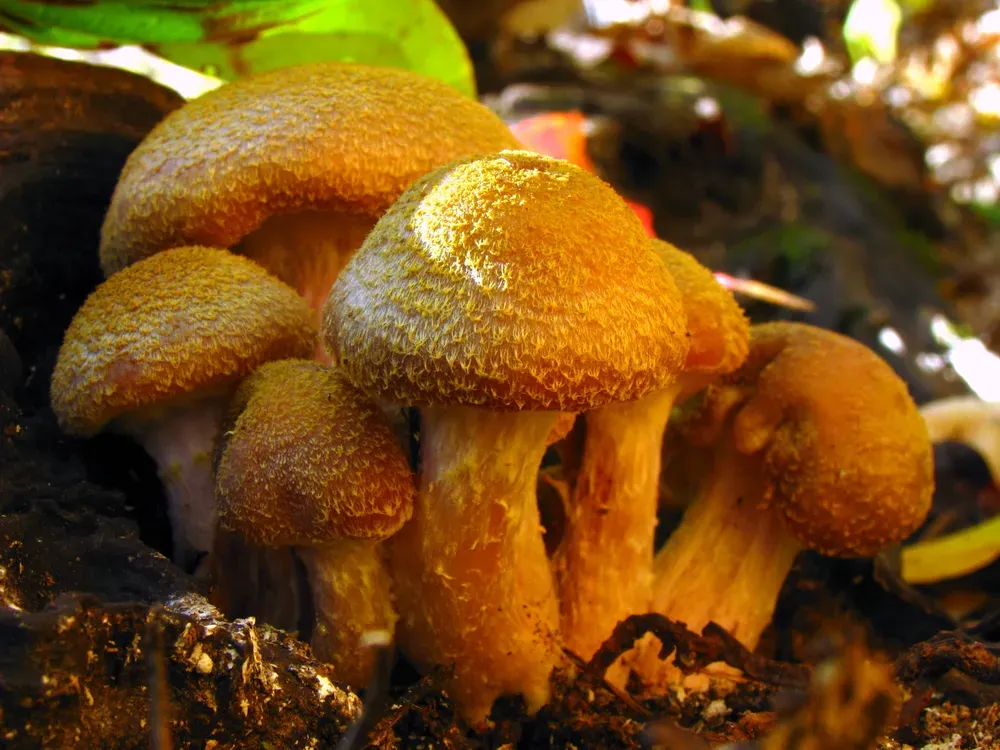
Bulbous honey fungus
Armillaria gallica
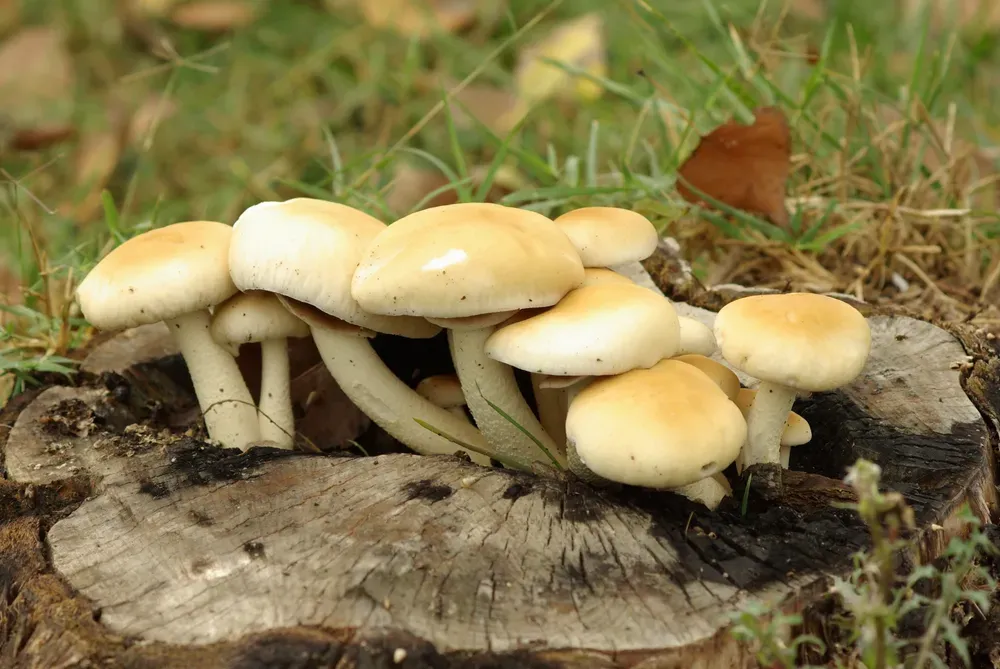
Poplar fieldcap
Cyclocybe aegerita
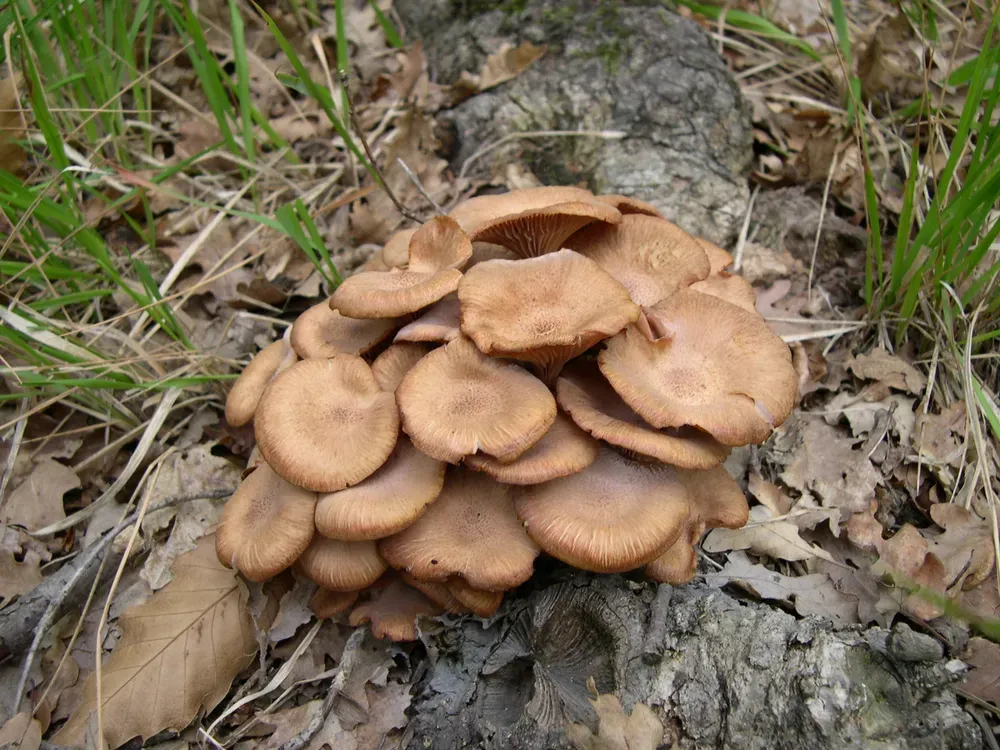
Ringless honey fungus
Desarmillaria tabescens
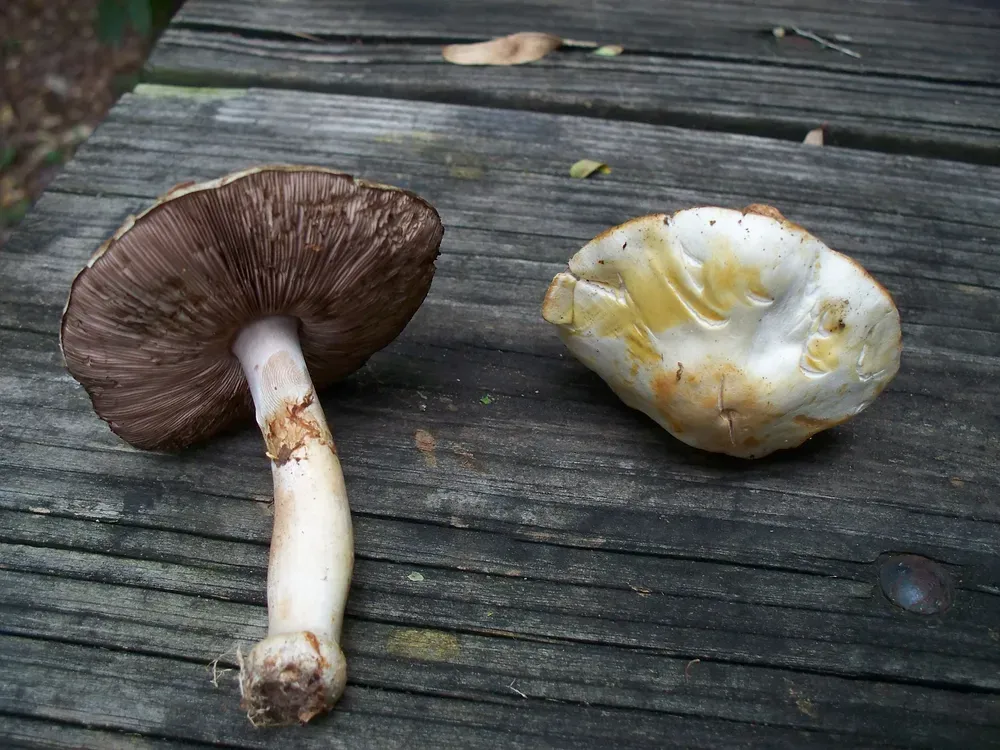
Agaricus abruptibulbus
Agaricus haemorrhoidarius
Agaricus haemorroidarius
Frequently asked questions
Can you eat it?
No, it's poisonous. It contains illudin S, a toxin that causes severe gastroenteritis. Don't taste it, don't sample it, don't mix it with chanterelles in your basket.
How do you tell it apart from a true chanterelle?
Four critical features. (1) Gills: a chanterelle has pronounced hymenophore ridges (wrinkles) that are hard to separate from the flesh. The jack-o'-lantern has true thin gills that come away cleanly. (2) Where it grows: the chanterelle is mycorrhizal, on the ground among moss, singly or in twos and threes. The jack-o'-lantern is a saprotroph/parasite on stumps, roots and at the base of broadleaf trunks, in clusters of 5-30. (3) Smell: the chanterelle has an intense fruity apricot scent. The jack-o'-lantern smells neutrally mushroomy. (4) Flesh: the chanterelle's is firm and meaty; the jack-o'-lantern's is softer and bitterish in taste.
Is it true that it glows in the dark?
Yes, faint bioluminescence is a hallmark of the genus Omphalotus. The fresh gills of a young mushroom give off a faint pale greenish light in total darkness (visible after 10-15 minutes in the dark, once your eyes adjust). The glow comes from the enzyme luciferase, similar to glowing fungi and fireflies. It is no proof of safety and no "natural warning": the mushroom is poisonous all the same.
What happens if you accidentally eat it?
After 30 min - 4 h: nausea, repeated vomiting, watery diarrhea, abdominal pain, dehydration. Calling an ambulance is essential: IV fluid therapy is needed. Symptoms last 6-24 h. Usually not fatal, but severe, especially for children.
Where does it grow?
A saprotroph or weak parasite on the roots and stumps of broadleaf trees: oak, more rarely chestnut, olive trees (in Crimea). It loves warm southern regions. It often grows in clusters right at the base of the trunk or out of cracks in the bark of a living tree.
Which regions of Ukraine is it found in?
Mainly the southern and southwestern regions: Crimea (the Black Sea coast, parks of Sevastopol and Simferopol), Odesa region, Zakarpattia. More rarely, the Carpathians. In the northern and central regions of Ukraine it is practically never found.
When should you look for it?
Better to ask "when to avoid it". August to November. In warm regions, into December.
What other mushrooms is it confused with?
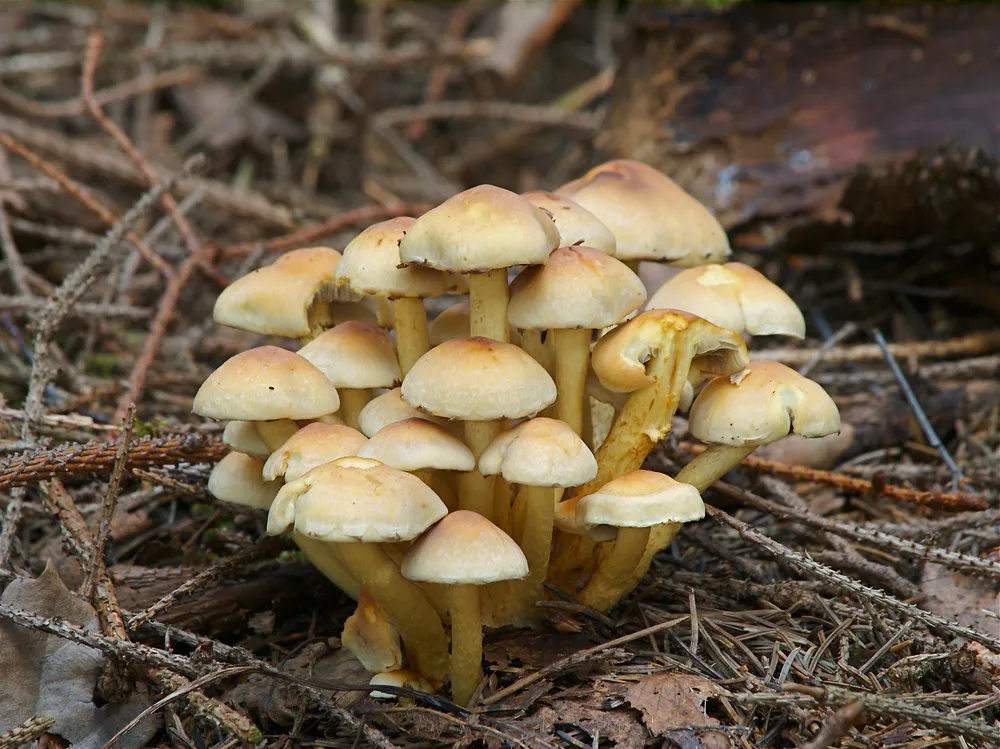
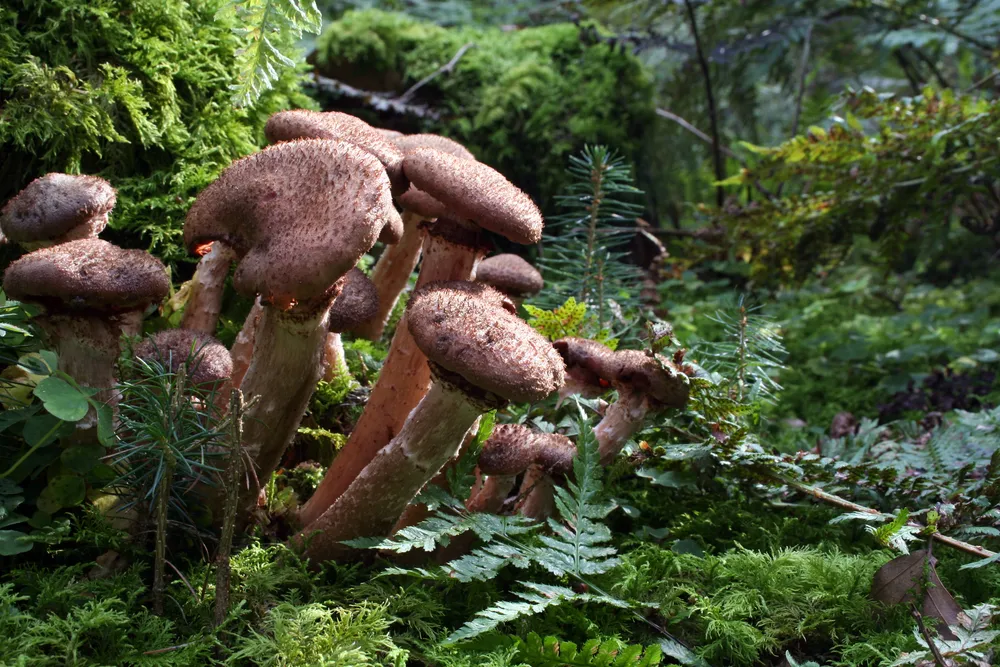
Besides the true chanterelle (Cantharellus cibarius), with the false chanterelle (Hygrophoropsis aurantiaca), which is also edible but less so. With common rustgill (Gymnopilus penetrans), which is bitter, inedible and grows on conifer wood. Among southern species, with young sulphur tufts (Hypholoma fasciculare), which are poisonous, but those are yellowish rather than orange. Among parasitic species, with Armillaria (honey fungus, Armillaria mellea), which is edible, but the jack-o'-lantern is brighter and has no ring on the stem.
Is Jack-o'-lantern mushroom edible or poisonous?
Does Jack-o'-lantern mushroom have gills or pores?
What does the cap of Jack-o'-lantern mushroom look like?
What does the stem of Jack-o'-lantern mushroom look like?
Sources
- [1]Вікіпедія (українська)
- [2]Атлас грибів України, Зеров Д.К. (1979)
- [3]MycoBank Database
- [4]Index Fungorum
- [5]GBIF
- [6]iNaturalist Ukraine