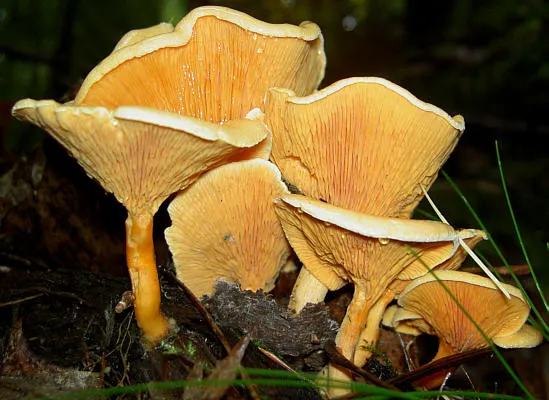
False chanterelleЛисичка несправжня
Expert-verifiedUpdated June 13, 2026
Passport
- Edibility
- Conditionally edible
- Season
- Aug — Nov
- Hymenophore
- Gilled
- Cap color
- Orange
- Size
- Small (up to 5 cm)
- Smell
- Odorless
- Reviewed
- Yes ✓
Quick answers
Where to look?
Conifer forest, Mixed forest
When does it appear?
Aug — Nov
Active months: August, September, October, November.
How to recognize it? Three signs
- Cap color: Orange, Yellow, Red
- Cap shape: Funnel-shaped
- Smell: Odorless
Fruiting season
August – November
Description
False chanterelle (Hygrophoropsis aurantiaca) — the best-known double of the real chanterelle, behind more kitchen mix-ups than any other mushroom in Ukraine's forests. It looks so much like the real chanterelle that even experienced foragers sometimes toss it into the basket along with the rest: bright orange color, funnel-shaped cap, growing in mossy litter under pines. But look closely and it's easy to tell apart — the false chanterelle's cap is more velvety and uneven, the stem flesh is watery and less springy, and the gills are true and crowded instead of the indistinct gill-like ridges of the real chanterelle.
This is a conditionally edible mushroom with a mixed reputation. It is not poisonous in the scientific sense, but in some people it causes gastrointestinal upset (nausea, mild diarrhea) 2-6 hours after eating — as an individual intolerance. Modern Western sources recommend skipping it, or cooking it only after a mandatory 15-minute boil, discarding the water. Its culinary value is far below the real chanterelle's: the flesh is thin, watery, and lacks the characteristic fruity aroma.
In Ukraine it occurs throughout the forest zone: in coniferous and mixed forests, mainly in pine woods and spruce stands with moss and bilberry. A saprotroph (unlike the real chanterelle, which is mycorrhizal). Season August-November, peaking in September-October. It often grows in groups of 5-20 fruiting bodies, especially abundantly in the pine forests of Polissia and the spruce forests of the Carpathians. One of the most common "orange forest" mushrooms in the autumn basket.
Cap
Cap 3-8 cm across, convex with an inrolled margin when young, becoming funnel-shaped with a thin wavy margin. Color bright orange, brick-toned, more intense in young mushrooms (orange to orange-red), paler in old ones, down to yellow-ochre. Cap surface velvety, suede-like, with barely visible fine scales, especially at the center. In wet weather it is slightly matte, not sticky.
Hymenophore
Gilled hymenophore — true, crowded gills (not gill-like ridges as in the real chanterelle). The gills are thin, decurrent, often forked or joined by cross-veins. Color orange-yellow, matching the cap. Spore print white to pale yellow. The key feature that sets it apart from the real chanterelle: if you see distinct thin gills — it's the false chanterelle.
Stem
Stem 2-6 cm tall, 0.5-1.2 cm thick, cylindrical, often curved, slightly thickened toward the base. Color orange-yellow, matching the cap. Surface smooth, no ring. Stem flesh hollow or watery — a key difference from the real chanterelle, whose flesh is springy and meaty.
Flesh
Flesh thin, watery, yellowish-cream, brittle. Does not change color when cut. No distinct smell. Older specimens taste slightly sour.
Smell
Faint, neutral, mushroomy, without the characteristic fruity apricot aroma of the real chanterelle. This is one of the key diagnostic differences: the real chanterelle smells of fresh apricots, the false one smells of nothing, or faintly "damp and mushroomy".
Lookalikes
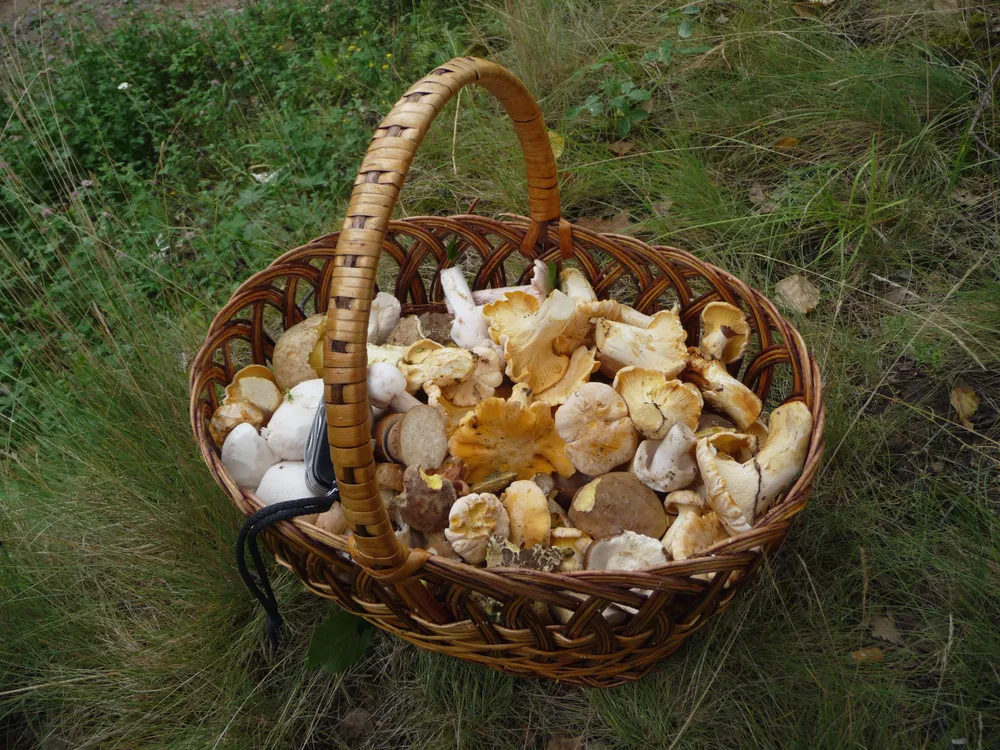
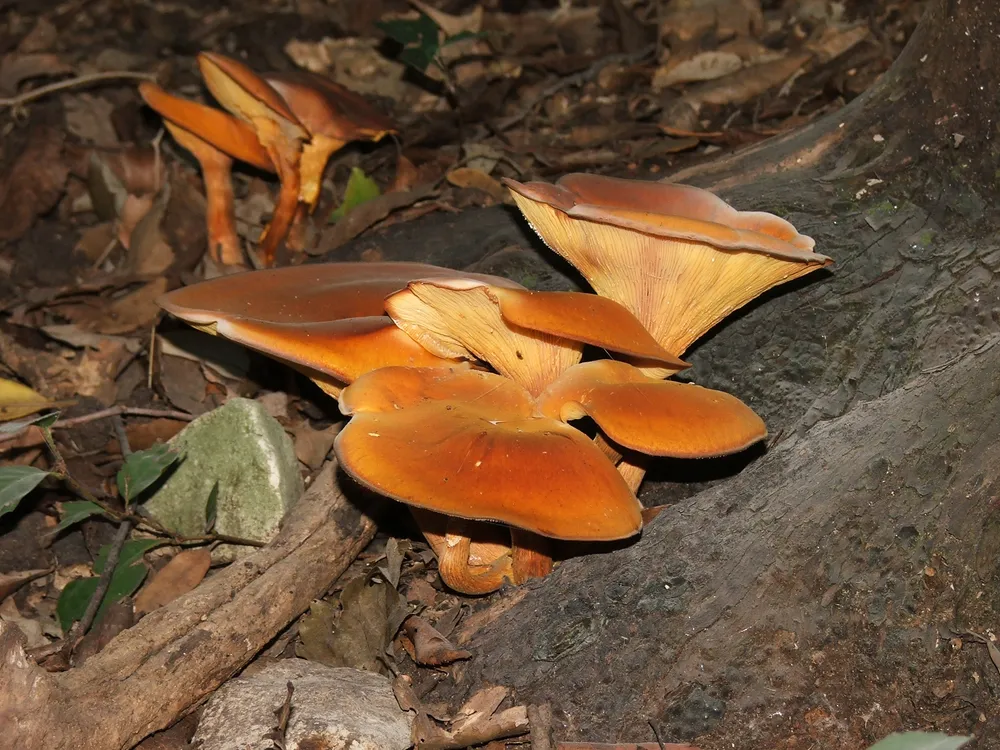
._Locatie,_Hortus_(Haren,_Groningen)_01.webp)
Related species
Mushrooms of the same genus and habitat — to study side by side and never mix up.
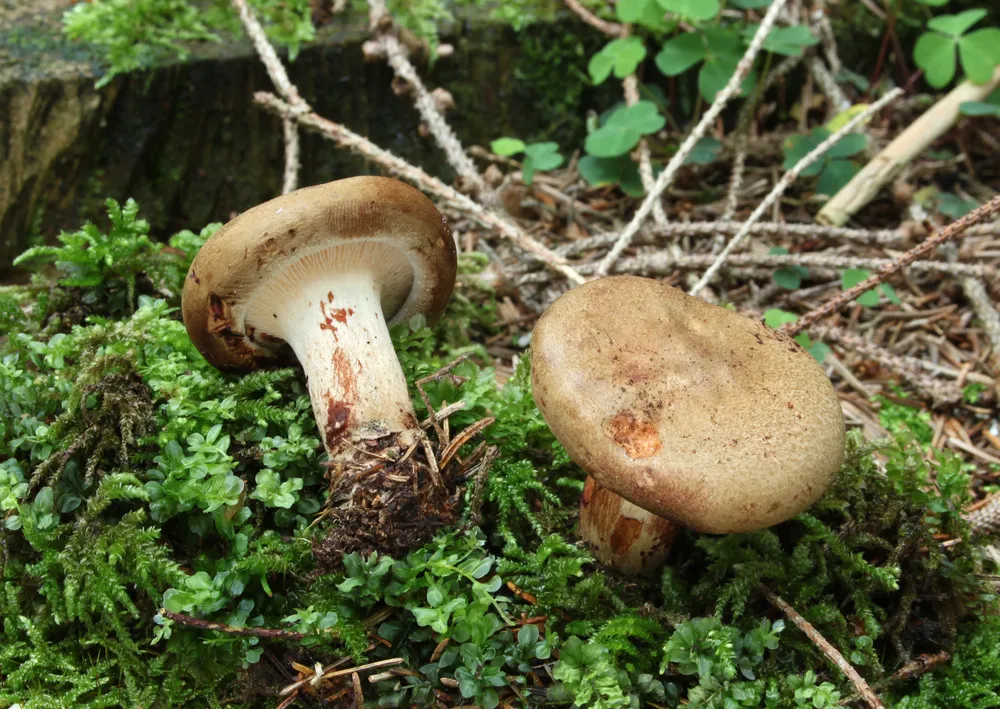
Brown rollrim
Paxillus involutus
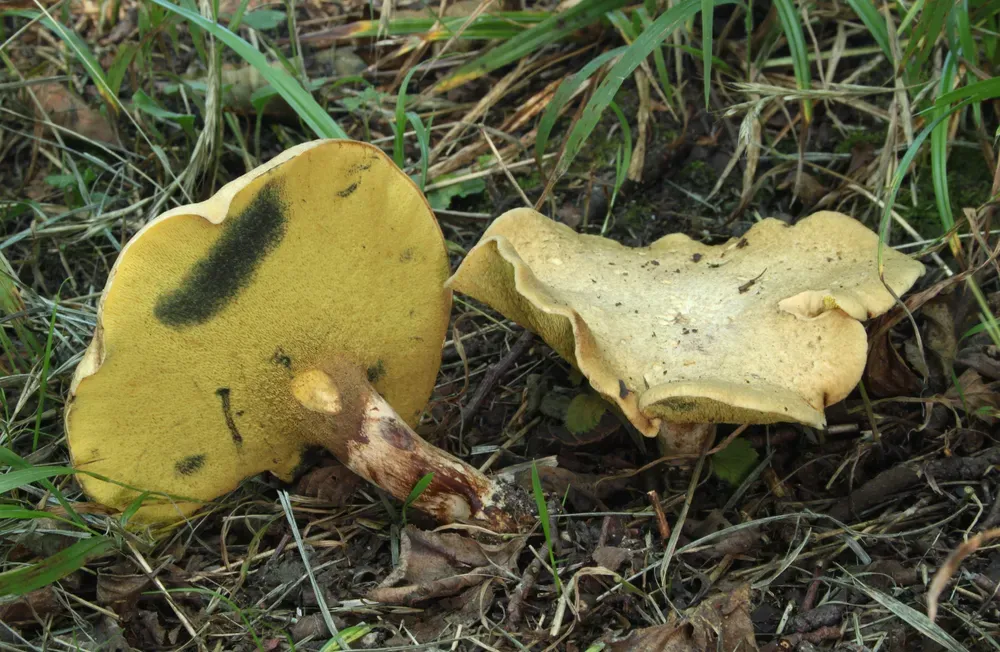
Alder bolete
Gyrodon lividus
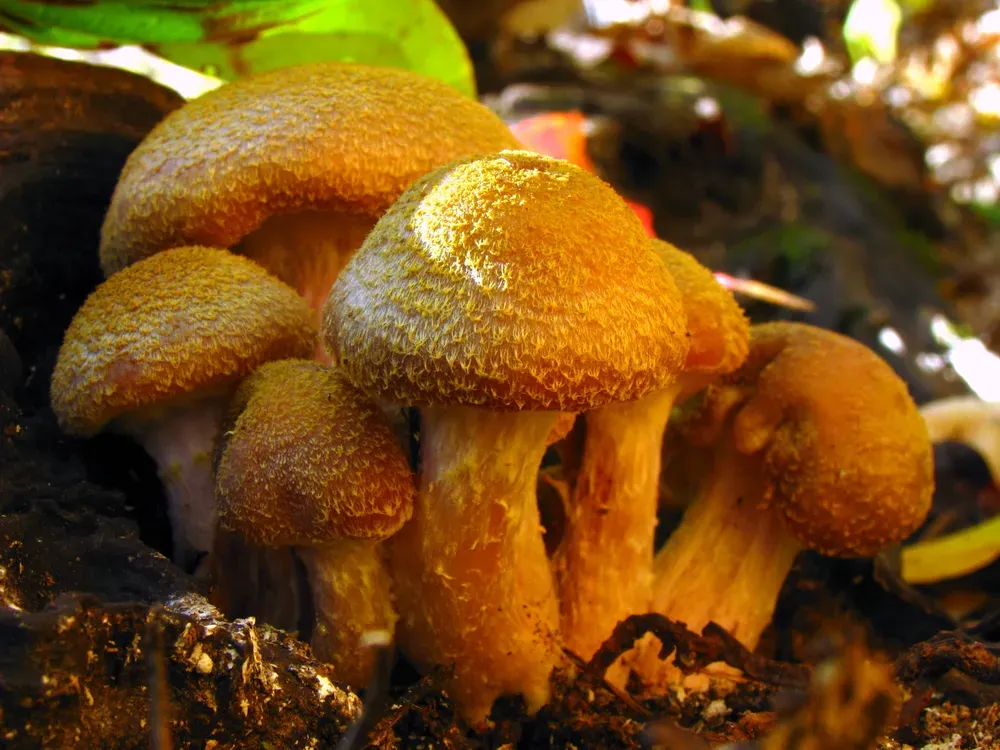
Bulbous honey fungus
Armillaria gallica
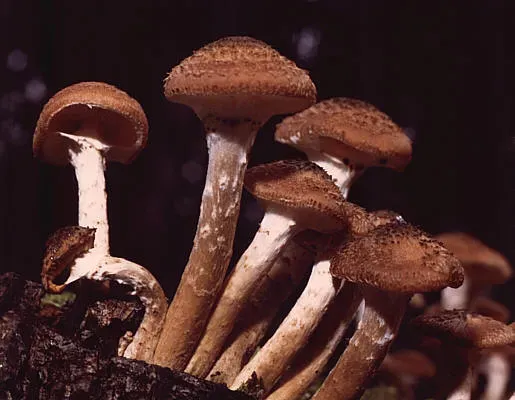
Dark honey fungus
Armillaria ostoyae
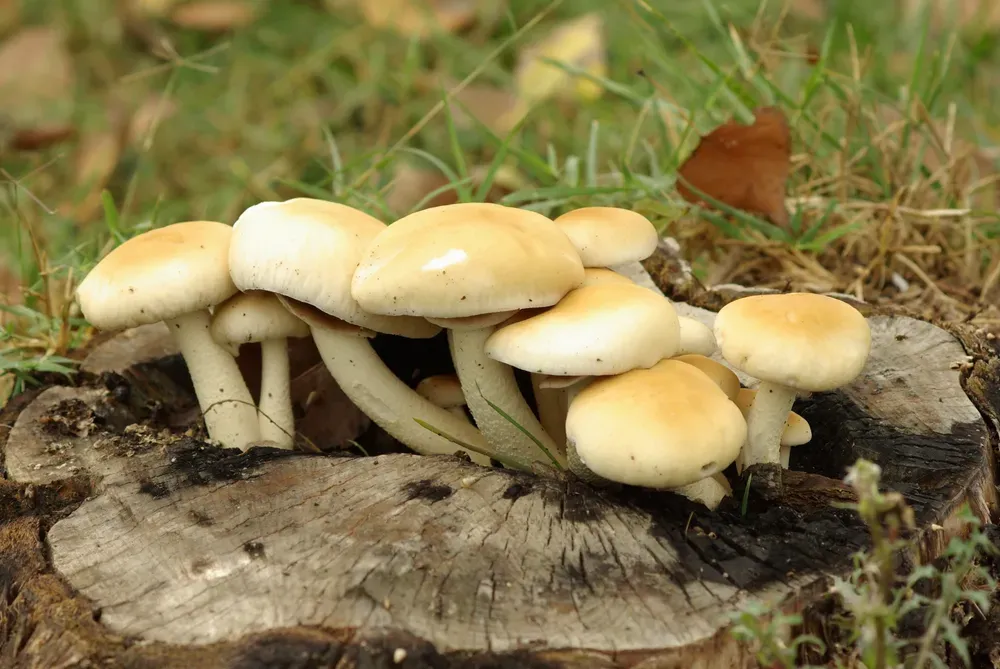
Poplar fieldcap
Cyclocybe aegerita
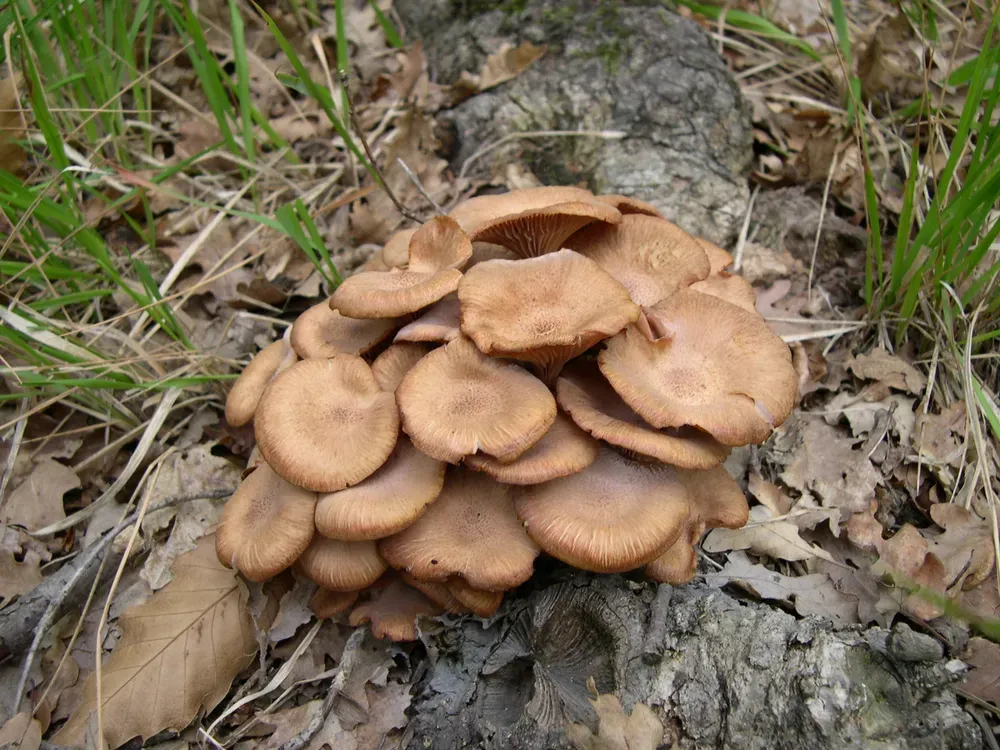
Ringless honey fungus
Desarmillaria tabescens
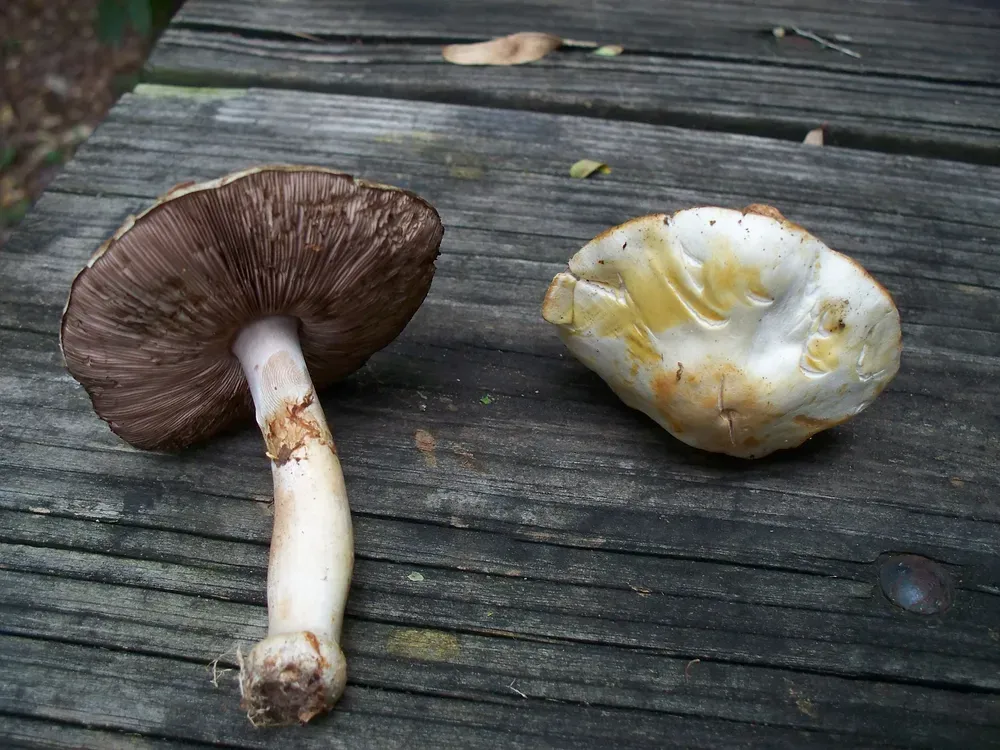
Agaricus abruptibulbus
Agaricus haemorrhoidarius
Agaricus haemorroidarius
Related reading
 How to identify
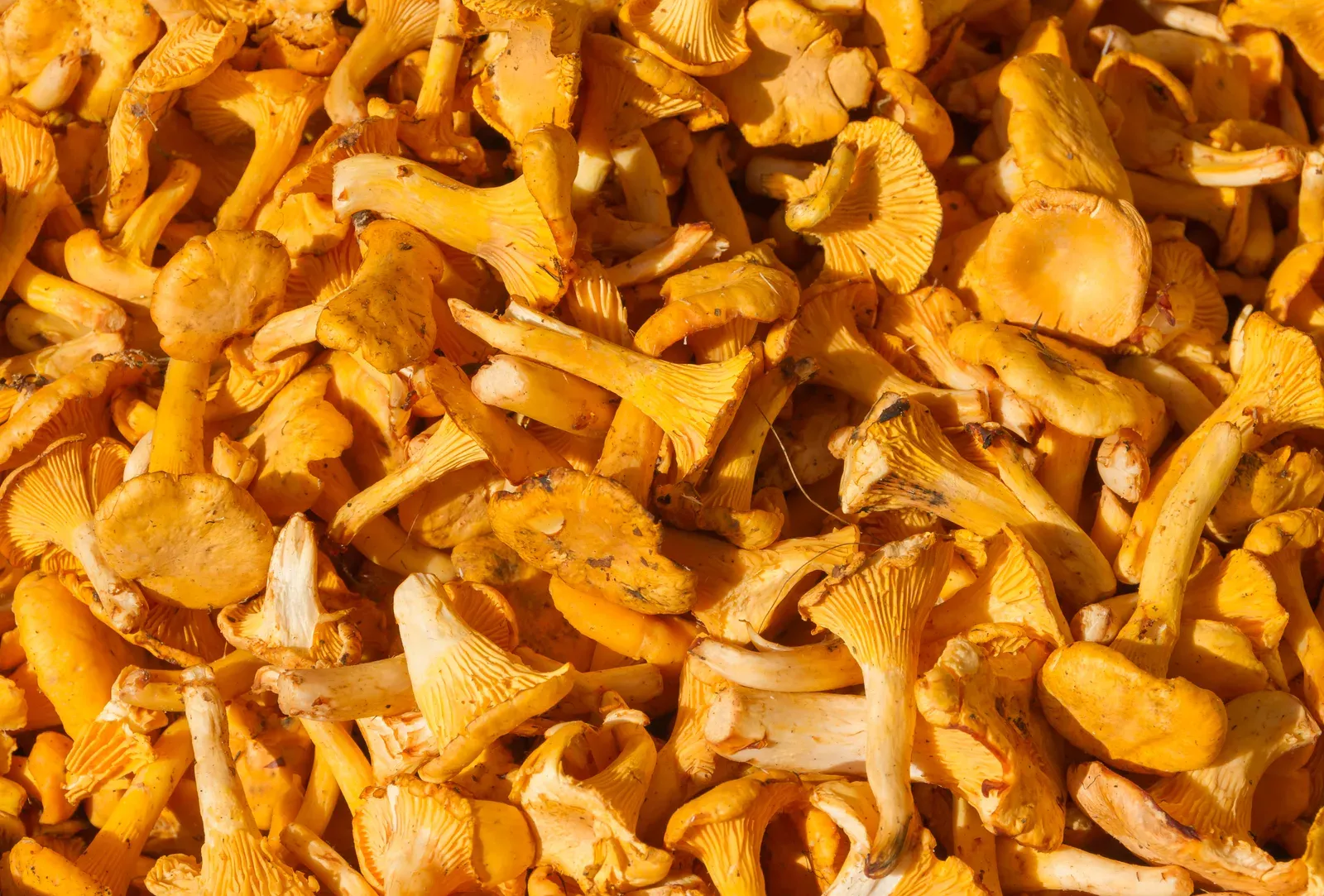
The golden chanterelle: portrait of a favorite mushroom
Bright, fragrant and almost never wormy, the chanterelle wins foragers over. Here's what it looks like, where…
June 9, 2026·3 min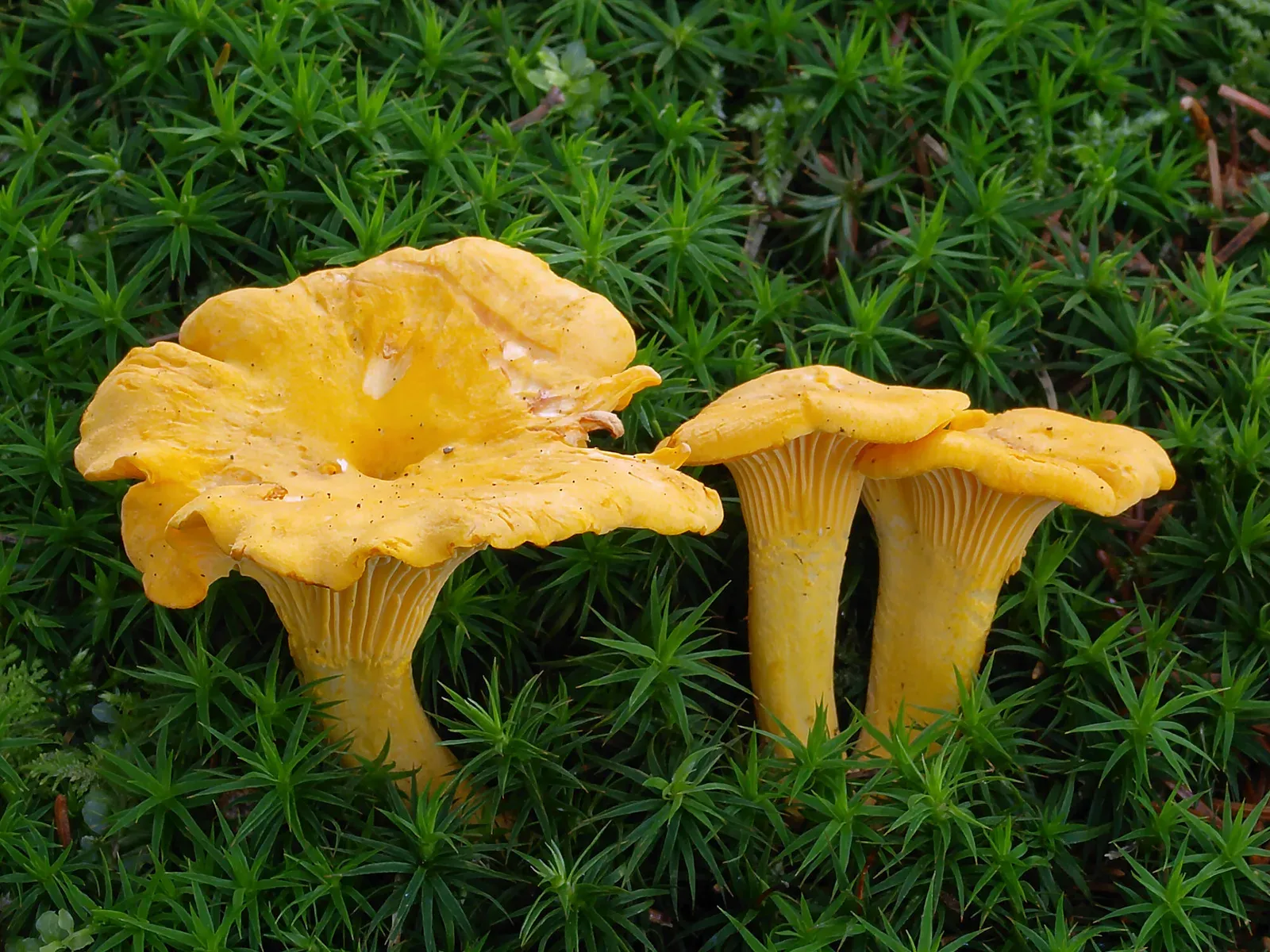 Safety
Chanterelle lookalikes: the true and the false chanterelle
The chanterelle is hard to confuse with anything, but it does have one lookalike. Here's how the false chanter…
June 7, 2026·3 min
Frequently asked questions
Is it safe to eat?
Conditionally — some people get stomach upsets even after proper preparation (individual intolerance). The careful forager's rule: skip it, because the real chanterelle tastes far better and is safer. If you do pick it, boil it for 15 min, discard the water, then cook as usual. Don't give it to children, pregnant women, or people with a sensitive digestive tract.
How do you tell it from the real chanterelle?
Three critical features. (1) Gills: the real chanterelle has indistinct gill-like ridges that look like wrinkles on skin. The false one has true thin, crowded gills with sharp edges. This is the most reliable test: run your finger along the underside of the cap — on the real one you won't feel distinct gills, on the false one you will. (2) Flesh: the real chanterelle has springy, meaty, heavy flesh in the stem; the false one — watery, thin, light. Snap the stem — the real one crunches, the false one squashes softly. (3) Smell: the real one has an intense fruity apricot scent, the false one is faint or neutral.
What happens if you accidentally eat a lot?
After 2-6 hours — nausea, mild diarrhea, abdominal discomfort. Symptoms pass on their own within 12-24 hours. Serious consequences are usually not seen. If the discomfort is severe or lasts more than a day, see a doctor. Keep the leftover mushrooms for identification — it's possible that a truly dangerous small reddish Lepiota or Inocybe ended up in the basket alongside them.
Where should you look for it?
In coniferous and mixed forests — mainly pine woods and spruce stands with moss and bilberry. It likes compacted conifer litter. A saprotroph — it grows on decaying wood material (unlike the real chanterelle, which is mycorrhizal). It often grows in groups of 5-20 fruiting bodies in one spot.
Which regions of Ukraine is it found in?
Throughout the forest zone wherever there are conifers: Polissia (especially abundant), the Carpathians, Prykarpattia, and partly the Forest-Steppe. In the steppe — in pine plantations.
When should you look for it?
August — November, peaking in September-October. Its season overlaps with the real chanterelle's — hence the risk of confusion. It tolerates the first light frosts. It often keeps fruiting after the real chanterelle has already disappeared.
What else is it confused with, besides the real chanterelle?
With the jack-o'-lantern mushroom (Omphalotus olearius) — a poisonous mushroom of southern regions with orange caps; rare in Ukraine, but finds are possible in Crimea and the southern steppe. That one is larger and darker. With young waxcaps (Hygrocybe) — small reddish mushrooms with smooth caps; also of no culinary value.
Is this species worth knowing at all?
Yes — it's a classic example of a "traitor mushroom" that you should recognize by heart. Picking chanterelles in the pine forests of Polissia without knowing their double is a serious culinary risk. For practice: find one specimen, look carefully at the gills and smell, and compare it with a real chanterelle. After 2-3 such comparisons, you'll tell them apart instinctively.
Is False chanterelle edible or poisonous?
Does False chanterelle have gills or pores?
What does the cap of False chanterelle look like?
What does the stem of False chanterelle look like?
Sources
- [1]Вікіпедія (українська)
- [2]Атлас грибів України, Зеров Д.К. (1979)
- [3]MycoBank Database
- [4]Index Fungorum
- [5]GBIF
- [6]iNaturalist Ukraine