Slimy spikeGomphidius glutinosus
Expert-verifiedUpdated June 13, 2026
Passport
- Edibility
- Edible
- Season
- Aug — Oct
- Hymenophore
- Gilled
- Cap color
- Brown
- Size
- Medium (5–15 cm)
- Smell
- Pleasant
- Reviewed
- Yes ✓
Quick answers
Where to look?
Conifer forest, Mixed forest
When does it appear?
Aug — Oct
Active months: August, September, October.
How to recognize it? Three signs
- Cap color: Brown, Dark brown, Grey
- Cap shape: Convex
- Smell: Pleasant
Fruiting season
August – October
Description
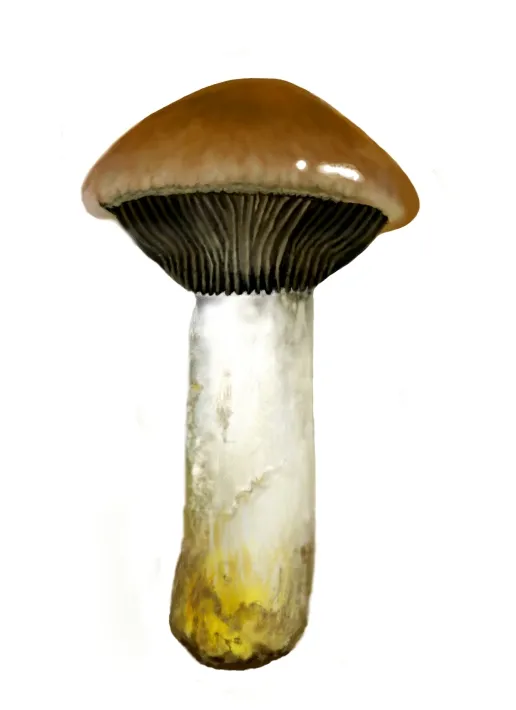
The slimy spike (Gomphidius glutinosus) is a true marvel of forest mycology: a gilled mushroom from the spike family that lives in partnership with spruce forests and parasitizes the mycorrhiza of Suillus and Xerocomus boletes. You'll recognize it instantly: a dark gray-brown slimy cap with a shiny, sticky skin, a thick whitish stem with a yellowish base, decurrent white gills that darken with age to dark gray, almost black, from the spore print.
Edible and quite tasty. You must peel the cap skin: it is very slimy and turns rubbery when cooked. Once peeled, the flesh is tender and fragrant, with a faint nutty note. Good for frying, pickling and freezing. In soup it makes a slightly cloudy broth because of leftover slime, so it's better to skip it for soups.
In Ukraine it is found wherever there is Norway spruce (Picea abies): the Carpathians, the Carpathian foothills, and parts of Polissia (where spruce has been planted). An epiparasite on the mycelium of the larch bolete and other pored mycorrhizal mushrooms of spruce. The season runs August to October, peaking in September. It often grows in groups of 3-10 fruiting bodies in spruce woods with mossy litter. Finding it is a sign of healthy spruce mycorrhiza, a nice bonus to know about this species.
Cap
Cap 4-10 cm across; hemispherical with an inrolled margin when young, later convex to flat with a shallow central depression. Color dark gray-brown, chocolate brown, almost black in wet weather; fading with age to brownish violet with darker spots. Surface very slimy, sticky; the skin peels off easily. Old mushrooms often have dark violet-black spots on the cap.
Hymenophore
Gilled hymenophore; gills decurrent, widely spaced (distant), thick, waxy. In young mushrooms whitish, later darkening to gray-black, almost black because of the dark spore print. Spore print dark brown to black. Decurrent gills plus darkening are the diagnostic features of the genus Gomphidius.
Stem
Stem 4-9 cm tall, 1-2 cm thick, cylindrical, thick, fleshy, narrowed at the bottom. Color whitish at the top, with a characteristic bright yellow or lemon-yellow tint at the base: the key diagnostic feature of the species. Above the ring zone (the remains of the veil) it is whitish; below, with fine grayish fibers. A ring zone from a white slimy veil in the upper part, stronger in young mushrooms, indistinct in old ones.
Flesh
Flesh fleshy, white in the cap, yellowish to yellow in the lower stem. When cut it turns slightly wine-pink in the stem. Smell faint, pleasantly mushroomy with a nutty note. Taste mild, not pronounced.
Smell
Faint, pleasantly mushroomy with a slight nutty or fruity note.
Lookalikes
.webp)
Related species
Mushrooms of the same genus and habitat — to study side by side and never mix up.
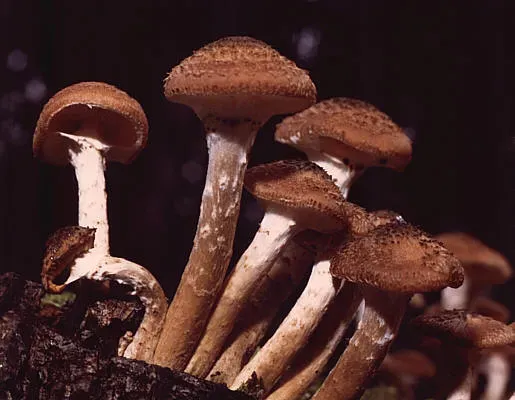
Bulbous honey fungus
Armillaria gallica
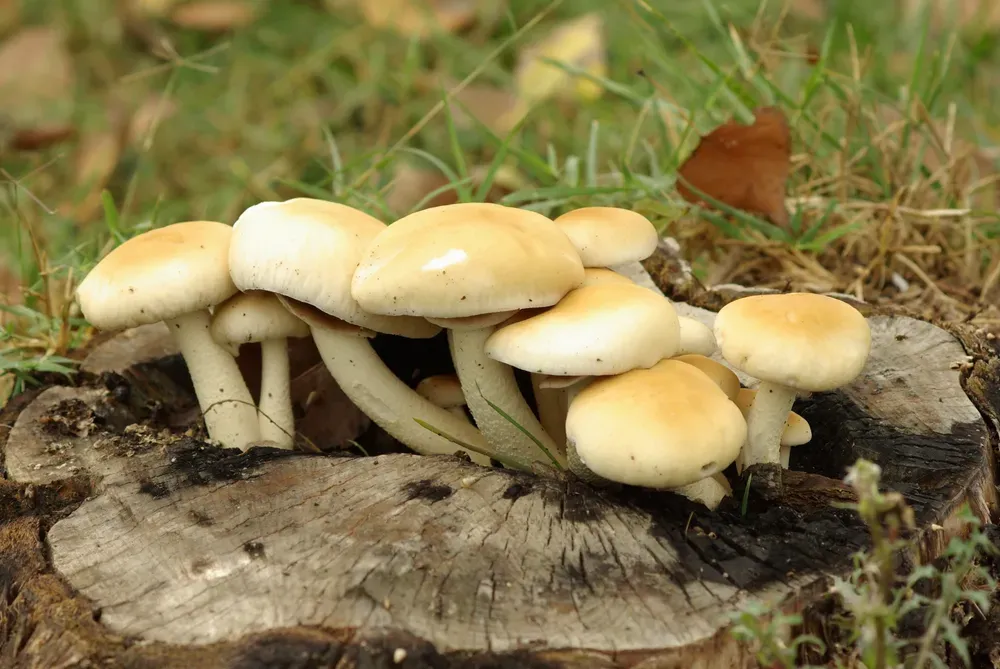
Dark honey fungus
Armillaria ostoyae
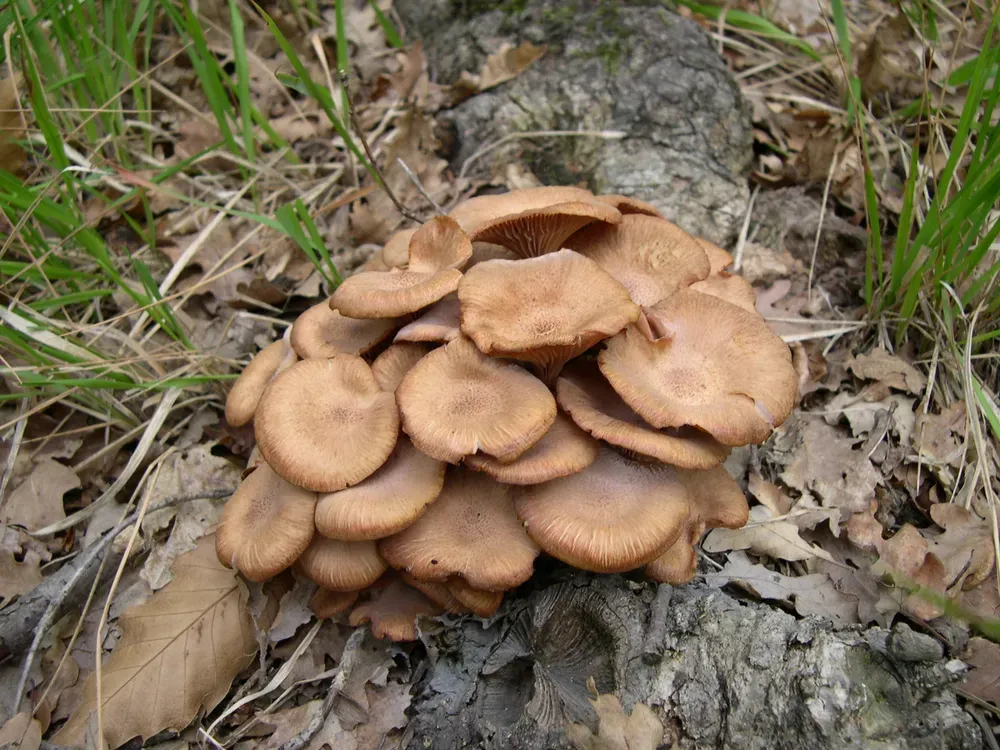
Poplar fieldcap
Cyclocybe aegerita
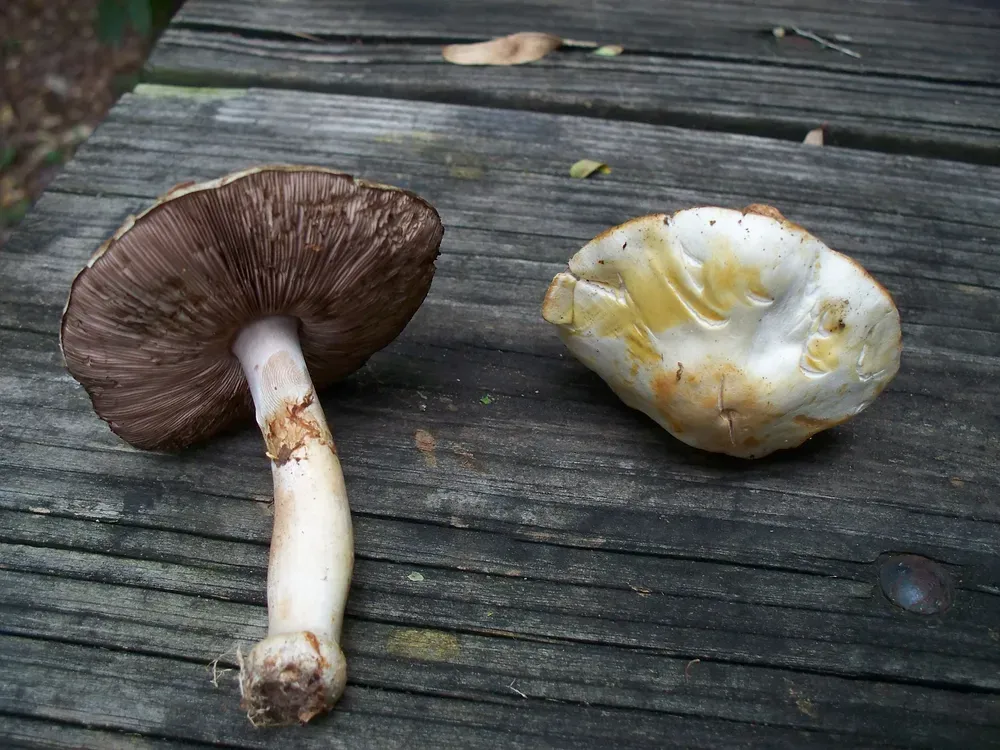
Ringless honey fungus
Desarmillaria tabescens
Agaricus abruptibulbus
Agaricus haemorrhoidarius
Agaricus haemorroidarius
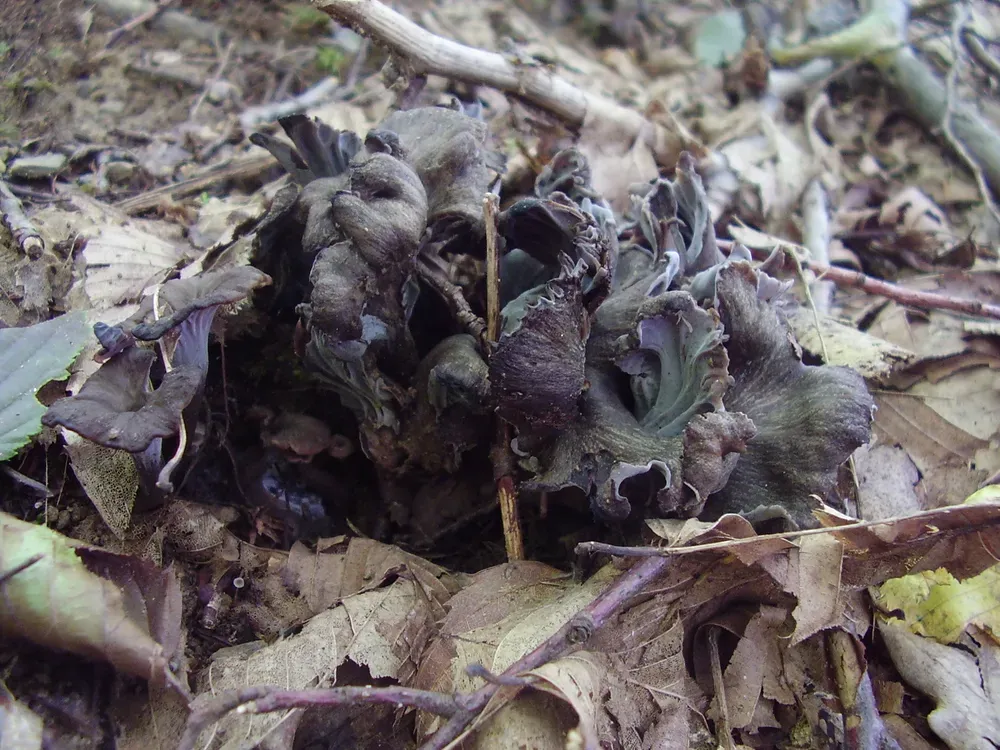
Ashen chanterelle
Cantharellus cinereus
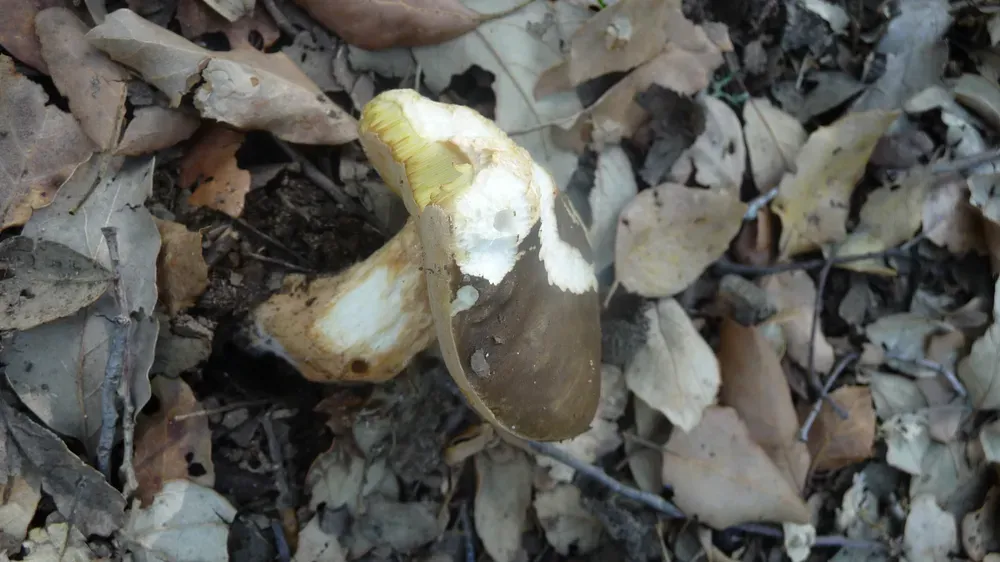
Blushing bolete
Leccinum roseofractum
Frequently asked questions
Is it safe to eat?
Yes, without restrictions. Always peel the slimy cap skin: it turns rubbery when cooked, and in some populations it also keeps a slightly bitter note. Young mushrooms are best; in old ones the flesh becomes stringy.
Does it have dangerous lookalikes?
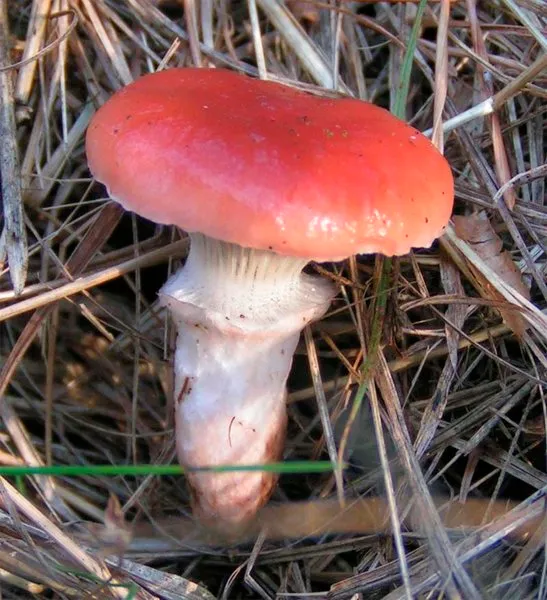
No serious ones. The genus Gomphidius in our flora is entirely edible (slimy, rosy and copper spike). You could mistake it for young dark Tricholoma (knights), which is also not critical, as most are edible. Or for young milk caps (Lactarius), which ooze milky latex when cut; the spike doesn't. The mistake is not critical.
Why do you need to peel the skin?
The slimy layer contains polysaccharides that turn into a rubbery film when cooked. On top of that, this layer traps forest debris that is hard to wash off. It peels off easily: catch the edge with a fingernail and pull the film away, like with a young slippery jack. For 1 kg of mushrooms this adds 10-15 min of work, but the result is worth it.
Where should you look for it?
In spruce woods and mixed forests with spruce, mostly in mountains and foothills. It likes mossy litter and damp, shady spots. As an epiparasite on Suillus mycorrhiza, it often grows near the larch bolete (Suillus grevillei) and Xerocomus boletes. If you've found a larch bolete, look around for a spike.
Which regions of Ukraine is it found in?
The Carpathians (especially plentiful in the old-growth spruce forests of the Zakarpattia and Lviv regions), the Carpathian foothills (Ivano-Frankivsk and Ternopil regions), and in part Polissia in planted spruce woods. In the steppe and southern forest-steppe it is practically absent.
When should you look for it?
August to October, peaking in September. In wet Carpathian autumns, right up to the first frosts in November.
How do you tell the spikes apart?
The slimy spike (G. glutinosus): dark gray-brown cap, spruce. The rosy spike (G. roseus): bright pink cap, larch. The copper spike (Chroogomphus rutilus): coppery reddish brown cap, with pine. All three are edible; you tell them apart by the neighboring tree and the cap color.
How do you cook it?
Peel the cap skin. Rinse. Fry it with onion and sour cream: the best dish, the flesh turns tender and fragrant. Pickle it with bay leaf and pepper after boiling for 10 min. Drying works less well, as the flesh is soft, but it's possible. In soup it makes a cloudy broth, so we don't recommend it for soups.
Is Slimy spike edible or poisonous?
Does Slimy spike have gills or pores?
What does the cap of Slimy spike look like?
What does the stem of Slimy spike look like?
Sources
- [1]Вікіпедія (українська)
- [2]Атлас грибів України, Зеров Д.К. (1979)
- [3]MycoBank Database
- [4]Index Fungorum
- [5]GBIF
- [6]iNaturalist Ukraine