._Locatie,_Hortus_(Haren,_Groningen)_01.webp)
Vermilion waxcapHygrocybe miniata
Expert-verifiedUpdated October 3, 2026
Passport
- Edibility
- Inedible
- Season
- Jul — Oct
- Hymenophore
- Gilled
- Cap color
- Red
- Size
- Small (up to 5 cm)
- Smell
- Odorless
- Reviewed
- Yes ✓
Quick answers
Where to look?
Mixed forest, Deciduous forest
When does it appear?
Jul — Oct
Active months: July, August, September, October.
How to recognize it? Three signs
- Cap color: Red, Orange
- Cap shape: Convex
- Smell: Odorless
Fruiting season
July – October
Description
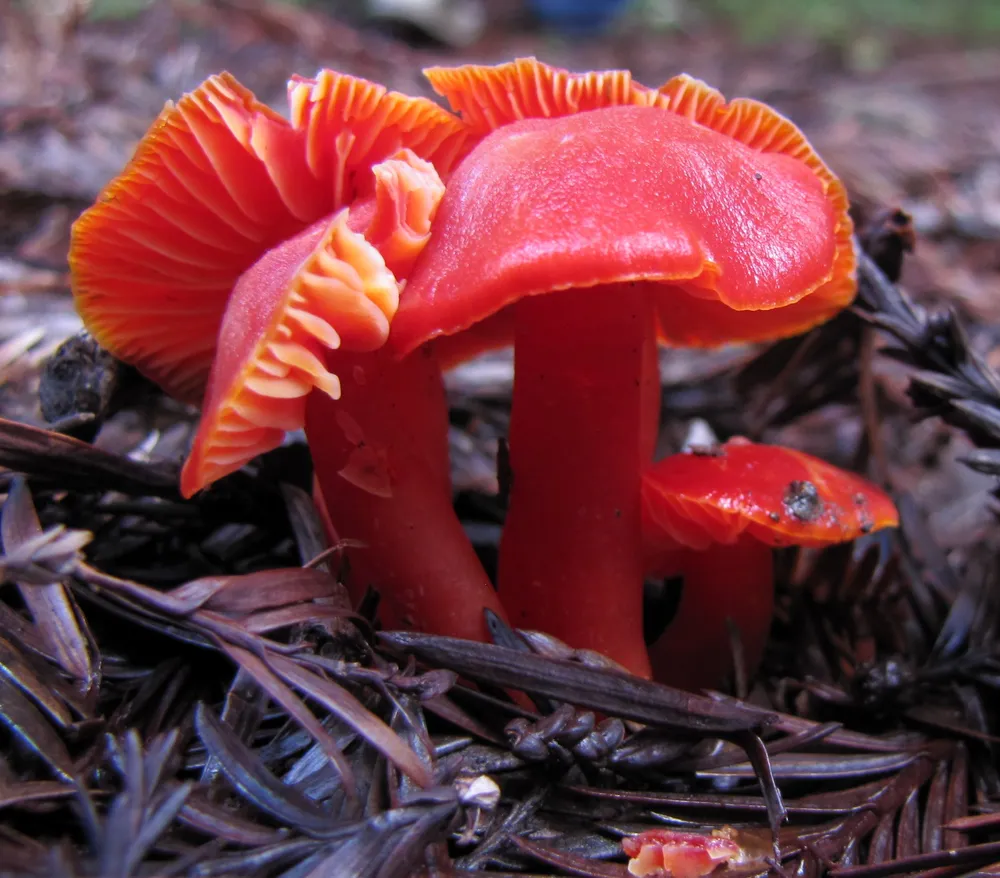
The vermilion waxcap is another of the bright waxcaps of Ukrainian meadows. It's a small mushroom, 1-3 cm, with a deep red or cinnabar cap with a finely scaly matte surface (hence its Ukrainian name, which means "matte red"). The stem is thinner and paler than the cap, orange-red. Like all waxcaps, it's a bioindicator of preserved natural grasslands — it doesn't grow on fertilized or plowed land.
Technically not poisonous, and some European sources list it as edible, but it has no culinary value and isn't worth picking. The reason is the same as for the scarlet waxcap: the mushroom is too rare, too small and has no distinct flavor, while waxcap populations in Ukraine are shrinking because of intensive farming. It's an ornamental, photogenic species — leave it in the grass and walk on.
It grows on mossy patches of meadows, pastures and forest edges, and in damp hollows. Season: July–October. Found mainly in the Carpathians, Polissia and the forest-steppe zone. It likes slightly acidic soils.
Cap
Cap 1-3 cm, hemispherical at first, then convex-spreading, sometimes with a small bump. Color bright red, cinnabar red, may turn orange with age. The surface is matte, finely scaly or granular-rough — a characteristic feature of the species. In wet weather it's slightly damp, but not slimy.
Hymenophore
Gilled hymenophore. Gills distant, thick, waxy, attached or slightly decurrent. Orange-yellow to reddish. Spore print white.
Stem
Stem 2-5 cm tall, 0.2-0.4 cm thick, thin, cylindrical, hollow. Orange-red or orange-yellow, paler toward the base. The surface is dry and smooth. There is no ring.
Flesh
The flesh is thin, brittle, orangey. It doesn't change color when cut. It has no culinary value.
Smell
No distinct smell. Mild taste, nothing special.
›Scientific synonyms (8)
Agaricus flammans Scop., Agaricus miniatus Fr., Hygrophorus miniatus (Fr.) Fr., Hygrophorus flammans (Scop.) J. Schröt., Hydrocybe flammea (Scop.) Murrill(1916), Hygrocybe flammea (Scop.) Murrill, Pseudohygrocybe miniata (Fr.) Kovalenko, Hygrophorus strangulatus P.D. Orton
Lookalikes
_1.webp)
Related species
Mushrooms of the same genus and habitat — to study side by side and never mix up.
Grayling
Cantharellula umbonata
Almond woodwax
Hygrophorus agathosmus
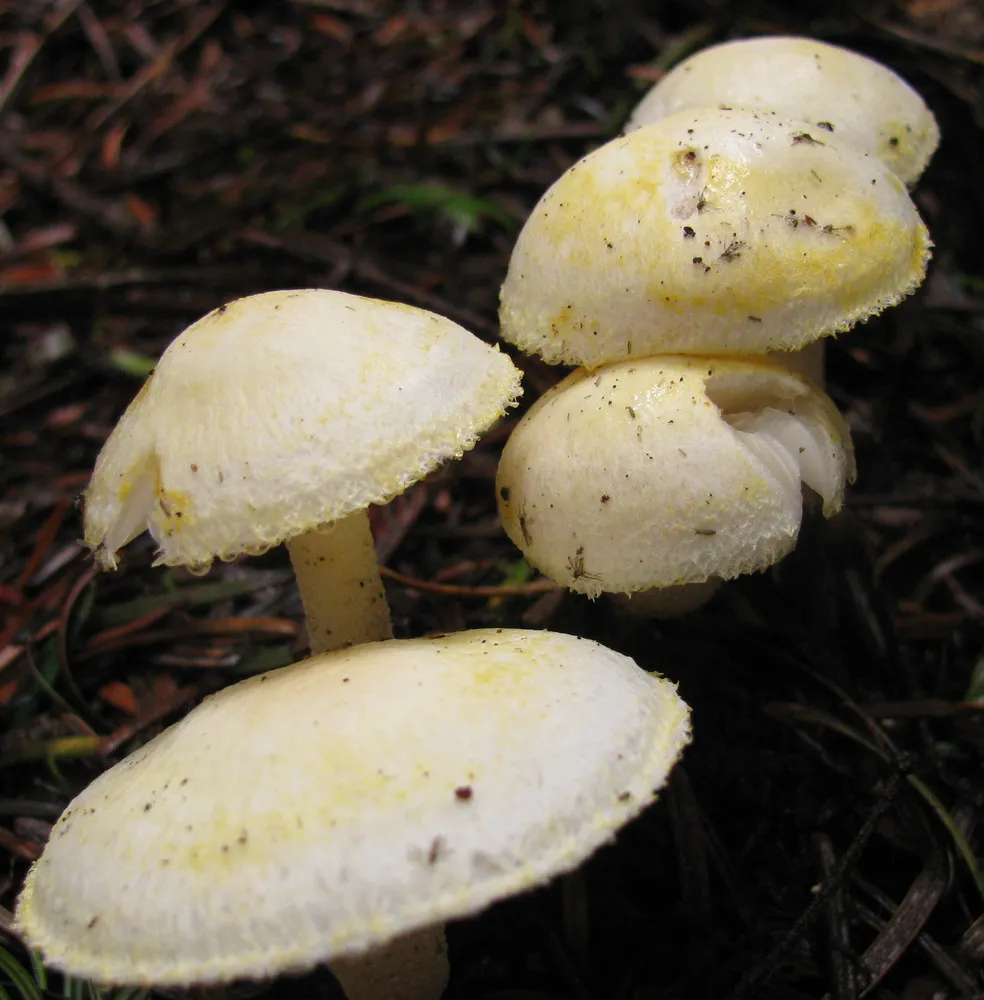
Gold flecked woodwax
Hygrophorus chrysodon
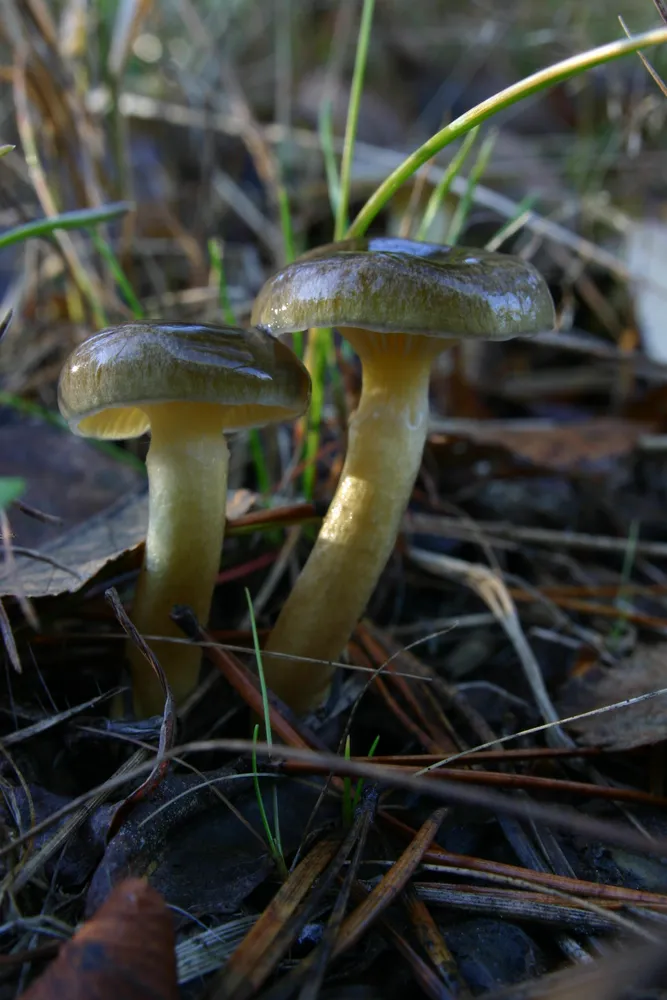
Herald of winter
Hygrophorus hypothejus
Hygrophorus leucophaeus
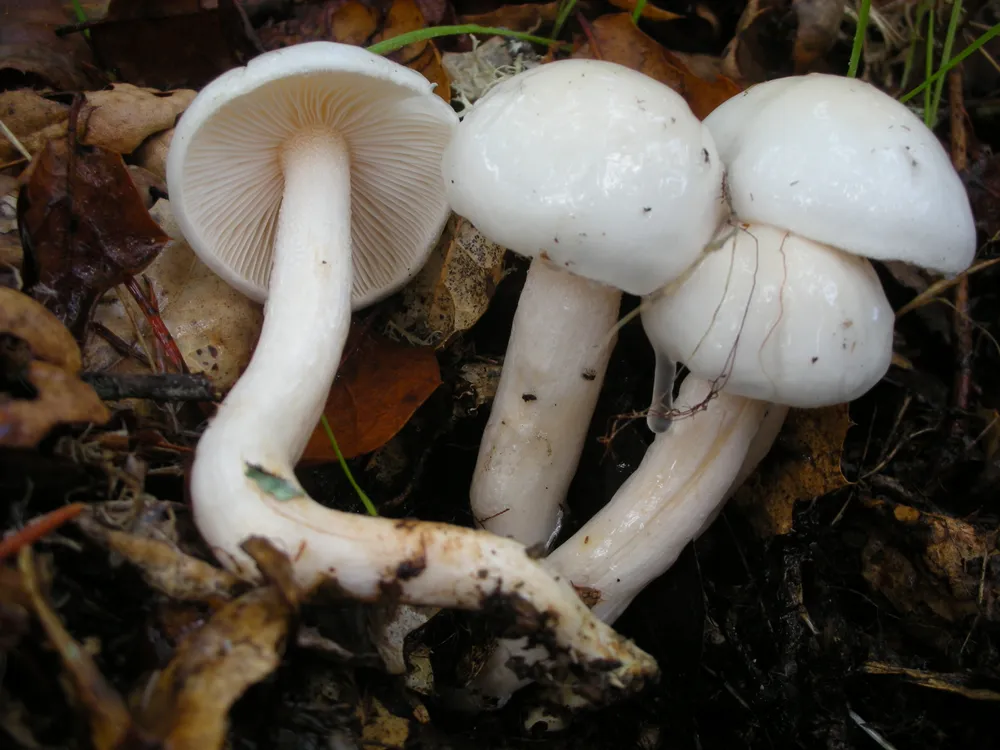
Ivory woodwax
Hygrophorus eburneus
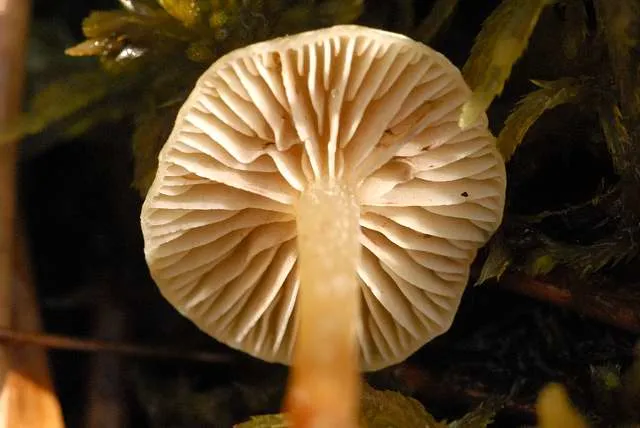
Larch woodwax
Hygrophorus lucorum
.webp)
March mushroom
Hygrophorus marzuolus
Frequently asked questions
Is it safe to eat?
Technically the mushroom isn't poisonous — some sources list it as edible. But it has no culinary value, and the species itself is rare and ecologically valuable. The modern approach: don't pick it. Leave it in the field — it's an indicator of well-preserved natural meadows.
Why do you label it as inedible?
In our classification, "inedible" means a mushroom that isn't worth picking: either because it has no flavor, or because it's ecologically rare. The vermilion waxcap ticks both boxes: it's small, flavorless, and important as a bioindicator of old unplowed meadows.
Where should you look for it?
On mossy patches of meadows, pastures and forest edges, and in damp hollows. It likes slightly acidic soils. It often grows among mosses and in short-grass patches. You won't find it on fertilized or plowed fields.
Which regions of Ukraine does it grow in?
Mainly in the Carpathians, the Carpathian foothills, Polissia and the forest-steppe zone. It doesn't occur in the steppe — it needs damp, slightly acidic soil. Especially rich spots are the mountain meadows (polonynas) and the mossy meadows of Polissia.
When should you look for it?
July–October. Peak fruiting is August–September after rain. In a wet summer, fruiting can start as early as late June.
Does it appear in late autumn?
The odd find is possible in October, in a warm autumn. But the main season ends by late September. The first serious frost stops waxcap fruiting completely.
What is it confused with?
With other red waxcaps — the scarlet waxcap (H. coccinea) and the blackening waxcap (H. conica). The vermilion waxcap is smaller (1-3 cm versus 2-5 and 2-7), with a matte, finely scaly cap, while the scarlet waxcap's is smooth and moist and the blackening waxcap's is conical and slimy. The blackening waxcap also turns black when touched — the vermilion waxcap doesn't.
How can you tell it for sure from the blackening waxcap?
Press the cap with your finger. The vermilion waxcap does NOT blacken — it stays red. The blackening waxcap turns black within a few minutes. Plus, the blackening waxcap's cap is pointed and conical, while the vermilion waxcap's is convex with a small bump. The blackening waxcap is considered poisonous, so telling them apart matters, even if you don't pick them.
Is Vermilion waxcap edible or poisonous?
Does Vermilion waxcap have gills or pores?
What does the cap of Vermilion waxcap look like?
What does the stem of Vermilion waxcap look like?
Sources
- [1]Вікіпедія (українська)
- [2]Атлас грибів України, Зеров Д.К. (1979)
- [3]MycoBank Database
- [4]Index Fungorum
- [5]GBIF
- [6]iNaturalist Ukraine