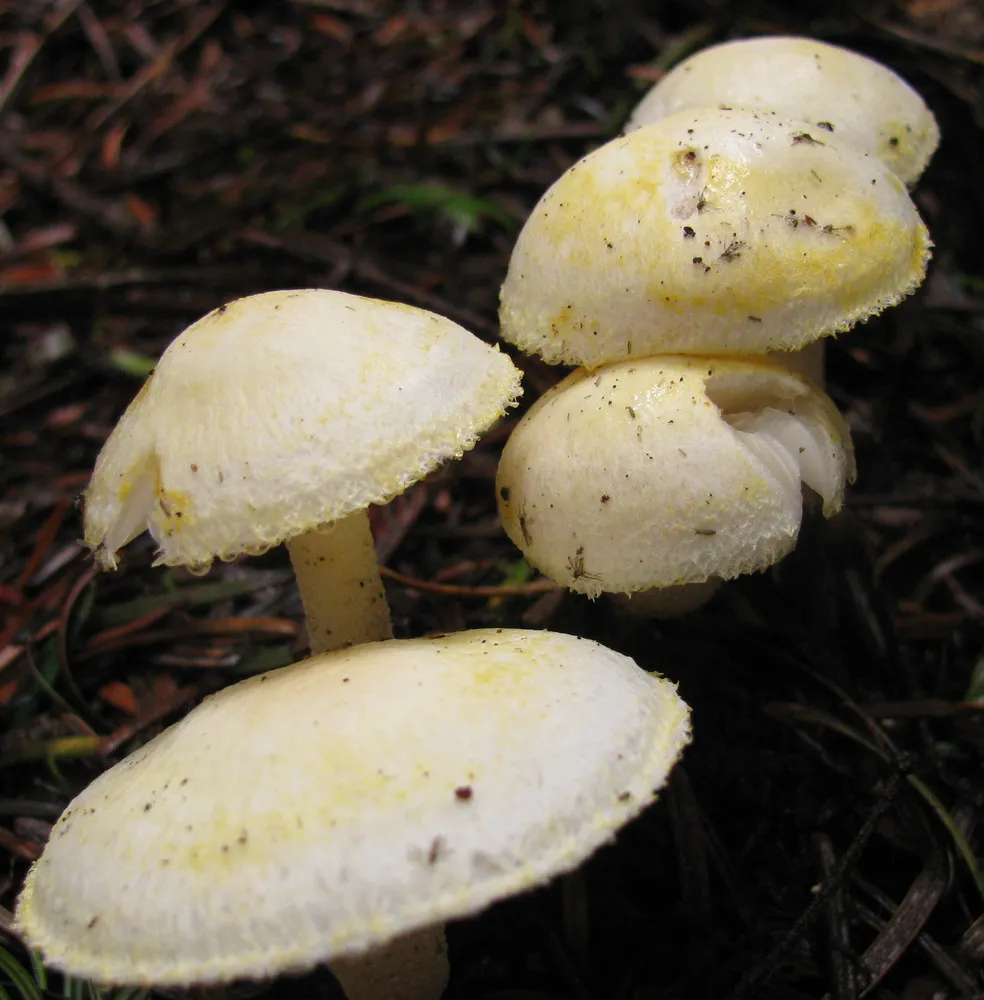
Gold flecked woodwaxHygrophorus chrysodon
Expert-verifiedUpdated October 3, 2026
Passport
- Edibility
- Edible
- Season
- Aug — Sep
- Hymenophore
- Gilled
- Cap color
- White
- Size
- Medium (5–15 cm)
- Smell
- Pleasant
- Reviewed
- Yes ✓
Quick answers
Where to look?
Deciduous forest, Mixed forest
When does it appear?
Aug — Sep
Active months: August, September.
How to recognize it? Three signs
- Cap color: White, Yellow, Cream
- Cap shape: Convex
- Smell: Pleasant
Fruiting season
August – September
Description
The Gold flecked woodwax is the most decorative of the white woodwaxes. A white cap with a distinct yellow margin and fine down, and a white stem with striking golden granules at the top — as if sprinkled with sugar crumbs. In books, mycologists call it the «adorned woodwax» — and it truly has a showy look.
This is a good edible mushroom with real culinary value. It is eaten fresh — fried, stewed, in soups. The flesh is firm with a distinctive aroma and holds its shape well. Unlike its ivory relative, it is not as slimy — nicer to handle. Safe for beginners, because the combination of features (white + yellow margin + golden granules) is easy to recognize.
In Ukraine it grows in deciduous forests, mostly beech and oak, less often in conifer forests. It is widespread across the whole country — a common background mycorrhizal species. The season runs August–September, peaking in September. Finds are regular in the Carpathians, Polissia, the Forest-Steppe, and the Crimean Mountains.
Cap
Cap 2-8 cm, hemispherical at first, then convex-flattened with a broad umbo. White or creamy white, with a distinctly yellow margin — a characteristic feature. The surface is covered in fine whitish or yellowish down (hence «hairy»). Slightly slimy in wet weather.
Hymenophore
Gilled hymenophore. The gills are widely spaced, thick, and decurrent (a typical feature of the genus). White at first, turning yellowish with age, especially the edges — golden yellow. Spore print white.
Stem
Stem 5-8 cm tall, 0.8-1.5 cm thick, cylindrical. White, with a characteristic band of yellow granular flecks at the top, as if dusted with semolina (this is what gave it the name «golden»). The surface is dry, without slime. No ring.
Flesh
The flesh is white, firm, with a distinctive aroma. Does not change color when cut. Springy texture — holds up well to frying and stewing.
Smell
A distinct, pleasant mushroomy smell. Some sources describe a hint of resin or wood. Taste mild, pleasantly mushroomy.
›Scientific synonyms (2)
Agaricus chrysodon Batsch 1789, Limacium chrysodon (Batsch) P. Kumm. 1871
Lookalikes
Related species
Mushrooms of the same genus and habitat — to study side by side and never mix up.
Almond woodwax
Hygrophorus agathosmus
Herald of winter
Hygrophorus hypothejus
Hygrophorus leucophaeus
.webp)
March mushroom
Hygrophorus marzuolus
Olive wax cap
Hygrophorus olivaceoalbus
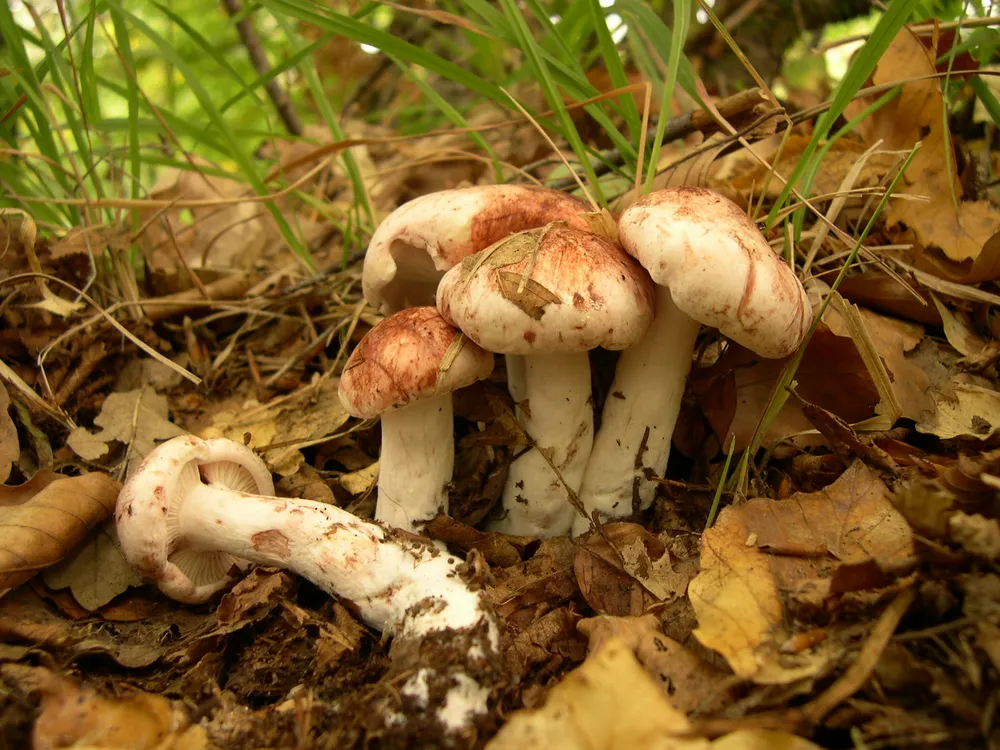
Pinkmottle woodwax
Hygrophorus russula
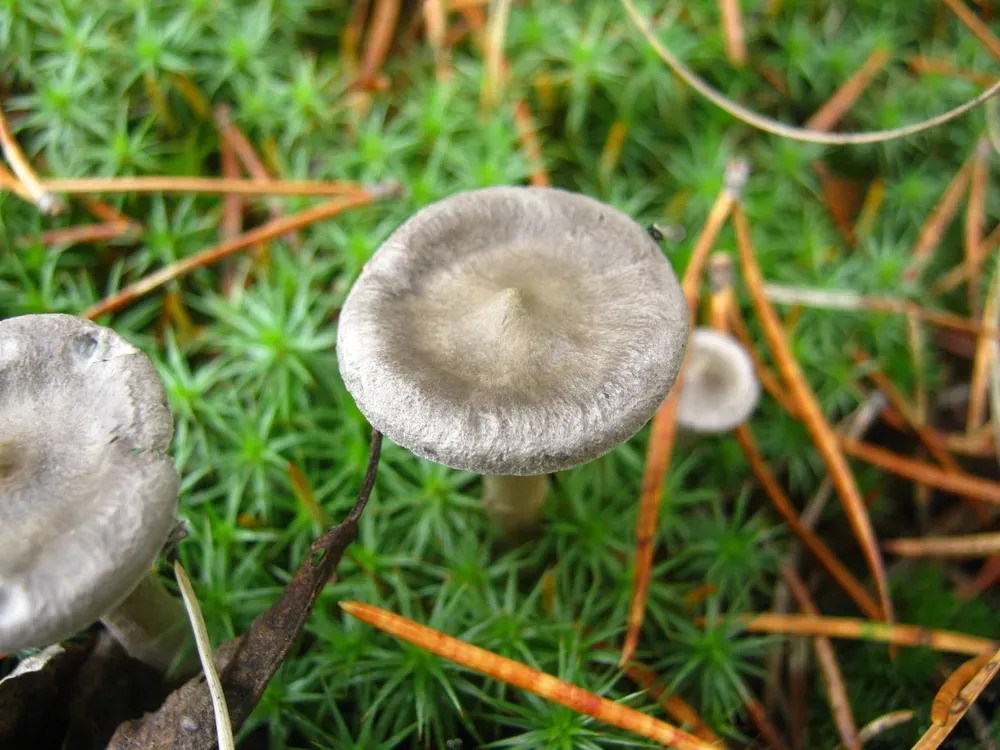
Grayling
Cantharellula umbonata
._Locatie,_Hortus_(Haren,_Groningen)_01.webp)
Vermilion waxcap
Hygrocybe miniata
Frequently asked questions
Is it safe to eat?
Yes, it is a good edible mushroom. Safe for beginners — the combination of features (white + yellow cap margin + golden granules on the stem) is easy to recognize and is not repeated in dangerous species.
Does it need parboiling first?
No, it isn't necessary. You can fry, stew, or add the Gold flecked woodwax to soups right away. Young mushrooms just need cleaning and a good rinse. Drying and preserving follow the standard recipes for wild mushrooms.
Where should you look for it?
In deciduous forests — mostly with beech and oak, less often in conifer forests. It likes shady spots with well-decomposed litter and is a mycorrhizal partner of beech/oak. Solitary or in groups of 2-3 fruiting bodies.
Which regions of Ukraine does it grow in?
Throughout Ukraine — a common background mycorrhizal species of deciduous forests. Especially rich harvests in the Carpathians and Zakarpattia (beech forests), in Polissia and the Forest-Steppe (oak and beech), and in the Crimean Mountains. In the steppe — only in planted stands.
When should you look for it?
August–September. Peak fruiting is the first half of September. This is an early-autumn species. The first fruiting bodies can appear as early as the second half of August, especially in the Carpathians.
Does it appear in October?
Occasional finds happen in the first half of October in a warm autumn. But the main flush is over by the end of September. In October its relative, the Ivory woodwax, takes its place.
What is it confused with?
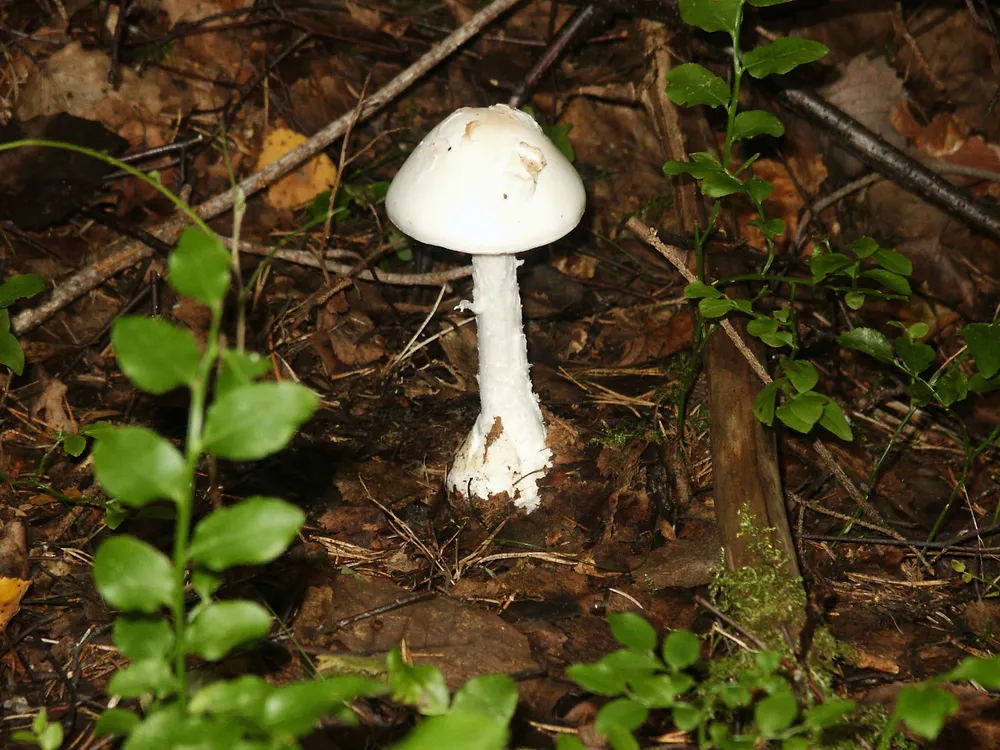
The most dangerous confusion is with the destroying angel (Amanita virosa) in its young form. It also has a white cap. The critical difference: the amanita has a ring on the stem and a volva (a sac at the base); in the woodwax both are absent. Plus, the golden granules on the woodwax's stem are a unique feature.
How do you tell it from the Ivory woodwax?
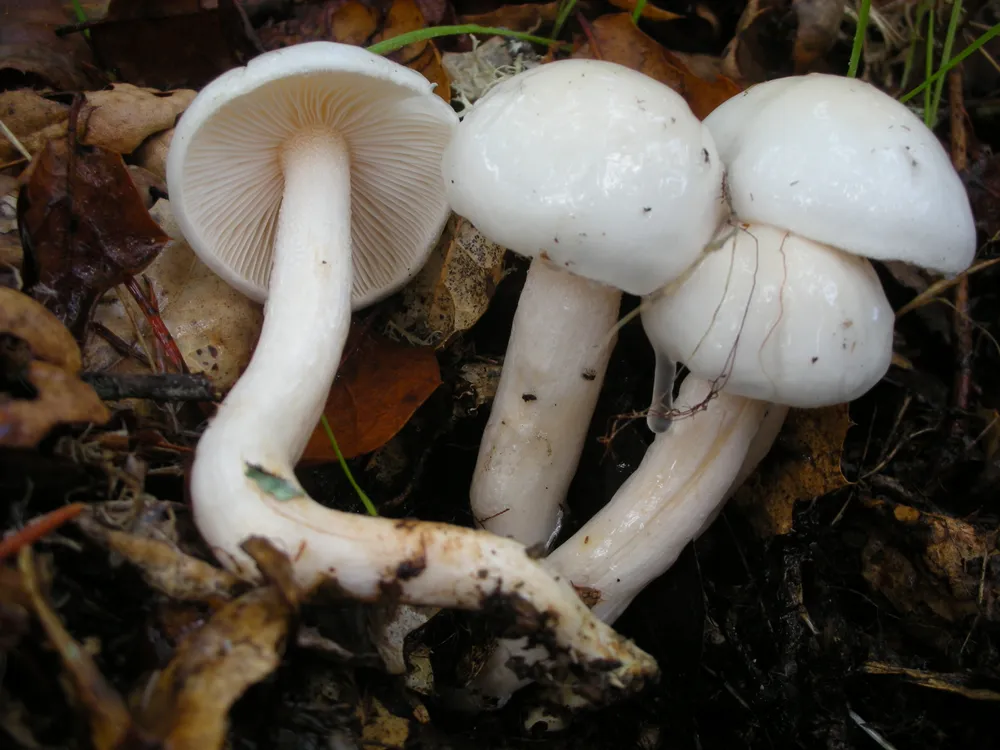
The Ivory woodwax (H. eburneus) is entirely white with a faint yellowish tint, WITHOUT a distinct yellow cap margin and WITHOUT golden granules on the stem. Very slimy. The Gold flecked woodwax has a clear yellow rim on the cap and characteristic yellow granules at the top of the stem. Its surface is dry, not slimy.
Is Gold flecked woodwax edible or poisonous?
Does Gold flecked woodwax have gills or pores?
What does the cap of Gold flecked woodwax look like?
What does the stem of Gold flecked woodwax look like?
Sources
- [1]Вікіпедія (українська)
- [2]Атлас грибів України, Зеров Д.К. (1979)
- [3]MycoBank Database
- [4]Index Fungorum
- [5]GBIF
- [6]iNaturalist Ukraine