Pine firefungusRhizina undulata
Expert-verifiedUpdated October 3, 2026
Passport
- Edibility
- Inedible
- Season
- Apr — Nov
- Hymenophore
- Smooth
- Cap color
- Brown
- Size
- Medium (5–15 cm)
- Smell
- Odorless
- Reviewed
- Yes ✓
Quick answers
Where to look?
Conifer forest, Mixed forest
When does it appear?
Apr — Nov
Active months: April, May, June, July, August, September, October, November.
How to recognize it? Three signs
- Cap color: Brown, Dark brown, Black
- Cap shape: Irregular
- Smell: Odorless
Fruiting season
April – November
Description
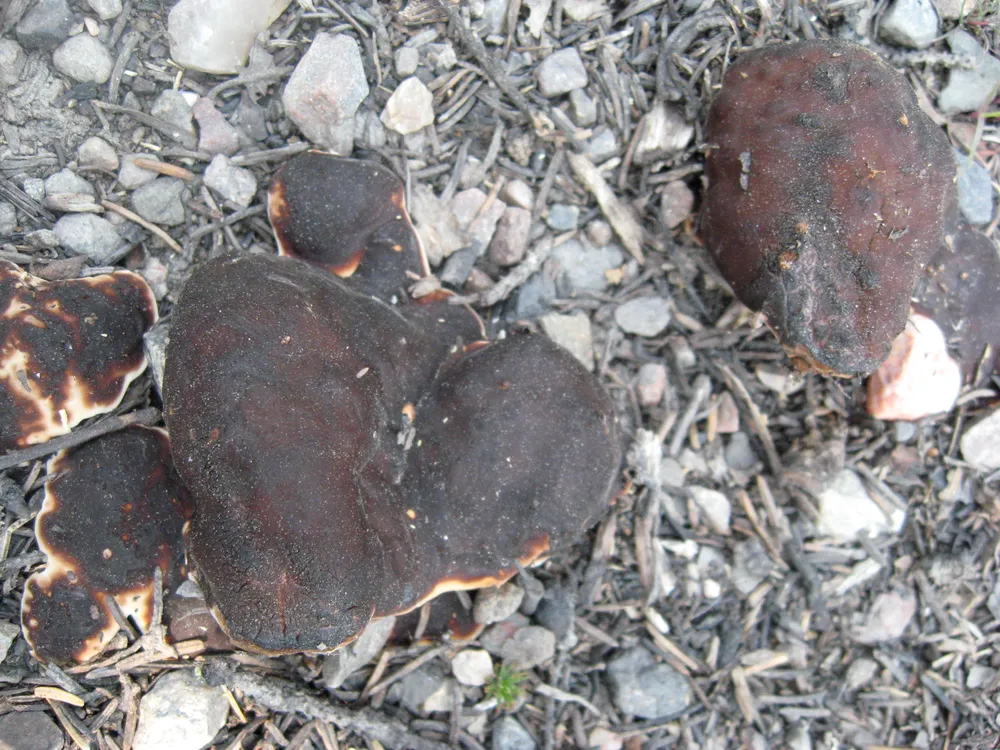
Pine firefungus (Rhizina undulata) — a characteristic pyrophilous (fire-loving) mushroom of burn sites from the family Rhizinaceae (ascomycetes). The Latin epithet undulata means "wavy" — the margin of the fruiting body is wavy-bent and irregular. It has a very distinctive shape: a dark chestnut-brown, cushion- or saddle-shaped fruiting body with no stem, attached to the substrate by thick root-like threads (hence Rhizina, "root-like"). The outer surface is smooth with a glossy upper side; the underside is light brown with clearly visible rhizoids.
Inedible — the mushroom is tough and cardboard-like, with an indistinct smell and taste. It has no culinary value. Raw, it isn't poisonous in the usual sense, but it is categorically not eaten.
The main interest in it is ecological: the pine firefungus is a serious pathogen of conifer seedlings and young spruces/pines. Its mycelium attacks the roots of young trees on burn sites, causing "group death" (group dying) — patches of dead seedlings around the fruiting bodies. Forestry authorities in Europe and Ukraine monitor its appearance on burn sites, especially after deliberate burning to clear plots: the firefungus loves fire-heated soil (its spores need heat activation at +35-50°C), so it fruits en masse on old campfires and burn sites 1-3 years later.
In Ukraine the pine firefungus is common on burn sites and old campfires in pine and spruce forests: the Carpathians, Prykarpattia, Polissia, the forest-steppe. Season: April — November, peaking in June-August. It often grows in groups of 5-20 fruiting bodies on a single campfire spot.
Cap
The fruiting body is 3-12 cm across, cushion-shaped to saddle-shaped and spreading, with no distinct stem. The upper (spore-bearing) surface is dark chestnut to blackish brown, smooth, glossy, becoming matte with age, with a characteristic wavy-bent margin. In young specimens the fruiting bodies are almost flat, with age becoming cushion-convex or saddle-shaped with uneven bumps. In mature ones the margin is often raised, wavy and irregular.
Hymenophore
Ascomycete — the hymenium (spore-bearing layer) is on the upper side of the fruiting body, as in morels (Morchella) and truffles. The spores form in sacs (asci), not on gills or tubes. Spore print white to yellowish.
Stem
No stem — the fruiting body is attached to the substrate by thick root-like rhizoids (coarse whitish strands of mycelium) that reach down into the soil. On the underside of the fruiting body you can see these characteristic thread-like "root" structures.
Flesh
Flesh tough, brittle, cardboard-like, dirty white to yellowish. When cut, it doesn't change color. Smell faint, indistinct, taste neutral, nothing distinctive.
Smell
Faint, indistinct, mushroomy, nothing characteristic.
›Scientific synonyms (4)
Helvella inflata Schaeff., Rhizina inflata (Schaeff.) Quél., Rhizina inflata var. rhizophora Massee, Rhizina laevigata Fr.
Related species
Mushrooms of the same genus and habitat — to study side by side and never mix up.
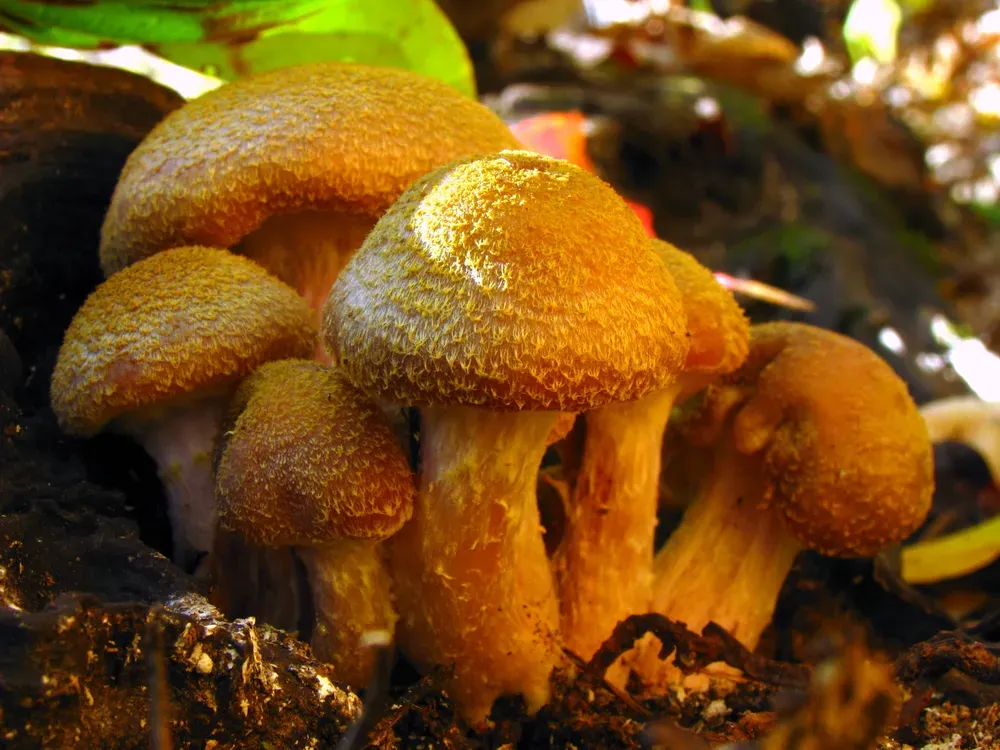
Bulbous honey fungus
Armillaria gallica
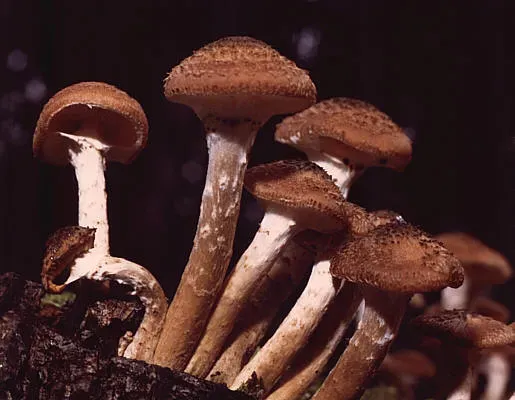
Dark honey fungus
Armillaria ostoyae
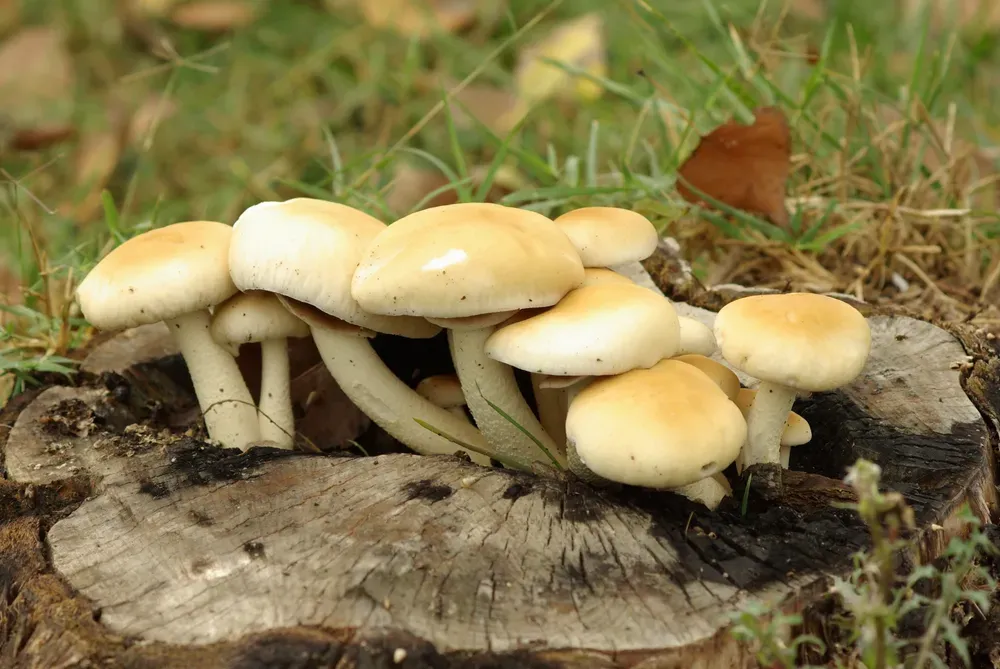
Poplar fieldcap
Cyclocybe aegerita
Ringless honey fungus
Desarmillaria tabescens
Agaricus abruptibulbus
Agaricus haemorrhoidarius
Agaricus haemorroidarius
Ashen chanterelle
Cantharellus cinereus
Blushing bolete
Leccinum roseofractum
Frequently asked questions
Is it poisonous?
Not poisonous to humans, but inedible because of its tough, cardboard-like flesh. No culinary value. If you find it, just walk on by.
Is it dangerous to the forest?
Yes — to young conifers. The pine firefungus is a root parasite of conifer seedlings: on burn sites its mycelium attacks the roots of young spruces and pines, causing "group death" (mass die-off of patches of 2-5-year-old seedlings). Forestry enterprises monitor the appearance of fruiting bodies as a sign of trouble.
Can it be confused with truffles or morels?
No, its overall look is fundamentally different. Morels (Morchella) — a raised stem plus a honeycombed, net-like cap, no rhizoids. Truffles — underground roundish bodies with no distinct upper/lower surface. Pine firefungus — a flat dark brown body with a wavy margin on the soil surface, attached by root-like threads. Hard to confuse.
Where can you find it, so you learn to recognize it?
On burn sites, old campfires and burned-over patches in pine and spruce forests. It loves fire-heated soil — in nature it fruits 1-3 years after a fire or burn. It often grows in groups of 5-20 fruiting bodies on a single campfire spot. In a "clean" forest with no traces of fire, it is practically never found.
Which regions of Ukraine is it found in?
Common throughout Ukraine's forest zone with conifers: the Carpathians, Prykarpattia, Polissia, and parts of the forest-steppe in pine stands.
When should you look for it?
April — November (a very long season), peaking in June-August. One of the longest-fruiting ascomycetes.
What mushrooms is it confused with?
With Peziza spp. (common "cup" ascomycetes) — but those are cup-shaped, not cushion-shaped. With young Sarcosoma — fleshy black cups on conifer litter (a completely different shape). The firefungus's look is fairly unique — a flat dark chestnut body with a wavy margin on a burn site.
Is Pine firefungus edible or poisonous?
What kind of spore-bearing surface does Pine firefungus have?
What does the cap of Pine firefungus look like?
What does the stem of Pine firefungus look like?
What do Pine firefungus smell and taste like?
Sources
- [1]Вікіпедія (українська)
- [2]Атлас грибів України, Зеров Д.К. (1979)
- [3]MycoBank Database
- [4]Index Fungorum
- [5]GBIF
- [6]iNaturalist Ukraine