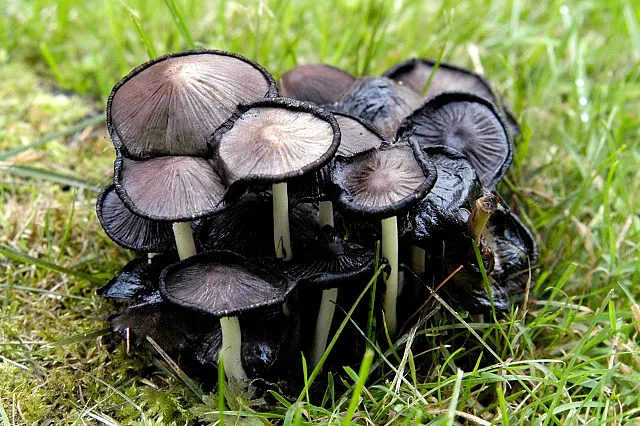
Common ink capCoprinopsis atramentaria
Expert-verifiedUpdated October 3, 2026
Passport
- Edibility
- Conditionally edible
- Season
- May — Nov
- Hymenophore
- Gilled
- Cap color
- Grey
- Size
- Medium (5–15 cm)
- Smell
- Pleasant
- Reviewed
- Yes ✓
Quick answers
Where to look?
Mixed forest, Deciduous forest
When does it appear?
May — Nov
Active months: May, June, July, August, September, October, November.
How to recognize it? Three signs
- Cap color: Grey, Brown
- Cap shape: Conical
- Smell: Pleasant
Fruiting season
May – November
Description
The common ink cap is the best-known “alcohol” mushroom. On its own, it is technically edible and not poisonous if you simply eat it. BUT it contains a substance called coprine, which blocks the enzyme acetaldehyde dehydrogenase — the same one targeted by Antabuse (disulfiram) in the treatment of alcoholism. So when eaten with alcohol, the mushroom causes a violent toxic reaction: flushing, palpitations, nausea, headache, sweating, a fear of dying. Symptoms begin 20-40 minutes after drinking and last 2-4 hours, but the effect of coprine lingers for up to 3 DAYS after eating the mushroom.
The fruit body has a gray-brown, bell-shaped cap with a ribbed surface and a thin white stem with no distinct ring. Like all ink caps, it autodigests as it matures — the gills turn black and dissolve into an inky liquid (hence the name). This liquid really was once used to make ink that wrote well and didn't fade.
In Ukraine it is widespread throughout the forest and forest-steppe zones, in human-shaped landscapes — along roads, in parks, on roadsides and on rich compost heaps. Season: May–November, in several flushes after rain.
Cap
The cap is at first egg-shaped or bell-shaped, 4-8 cm tall and 3-7 cm wide. It opens up with age. Color gray, gray-brown, sometimes with an olive tinge, darker in the center. The surface has distinctive radial ribs and grooves and small scales in the center. In old specimens it blackens and dissolves.
Hymenophore
Gilled hymenophore. Gills very crowded, thin, free. Color: young ones are white, then turning gray, pinkish, then black and autodigesting. Spore print black.
Stem
Stem 8-15 cm tall, 0.5-1.5 cm thick, cylindrical, white, smooth, hollow inside. There is no distinct ring — there may be a thin ring-like thickening near the base. Surface smooth or with barely noticeable down.
Flesh
The flesh in the cap is thin, white to grayish. In old specimens it quickly blackens and autodigests. When a young one is cut, the color barely changes.
Smell
Faint, pleasant mushroomy smell. Mild taste with nothing special about it.
›Scientific synonyms (1)
Coprinus atramentarius
Lookalikes
.webp)
_Redhead,_Vilgalys_&_Moncalvo_593470.webp)
Related species
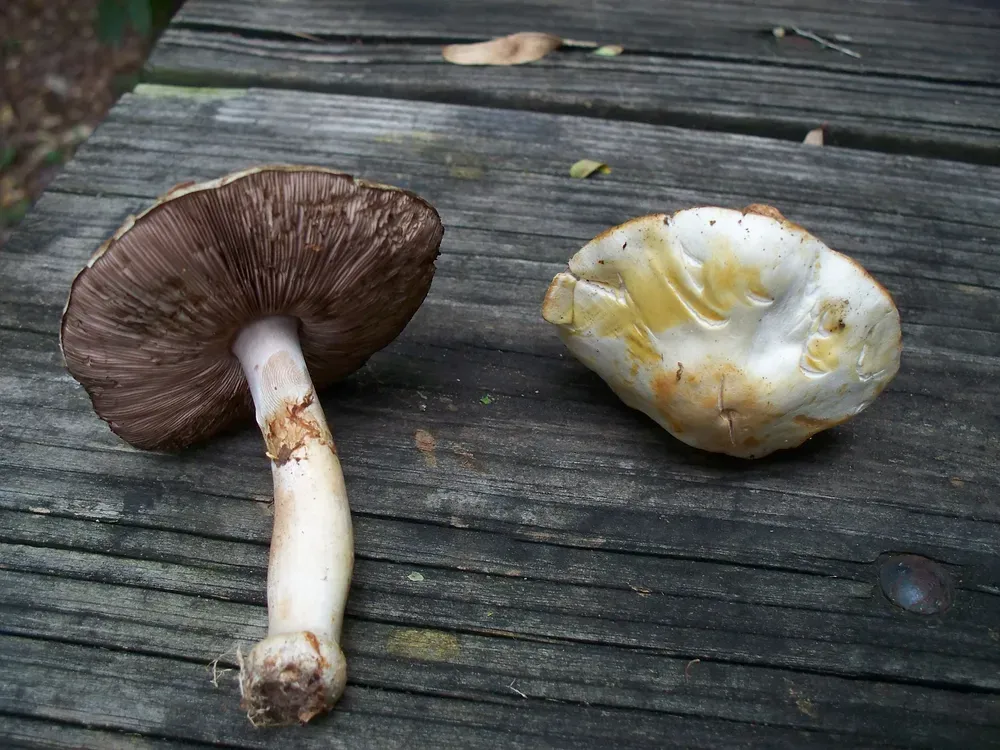
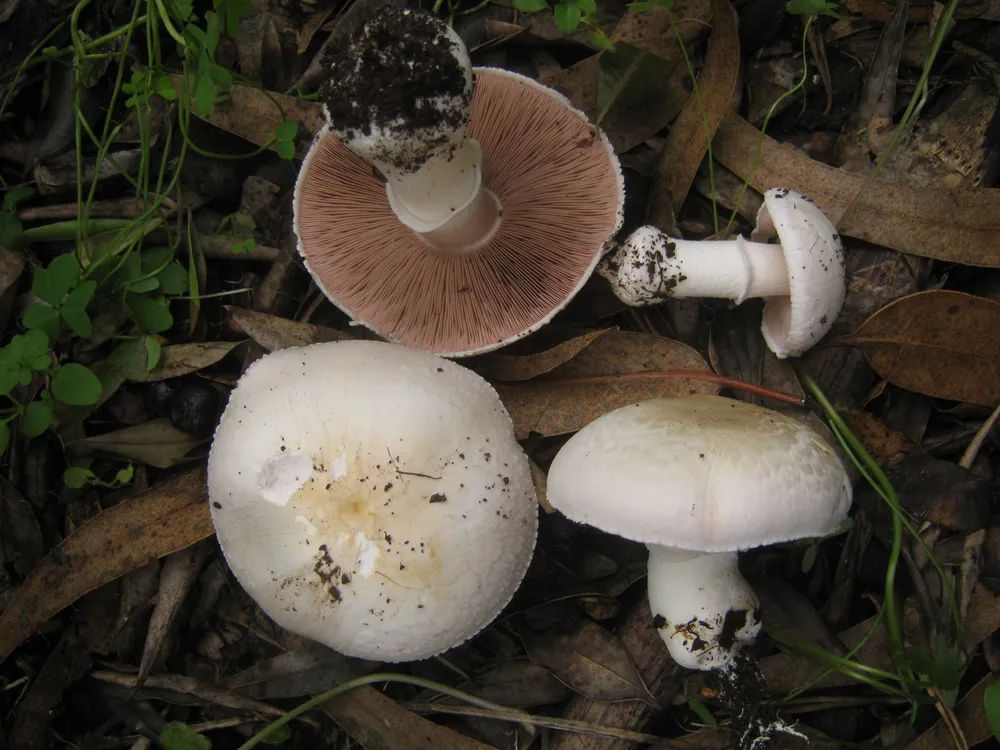
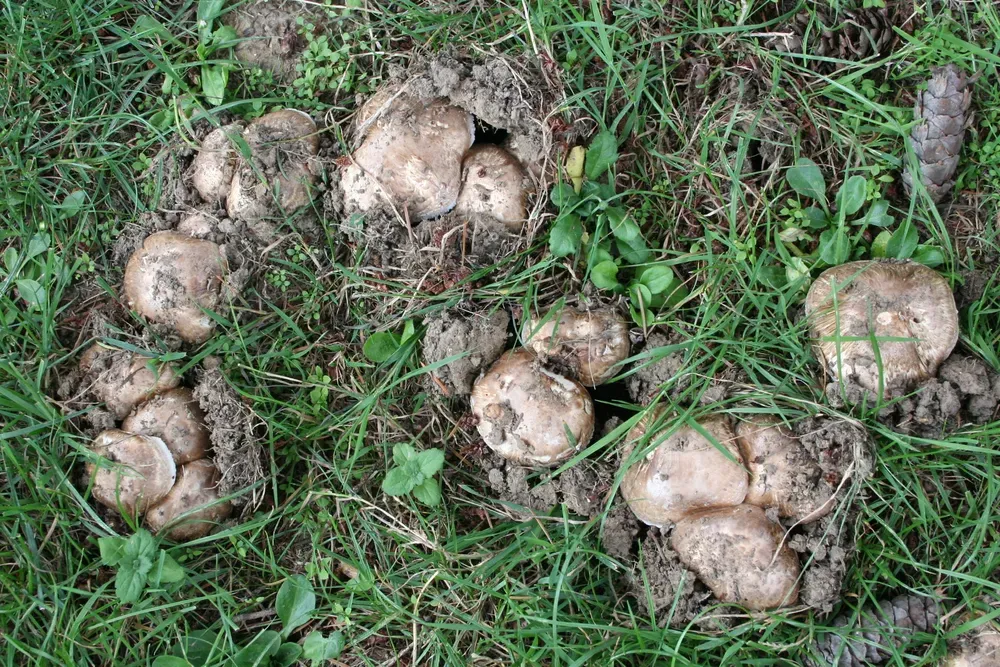
Mushrooms of the same genus and habitat — to study side by side and never mix up.
.webp)
_Fr._4948278370-2.webp)
Frequently asked questions
Can you eat it?
The mushroom itself is technically edible and not poisonous — but only if you avoid alcohol for 72 hours before, during and after eating it. Otherwise a strong disulfiram-like reaction sets in: hot flushes, palpitations, nausea, headache. In households where someone drinks, it's best not to pick this mushroom at all. It's safer to pick the white, which is compatible with alcohol.
What happens if you drink after eating it?
The reaction starts 20-40 minutes after alcohol: hot flushing of the face and chest, palpitations, tachycardia, nausea, headache, sweating, fear. It lasts 2-4 hours. It is not fatal for a healthy person, but very unpleasant. For people with cardiovascular disease it is potentially dangerous. The effect of coprine lingers for UP TO 3 DAYS after eating the mushroom.
What should you do if a reaction starts?
Lie down, drink plenty of water and don't panic — the reaction will pass within 2-4 hours. If the symptoms are severe (strong tachycardia, chest pain, loss of consciousness, a drop in blood pressure), immediately call an ambulance (112 or your local emergency number). There is no special home remedy for this reaction; treatment is symptomatic and given by medical staff. Do not drink any alcohol for at least 3 days after eating the mushroom — it can make the reaction worse or bring it back.
Where to look for it?
On fertile soils, on compost, along roads, in parks, on roadsides, on rich compost heaps, in gardens. It's a mushroom of human-shaped landscapes — you'll hardly ever find it in the forest. It often grows in large groups near a source of nutrients (compost, manure, humus).
Which regions of Ukraine does it grow in?
Throughout the forest and forest-steppe zones and across human-shaped landscapes: the Carpathians, Prykarpattia, Polissia, the Forest-Steppe, parks and vegetable gardens in every city. In the steppe — in damp spots near settlements. One of the most widespread synanthropic mushrooms.
When to look for it?
May–November, in several flushes after heavy rain. The first in May–June, the second in August, the third in September–October. It tolerates the first frosts. In a warm autumn — until November.
What is it confused with?
With the shaggy ink cap (Coprinus comatus). The critical difference: the shaggy ink cap has an elongated, egg-shaped white cap with fluffy scales and a distinct movable ring on the stem; the common ink cap has a gray-brown, bell-shaped cap with radial grooves and NO distinct ring. The shaggy ink cap is compatible with alcohol — so for a festive table, pick the shaggy ink cap.
How to tell it apart from other ink caps?
Other ink caps (Coprinellus micaceus, Coprinopsis lagopus and others) are mostly smaller (2-4 cm) and grow on wood. The common ink cap is bigger (4-8 cm) and grows on soil in groups. If you do need to put one in your basket, take photos and ask in an identification guide, because coprine occurs in several species of the genus Coprinopsis. When in doubt, don't drink alcohol for 3 days.
Is Common ink cap edible or poisonous?
Does Common ink cap have gills or pores?
What does the cap of Common ink cap look like?
What does the stem of Common ink cap look like?
Sources
- [1]Вікіпедія (українська)
- [2]Атлас грибів України, Зеров Д.К. (1979)
- [3]MycoBank Database
- [4]Index Fungorum
- [5]GBIF
- [6]iNaturalist Ukraine