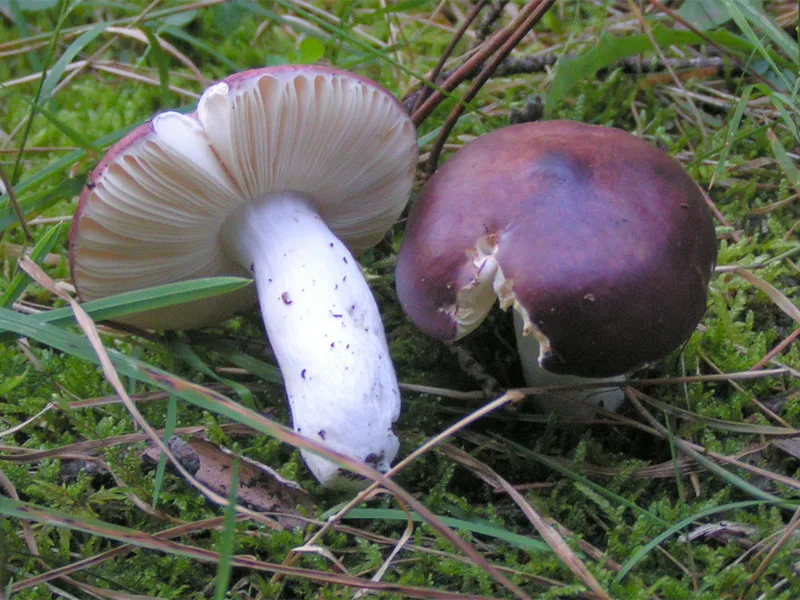
Humpback brittlegillRussula caerulea
Expert-verifiedUpdated October 3, 2026
Passport
- Edibility
- Edible
- Season
- Aug — Oct
- Hymenophore
- Gilled
- Cap color
- Violet
- Size
- Small (up to 5 cm)
- Smell
- Pleasant
- Reviewed
- Yes ✓
Quick answers
Where to look?
Conifer forest
When does it appear?
Aug — Oct
Active months: August, September, October.
How to recognize it? Three signs
- Cap color: Violet, Brown
- Cap shape: Umbonate
- Smell: Pleasant
Fruiting season
August – October
Description
The humpback brittlegill (Russula caerulea, synonyms R. amara, R. sardonia var. amara) is a distinctive pine-forest brittlegill with a pronounced pointed bump on the cap and violet-azure-chestnut coloring. The Latin epithet caerulea means "azure, deep blue", a nod to the bluish-violet tone of the cap. Its Ukrainian name, "buhorchata" ("bumpy"), points to the diagnostic feature — a sharp papillate bump in the center of the cap, which is especially pronounced in young specimens (unlike other brittlegills, whose caps are convex to flat).
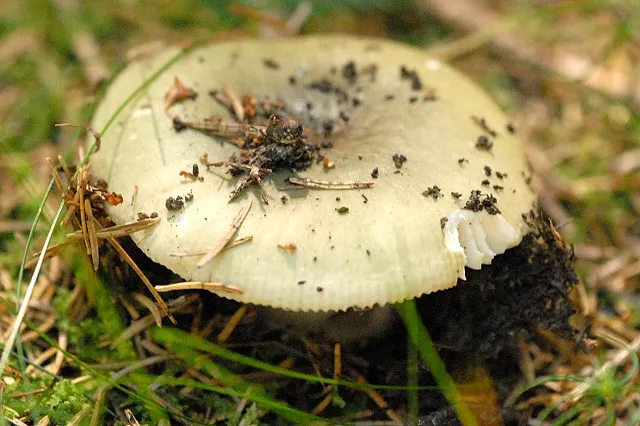
Cap 3-8 cm across, conical-convex with a sharp bump when young, becoming flat and spreading with age, but the bump remains. Color dark violet-azure with a purple-chestnut tint, richer in the center, paler and faded toward the edge. In wet weather the cap is sticky and slimy.
Edible, but of modest culinary value because of the slightly bitter taste of the flesh, especially in the stem. Foragers rarely pick it because of its small size, infrequent occurrence and mediocre taste — the bitterness disappears only with prolonged boiling. The literature lists it as "edible, category 3", some sources as "conditionally edible".
The essential check is a taste test: bite off a tiny piece of the gill edge (1-2 mm), hold it in your mouth for 30 seconds: slightly bitter and mild — that's R. caerulea (edible); burning-acrid — that's R. queletii, R. sardonia or another acrid violet brittlegill (DO NOT EAT).
Diagnostic features: (1) a sharp papillate bump in the center of the cap; (2) violet-azure-chestnut coloring with a bluish tint; (3) grows in pine forests (a mycorrhizal partner of pine); (4) spore print yellow-ochre; (5) a mild, slightly bitter taste, with no sharp burning aftertaste; (6) a faint fruity smell, with a hint of coconut in young specimens.
In Ukraine, Russula caerulea is common in pine forests: the Carpathians, Prykarpattia, Polissia, and in places the forest-steppe in pine stands. Season: August — October.
Cap
Cap 3-8 cm across, when young conical-convex with a sharp papillate bump in the center — a diagnostic feature. With age it becomes flat-convex, but the bump remains. The cap skin is smooth, slimy and sticky in wet weather, dry and matte in dry weather, peels 1/3 of the way to the center. Color dark violet, violet-azure, purple-chestnut, richer in the center, paler toward the edge, fading to grayish. In mature caps the edge has fine radial grooves.
Hymenophore
Gilled hymenophore — the gills are attached or free from the stem, moderately crowded, fleshy, brittle. Color whitish at first, becoming cream-ochre-yellowish with age because of the mature spore powder. Spore print yellow-ochre — a diagnostic feature.
Stem
Stem 4-8 cm tall, 1-2 cm thick, firm, cylindrical, hollow inside in old specimens. Color whitish, often with a faint violet-pink tint in the lower part. Surface smooth with fine lengthwise wrinkles. No ring.
Flesh
Flesh firm, brittle, white, where cut it slowly turns yellow. Smell faint and pleasant, with a hint of coconut and fruit in young specimens, taste mild and slightly bitter, especially in the stem — not burning-acrid (this sets it apart from its poisonous relatives).
Smell
A faint, pleasant fruity-coconut smell in young specimens, neutral with age.
›Scientific synonyms (1)
Russula amar Kucera
Lookalikes
.webp)
Related species
Mushrooms of the same genus and habitat — to study side by side and never mix up.
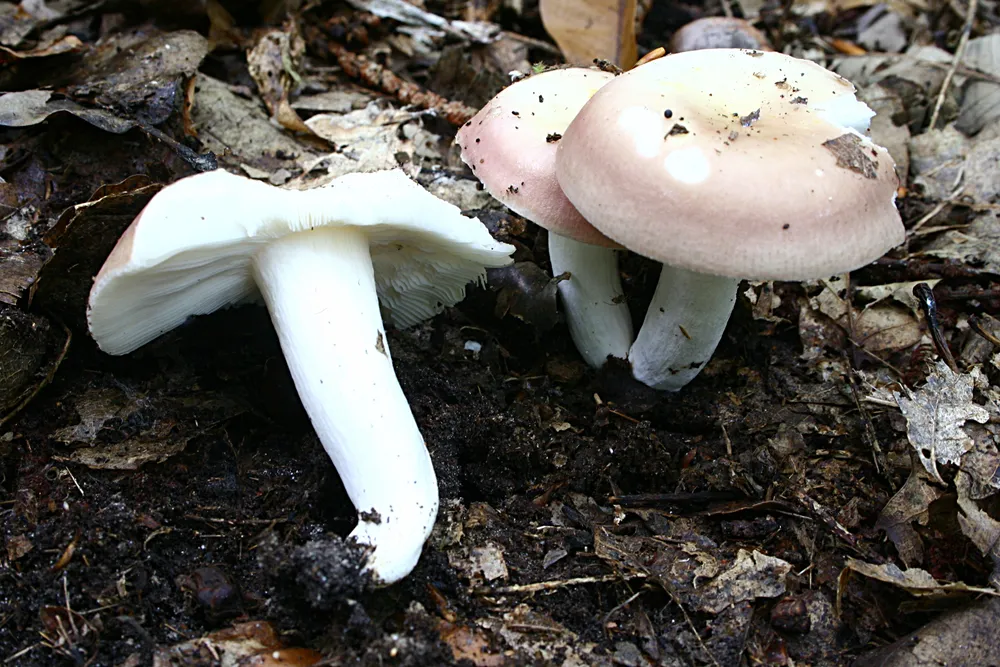
Bare-toothed russula
Russula vesca
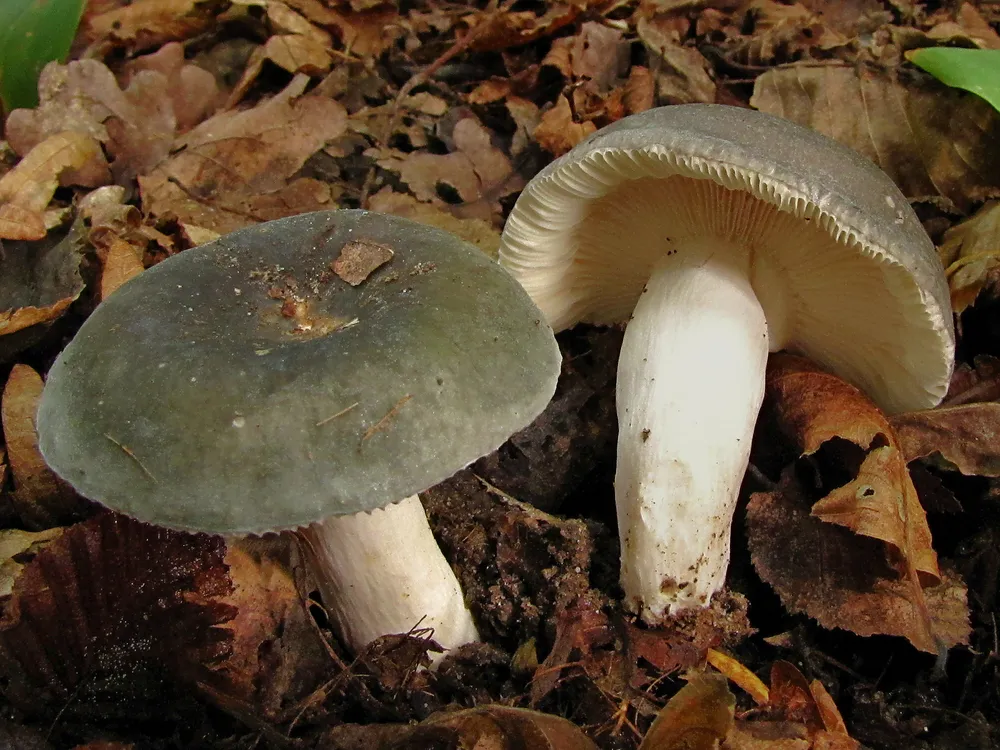
Charcoal burner
Russula cyanoxantha
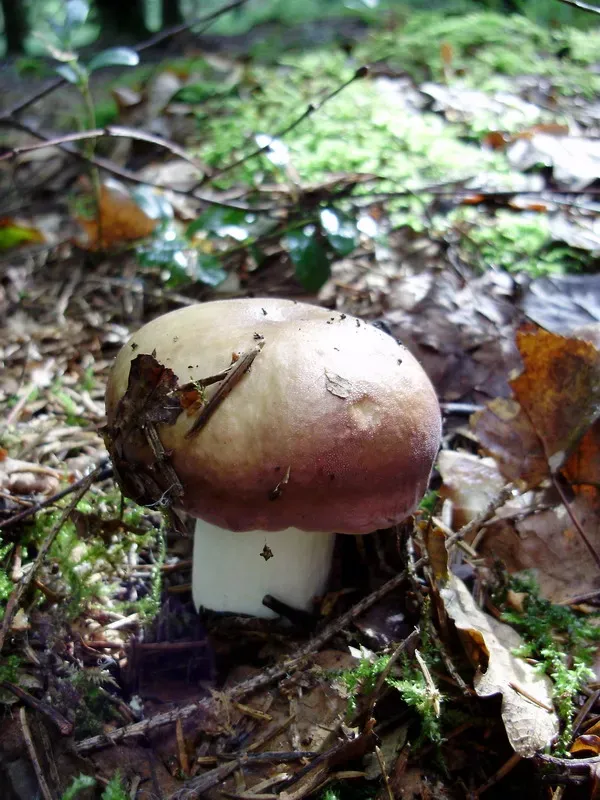
Copper brittlegill
Russula decolorans
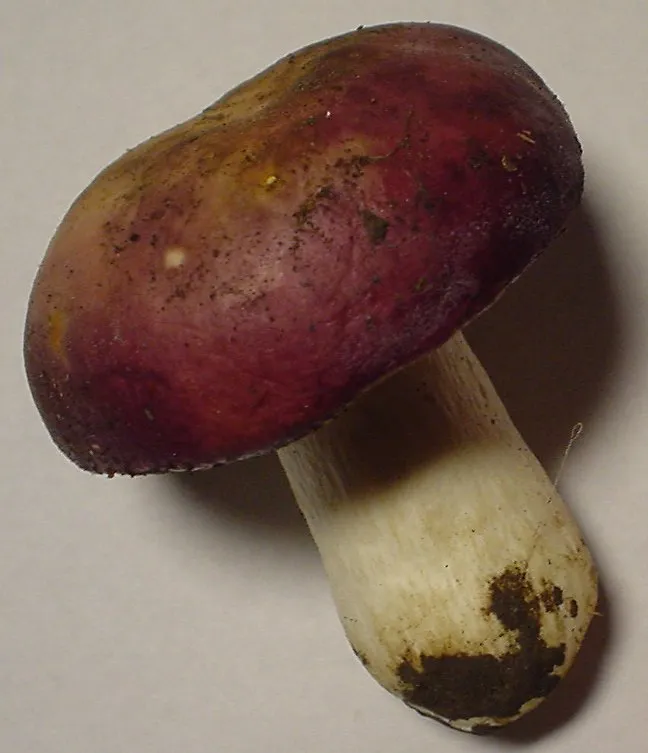
Crab brittlegill
Russula xerampelina
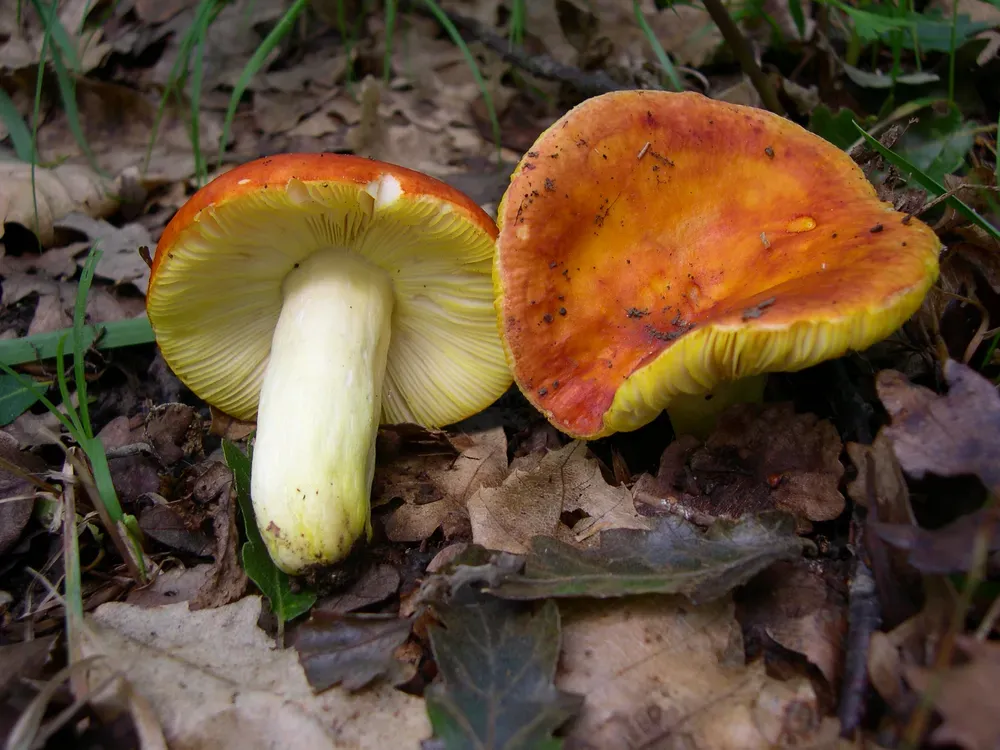
Gilded brittlegill
Russula aurea
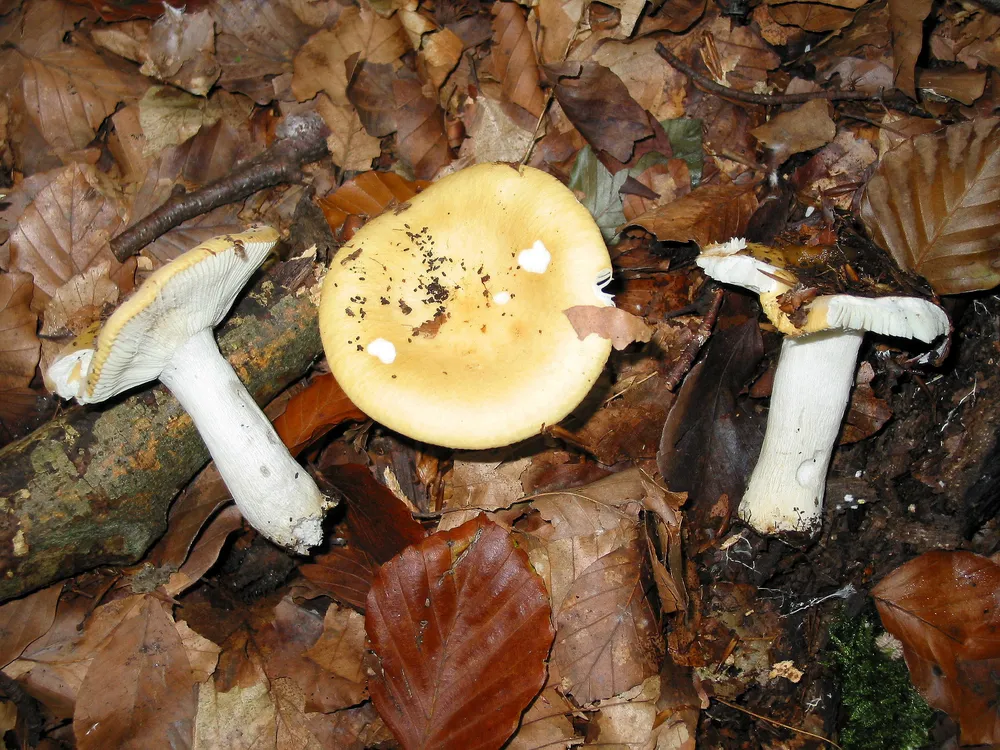
Golden brittlegill
Russula lutea
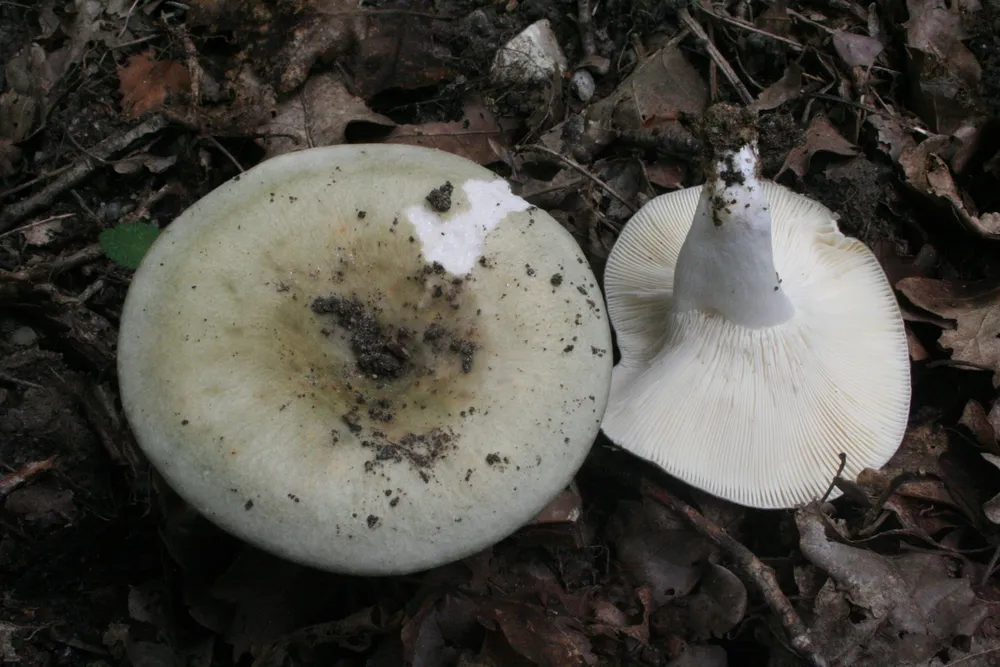
Greasy green brittlegill
Russula heterophylla
Green brittlegill
Russula aeruginea
Frequently asked questions
How do you tell it apart from poisonous violet brittlegills?
The essential check is a taste test. A tiny piece (1-2 mm) of the gill edge on your tongue for 30 sec: R. caerulea — slightly bitter and mild, no burning; R. queletii (fruity brittlegill), R. sardonia (primrose brittlegill) — distinctly burning-acrid, causing a strong burning sensation within 5-10 sec. Second check: R. caerulea has a sharp bump on the cap, other violet brittlegills have no pronounced bump.
How do you cook it?
Boil for 10-15 min in salted water, then discard the water — this removes the slightly bitter taste. Then fry with onions, or add to a mix with more aromatic mushrooms. It isn't worth cooking on its own — its culinary value is modest. Pickling works fine.
Where should you look for it?
In pine forests — on the forest floor among moss and grass, near old pines. On sandy and acidic soils. Often grows in groups of 3-10 fruiting bodies.
Which regions of Ukraine is it found in?
Common in the forest zone with pine forests: the Carpathians, Prykarpattia, Polissia, and in places the forest-steppe in pine stands.
When should you look for it?
August — October, peaking in September. It likes a warm autumn.
Which mushrooms is it confused with?
With R. queletii (fruity brittlegill, acrid) — burning-bitter, no bump. With R. sardonia (primrose brittlegill, acrid) — burning-acrid, with yellowish gills. With R. integra (edible) — larger, in spruce-beech forests, no bump. The essential check is a taste test.
Is Humpback brittlegill edible or poisonous?
Does Humpback brittlegill have gills or pores?
What does the cap of Humpback brittlegill look like?
What does the stem of Humpback brittlegill look like?
What do Humpback brittlegill smell and taste like?
Where does Humpback brittlegill grow?
Sources
- [1]Вікіпедія (українська)
- [2]Атлас грибів України, Зеров Д.К. (1979)
- [3]MycoBank Database
- [4]Index Fungorum
- [5]GBIF
- [6]iNaturalist Ukraine