Golden brittlegillRussula lutea
Expert-verifiedUpdated October 3, 2026
Passport
- Edibility
- Edible
- Season
- Jul — Oct
- Hymenophore
- Gilled
- Cap color
- Yellow
- Size
- Small (up to 5 cm)
- Smell
- Pleasant
- Reviewed
- Yes ✓
Quick answers
Where to look?
Deciduous forest, Mixed forest
When does it appear?
Jul — Oct
Active months: July, August, September, October.
How to recognize it? Three signs
- Cap color: Yellow, Orange
- Cap shape: Depressed
- Smell: Pleasant
Fruiting season
July – October
Description
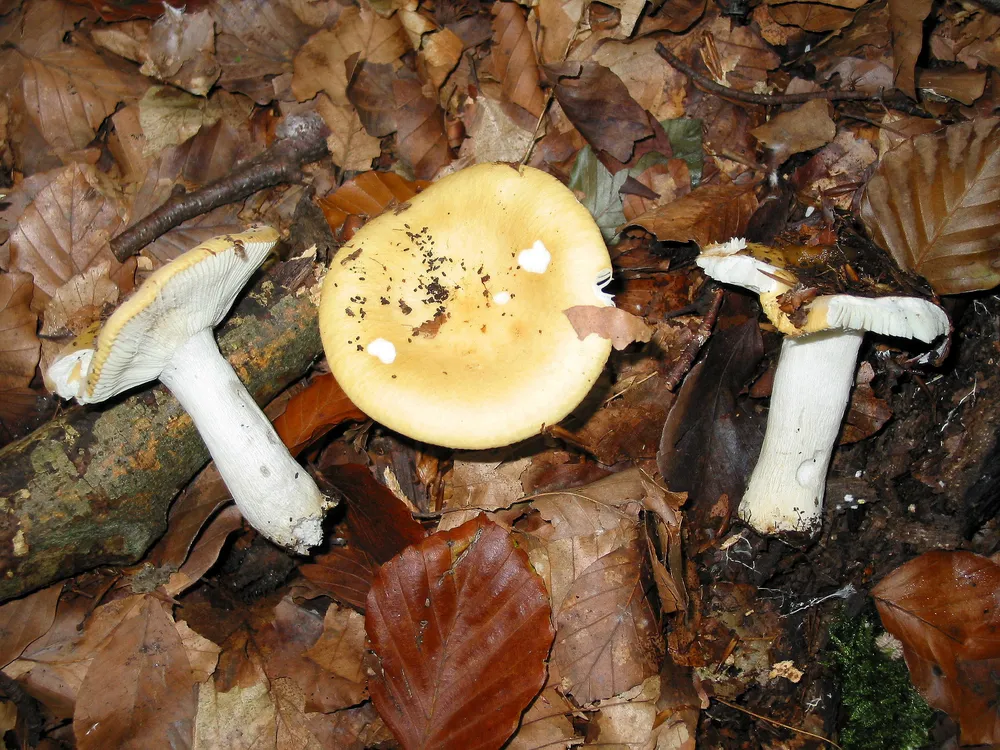
The golden brittlegill (Russula lutea, synonym R. risigallina) is a small but recognizable edible brittlegill with a strikingly bright yellow-orange or yellow-apricot cap. The Latin epithet lutea simply means "yellow." The cap is 2-5 cm across (clearly smaller than most brittlegills); convex when young, flat and spread out with a slightly sunken center with age, bright yellow-orange, ocher-orange, with paler faded patches in mature ones.
A distinctive feature is its yellow-ocher spore print (one of the most richly yellow among brittlegills), which colors the gills bright yellow and leaves a visible layer on the underside of the cap.
Edible, of moderately good culinary quality, but because of its small size (2-5 cm) it is rarely picked in large amounts. The flesh is delicate, with a mild taste and no bitterness, a faint, pleasantly fruity smell, and in some fruiting bodies a hint of apricot or stewed peaches. Cook it like other brittlegills: fry, stew, pickle. It dries only so-so because the flesh is thin.
Diagnostic features of Russula lutea: Small size of the cap (2-5 cm) Bright yellow-orange color of the cap Bright yellow gills (from the yellow spore print) Spore print rich yellow-ocher, a diagnostic feature Mild taste, fruity smell Grows in broadleaf forests (oak, beech, hornbeam, birch)
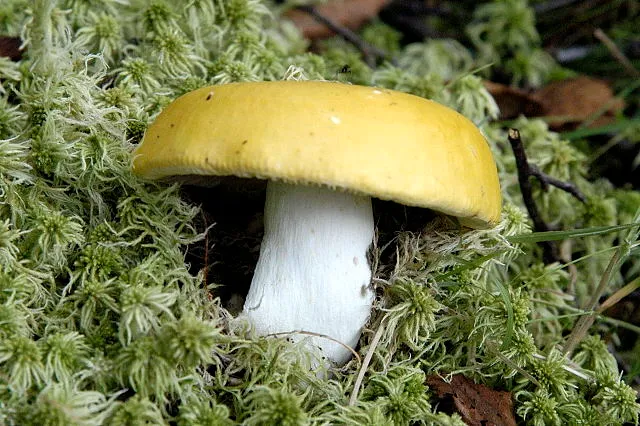
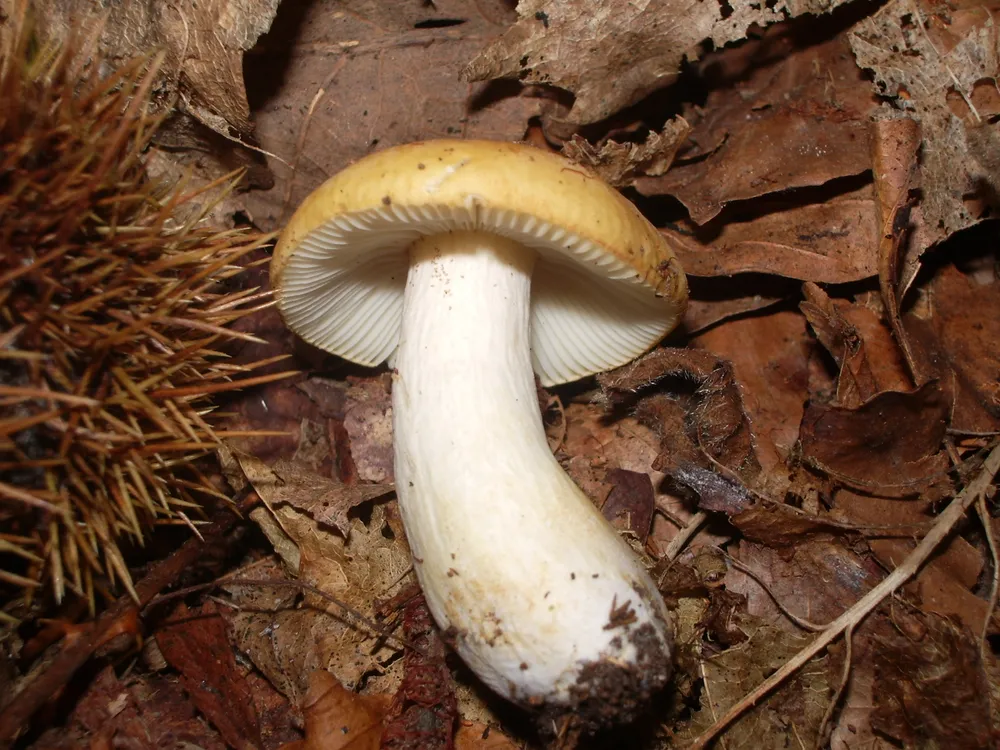
The main risk is confusing it with young poisonous amanitas, Amanita junquillea (old names) or A. gemmata (also yellowish, with a ring and a volva), and with small yellow webcaps (Cortinarius spp.). Always dig up the base of the stem and check for a sac-like volva.
In Ukraine, Russula lutea is common in broadleaf forests: the Carpathians, Prykarpattia, Polissia, the forest-steppe. It forms mycorrhiza with oak, beech, hornbeam and birch. Season: July to October.
Cap
Cap 2-5 cm across (small!); when young it is convex with an inrolled margin, becoming with age flat and spread out with a slightly sunken center. The cap skin is smooth, slightly slimy in wet weather, peels easily over up to 2/3 of the cap. The color is bright yellow-orange, ocher-orange, apricot, richer in the center, with paler faded patches in mature ones. The margin of mature ones has fine radial grooves.
Hymenophore
Gilled hymenophore: the gills are attached or free from the stem, moderately crowded, thin, brittle. The color is distinctly bright yellow thanks to the ripe spores, a diagnostic feature. The spore print is rich yellow-ocher (one of the brightest yellows among brittlegills).
Stem
Stem 3-6 cm tall, 0.5-1.5 cm thick, firm, cylindrical, hollow in old ones. The color is white to cream. The surface is smooth with fine lengthwise wrinkles. No ring.
Flesh
Flesh thin, brittle, white; it doesn't change color when cut. The smell is pleasantly fruity, in some fruiting bodies with a distinct hint of apricot or stewed peaches, the taste mild, slightly sweet, no bitterness.
Smell
Pleasantly fruity; many fruiting bodies have a distinct hint of apricot or stewed peaches. A diagnostic feature for some populations.
›Scientific synonyms (4)
Agaricus luteus Huds., Russula chamaeleontina var. lutea(Huds.) Melzer & Zvara, Russula nauseosa var. flavida Cooke, Russula acetolens Rauschert
Lookalikes
Related species
Mushrooms of the same genus and habitat — to study side by side and never mix up.
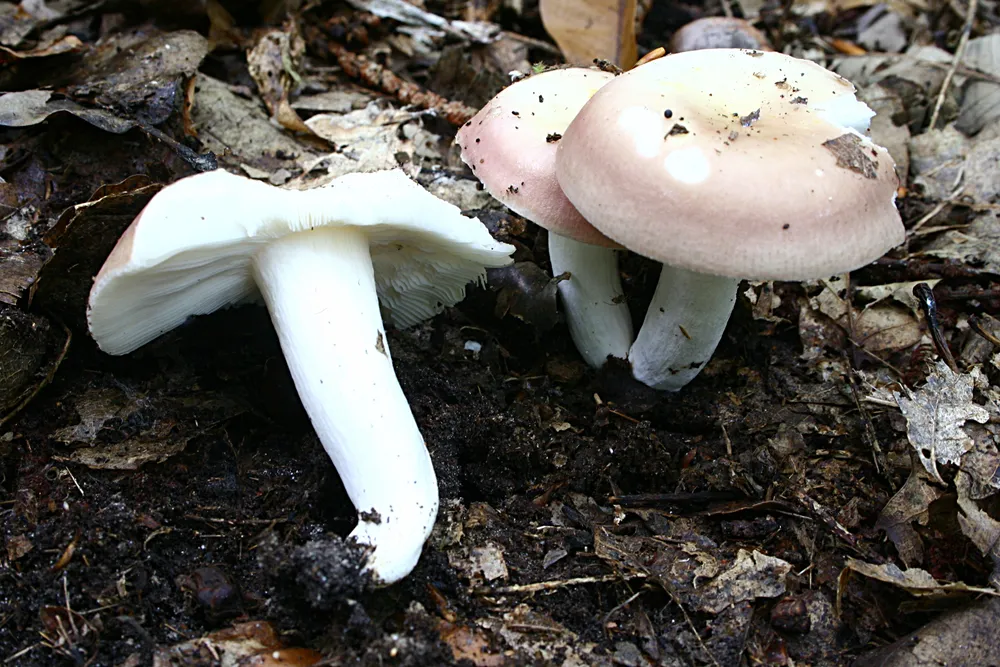
Bare-toothed russula
Russula vesca
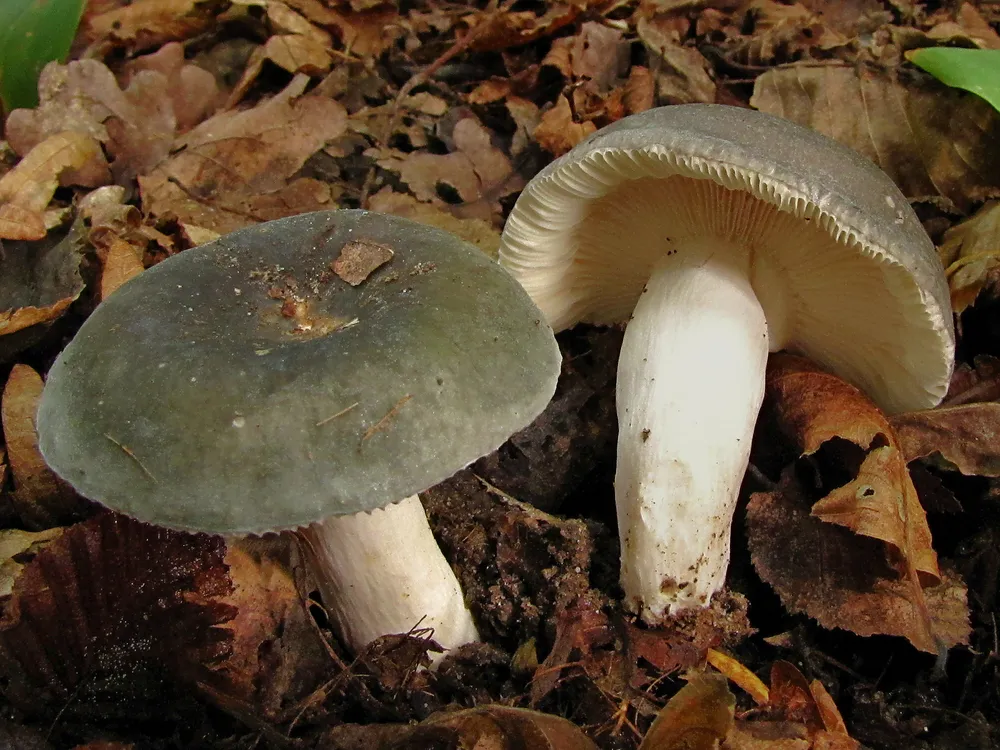
Charcoal burner
Russula cyanoxantha
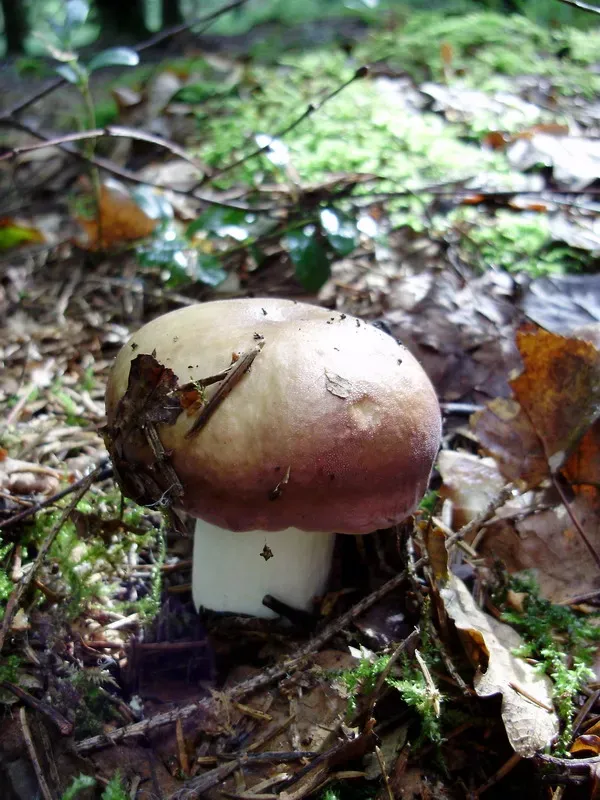
Copper brittlegill
Russula decolorans
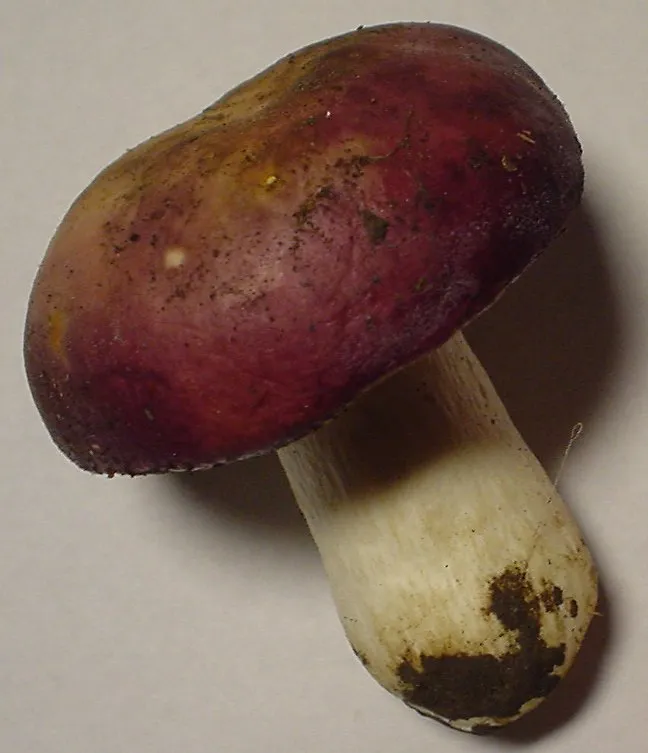
Crab brittlegill
Russula xerampelina
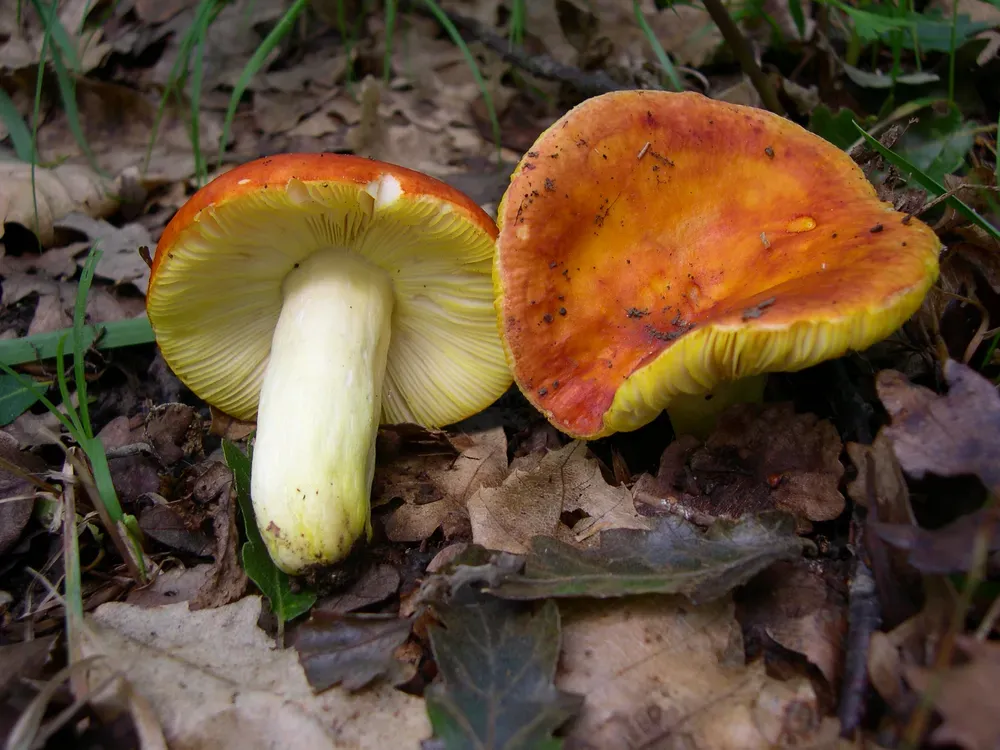
Gilded brittlegill
Russula aurea
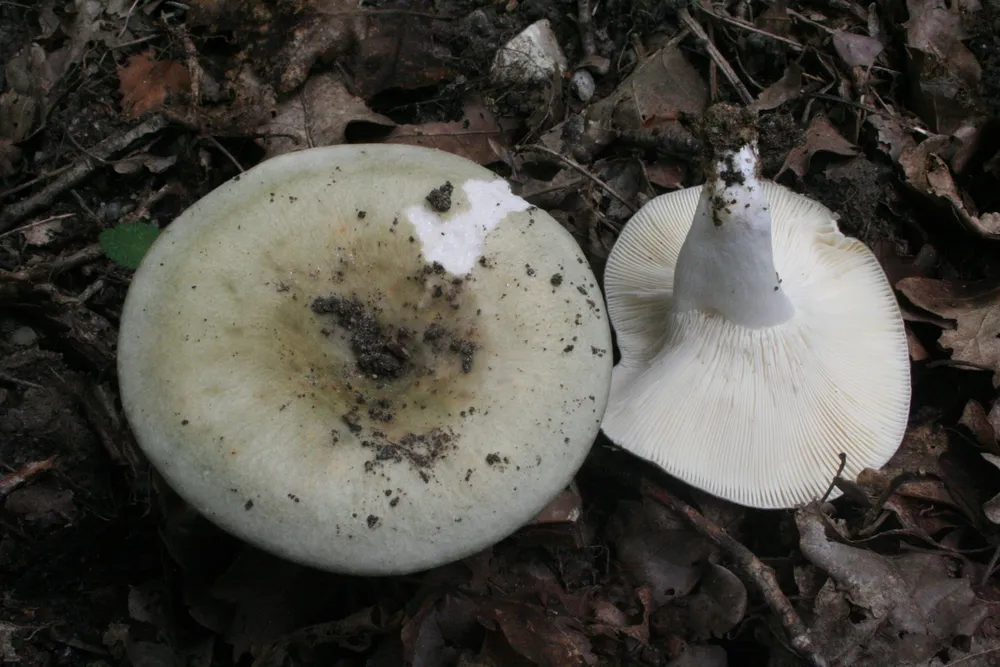
Greasy green brittlegill
Russula heterophylla
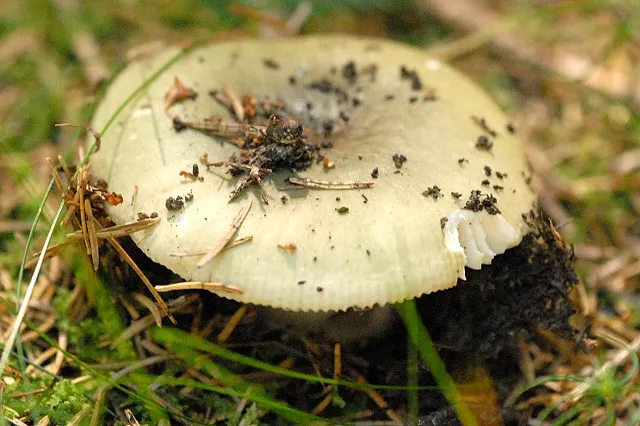
Green brittlegill
Russula aeruginea
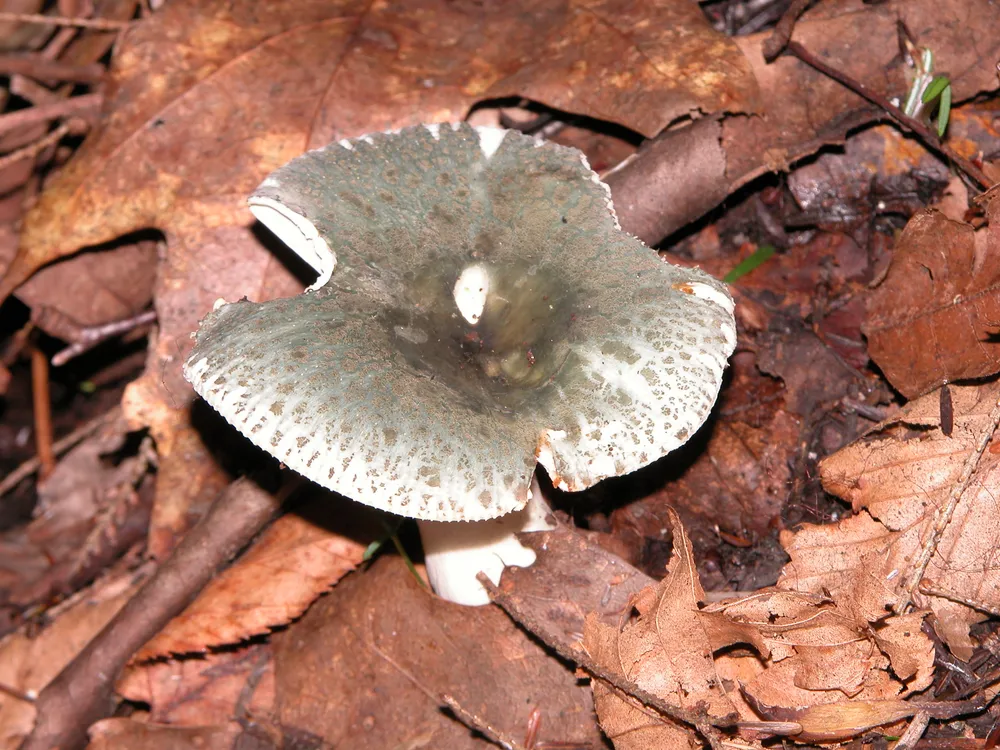
Greencracked brittlegill
Russula virescens
Related reading
Frequently asked questions
How do you tell it apart from poisonous yellow mushrooms?
From amanitas (Amanita gemmata, A. junquillea): they have a ring on the stem and a sac-like volva at the base. Dig up the base of the stem: no sac or ring means it's a brittlegill. From yellow webcaps — the spore print of R. lutea is rich yellow-ocher, webcaps' is rusty brown, plus young webcaps have a cobwebby veil (cortina).
How do you cook it?
No need to boil first (no bitterness). The small fruiting bodies are best mixed with tastier mushrooms, added to soups, or pickled. They aren't worth cooking as a dish on their own because they're so small.
Where should you look for it?
In broadleaf and mixed forests, under oak, beech, hornbeam and birch. On the forest floor in grass and moss. It often grows in groups of 5-10 fruiting bodies.
Which regions of Ukraine is it found in?
Common throughout the forest zone: the Carpathians, Prykarpattia, Polissia, the forest-steppe.
When should you look for it?
July to October, peaking in August-September.
Which brittlegills is it confused with?
With R. claroflava (yellow swamp brittlegill): larger, with no orange tone, in birch woods. With R. ochroleuca (ochre brittlegill): with a grayish tone, tastes bitter. The key check: small size (2-5 cm), bright yellow gills, fruity smell.
Is Golden brittlegill edible or poisonous?
Does Golden brittlegill have gills or pores?
What does the cap of Golden brittlegill look like?
What does the stem of Golden brittlegill look like?
What do Golden brittlegill smell and taste like?
Where does Golden brittlegill grow?
Sources
- [1]Вікіпедія (українська)
- [2]Атлас грибів України, Зеров Д.К. (1979)
- [3]MycoBank Database
- [4]Index Fungorum
- [5]GBIF
- [6]iNaturalist Ukraine