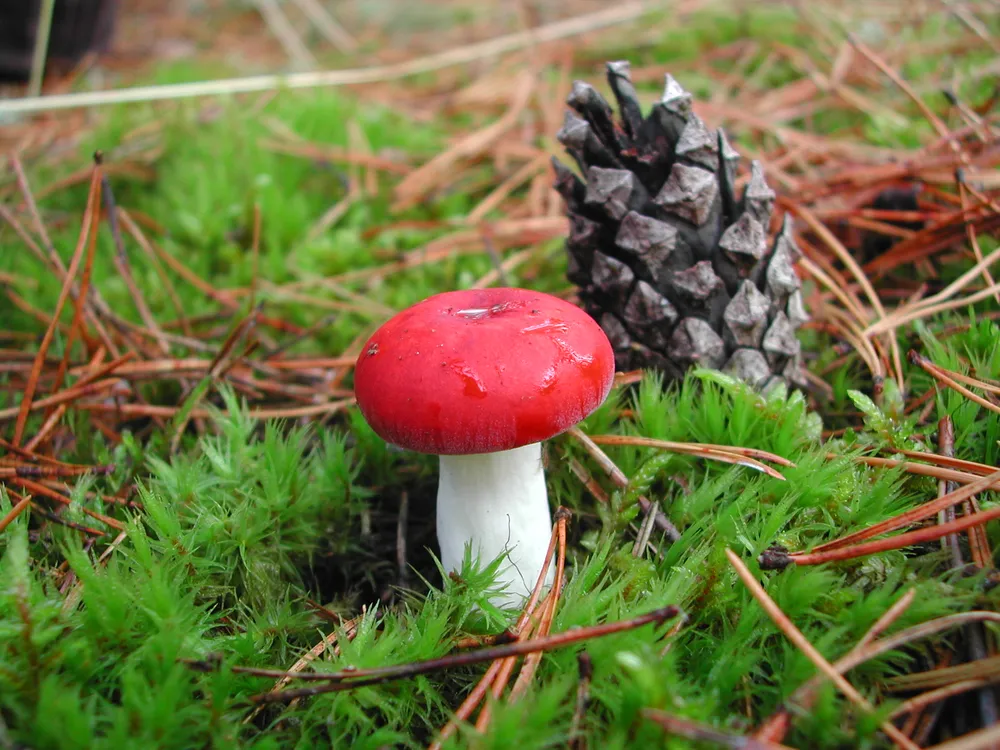
SickenerRussula emetica
Expert-verifiedUpdated October 3, 2026
Passport
- Edibility
- Poisonous
- Season
- Jul — Oct
- Hymenophore
- Gilled
- Cap color
- Red
- Size
- Small (up to 5 cm)
- Smell
- Pleasant
- Reviewed
- Yes ✓
POISONOUS
Eating it causes poisoning. Do not pick it unless you have identified it with certainty.
Gastrointestinal poisoning of moderate severity — the most common serious mushroom poisoning among beginners in Europe and Ukraine.
Active toxins: heat-labile sesquiterpenes (including russulin), which irritate the lining of the stomach and intestines. Muscarine and phenolic irritants may also contribute, but the exact makeup of the toxic cocktail has not been fully established.
Latency period: short — 30 minutes — 2 hours (typical of gastrointestinal poisonings).
Symptoms: Intense nausea and repeated vomiting (often 5-10 episodes) Watery diarrhea, sometimes with mucus Severe cramping abdominal pain Profuse sweating, tachycardia, hypotension from dehydration Dizziness, headache In children — rapid dehydration with a risk of collapse
Duration: 6-24 hours in ordinary cases, up to 2-3 days in severe ones. Full recovery usually takes 3-5 days.
Deaths among healthy adults are practically unknown, but deaths from dehydration have been described in children under 5 and in people over 70 with cardiovascular disease.
First aid: 1. Call an ambulance — 112 or your local emergency number, without fail. 2. Do NOT induce vomiting (the person is already vomiting). 3. Rehydration — oral rehydration salts (Regidron, Humana Electrolyte) if the person can swallow; IV fluids in hospital for severe dehydration. 4. Keep a sample of the mushroom so a toxicologist can identify it. 5. Loperamide is CONTRAINDICATED in the first 12 h (it slows the elimination of toxins). 6. Activated charcoal — only if a doctor or poison center advises it.
The prognosis is good with adequate rehydration; mortality <0.5%.
Prevention — the golden rule of brittlegill foraging: acrid, burning-hot brittlegills — DO NOT EAT. The tongue test (a tiny 1-2 mm piece from the gill edge, 30 sec, spit it out) saves you from this poisoning.
If you suspect poisoning, call an ambulance immediately: 112 (the European emergency number) or your local emergency number
Quick answers
Where to look?
Conifer forest, Mixed forest
When does it appear?
Jul — Oct
Active months: July, August, September, October.
How to recognize it? Three signs
- Cap color: Red
- Cap shape: Convex
- Smell: Pleasant, Odorless
Fruiting season
July – October
Description
The sickener (Russula emetica) is Europe's best-known poisonous brittlegill, and its name (both the Latin emetica, "emetic," and the Ukrainian one) points straight to the main symptoms: 30 min to 2 hours after eating — sudden, violent vomiting and diarrhea. The cap is 3-10 cm across, distinctly bright red, blood-red or raspberry-red, with a shiny skin, slimy in wet weather and dry and matte in dry weather. Young caps are especially deep red; older ones fade to pink with pale blotches.
Seriously poisonous — causes severe gastroenteritis: intense nausea, repeated vomiting, watery diarrhea, cramping abdominal pain. Symptoms start quickly (30 min–2 h) after eating the raw or undercooked mushroom. Symptoms last 6-24 hours, with no serious systemic complications in healthy adults, but dehydration can be significant, especially in children and older people. Deaths usually do not occur with adequate rehydration, but deaths among elderly people from complications have been described.
The main toxin is heat-labile sesquiterpenes (including russulin and related compounds). Partial inactivation with long boiling: in some traditions the mushroom is boiled for 30 minutes, changing the water three times, and then salted (in Scandinavia, partly in Poland), but current advice is DO NOT EAT it in any form, because: (1) its culinary value is zero, (2) there is a risk of incomplete detoxification, (3) there are plenty of truly safe red mushrooms.
The golden rule of brittlegill foraging that comes from this species: acrid/burning-hot brittlegills — DO NOT EAT. Tasting on the tongue is the key test. Raw R. emetica is distinctly burning, bitter and acrid, and even a tiny piece causes a strong burning sensation in the mouth within seconds. That is the warning signal.
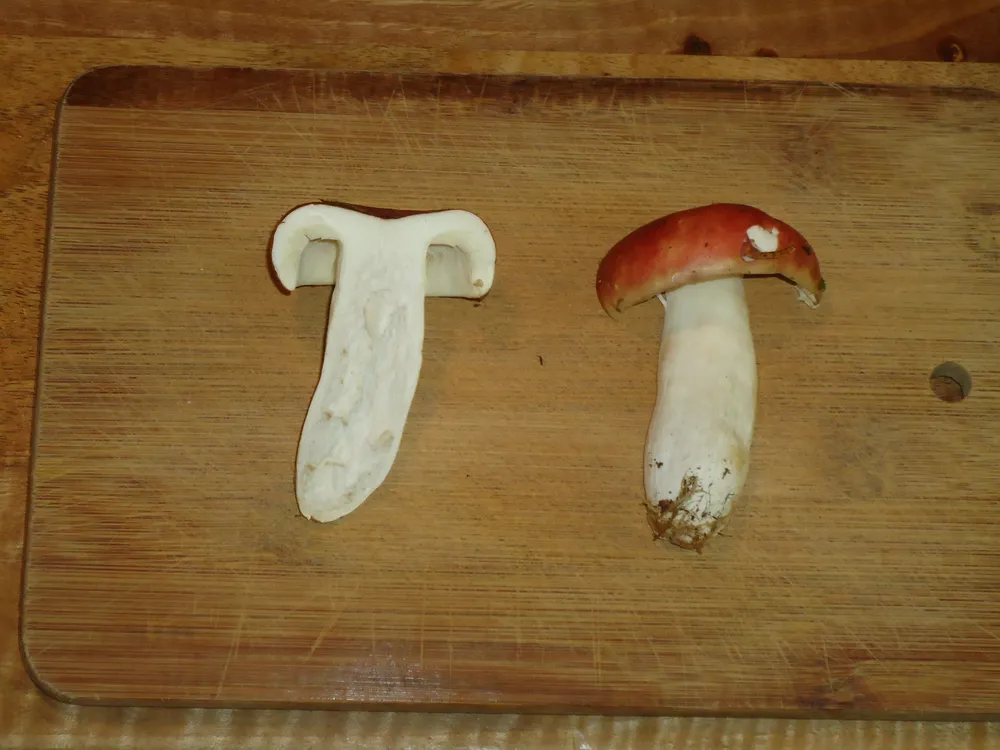
Diagnostic features of Russula emetica: (1) bright red cap with a shiny skin; (2) the skin peels off EASILY and completely (all the way to the center!); (3) distinctly burning, acrid taste of the raw flesh; (4) faintly fruity smell, unpleasant in mature specimens; (5) grows in conifer forests (pine, spruce), mostly on sphagnum and damp soils.
In Ukraine, Russula emetica is common in pine and spruce forests: the Carpathians, Prykarpattia, Polissia. A mycorrhizal partner of pine and spruce. Season: July — October.
Cap
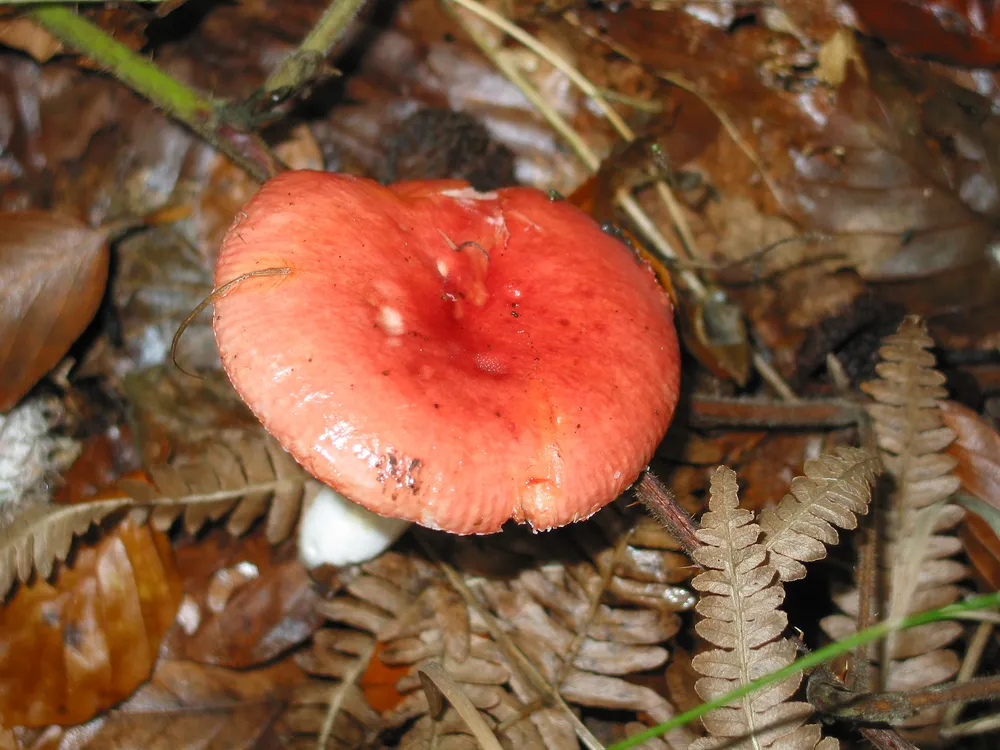
Cap 3-10 cm across, when young hemispherical, with age becoming flat and spread out with a slightly depressed center. The skin is smooth and shiny, distinctly slimy in wet weather, dry and matte in dry weather. The skin peels off EASILY, COMPLETELY, all the way to the center — a diagnostic feature. Color: bright red, blood-red, raspberry-red, deeper in the center; mature caps fade to pink with pale blotches. In mature specimens the margin has fine radial grooves.
Hymenophore
Gilled hymenophore — the gills are attached or free from the stem, crowded, thin, fleshy. Color: white to creamy white, cream with age. Spore print white — a diagnostic feature.
Stem
Stem 4-8 cm tall, 1-2.5 cm thick, firm, fleshy, cylindrical, hollow inside in old specimens. Color: pure white, often with a faint pinkish tint toward the base. Surface smooth with fine lengthwise wrinkles. No ring.
Flesh
Flesh firm, brittle, white, does not change color when cut. Smell faintly fruity-coconut in young specimens, faintly unpleasant in mature ones, taste distinctly burning, acrid and bitter: a tiny piece (1-2 mm) on the tongue causes a strong burning sensation within 5-10 seconds — this is a diagnostic test that saves you from poisoning. Spit it out right away; do not swallow.
Smell
Faintly fruity-coconut in young specimens; in mature ones neutral or slightly unpleasant.
Lookalikes
Related species
Mushrooms of the same genus and habitat — to study side by side and never mix up.
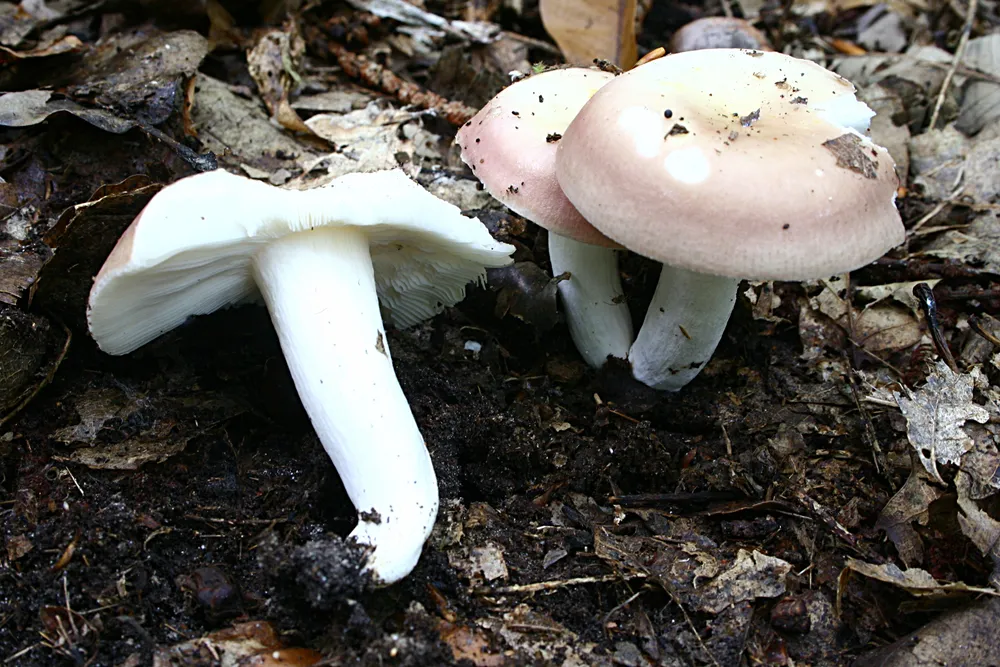
Bare-toothed russula
Russula vesca
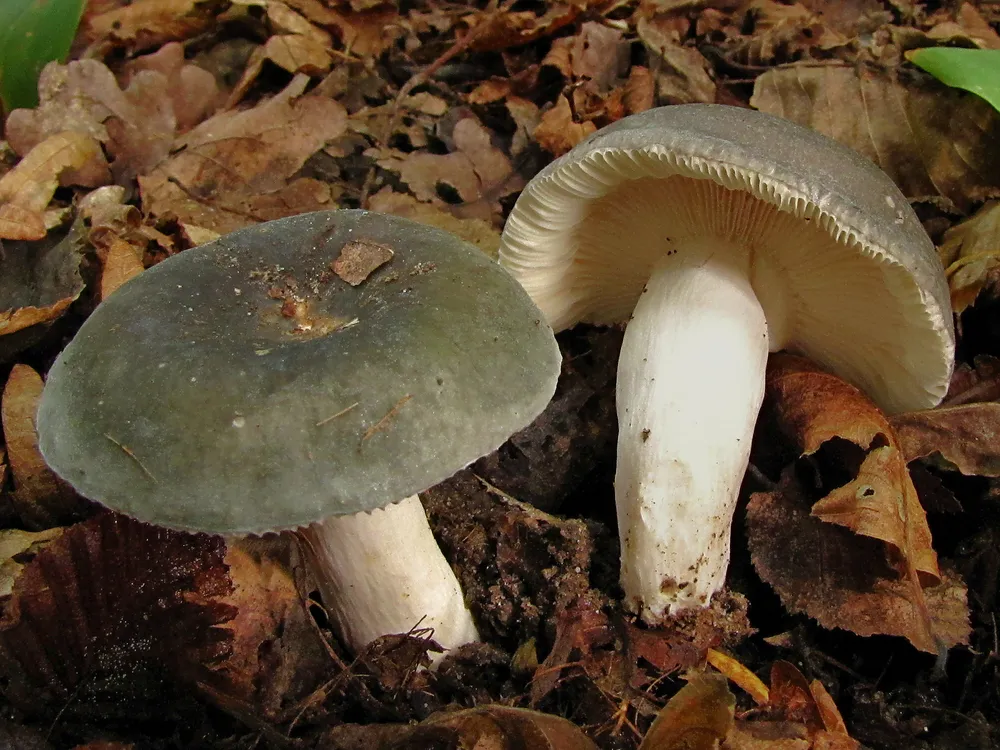
Charcoal burner
Russula cyanoxantha
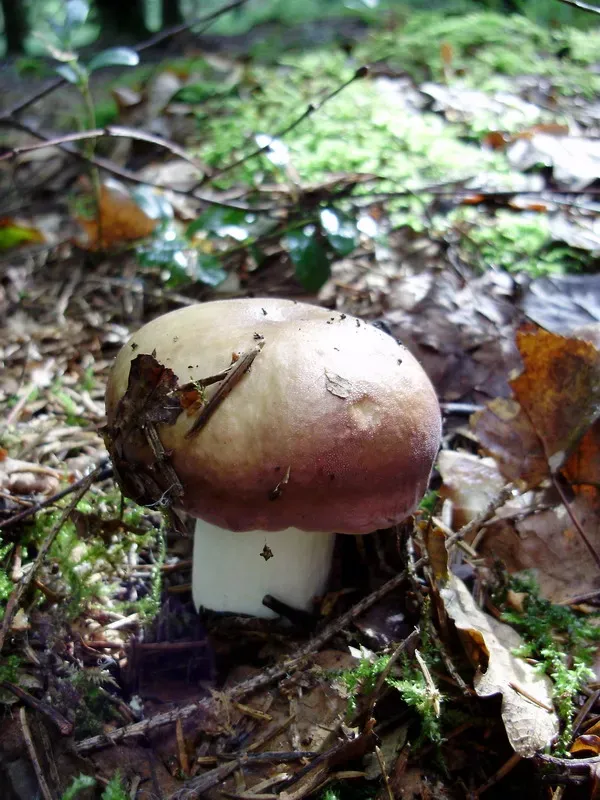
Copper brittlegill
Russula decolorans
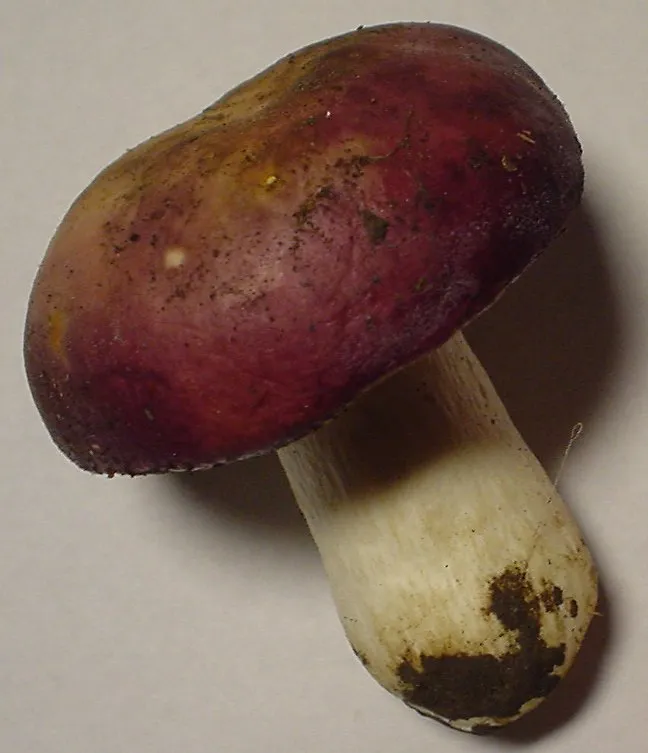
Crab brittlegill
Russula xerampelina
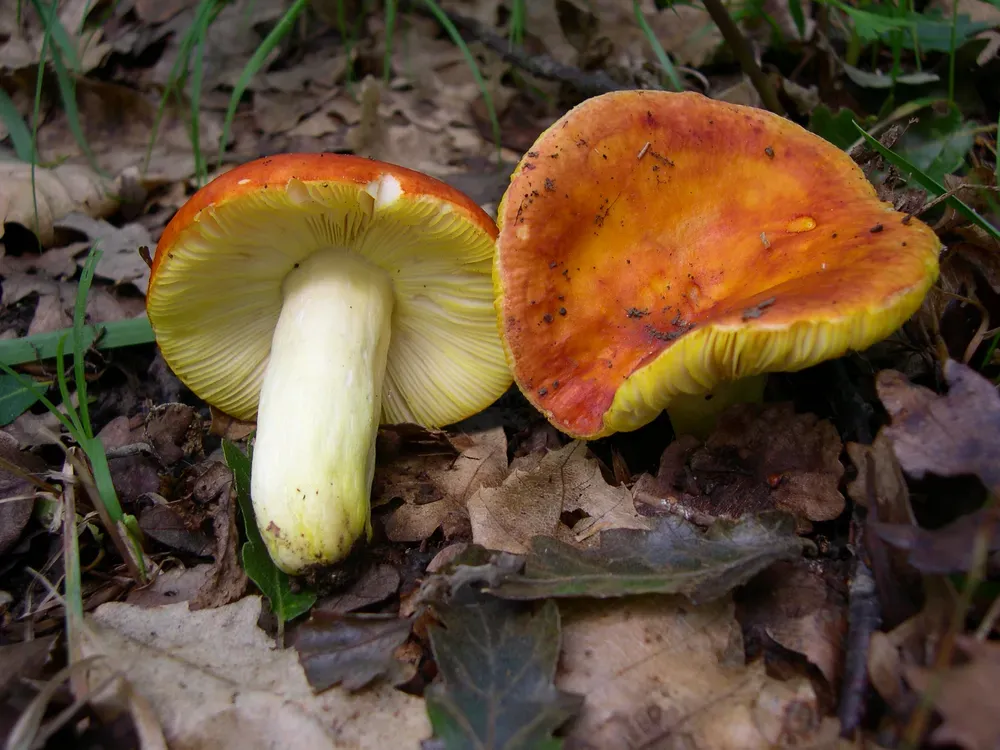
Gilded brittlegill
Russula aurea
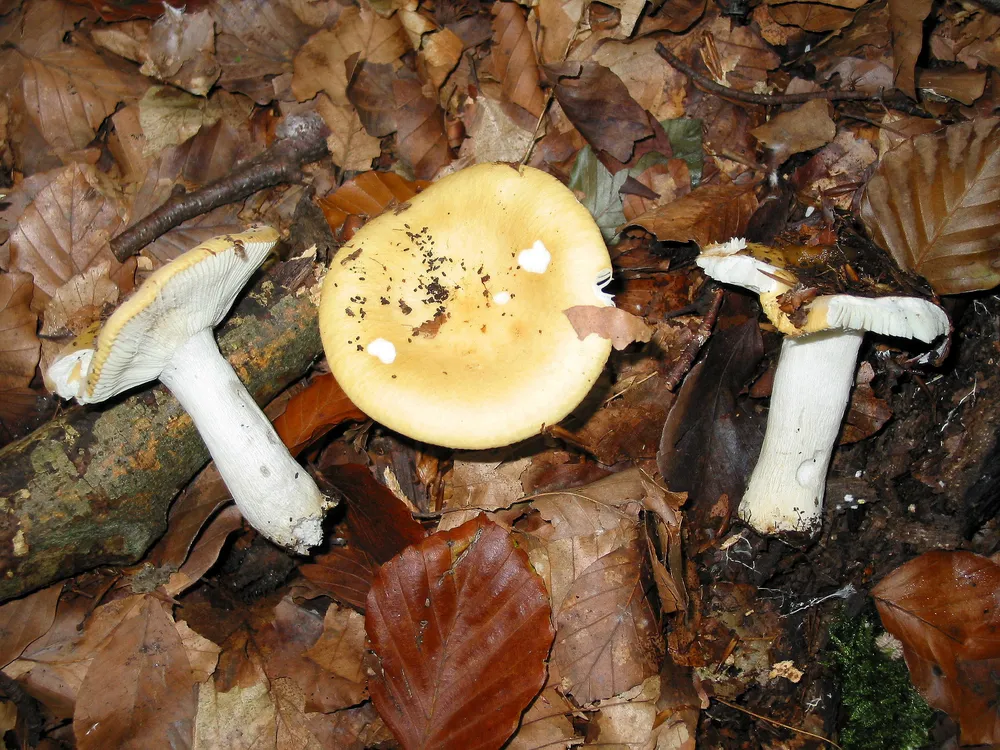
Golden brittlegill
Russula lutea
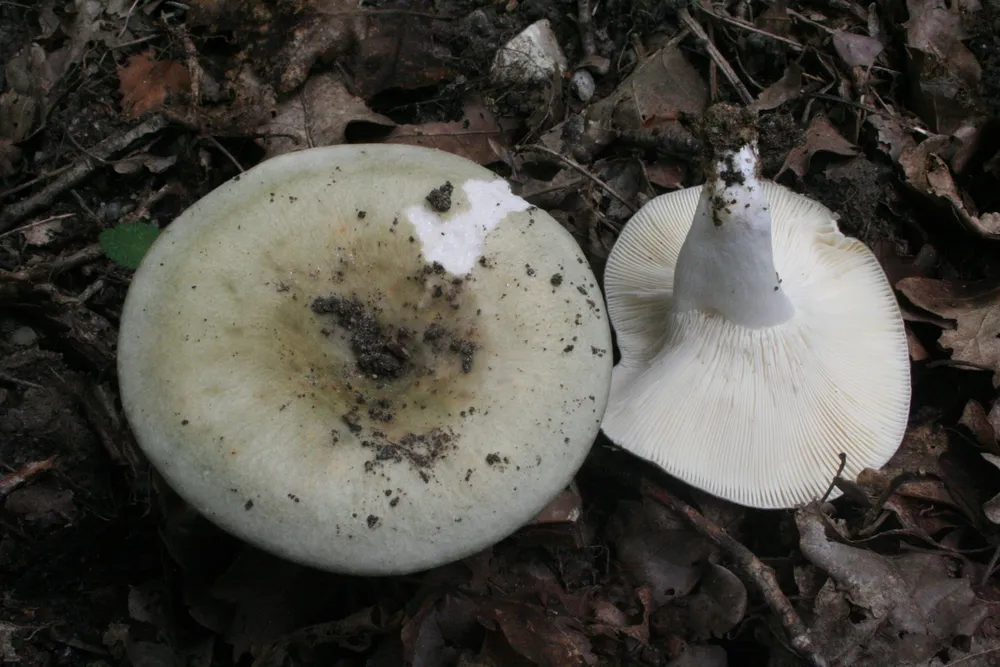
Greasy green brittlegill
Russula heterophylla
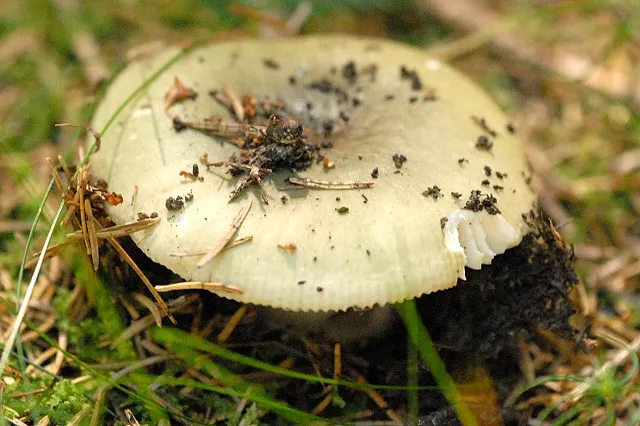
Green brittlegill
Russula aeruginea
Related reading
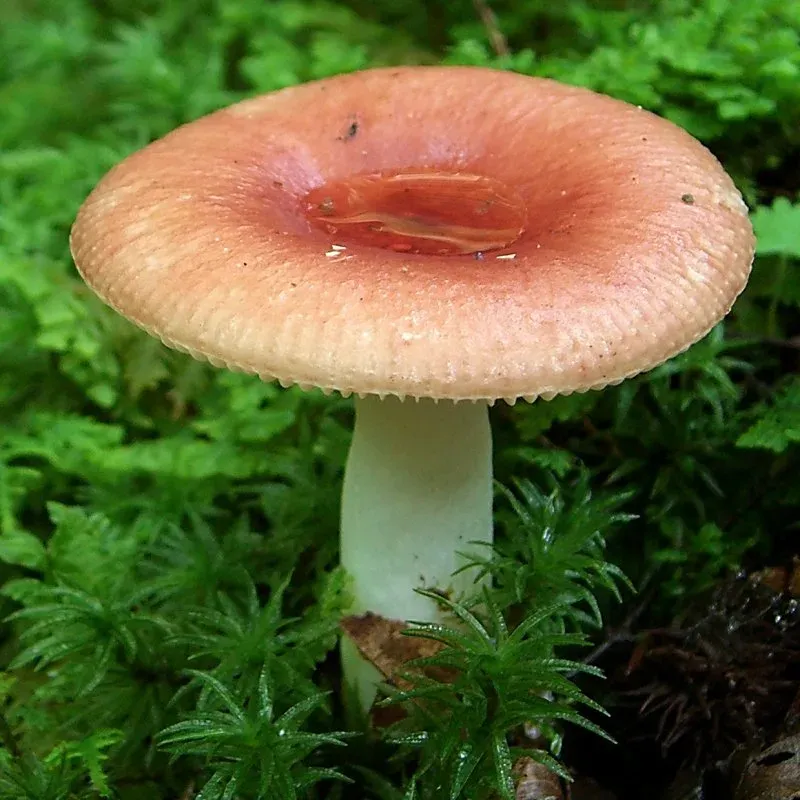 How to identify
Red-capped mushrooms: edible and dangerous
A red cap in the forest is a reason to stop. These mushrooms include both tasty red-capped scaber stalks and p…
August 21, 2026·3 min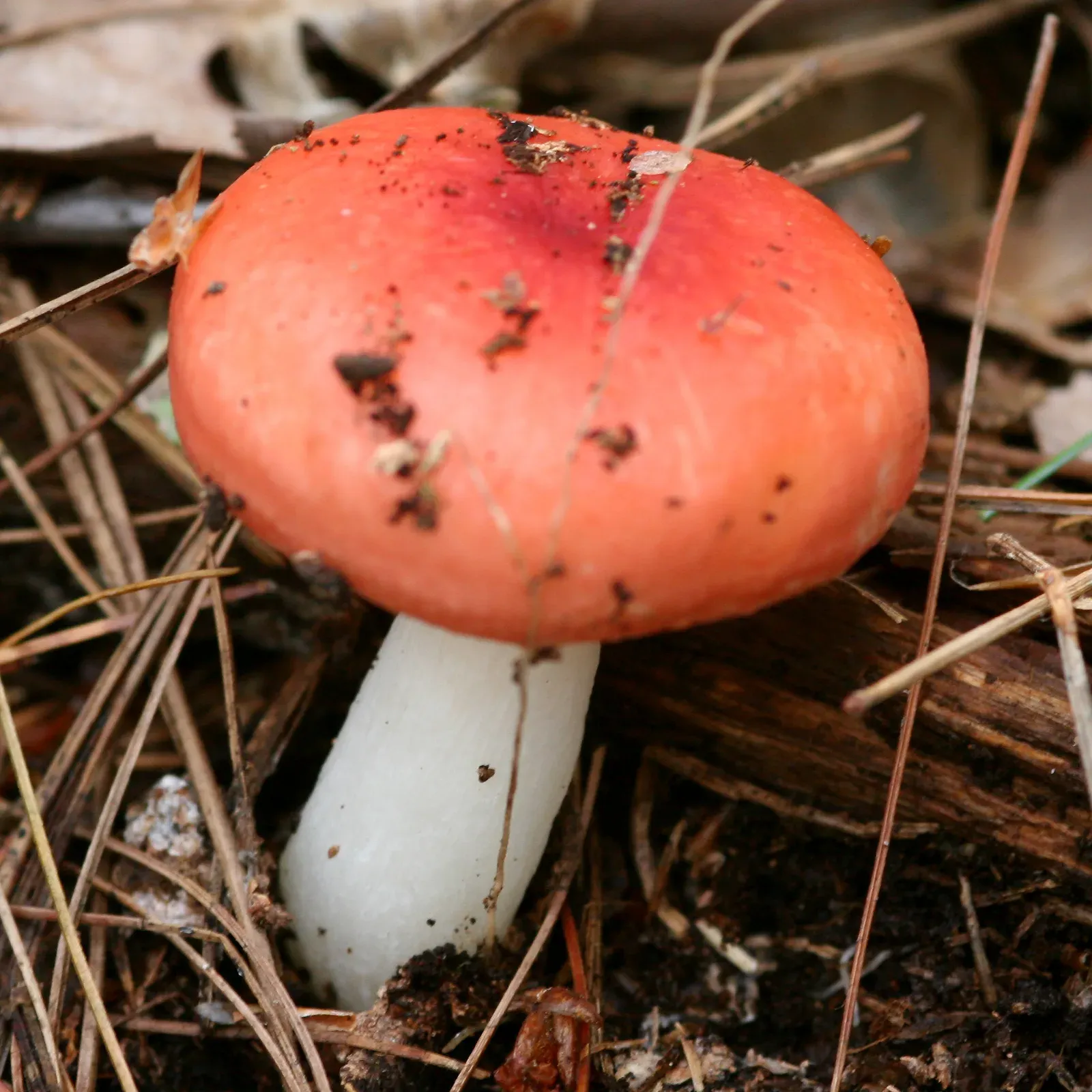 How to identify
Types of brittlegills in Ukraine: a complete guide
Brittlegills are the most colorful family in our forests: green, red, blue, yellow. Some are tasty, others are…
July 18, 2026·2 min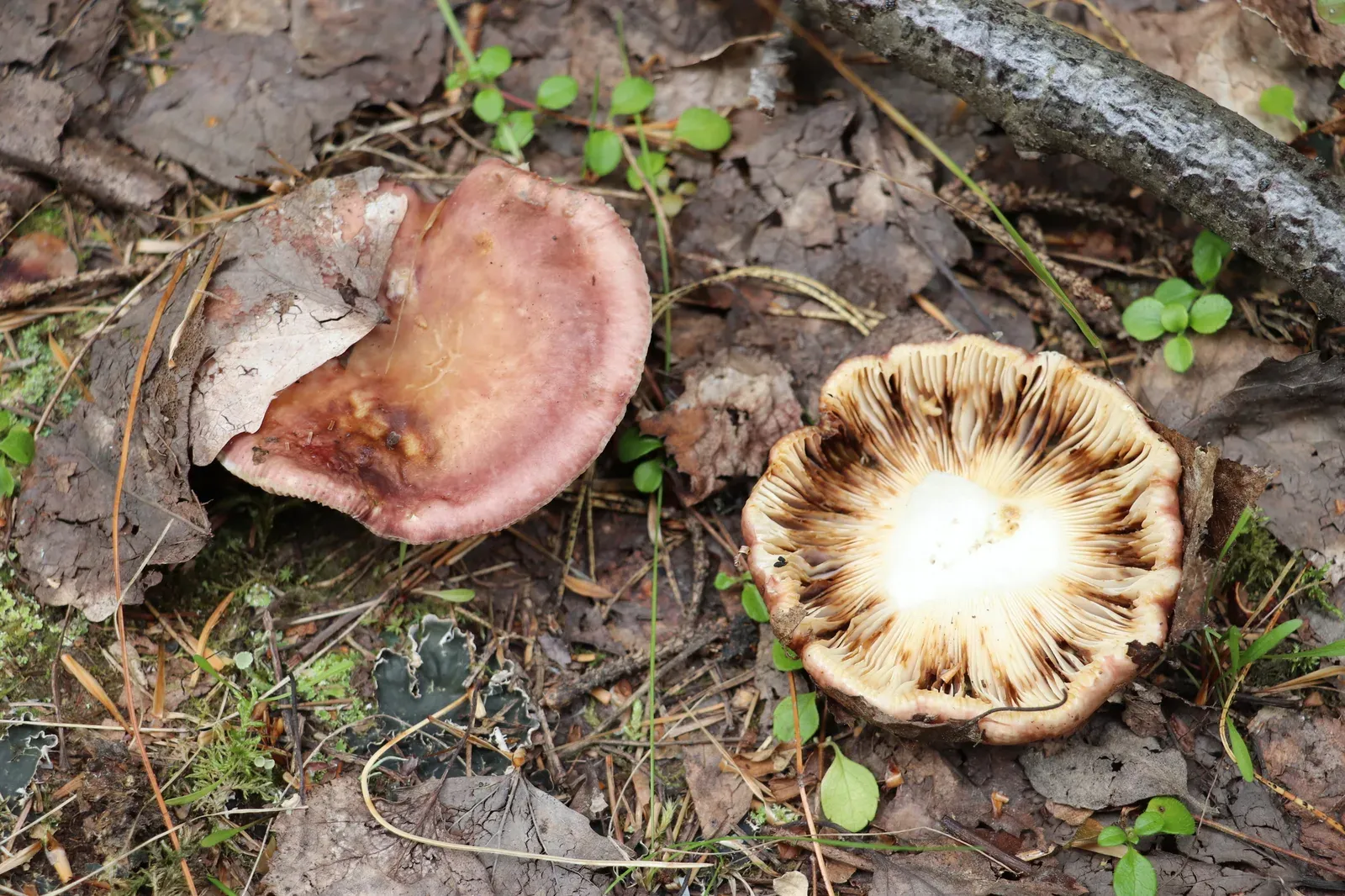 How to identify
Brittlegills, the most common mushrooms in the forest
Brittlegills turn up practically at every step, but you need to pick them wisely. Here's how to recognize a go…
June 11, 2026·3 min
Frequently asked questions
How can you recognize it for sure, so you can avoid it?
Five signs. (1) Bright red, shiny cap (3-10 cm). (2) The skin peels off EASILY all the way to the center — that's characteristic. (3) White gills and a pure white stem. (4) Distinctly burning, acrid taste of the raw flesh (tongue test — it burns within 5 sec). (5) Grows in conifer forests (pine, spruce), often on sphagnum.
How much do you have to eat to get poisoned?
Just 30-50 g of the raw or undercooked mushroom is enough to cause gastroenteritis in an adult. In children — less. Long boiling partly neutralizes it, but full safety is not guaranteed. There is no "safe dose" — this mushroom is not meant to be eaten.
What should you do if you ate it by mistake?
Call an ambulance — 112 or your local emergency number. If vomiting keeps recurring, drink oral rehydration solution in small sips. Keep a sample of the mushroom (fresh, or from the vomit). In hospital — IV rehydration and electrolyte monitoring. Do not take loperamide or drink milk! Take activated charcoal only if a doctor or poison center advises it.
How does it differ from edible red brittlegills?
The key test is tasting. A tiny piece (1-2 mm) of the gill edge on your tongue, 30 sec: acrid and burning — DO NOT EAT (R. emetica and relatives), mild and sweetish — edible (R. vesca, R. cyanoxantha, R. virescens). Second — habitat: R. emetica grows under conifers on damp soils; many edible red species grow in broadleaf woods. Third — the raw taste: R. emetica causes a strong burning in the mouth within seconds.
Can you cook it after boiling?
In old traditions (Scandinavia, partly Poland), it is boiled for 30 minutes with a change of water and then salted. Current advice is DO NOT EAT it in any form, because: (1) its culinary value is zero, (2) there is a risk of incomplete detoxification, (3) there are plenty of truly safe mushrooms. There's no point in taking the risk.
Where can you find it?
In pine and spruce forests, in the forest litter among moss, often on sphagnum cushions in damp spots. On acidic soils. It often grows in groups of 3-10 fruiting bodies.
Which regions of Ukraine is it found in?
Common in the forest zone wherever there are conifers: the Carpathians, Prykarpattia, Polissia, and in part the forest-steppe.
When can you find it?
July — October, peaking in August-September.
Which brittlegills does it resemble?
Many red brittlegills: R. paludosa (hintapink, edible) — larger, with an orange-red cap and a mild taste; R. fragilis (fragile brittlegill, also acrid) — smaller; R. queletii (fruity brittlegill, acrid) — violet to wine-colored. Among all the red ones, taste is the key test: burning and acrid — poisonous, mild and sweetish — edible.
Is Sickener edible or poisonous?
Does Sickener have gills or pores?
What does the cap of Sickener look like?
Sources
- [1]Вікіпедія (українська)
- [2]Атлас грибів України, Зеров Д.К. (1979)
- [3]MycoBank Database
- [4]Index Fungorum
- [5]GBIF
- [6]iNaturalist Ukraine