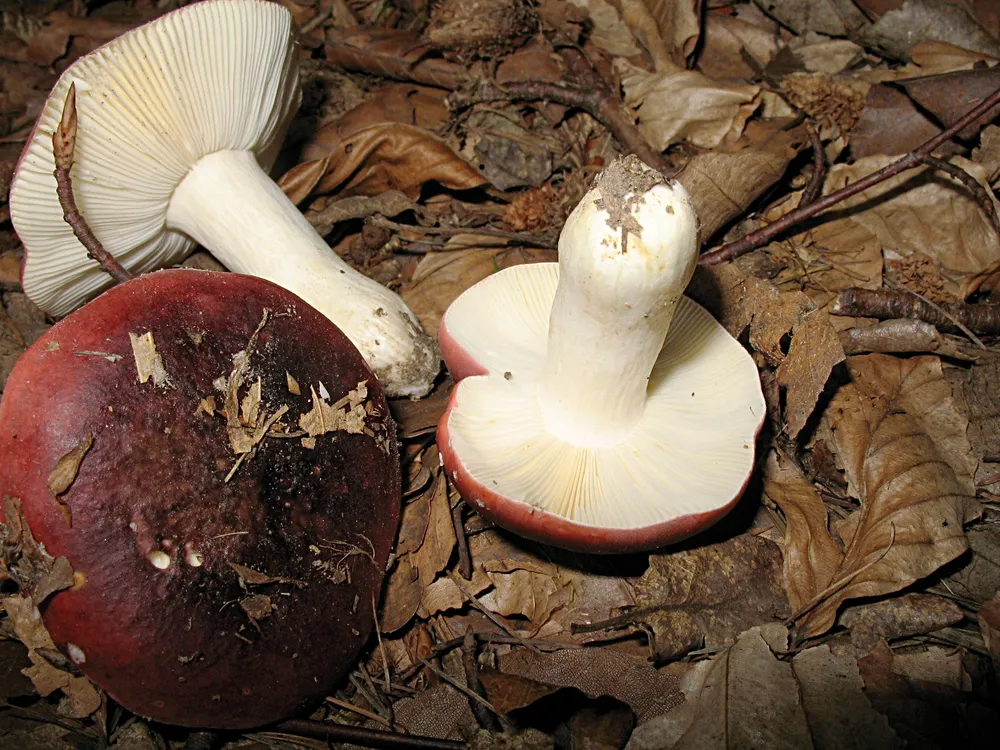
Purple brittlegillRussula atropurpurea
Expert-verifiedUpdated June 13, 2026
Passport
- Edibility
- Conditionally edible
- Season
- Aug — Oct
- Hymenophore
- Gilled
- Cap color
- Violet
- Size
- Small (up to 5 cm)
- Smell
- Pleasant
- Reviewed
- Yes ✓
Quick answers
Where to look?
Deciduous forest, Mixed forest
When does it appear?
Aug — Oct
Active months: August, September, October.
How to recognize it? Three signs
- Cap color: Violet, Black
- Cap shape: Depressed
- Smell: Pleasant
Fruiting season
August – October
Description
The purple brittlegill (Russula atropurpurea, synonym R. krombholzii) is a widespread dark purple brittlegill of oak and beech forests, with a distinctive almost black-purple central zone on the cap. The Latin epithet atropurpurea means "dark purple" (atro- = "dark," purpurea = "purple"). The cap is 4-9 cm across, convex to flat and spread out, distinctly dark purple, wine-violet with a blackish center, paler toward the edge with a pinkish-violet tinge.
Conditionally edible: the flesh of young mushrooms has a faint acrid or bitterish note in the gills and stem, which disappears with boiling. Its culinary value is moderate; foragers like it less than R. vesca or R. cyanoxantha because it needs boiling and its taste is inconsistent. Some fruiting bodies are completely mild, others have a distinct bitterish note (depending on age, weather and habitat).
Diagnostic features of Russula atropurpurea: Dark purple cap color with a blackish center Cap skin peels back over 1/2 of the cap (not all the way) Spore print creamy white to pale ocher White flesh, turns slightly gray where cut Mild to slightly bitterish taste (tongue test) Faint, pleasant smell with a fruity note Grows in oak and beech forests
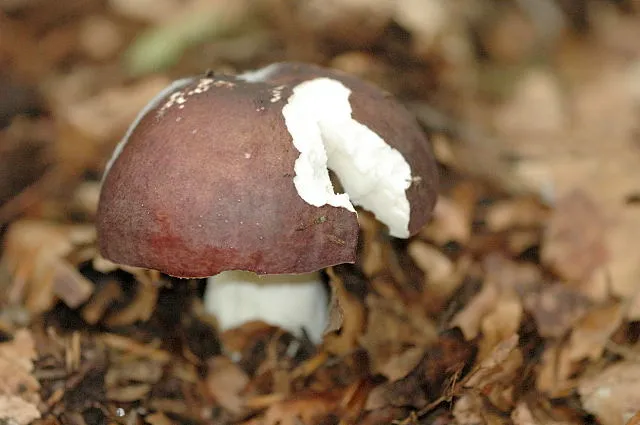
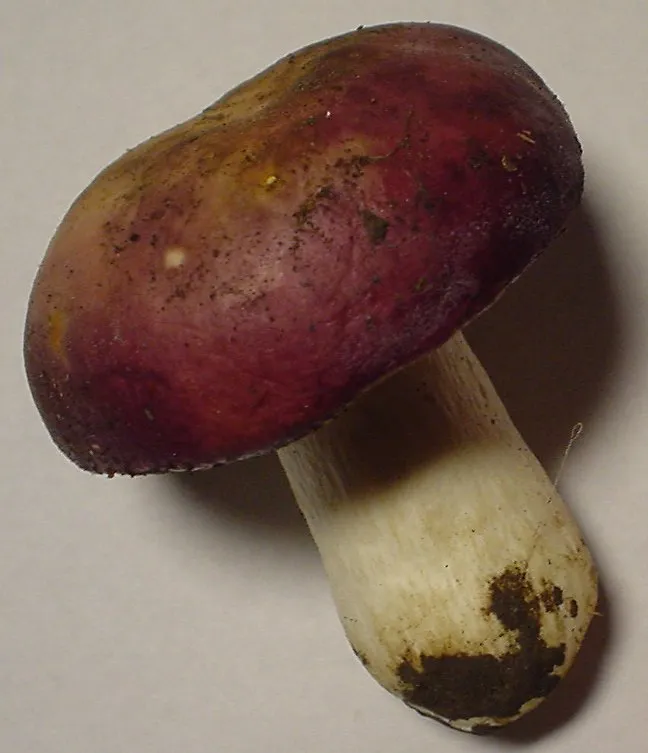
The main risk is confusing it with acrid purple brittlegills (R. queletii, burning-hot; R. drimeia / R. sardonia, also acrid) and with young purple webcaps (Cortinarius spp., some of them deadly dangerous). The key check is a taste test on the tongue and a spore print (R. atropurpurea: creamy white; webcaps: rusty brown).
In Ukraine, Russula atropurpurea is common in oak and beech forests: the Carpathians, Prykarpattia, Polissia and the forest-steppe. It forms mycorrhiza with oak and beech. Season: August to October.
Cap
Cap 4-9 cm across; when young it is convex with an inrolled margin, becoming with age flat and spread out with a slightly sunken center. The cap skin is smooth, slimy in wet weather, peels back over 1/2 of the cap. The color is dark purple, wine-violet, with a distinctive blackish center (atropurpurea), paler pinkish-violet toward the edge. Old ones fade to a dingy purple. The margin of mature ones has fine radial grooves.
Hymenophore
Gilled hymenophore: the gills are attached or free from the stem, moderately crowded, thin, brittle. The color is white at first, cream with a pale ocher tinge with age. The spore print is creamy white to pale ocher.
Stem
Stem 3-7 cm tall, 1-2 cm thick, firm, cylindrical, hollow in old ones. The color is white to cream, often with gray or gray-purple patches in the lower part. The surface is smooth with fine lengthwise wrinkles. No ring.
Flesh
Flesh firm, brittle, white; when damaged it slowly turns slightly gray. The smell is faint, pleasant, fruity-mushroomy, the taste mild in young ones; in mature ones slightly acrid-bitterish in the gills and stem (tongue test).
Smell
Faint, pleasant, fruity-mushroomy, neutral.
Lookalikes
.webp)
Related species
Mushrooms of the same genus and habitat — to study side by side and never mix up.
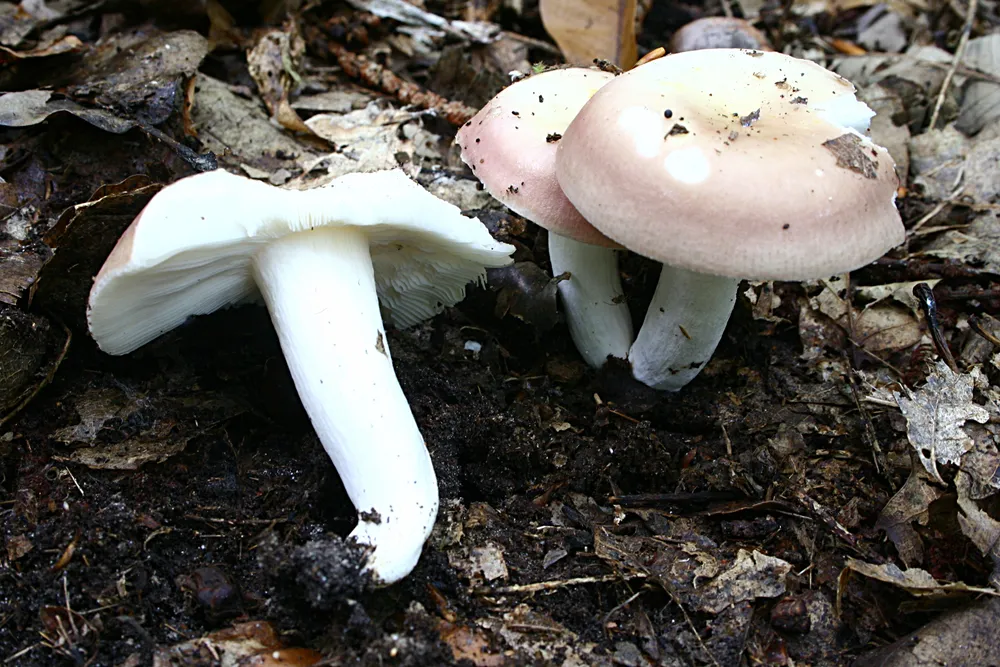
Bare-toothed russula
Russula vesca
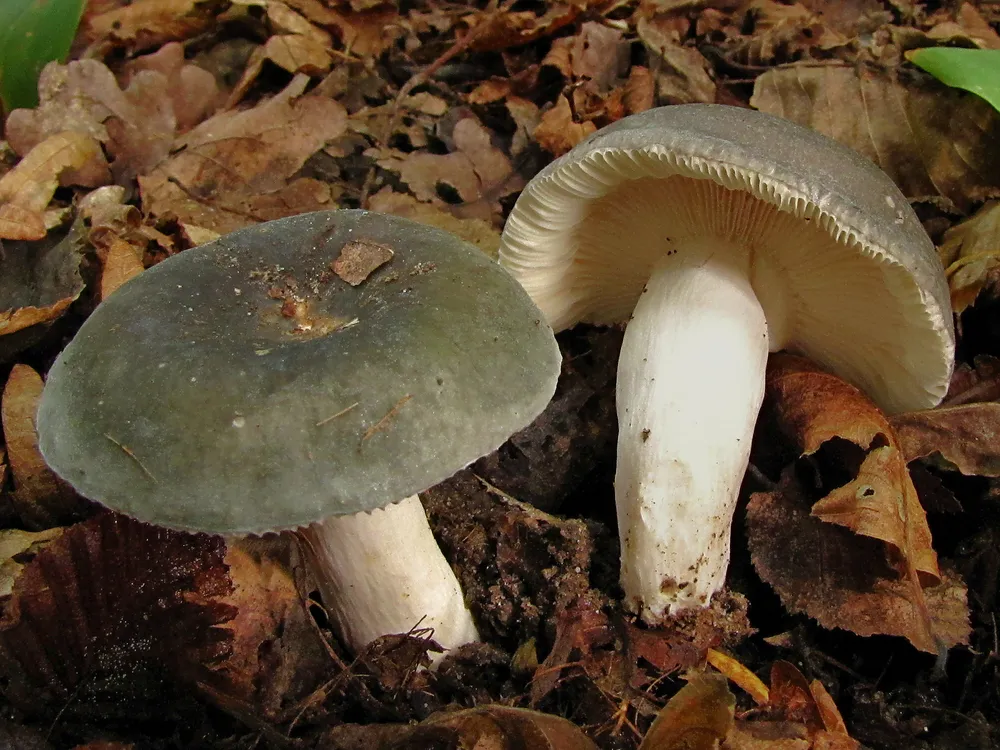
Charcoal burner
Russula cyanoxantha
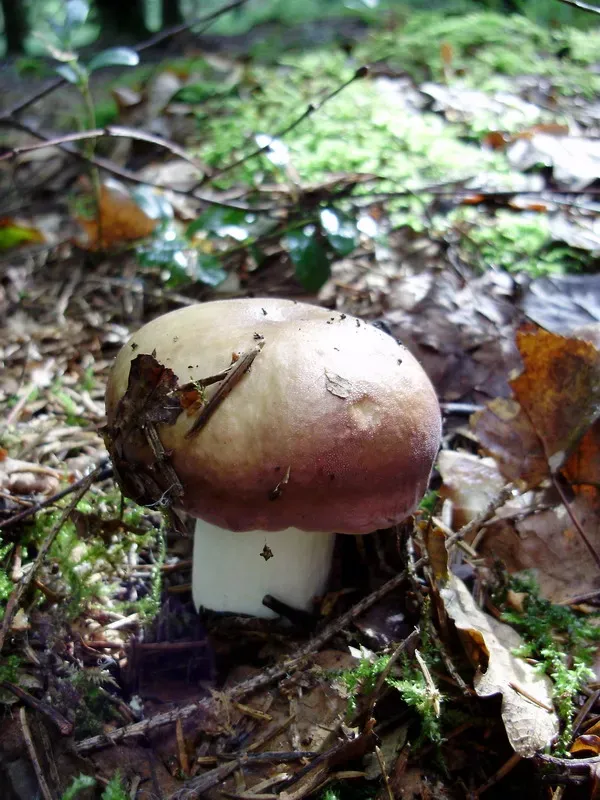
Copper brittlegill
Russula decolorans
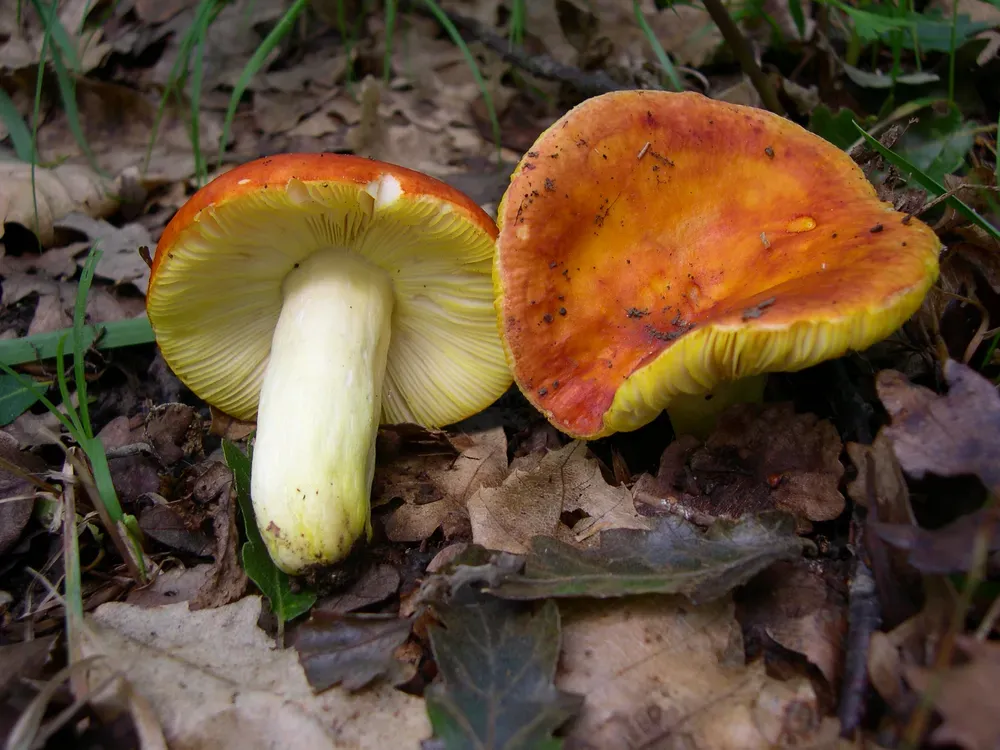
Gilded brittlegill
Russula aurea
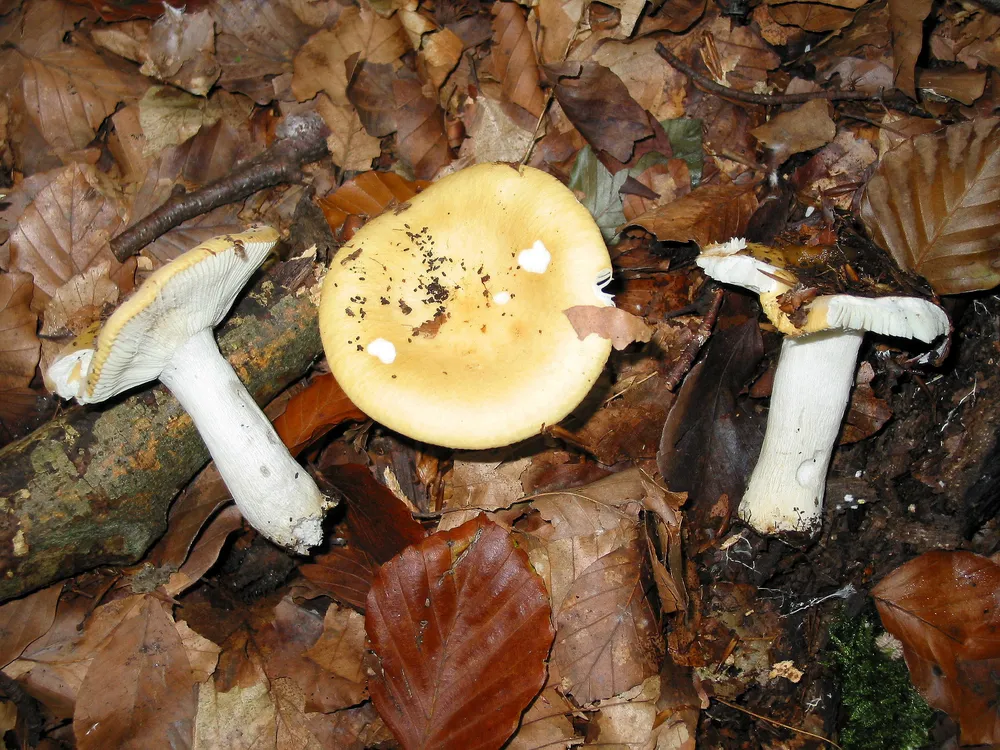
Golden brittlegill
Russula lutea
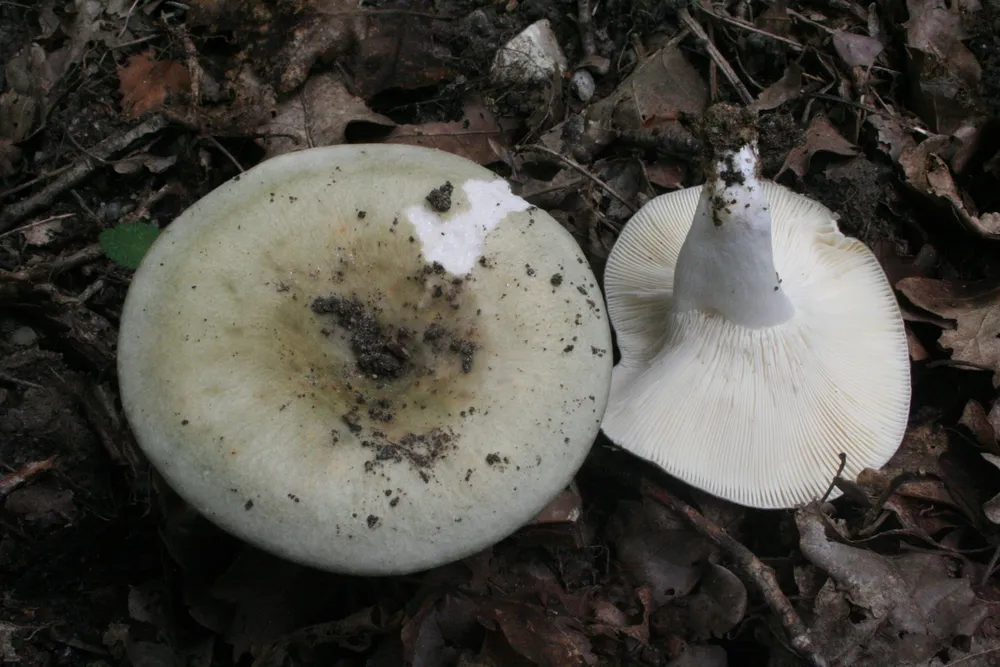
Greasy green brittlegill
Russula heterophylla
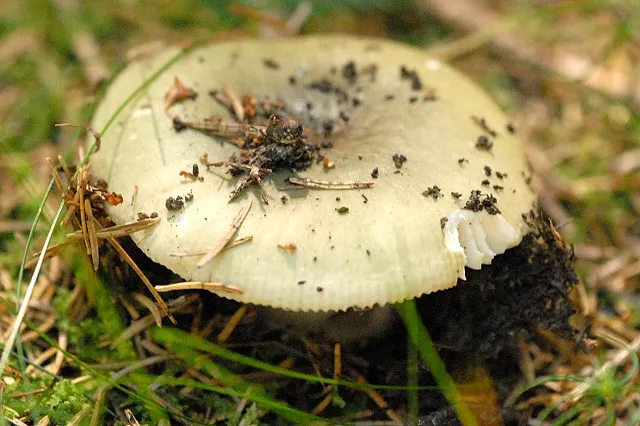
Green brittlegill
Russula aeruginea
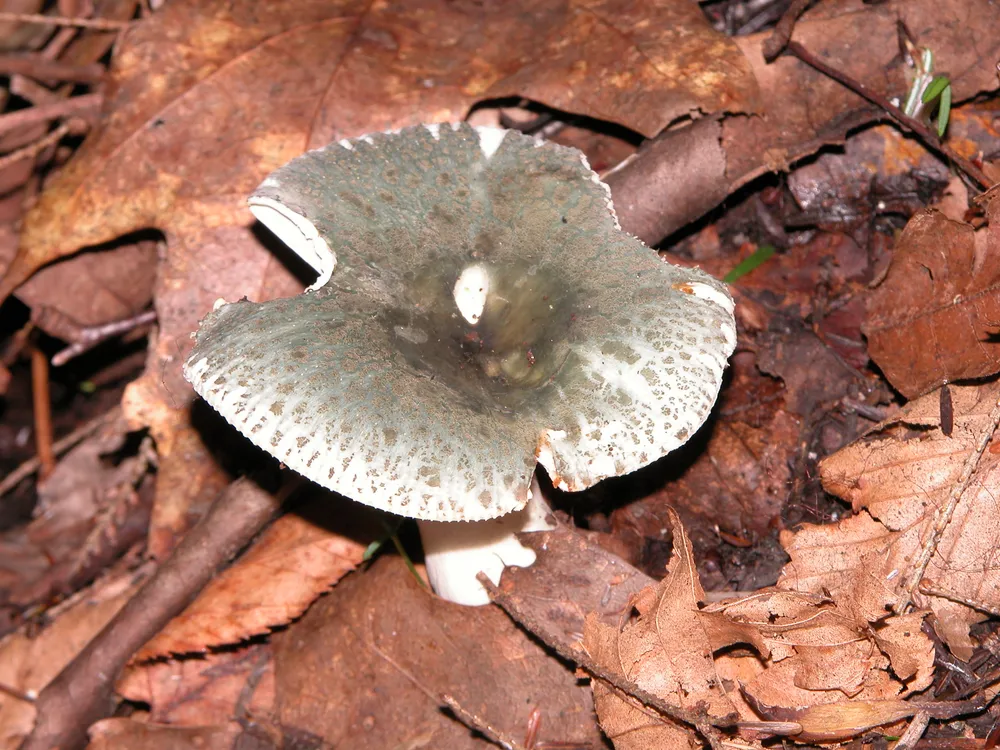
Greencracked brittlegill
Russula virescens
Frequently asked questions
How do you tell it apart from acrid purple brittlegills?
The key check is a taste test. Put a tiny piece (1-2 mm) of the gill edge on your tongue for 30 sec: R. atropurpurea is mild or slightly bitterish, with no burning; R. queletii, R. drimeia — distinctly burning-hot and acrid (burning within 5-10 sec). Second check: color: R. atropurpurea has a blackish center; R. queletii is evenly violet-wine colored.
How do you tell it apart from poisonous webcaps?
A spore print is a must. R. atropurpurea: creamy white; webcaps: rusty brown. Young webcaps have a cobwebby veil (cortina) between the cap edge and the stem; brittlegills don't. Habitat: R. atropurpurea is mostly in oak and beech woods; webcaps are more often in conifer forests.
How do you cook it?
Boil for 10-15 min in salted water and drain the water: this removes the bitterish aftertaste. Then fry it with onions, add it to soups, or pickle it. Its culinary value is moderate, so it's best mixed with more aromatic mushrooms.
Where should you look for it?
In oak, beech and mixed forests on the forest floor among moss and grass.
Which regions of Ukraine is it found in?
Common throughout the forest zone: the Carpathians, Prykarpattia, Polissia, the forest-steppe.
When should you look for it?
August to October, peaking in September.
Which brittlegills is it confused with?
With R. queletii (acrid!): burning-hot, with no blackish center. With R. integra (edible): in spruce-beech forests, larger, with a white spore print. With R. brunneoviolacea (edible): shading to brown at the edge, in oak-beech woods. With R. xerampelina (crab brittlegill, edible): with a distinct fishy smell.
Is Purple brittlegill edible or poisonous?
Does Purple brittlegill have gills or pores?
What does the cap of Purple brittlegill look like?
What does the stem of Purple brittlegill look like?
What do Purple brittlegill smell and taste like?
Sources
- [1]Вікіпедія (українська)
- [2]Атлас грибів України, Зеров Д.К. (1979)
- [3]MycoBank Database
- [4]Index Fungorum
- [5]GBIF
- [6]iNaturalist Ukraine