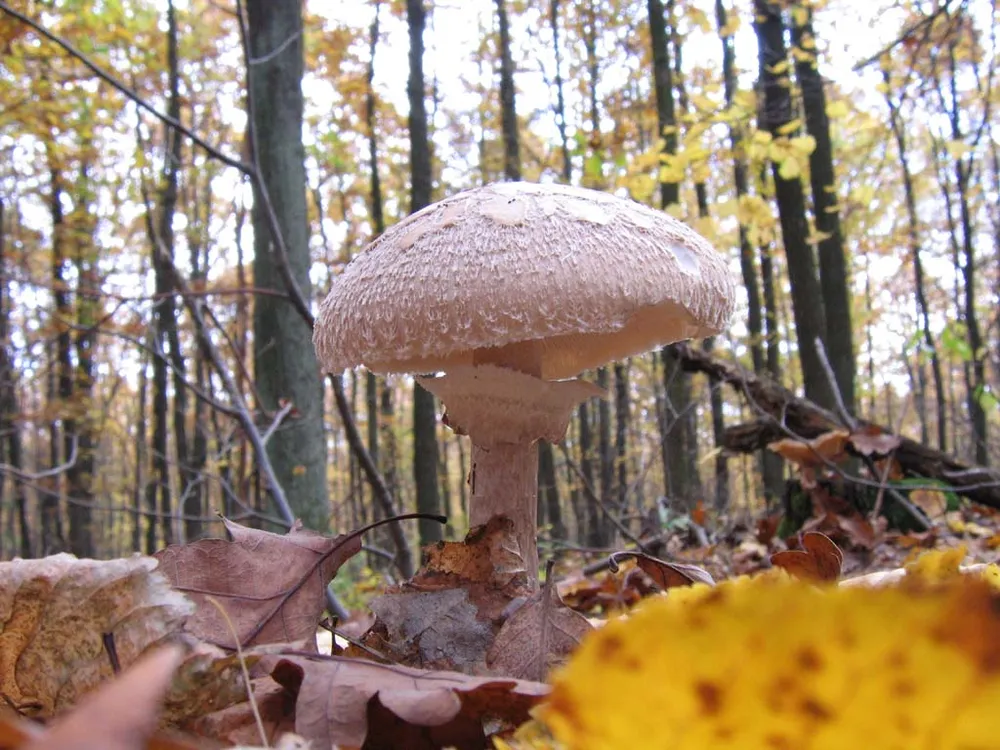
Macrolepiota puellaris
Expert-verifiedUpdated October 3, 2026
Passport
- Edibility
- Edible
- Season
- Aug — Sep
- Hymenophore
- Gilled
- Cap color
- White
- Size
- Small (up to 5 cm)
- Smell
- Radish-like
- Reviewed
- Yes ✓
Quick answers
Where to look?
Conifer forest, Mixed forest, Deciduous forest
When does it appear?
Aug — Sep
Active months: August, September.
How to recognize it? Three signs
- Cap color: White, Brown
- Cap shape: Convex
- Smell: Radish-like
Fruiting season
August – September
Description
Macrolepiota puellaris is a rare gilled mushroom of the Agaricaceae family. It looks like a small, slender parasol: a white cap with a brown umbo in the center, and a stem with a movable ring and a bulbous swelling at the base. A close relative of the familiar Agaricus mushrooms, but much more delicate and elegant.
The mushroom is listed in the Red Data Book of Ukraine, so you must not pick it. If you come across one, photograph it, note the spot and let the mushroom finish its season in peace. It is an edible species, but its protected status makes it a "mushroom for the eyes," not for the basket. For cooking there are far more accessible relatives — the parasol mushroom or the horse mushroom.
In Ukraine, finds occur in deciduous and mixed forests, along forest edges, in meadows and on well-fertilized soils. The season is short — August–September. The mushroom loves warm rainy weeks after a hot July.
Cap
Cap 5–8 cm, egg-shaped at first, opening with age to flat-expanded with a small brown umbo in the center. White in color, the surface covered in fibrous white scales — the typical "parasol" texture.
Hymenophore
Gilled hymenophor. Gills crowded, free, not attached to the stem. White at first, with age taking on a faint pinkish tint; they darken when pressed. Spore print white.
Stem
Stem 5–12 cm tall, 0.5–1 cm thick, slender, cylindrical, with a bulbous swelling at the base. White. It has a movable milky-white ring — a typical feature of the genus Macrolepiota.
Flesh
Flesh white, thin, tender. On exposure to air it gradually whitens in the lower part of the stem. No sharp color changes when cut.
Smell
A faint radish smell. Mild taste, without distinct notes.
›Scientific synonyms (8)
Agaricus rhacodes var. puellaris Fr., Lepiota rhacodes var. puellaris (Fr.) Sacc., Lepiota procera var. puellaris (Fr.) Massee, Lepiota puellaris (Fr.) Rea, Lepiotophyllum rhacodes var. puellaris (Fr.) Locq., Leucocoprinus puellaris (Fr.) Locq., Leucocoprinus puellaria (Fr.) Locq. (1945), Lepiota densesquamosa Velen.
Lookalikes
Related species
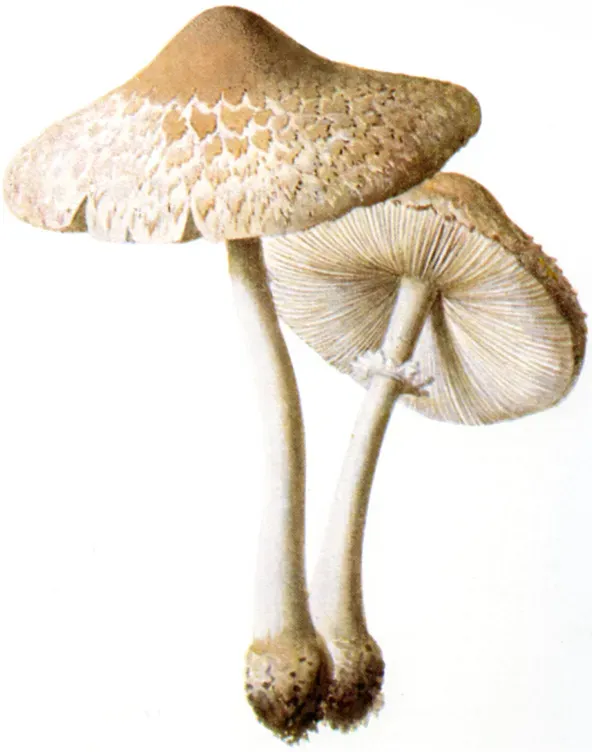
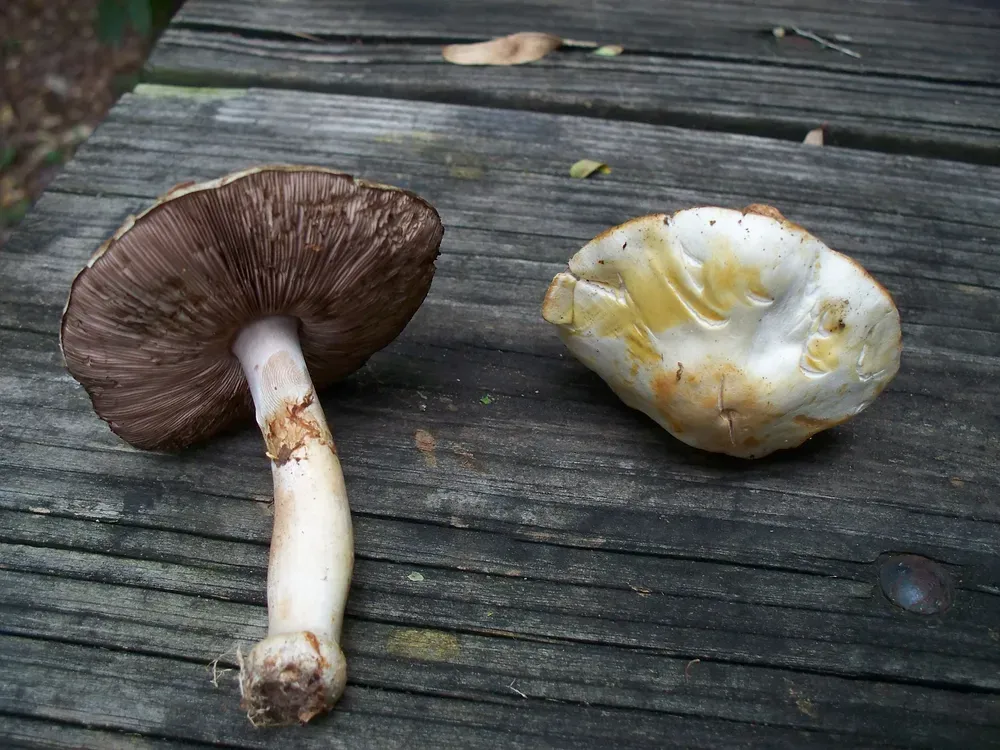
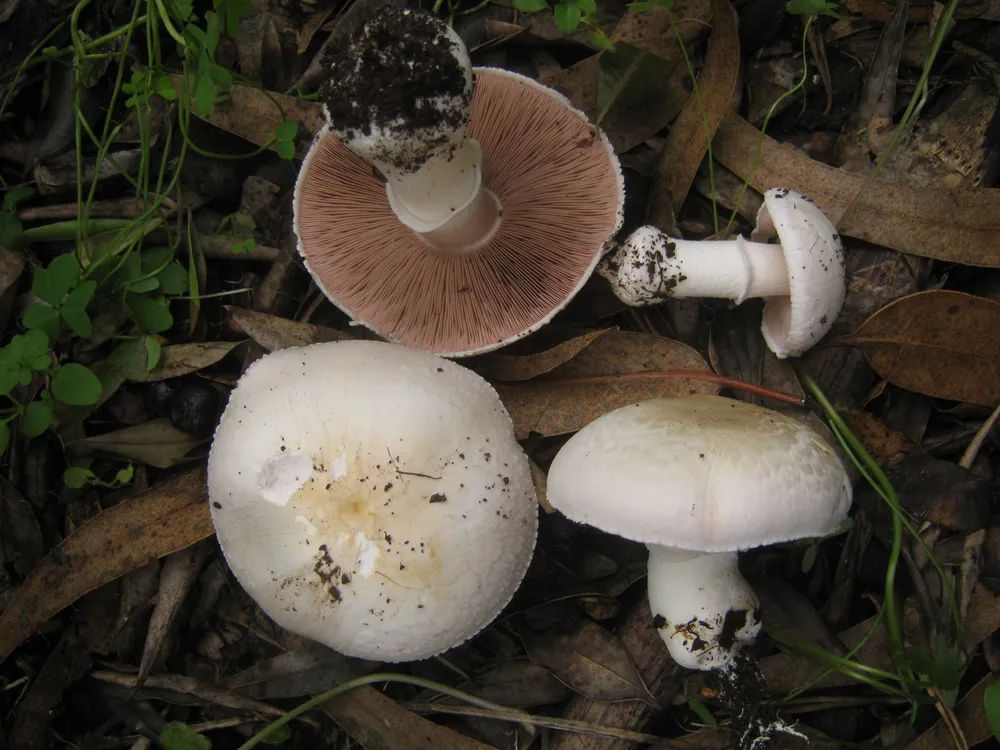
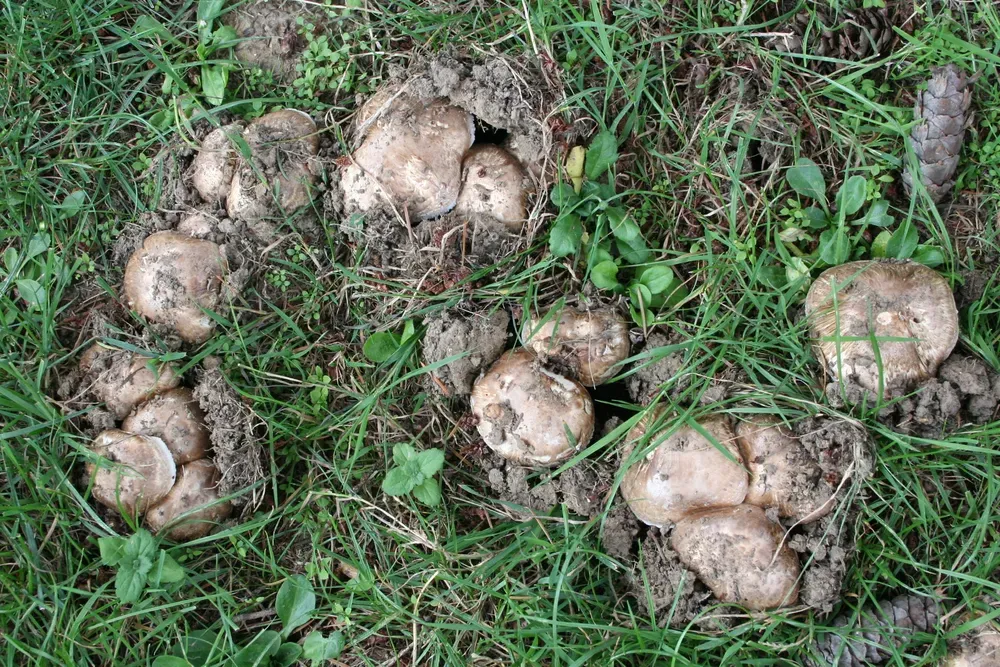
Mushrooms of the same genus and habitat — to study side by side and never mix up.
.webp)
_Fr._4948278370-2.webp)
Frequently asked questions
Can you pick it?
No. Macrolepiota puellaris is listed in the Red Data Book of Ukraine. You can photograph and study it, but picking and eating it are prohibited. If you find one, leave it where it is.
Is it edible at all?
Yes, technically it is an edible species with a pleasant mild taste. But because of its protected status we do not recommend trying it — for cooking, it is better to choose its more accessible relatives in the genus Macrolepiota.
Where should you look for it?
Along the edges of coniferous and mixed forests, in dry meadows, and in parks on well-fertilized soils. It often grows as single fruiting bodies or in small groups.
Which regions of Ukraine is it found in?
Isolated finds are recorded in various regions of Ukraine, but the species is rare everywhere. Exact locations are not made public — standard practice for Red Data Book species.
When does it appear?
August–September. The season is short and fruiting is episodic — the mushroom may not appear every year, even in familiar spots.
Can you find it in July or October?
Very rarely. The main peak is late August to the first half of September, when there is moisture after the summer rains.
What is it confused with?
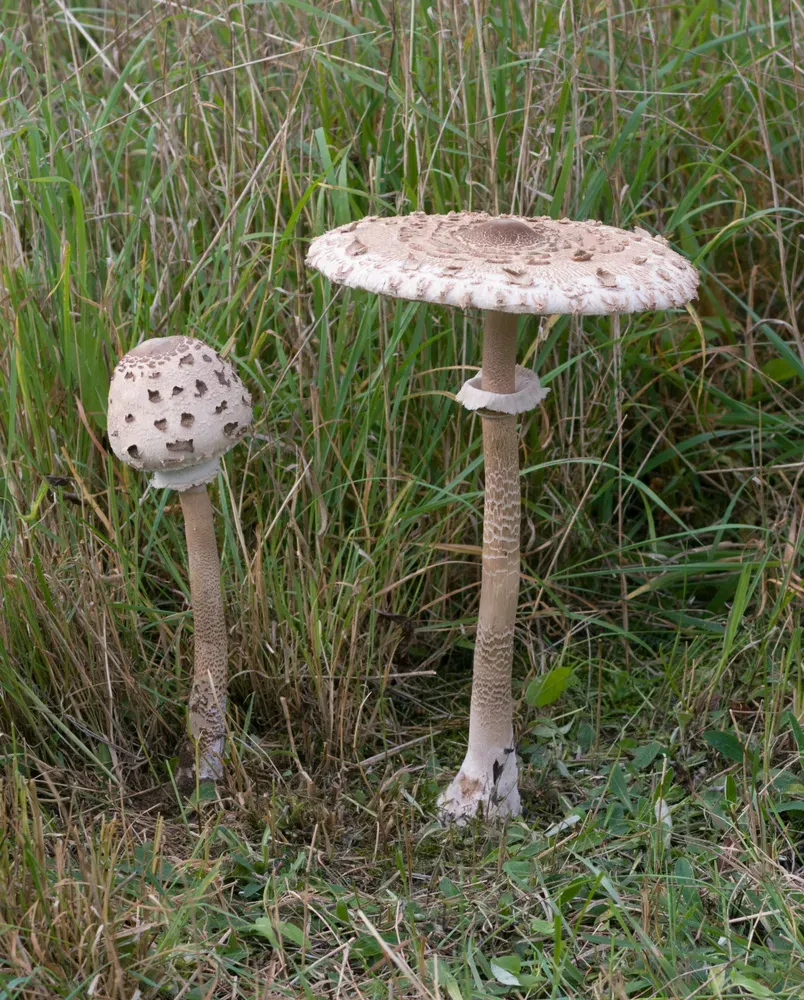
With slenderer species of the genus Macrolepiota — for example, the slender parasol (Macrolepiota mastoidea). The key features of Macrolepiota puellaris are the pinkish tint the gills take on with age and the radish smell. Ordinary meadow mushrooms also have a similar silhouette, but they have pink or chocolate-brown gills and live in meadows, with no bulb at the base.
Can it be confused with a poisonous mushroom?
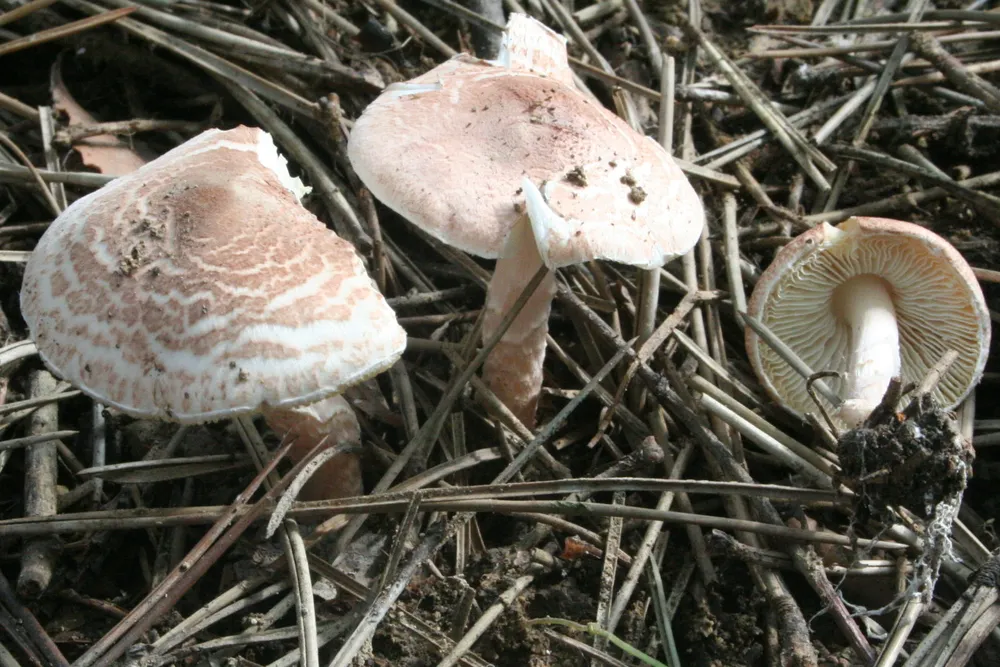
In general, the small parasols of the Lepiota family include several small, deadly poisonous species (Lepiota brunneoincarnata and others). In size and appearance, Macrolepiota puellaris looks more like them than like the large edible parasols. That is one more reason not to put it in your basket — even without its protected status, the risk of a mistake is real.
Is Macrolepiota puellaris edible or poisonous?
Does Macrolepiota puellaris have gills or pores?
What does the cap of Macrolepiota puellaris look like?
What does the stem of Macrolepiota puellaris look like?
Sources
- [1]Вікіпедія (українська)
- [2]Атлас грибів України, Зеров Д.К. (1979)
- [3]MycoBank Database
- [4]Index Fungorum
- [5]GBIF
- [6]iNaturalist Ukraine