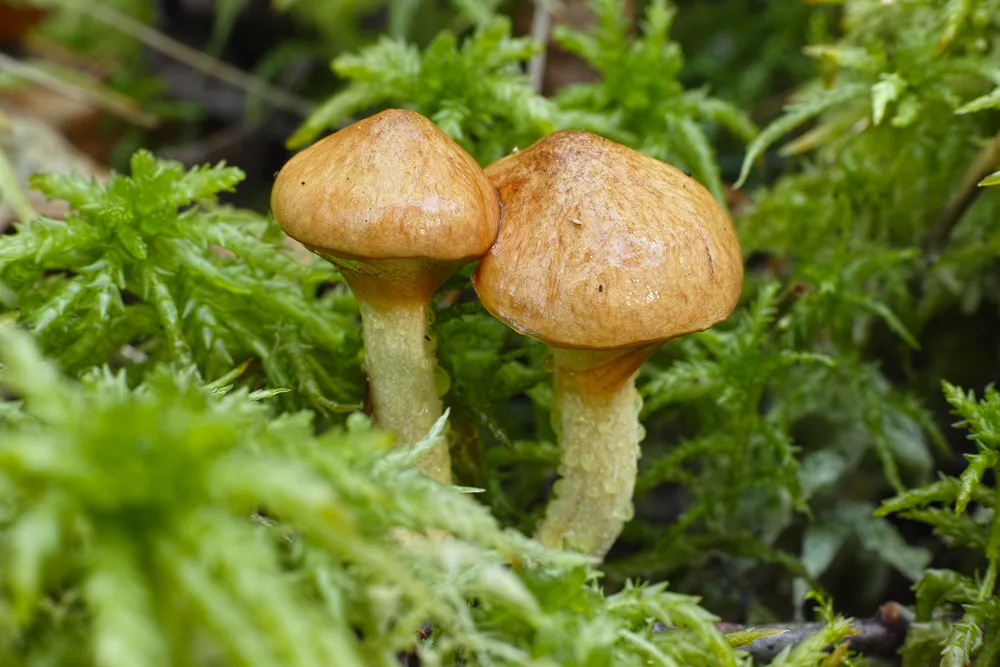
Suillus flavidus
Expert-verifiedUpdated June 13, 2026
Passport
- Edibility
- Edible
- Season
- Jul — Oct
- Hymenophore
- Pored
- Cap color
- Yellow
- Size
- Small (up to 5 cm)
- Smell
- Pleasant
- Reviewed
- Yes ✓
Quick answers
Where to look?
Conifer forest
When does it appear?
Jul — Oct
Active months: July, August, September, October.
How to recognize it? Three signs
- Cap color: Yellow, Cream, Olive
- Cap shape: Convex
- Smell: Pleasant
Fruiting season
July – October
Description
Suillus flavidus is a rare relative of the common slippery jack that lives only in sphagnum bogs and boggy pine woods. Its cap is a pale yellowish ocher, with a noticeably slimy skin in wet weather, and the stem is thinner and paler than in the common slippery jack. Foragers who love sphagnum bogs know it as a quiet summer-to-autumn bonus on walks through the blueberry bogs of Polissia and the Carpathian foothills.
Edible without restrictions. In the kitchen it falls short of the common slippery jack: the flesh is softer and more watery, with a less pronounced mushroom flavor. Always peel off the slimy cap skin before cooking — it keeps a slightly bitter taste and makes the dish slimy. Good for frying, pickling and drying. Especially tasty in mushroom soups together with porcini and other boletes.
In Ukraine, Suillus flavidus is uncommon and is listed in some regional red lists because sphagnum bogs are shrinking. It is found mainly in Polissia (Rivne, Volyn, Zhytomyr and Chernihiv regions), and in the Carpathians and Prykarpattia in boggy riverside pine woods. It is a mycorrhizal partner of Scots pine (Pinus sylvestris). Season: July — October, peaking in August–September. It always grows singly or in small groups of 2-5 fruiting bodies, never en masse.
Cap
Cap 3-7 cm across, hemispherical in young mushrooms, becoming convex to flat with age. Color: pale yellow-ocher, straw-yellow, with a faint greenish tint. The skin is slimy in wet weather and peels off easily. In young mushrooms the cap margin is joined to the stem by a thin white veil, which later leaves a ring zone on the stem.
Hymenophore
The hymenophore is made of tubes — they are attached to the stem, yellowish, becoming yellow-olive with age. The pores are small and angular, the same color as the tubes. Spore print ocher-brown. In young mushrooms the pores are covered by a whitish partial veil.
Stem
Stem 4-7 cm tall, 0.5-1 cm thick, cylindrical, slender, often curved. Color: light yellow, with fine reddish-brown dots (glandular dots) above the ring zone. A ring zone from the whitish veil in the upper part is a hallmark of the genus Suillus. Below the ring zone the stem is smooth.
Flesh
The flesh is soft, pale yellow, watery. When cut it turns faintly pinkish in the cap; in the stem it does not change color. Smell and taste are mild and neutral, with no sharp notes.
Smell
Faint, pleasant, mushroomy, with no distinctive undertones.
Lookalikes
Related species
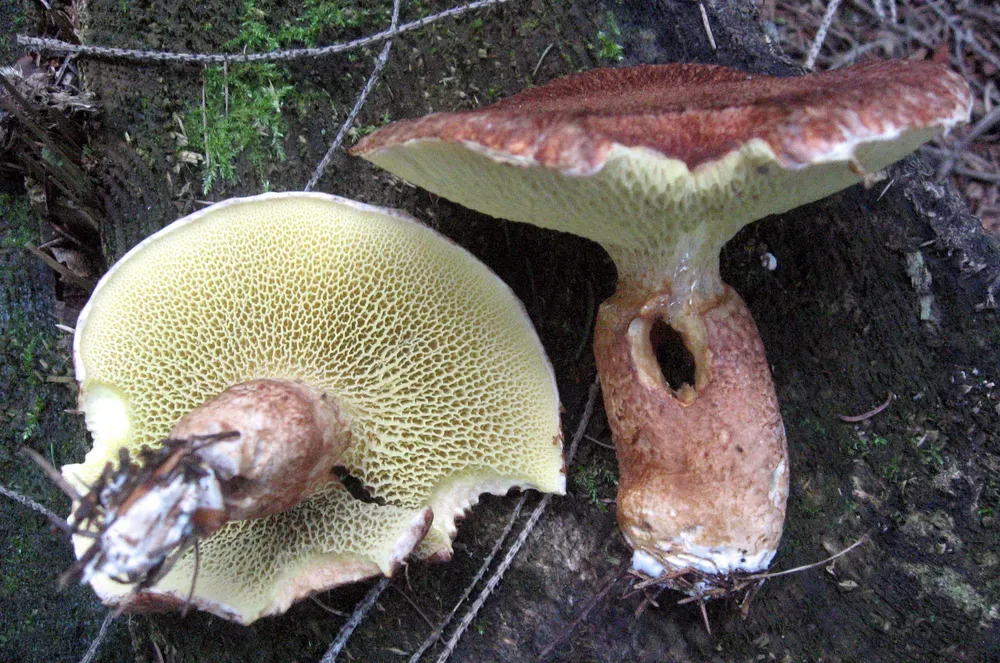
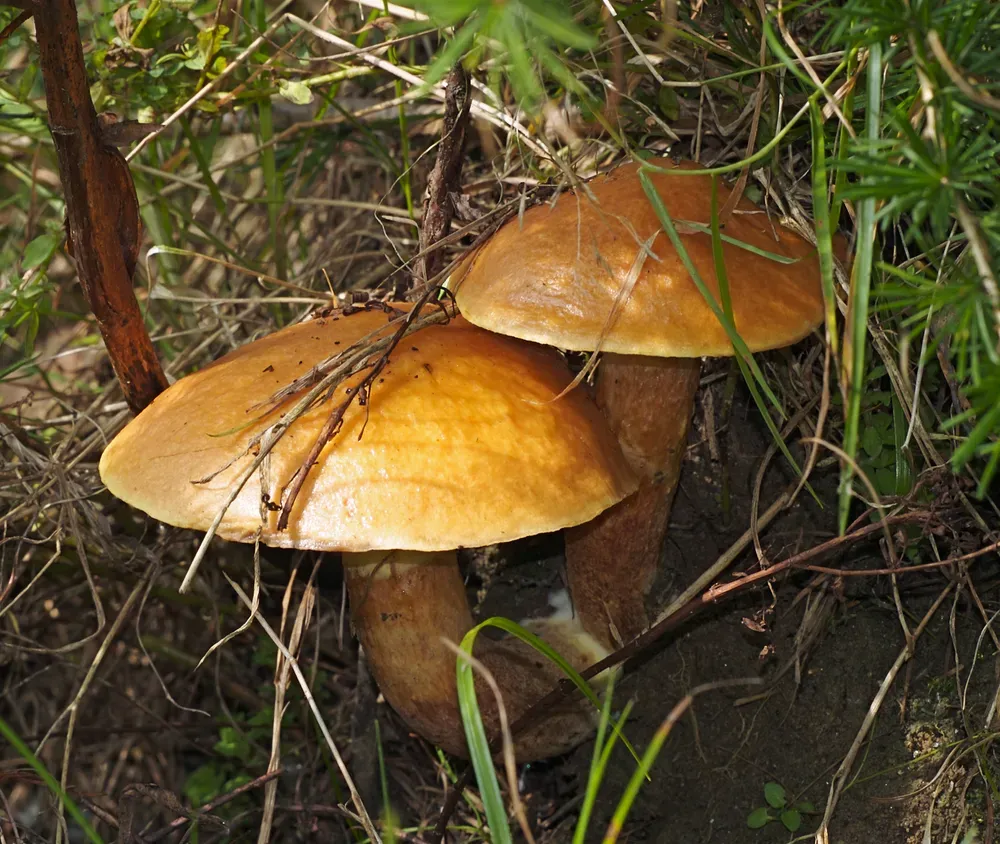
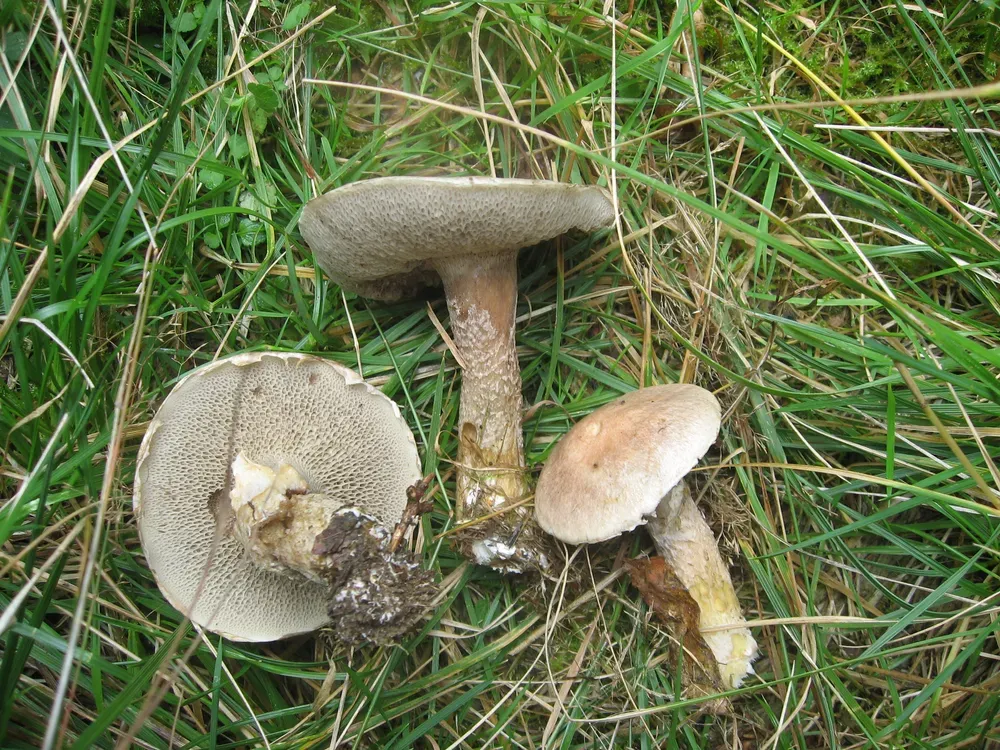
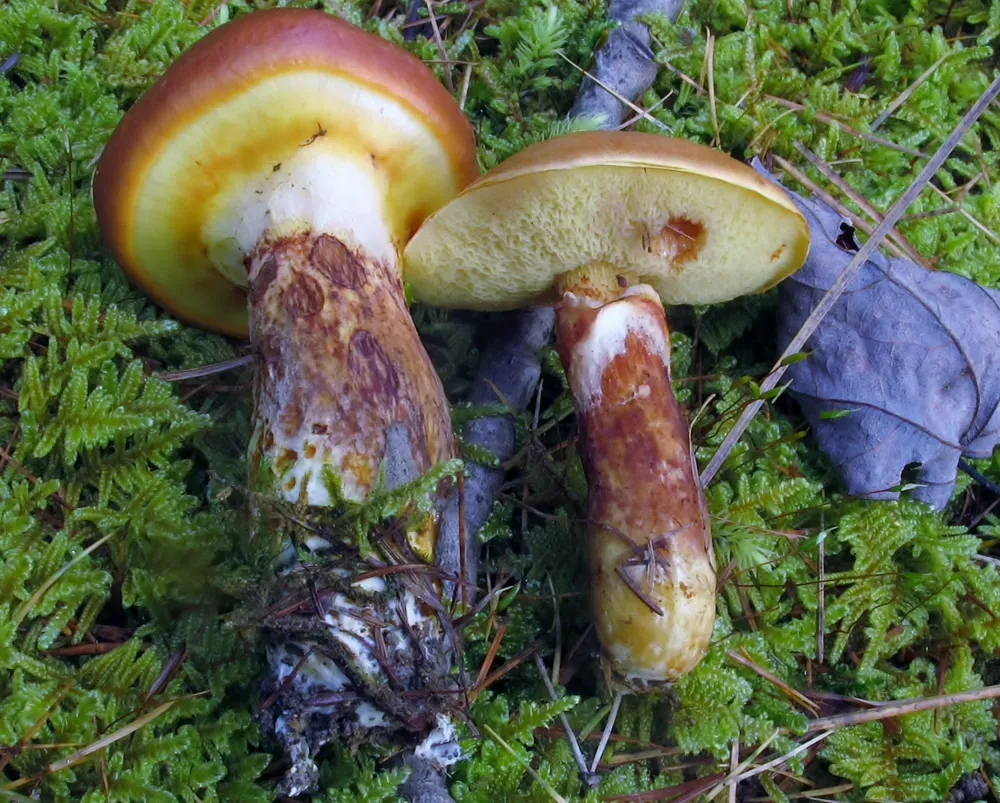
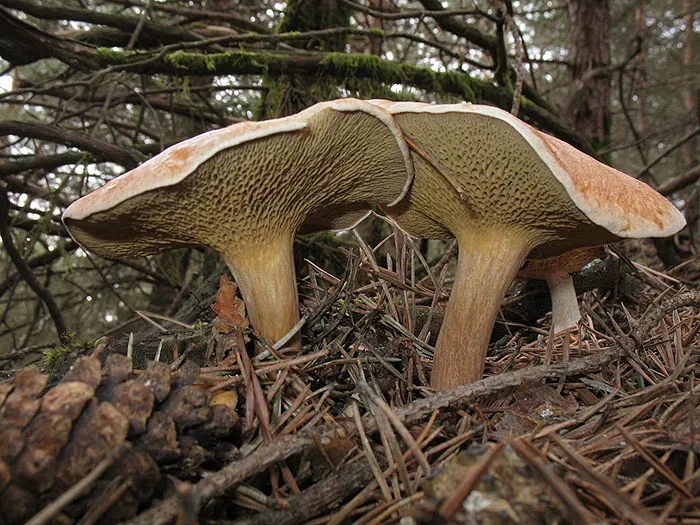
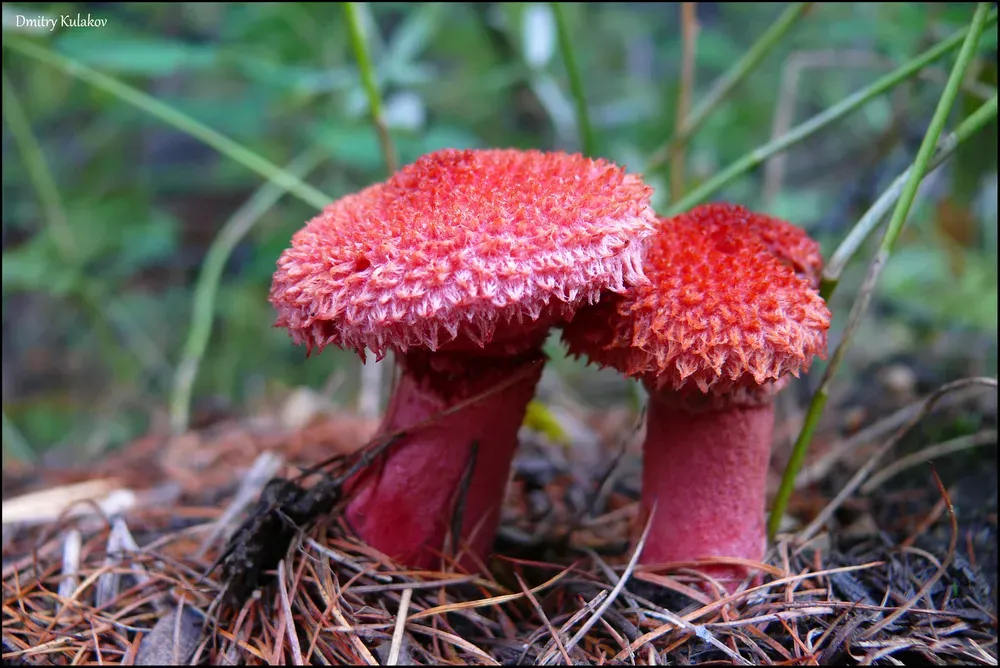
Mushrooms of the same genus and habitat — to study side by side and never mix up.
_Kuntze_791558.webp)
Related reading
Frequently asked questions
Is it safe to eat?
Yes, without restrictions. Before cooking, peel off the slimy cap skin — it gives a slightly bitter taste and makes the dish slimy. Young mushrooms can be cooked without boiling first; older ones are better boiled for 10 min, with the water poured off.
Does it have dangerous lookalikes?
No serious ones. All true slippery jacks (genus Suillus) in our flora are edible. In theory you could confuse it with young velvet boletes (Suillus variegatus) — also edible, though that one grows in drier pine woods. Or with the bay bolete (Imleria badia) — also edible. The mistake is not critical.
Why do you need to peel the skin?
In the genus Suillus, the cap skin contains substances that give some people mild diarrhea. Plus, when cooked it turns slimy and "rubbery". So the rule is: peel it. It's easy — catch the edge with a fingernail and the skin comes off like a film.
Where should you look for it?
In sphagnum bogs with Scots pine, and in boggy pine woods along rivers and lakes. It loves wet moss and thickets of Labrador tea and blueberry. Most often it turns up on small islands of pine in a carpet of sphagnum. Always together with Scots pine — it does not grow outside that tree's range.
Which regions of Ukraine is it found in?
Mostly Polissia (Rivne, Volyn, Zhytomyr, Chernihiv and Sumy regions) — wherever sphagnum bogs have survived. In the Carpathians and Prykarpattia — in boggy riverside pine woods. It does not occur in the steppe.
When should you look for it?
July — October, peaking in August–September. Later than most boletes, because sphagnum bogs warm up more slowly. It tolerates moderate night-time cold snaps.
How do you tell it from the common slippery jack?
The slippery jack (Suillus luteus) is darker (chocolate-brown or chestnut) and has a prominent dark ring on the stem. Suillus flavidus is paler, yellowish, with a thin whitish ring zone (not a true ring). And the habitat: the slippery jack grows under ordinary pines on dry soil, Suillus flavidus on sphagnum near water.
Does this species need protection?
Yes, indirectly — Ukraine's sphagnum bogs are shrinking fast because of drainage, peat extraction and climate change. Suillus flavidus is an indicator of a healthy sphagnum bog. If you find it, cut it carefully, leave the mycelium, and don't pick everything you see.
Is Suillus flavidus edible or poisonous?
Does Suillus flavidus have gills or pores?
What does the cap of Suillus flavidus look like?
What does the stem of Suillus flavidus look like?
Sources
- [1]Вікіпедія (українська)
- [2]Атлас грибів України, Зеров Д.К. (1979)
- [3]MycoBank Database
- [4]Index Fungorum
- [5]GBIF
- [6]iNaturalist Ukraine